




How to Talk About a Hard-to-Fill Role You Successfully Closed: A Guide for HR Professionals
A hard-to-fill role that you managed to close can be a strong career argument for an HR professional. But only if you present it not as a lucky break, but as a clear professional case: there was a task, there were constraints, there were actions, there were metrics, and there was a result.
The phrase “closed a difficult vacancy” may sound confident, but on a CV, LinkedIn profile, portfolio, or in an interview, it explains almost nothing. Difficult in what way? Why couldn’t the role be filled before? What exactly did the recruiter do? What was the outcome? Did the candidate start? Did they pass probation? Did the team finally stop living in “when is someone going to join?” mode?
A strong recruiting case shows not only that the position was filled, but also the professional thinking behind the work. You did not simply find a person. You understood the market, clarified the profile, aligned with the hiring manager, built the sourcing process, moved the candidate through the funnel, helped them accept the offer, and solved a business need.
This article explains how to talk about a hard-to-fill vacancy you successfully closed so that it sounds convincing, calm, and professional. No “I am the hero of recruitment, please give me a medal.” But also no modest “well, I was just doing recruitment.”
Why “Closed a Difficult Vacancy” Is Not Enough
HR CVs often include phrases such as:
- “Closed difficult vacancies.”
- “Managed full-cycle recruitment.”
- “Successfully recruited staff.”
- “Worked with different roles.”
- “Sourced candidates.”
The problem is not that these phrases are wrong. The problem is that they are too generic. Almost any recruiter can write them, including someone who closed one role after a candidate came through a referral, passed every stage without issues, and accepted the offer faster than the HR specialist had time to open the tracking spreadsheet.
For an employer, this kind of phrase does not reveal your level. It does not show what exactly you dealt with. In HR, especially in roles such as recruiter, senior recruiter, talent acquisition specialist, HR generalist, or HRBP, the fact that a vacancy was closed is not the only thing that matters. What matters is how you worked with the task.
A hard-to-fill vacancy is not simply a role that stayed open for a long time. Sometimes a position remains open not because the market is difficult, but because the profile is poorly defined, the hiring manager wants “a unicorn on an intern’s budget,” the interview process is stretched out, feedback takes two weeks, and the offer looks as if it was assembled from last year’s leftover budget.
If you managed to bring the search to a result in this kind of situation, it is no longer just “closing a vacancy.” It is a case of closing a hard-to-fill role. And it is worth describing as an achievement.
A good description answers several questions:
- What was the task?
- Why was the vacancy difficult?
- What was not working before your involvement?
- What did you do?
- Which tools did you use?
- Which numbers prove the result?
- What did the business gain?
- Which professional skill does this case demonstrate?
Here is the difference.
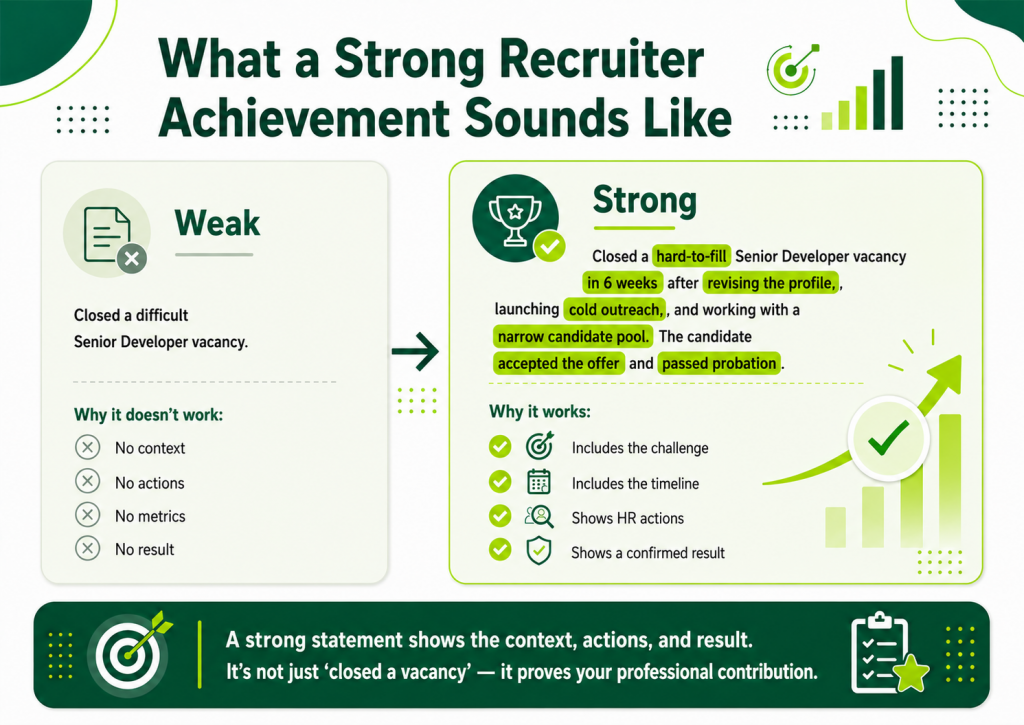
Weak wording:
“Closed a difficult Senior Developer vacancy.”
Strong wording:
“Closed a Senior Backend Developer role in six weeks in a limited talent market with high competition for candidates: rebuilt the profile with the hiring manager, expanded sourcing channels, created a shortlist of eight relevant candidates, and hired a candidate who accepted the offer and successfully passed probation.”
The second version does not just sound stronger. It shows the work. You can see that the person understands recruitment as a process: role profile, market, recruitment funnel, communication with the hiring manager, and result.
That is why recruiter achievements on a CV are better described not through responsibilities, but through specific career cases.
What Makes a Vacancy Difficult
Before describing a difficult vacancy on a CV or talking about it in an interview, you need to understand what made it difficult. Not every closed role automatically becomes “difficult.” If you write this about every vacancy, the employer may sense a touch of unnecessary drama.
A hard-to-fill vacancy is a role that is difficult to close because of a rare candidate profile, a narrow market, high competition, urgency, complex requirements, unattractive conditions, or internal company constraints.
Let’s look at the main reasons.
A Rare Candidate Profile
The most obvious case is when there are very few specialists on the market with the required expertise.
For example, a company does not need just any backend developer, but someone with a specific tech stack, fintech experience, English for communication with an international team, an understanding of high-load systems, and willingness to work in a hybrid format.
Or the company does not need just any HRBP, but an HRBP with experience scaling a team in a product company, knowledge of analytics, experience with performance reviews, and the ability to work with managers who think HR is “the team that organizes office parties.”
A rare profile does not always mean a very senior role. Sometimes even a middle-level position can be hard to fill if the requirements are narrow, the market is small, and the company is not ready to look at candidates flexibly.
How to describe it:
“The role was challenging because of a narrow combination of requirements: the company needed a specialist with industry experience, knowledge of specific tools, and readiness to work in a distributed team.”
This sounds better than simply saying “we were looking for a rare candidate.” Rare is not a description. It is an evaluation. You need facts.
A Narrow Market and Few Relevant Specialists
Sometimes the profile itself is not unique, but the market is limited. For example, there may be few candidates in a specific region. Some specialists already work for competitors, some are not considering a move, some want remote work only, while the company offers office-based or hybrid work.
For the CIS market, this is especially relevant. Candidates may be based in different countries, work for international companies, receive offers in different currencies, and choose between remote work and relocation. That is why recruiters often need not only to search for people, but to understand the market: where these candidates live, which conditions they consider, which channels they read, and what expectations they have around salary, work format, and responsibilities.
How to describe it:
“The search took place in a narrow market: relevant candidates were rarely actively looking, so the main focus was on cold outreach, referrals, and professional communities.”
This immediately shows that you were not simply posting the vacancy on a job board and waiting for a candidate to appear with a bouquet of relevant experience.
A Challenging Hiring Manager
Let’s put it carefully: sometimes the complexity of the vacancy sits not in the market, but in the meeting room. Or in the calendar. Or in a message from the hiring manager: “The candidate is good, but something is missing.” What exactly? A mystery worthy of an ancient civilization.
A challenging hiring manager is not necessarily a bad manager. Often, this is a person who is overloaded, has not had time to formulate expectations, does not fully understand the candidate market, or wants to find the perfect specialist because a previous hire was painful.
The complexity may include:
- Requirements changing during the search.
- Must-have and nice-to-have skills being mixed together.
- Feedback arriving slowly.
- Candidates being rejected without clear reasons.
- The hiring manager wanting “someone like the person who left, only better and cheaper.”
- The team not being ready to reconsider the salary range or work format.
If you managed to build effective collaboration with the hiring manager, that is an important professional result. Especially for senior HR roles.
How to describe it:
“At the start of the search, the requirements were unclear, so I conducted a second intake with the hiring manager, separated must-have and nice-to-have criteria, clarified the role’s priorities for the first three to six months, and rebuilt the search based on that.”
This wording shows maturity. You do not blame the hiring manager, dramatize the situation, or write “fought with the business.” You show that you know how to work with expectations.
Unattractive Conditions
Sometimes the vacancy is difficult not because there are no candidates. There are candidates. They simply read the conditions and quietly close the tab.
The reasons may differ:
- The salary range is below market.
- There is no remote work option.
- The product is unclear.
- There is little information about the team.
- The selection process is too long.
- The job description is weak.
- The employer brand is not strong.
- There is no clear growth path.
- Expectations are higher than what the company can offer.
A recruiter cannot always change the budget or company policy. But they can help present the role honestly, highlight its real strengths, explain the responsibilities to candidates, improve communication, and show the business where the offer is losing to the market.
How to describe it:
“The role was difficult because of a limited salary range and strong competition for specialists. I rebuilt the EVP for the position, strengthened the description of responsibilities, and added the team’s real advantages to candidate communication: autonomy, product impact, and fast access to decision makers.”
Important: do not write “the conditions were bad.” It sounds rough and may raise questions about your loyalty. It is better to use neutral wording: “limited salary range,” “conditions were less competitive than some market offers,” or “the value of the role needed to be communicated more clearly.”
Urgency
Urgent hiring is a sport of its own. Only instead of a medal at the end, you usually get the message: “Are we sure the candidate will start on Monday?”
A vacancy may become difficult if the business needs someone quickly: a project is launching, a key employee has left, a new market is opening, the team is overloaded, a client contract has already been signed, but the person needed for it has not been hired yet.
But urgency alone does not make a case strong. It is important to show how you acted under time pressure.
For example, you may have:
- Quickly conducted the intake.
- Agreed on a shorter selection process.
- Removed unnecessary stages.
- Secured fast interview slots.
- Launched several search channels in parallel.
- Prepared the offer in advance.
- Aligned the hiring manager, HR, and final approval process.
How to describe it:
“Closed an urgent vacancy in four weeks: together with the hiring manager, reduced the selection process to two stages, agreed on evaluation criteria in advance, and launched parallel sourcing through LinkedIn, Telegram channels, and referrals.”
This shows that urgency did not turn into chaos. And that is already an achievement.
Competition for Candidates
In some fields, the candidate is not “looking for a job.” They are choosing between several offers. This is especially common with strong technical specialists, sales leaders, product managers, HRBPs with transformation experience, analysts with rare domain expertise, or senior marketers with clear results.
In this case, closing the vacancy is not only about finding the candidate. It is about moving them through the process in a way that keeps them interested, prevents them from going to competitors, and helps them accept your offer.
Important factors include:
- Communication speed.
- Quality of feedback.
- Clear role description.
- Transparent stages.
- Personalized approach.
- Work with candidate motivation.
- Hiring manager involvement in selling the role.
- Careful offer negotiations.
How to describe it:
“Worked in a competitive candidate market: reduced feedback time between stages, set up personalized communication, and helped the hiring manager present the role more clearly in terms of responsibilities and product impact.”
This shows that you understand candidate experience not as a buzzword, but as a real hiring factor.
High Soft Skills Requirements
Sometimes professional skills are easy to check. But understanding whether a person can work with a specific team, handle uncertainty, negotiate with several stakeholders, and avoid turning every meeting into a mini-series is harder.
This is especially important for roles where the person interacts a lot with the business, clients, managers, or a distributed team. For example: HRBP, project manager, account manager, head of department, customer success manager, recruiter, or team lead.
The difficulty may be that you need not simply an experienced specialist, but someone with a particular working style.
How to describe it:
“The complexity of the role was not only in the professional requirements, but also in the high expectations for communication: the candidate had to work with several teams, quickly align with internal stakeholders, and maintain structure in uncertain conditions.”
This kind of case is especially useful for showing HR expertise if you explain how you assessed soft skills: structured interviews, behavioral questions, agreed criteria, and feedback from several participants in the process.
Confidential Search
Confidential recruitment is when you cannot simply publish a vacancy and write: “We are looking for a new manager to replace the current one, just don’t tell anyone.”
That is not how it works. Or rather, it works, but usually not for long and not without consequences.
A confidential search may be connected with replacing an employee, creating a new strategic role, internal changes, launching a new direction, or hiring for a management position. Here, the recruiter has fewer open tools and higher communication requirements.
It is important not to disclose unnecessary information, to manage candidates carefully, to protect company data, and still maintain the quality of the process.
How to describe it:
“Closed a confidential management position: worked with a limited pool of sources, used targeted outreach, maintained a neutral role description, and aligned communication with the hiring manager at every stage.”
This is a strong case because it shows not only sourcing, but also maturity, accuracy, and business ethics.
What Data to Collect Before Describing the Case
Before writing a recruiting case, do not start with beautiful wording. Start with facts. Otherwise, you will get a text along the lines of “the difficult vacancy was difficult because it was difficult.” Better leave that for the internal chat on a Friday evening.
Collect the case data.
Write down:
- Role title or a safe general description.
- Position level.
- Business area.
- Country or market of search, if relevant.
- Why the vacancy was open.
- Why it was considered difficult.
- How long it had been open before you got involved.
- Which channels had already been used.
- What was not working.
- Which requirements were mandatory.
- Which requirements had to be clarified.
- Which sourcing channels you used.
- How many candidates you found.
- How many candidates passed screening.
- How many reached interviews.
- How many reached the final stage.
- Whether there was an offer.
- Whether the candidate accepted the offer.
- Whether the candidate passed probation.
- What changed for the team after the candidate joined.
- What conclusion you drew from the case.
You do not need to include all of this in the final text. But if you collect the information, you will have material. And good material is almost always better than trying to invent a “strong achievement” from thin air.
For example, you have the fact:
“The role had been open for four months before I got involved.”
That already shows complexity.
You have the fact:
“After a second intake, we removed two non-essential requirements.”
That shows work with the hiring manager.
You have the fact:
“The number of relevant candidates increased after we changed the sourcing strategy.”
That shows the impact of your actions.
You have the fact:
“The candidate passed probation.”
That shows quality of hire, not just speed of closing.
For HR, it is especially important not to substitute activity for results. “Messaged 300 candidates” is activity. “Built a shortlist of 10 relevant candidates and brought one of them to an accepted offer” is much closer to a result.
Activity can be mentioned too, but it must be connected to the outcome.
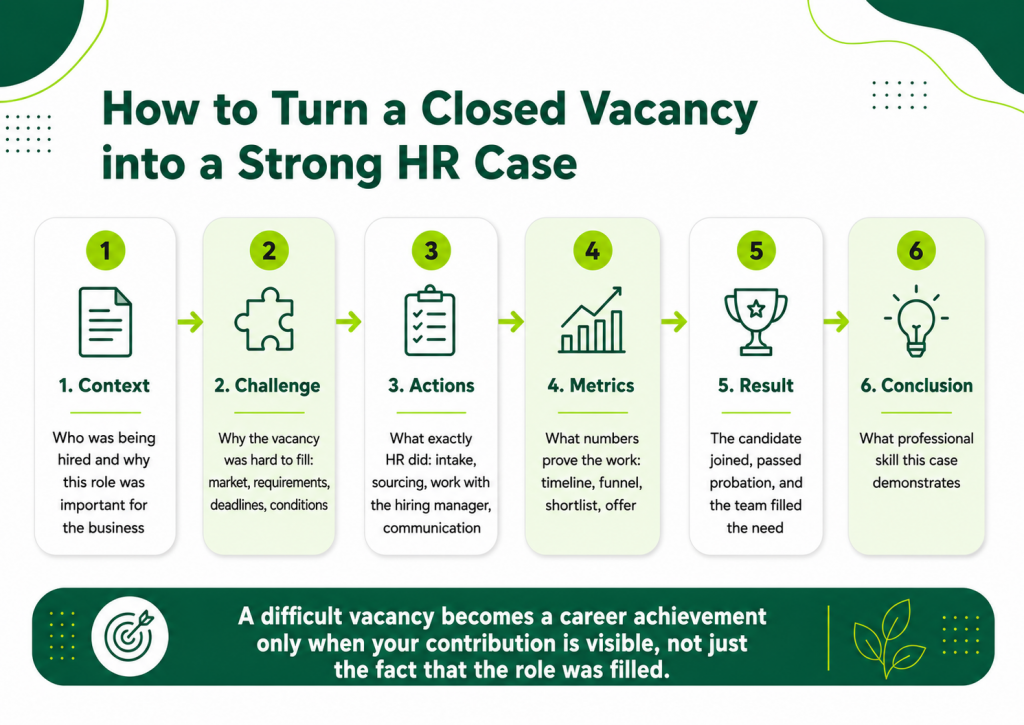
The Formula for a Strong HR Case Description
A useful formula:
Context → Complexity → Actions → Metrics → Result → Takeaway
You can use this structure for a CV, portfolio, LinkedIn, and interviews. Only the length will differ.
Context
Context answers the question: who were you looking for and why?
You do not need to disclose confidential data. You can write in general terms:
“B2B SaaS company was looking for a senior specialist for a product team.”
“The team needed an HRBP to support rapid growth.”
“The company was launching a new business direction and needed a commercial leader.”
“The task was to close technical roles for a distributed team.”
Context matters because without it, the employer cannot understand the scale. Closing a junior role, a senior role, an executive position, and mass hiring are different tasks.
Complexity
Here you need to explain why the role was hard to fill.
Weak version:
“The vacancy was very difficult.”
Strong version:
“The difficulty was a narrow candidate market, a limited salary range, and the requirement for industry experience.”
Even stronger:
“Before I joined the process, the position had been open for almost three months: there were few candidates, some declined because of the work format, and others did not pass the technical interview.”
This immediately shows the reality of the case.
Actions
This is the key section. This is where it becomes clear what HR actually did.
Possible actions:
- Conducted a second intake.
- Separated must-have and nice-to-have requirements.
- Rewrote the job description.
- Analyzed the market.
- Changed sourcing channels.
- Used Boolean search.
- Launched cold outreach.
- Added professional communities.
- Used referrals.
- Shortened the selection process.
- Set up regular feedback.
- Helped the hiring manager prepare for interviews.
- Improved candidate communication.
- Rebuilt the offer.
- Worked with a counteroffer risk.
- Supported the candidate until their start date.
- Collected recruitment funnel analytics.
It is important to write not “participated,” but “did.” Not “helped with search,” but “built a sourcing strategy.” Not “communicated with the hiring manager,” but “conducted an intake and agreed on evaluation criteria.”
Metrics
Recruitment metrics help show the result. But they need to be used carefully. Numbers without context can look dry or even strange.
For example:
“Found 120 candidates.”
So what? Were they relevant? Did anyone reach the interview stage? Was there an offer? Or were they simply 120 people who received a message and decided this was not their day?
Better:
“Built a funnel of 64 potential candidates, conducted 18 screenings, presented seven relevant profiles to the hiring manager, three candidates reached the final stage, and one accepted the offer.”
This shows the process.
Result
The result is not always only “the candidate started.” The effect may also matter:
- Position closed.
- Candidate accepted the offer.
- Employee passed probation.
- Team closed an expertise gap.
- Time to fill decreased.
- Company avoided agency involvement.
- New sourcing channel appeared.
- Funnel conversion improved.
- Hiring manager changed the approach to requirements.
- The recruitment process became faster.
If you can show business impact, show it. Especially if you are applying for a senior or lead role.
Conclusion
A conclusion is not always necessary, but it is useful in a portfolio or interview. It shows what the case taught you.
For example:
“This case showed that in difficult recruitment, the key is not to increase the number of messages first, but to define the profile and evaluation criteria accurately.”
Or:
“For me, this case became an example of how work with the hiring manager affects hiring speed and quality no less than sourcing.”
This sounds professional and calm. No unnecessary drama.
Which Metrics to Use in the Description
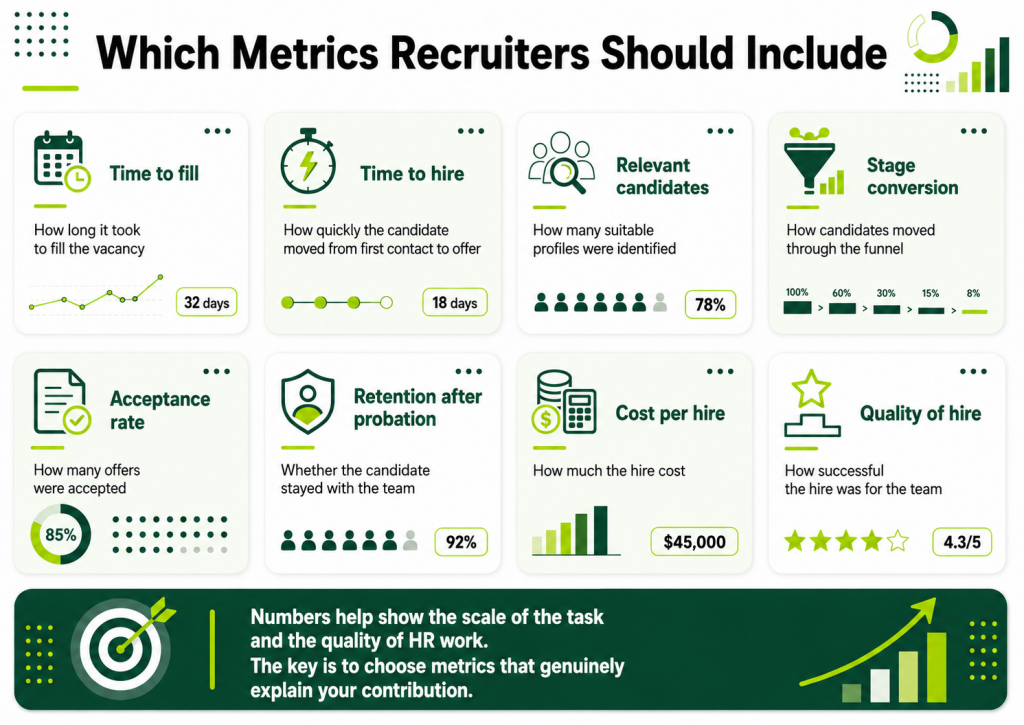
Metrics are a way to show that your result can be verified. But you do not need to turn your CV into an accounting report on candidates. It is enough to choose two to four indicators that actually reveal the case.
Time to Fill
Time to fill is the period from opening the vacancy to offer acceptance or candidate start date, depending on how the company calculates it.
You can write:
“Closed the vacancy in 45 days, while the average time to fill for similar roles was 70–90 days.”
Or:
“Reduced time to fill for a hard-to-fill role from 90 to 50 days after revising the sourcing strategy.”
Important: use these comparisons only if you really have the data. Do not write “cut it in half” if that is simply how it felt. Feelings are useful for choosing coffee, not for writing a CV.
Time to Hire
Time to hire shows how much time passed from the candidate entering the process to accepting the offer. This metric is especially useful if you improved the selection process.
For example:
“Reduced time to hire by agreeing on a shorter process: screening, technical interview, and final meeting.”
Or:
“Reduced delays between stages: candidates received feedback within 24–48 hours, which helped maintain the interest of strong specialists.”
Number of Relevant Candidates
Not just “found candidates,” but “found relevant candidates.”
For example:
“Built a shortlist of nine relevant candidates for a rare profile within the first month.”
Or:
“Presented 12 candidates who met the must-have requirements to the hiring manager; five moved to the next stage.”
This shows sourcing quality well.
Stage-by-Stage Conversion
If you have recruitment funnel data, use it.
For example:
“After clarifying the profile, conversion from screening to interview improved: the hiring manager started receiving fewer random CVs and more suitable candidates.”
You do not need exact percentages if you do not have them. The main point is to show that you analyzed the process rather than simply moved candidates through a spreadsheet.
Acceptance Rate
Acceptance rate shows how many candidates accepted offers. This metric matters if candidates previously declined or went to competitors.
For example:
“Rebuilt communication around the role and candidate expectations, which helped bring the finalist to an accepted offer despite a competing offer.”
You do not necessarily need a percentage if you are describing one case. You can explain the situation in words.
Retention After Probation
This is one of the strongest quality-of-hire indicators. Closing a vacancy is one thing. Closing it in a way that the person stays and performs is another.
Possible wording:
“The candidate successfully passed probation and remained with the team.”
Or:
“The hired specialist passed the probation period, handled key tasks in the first months, and continued working with the team.”
This result is especially strong for an HR portfolio or interview.
Quality of Hire
Quality of hire is harder to show because companies measure it differently. It may include passing probation, hiring manager feedback, goal completion, retention, speed of onboarding, or contribution to the team.
If you do not have a formal metric, describe it carefully:
“Quality of hire was confirmed after the start date: the employee passed probation, received positive feedback from the hiring manager, and stayed with the team.”
Reduced Dependence on Agencies
If you closed a difficult role without an agency or reduced external costs, that is a strong argument.
For example:
“Closed a rare role without agency support by expanding sourcing channels and working with referrals.”
Or:
“Reduced dependence on external recruitment by building an internal pipeline of candidates for technical roles.”
Expansion of the Candidate Pool
Sometimes the result of a case is not only closing one vacancy, but also creating a new candidate pool for the company.
For example:
“During the search, built a database of relevant specialists for future roles in the function.”
Or:
“Added new sourcing channels that were later used for similar positions.”
This shows a systematic approach.
How to Describe a Hard-to-Fill Vacancy on a CV
A CV has limited space. That means the case needs to be compact but meaningful.
Basic formula:
Closed [role] in [timeframe] under [complexity], using [approach/tools], which led to [result].
Example:
“Closed a Senior Backend Developer role in six weeks in a limited candidate market: rebuilt the profile with the hiring manager, expanded sourcing channels, and built a shortlist of eight relevant specialists.”
For a CV, it is better to use bullet-point achievements. You do not need to write a half-page story. The employer should quickly see the scale.
Example CV Wording for HR Professionals
“Closed a hard-to-fill senior-level role in 45 days: conducted a second intake with the hiring manager, clarified must-have requirements, and rebuilt the sourcing strategy.”
“Reduced the time to fill for a difficult vacancy from 90 to 50 days by revising the profile, regularly analyzing funnel data, and expanding sourcing channels.”
“Hired a rare specialist with industry expertise without involving agencies, reducing hiring costs while maintaining candidate experience quality.”
“Closed a confidential management position: used targeted outreach, a limited shortlist, and aligned communication with the hiring manager.”
“Rebuilt the recruitment process for a technical role: separated must-have and nice-to-have requirements and improved the relevance of candidates reaching interviews.”
“Built a candidate pipeline for a difficult function: added professional communities, referrals, and cold outreach.”
“Closed a vacancy after several months of unsuccessful search: clarified the profile, changed sourcing channels, and brought the candidate to offer acceptance and team onboarding.”
“Worked in a competitive candidate market: accelerated feedback between stages and helped retain the finalist through to offer acceptance.”
“Closed a role for a distributed team, taking into account English language requirements, remote work experience, and candidate independence.”
“Improved the recruitment funnel for a difficult role: reduced the number of irrelevant interviews and strengthened shortlist quality.”
How to Choose Wording for Your Level
If you are a junior recruiter, show that you can act in a structured way:
“Participated in closing a hard-to-fill role: handled initial sourcing, candidate screening, and communication across stages, helping build a shortlist for the hiring manager.”
If you are a middle recruiter, show independence:
“Independently closed a hard-to-fill role in a narrow market: conducted the intake, selected sourcing channels, and managed candidates through to offer.”
If you are a senior recruiter or talent acquisition specialist, show impact on the process and the business:
“Rebuilt the recruitment strategy for a hard-to-fill role: clarified the profile with the business stakeholder, implemented funnel analytics, reduced time to fill, and built a pipeline for future positions.”
If you are an HRBP or HR generalist, connect recruitment to team needs:
“Closed a key role for a growing team: clarified the profile together with the manager, built the assessment process, and ensured the candidate joined and successfully passed probation.”
How to Talk About the Case in an Interview
In an interview, you have more space than on a CV. But that does not mean you need to tell the story from the moment the vacancy was created, including the weather, the hiring manager’s mood, and the color of the stickers in Notion.
It is better to use a clear structure.
Answer Structure
- What the vacancy was.
- Why it was difficult.
- What had not worked before you.
- How you clarified the profile.
- Which sourcing channels you used.
- How you worked with the hiring manager.
- What difficulties appeared during the process.
- How you brought the candidate to the offer.
- What the final result was.
- What you would do differently now.
The last point is especially valuable. It shows maturity. A good HR professional does not say, “I did everything perfectly and the universe applauded.” A good HR professional understands that any case can be improved.
How to Sound Professional
Talk not only about actions, but also about logic.
Not like this:
“I started looking for candidates on LinkedIn and Telegram.”
Better:
“First, I checked which channels had already been used and why they had not produced results. After that, I divided the search into two directions: active cold outreach to relevant profiles and expansion of the candidate pool through professional communities and referrals.”
Not like this:
“The hiring manager took too long to give feedback.”
Better:
“One of the challenges was delayed feedback. I suggested short regular syncs with the hiring manager and agreed on evaluation criteria in advance so candidates would not drop out of the process.”
Not like this:
“The candidate had doubts, but I convinced them.”
Better:
“The finalist had concerns because of another offer. I clarified their motivation, helped the team present the role more accurately, and arranged an additional meeting with the manager. After that, the candidate accepted the offer.”
This does not sound like selling at any cost. It sounds like professional work with motivation.
Example Interview Answer for HR
“In my previous company, we had a Senior Data Analyst role requiring fintech experience. Before I joined the process, the position had been open for almost three months: there were few candidates, some declined because of the salary range, and others did not pass the technical interview.
I started with a second intake with the hiring manager. We separated must-have and nice-to-have requirements, removed several constraints that were narrowing the market, and clarified which tasks the employee would handle in the first six months. This helped us understand who we really needed, rather than simply collecting candidates against a long list of requirements.
After that, I rebuilt the sourcing strategy. I added professional communities, LinkedIn, Telegram channels, and referrals. I also changed the first message to candidates: instead of using a generic job description, I focused on the responsibilities, the team, and the role’s area of impact.
In five weeks, I built a shortlist of nine relevant candidates. Four reached the final interview, and one accepted the offer. The candidate passed probation and stayed with the team.
For me, this case matters because the result came not from sending more messages, but from accurately defining the profile, working with the hiring manager’s expectations, and using proper funnel analytics. Today, I would agree on the feedback format with the hiring manager even earlier, so we could test and reject search hypotheses faster.”
This answer works because it includes context, complexity, actions, metrics, result, and takeaway. It does not sound like a memorized speech, but it shows professional level.
How to Talk About a Hard-to-Fill Vacancy on LinkedIn
LinkedIn, or another professional profile, is not a CV and not a novel. The tone can be more alive, but without disclosing confidential information.
A post can follow this format:
- Task: close a difficult vacancy.
- Context: market, requirements, constraints.
- What was difficult: reasons.
- What HR did: specific actions.
- Result: numbers and outcome.
- Takeaway: what the case taught you.
Example LinkedIn Post
“One of the most illustrative cases in my recruiting experience was closing a vacancy that had not moved for several months.
The role was senior-level, the market was narrow, and the requirements for domain expertise were high. Before I joined the process, there were few candidates, and some of those who reached the interview stage did not match the team’s expectations.
I did not start with a new search. I started with a second intake. Together with the hiring manager, we separated must-have and nice-to-have requirements, clarified the role’s priorities for the first months, and revised the job description.
After that, I changed the sourcing strategy: added cold outreach, professional communities, and referrals. I also adjusted candidate communication so that we showed not only the requirements, but also the purpose and value of the role.
As a result, we built a shortlist of relevant candidates and closed the position. The candidate accepted the offer and successfully passed probation.
This case reminded me that a difficult vacancy is rarely closed by sending more messages alone. More often, the result appears when HR can work with the profile, the market, the hiring manager’s expectations, and the recruitment funnel.”
This kind of post shows expertise without revealing confidential data.
How to Format the Case for an HR Portfolio
An HR portfolio is especially useful if you want to show not only a list of workplaces, but specific results. For a recruiter, it can include a collection of cases: a hard-to-fill vacancy, mass hiring, process launch, funnel improvement, employer brand work, or analytics implementation.
A case about closing a hard-to-fill role can be formatted like this:
Case Title
“Closing a hard-to-fill senior-level vacancy in a narrow market.”
Task
“The company needed to find a specialist with rare expertise for a product team.”
Context
“The position had been open for several months, and previous search channels had not produced relevant candidates.”
Complexity
“Narrow market, high competition, limited salary range, and unclear requirements at the start.”
Actions
“Conducted a second intake, clarified must-have criteria, rebuilt the job description, launched cold outreach, added professional communities and referrals, and set up weekly syncs with the hiring manager.”
Metrics
“Built a shortlist of eight relevant candidates, four candidates interviewed with the team, two reached the final stage, and one accepted the offer.”
Result
“The candidate joined the team, passed probation, and the position was closed without agency involvement.”
Takeaway
“The case showed that in difficult recruitment, it is critical to start not with mass outreach, but with an accurate profile, clear criteria, and fast feedback.”
This format is easy to read. It shows that you can think structurally.
What Not to Write About a Difficult Vacancy
There are phrases that are better removed from a CV or portfolio. They are familiar, but they do not work.
“Closed a Difficult Vacancy”
Why it is weak: there is no context. It is unclear what was difficult.
Better:
“Closed a senior-level role in six weeks in a narrow market with high competition for candidates.”
“Found the Ideal Candidate”
“Ideal candidate” is a risky phrase. First, ideal people do not exist. Second, HR usually looks not for someone ideal, but for someone suitable for the tasks, team, level, and conditions.
Better:
“Hired a candidate who matched the must-have requirements, accepted the offer, and successfully passed probation.”
“Quickly Closed the Position”
Quickly means what? Three days? Three weeks? Three months, but compared with last year that felt like the speed of light?
Better:
“Closed the position in 28 days, while the standard hiring period for similar roles was 45–60 days.”
If you do not have a comparison:
“Closed the position in four weeks after revising the profile and launching new sourcing channels.”
“Worked with a Large Number of Candidates”
A large number of candidates is not always an achievement. Sometimes it is a sign of an unclear profile.
Better:
“Built a relevant shortlist of 10 candidates after screening 40 profiles.”
“Managed Full-Cycle Recruitment”
This is a responsibility, not an achievement. You can keep it in the experience section, but in achievements, it is better to show the result.
Better:
“Managed the full recruitment cycle for a hard-to-fill role: from intake and sourcing to offer and candidate start.”
“Successfully Managed Recruitment”
Successfully how? Did the candidate start? Pass probation? Did the team close its need?
Better:
“Closed a key role for the team; the candidate started on time and continued after the probation period.”
How Not to Disclose Confidential Information
HR works with sensitive data. That is why it is important not to violate confidentiality when describing a case.
Do not disclose:
- Candidate names.
- Company name, if the case is confidential.
- Salary ranges, if they are not public.
- Reasons for replacing an employee.
- Internal conflicts.
- Team structure, if sensitive.
- Commercial plans.
- Client data.
- Strategic changes.
- Exact offer terms, if confidential.
But this does not mean you cannot talk about the case at all. You can describe it safely.
Instead of the company name:
- “B2B SaaS company.”
- “International product company.”
- “Fintech team.”
- “E-commerce company.”
Instead of the exact job title:
- “Senior technical role.”
- “Leadership role in the commercial function.”
- “Business partner-level HR role.”
- “Specialist with industry expertise.”
Instead of the salary range:
- “Limited compensation framework.”
- “The conditions were less competitive than some market offers.”
- “The budget was below the expectations of some candidates.”
Instead of internal reasons:
- “The position was critical for the development of the function.”
- “The team needed to close an expertise gap.”
- “The role was connected with launching a new process.”
Instead of strategic details:
- “The position required experience in a narrow domain area.”
- “The candidate needed experience with a similar business model.”
This way, you preserve the meaning without revealing too much.
How to Show Work with the Hiring Manager
Working with the hiring manager is one of the most important parts of a strong HR case. A recruiter does not close a hard-to-fill role in a vacuum. They work with the stakeholder, expectations, criteria, deadlines, and feedback.
You can show that you:
- Conducted an intake.
- Clarified the role’s tasks.
- Separated requirements.
- Agreed on the interview format.
- Aligned evaluation criteria.
- Set up regular feedback.
- Presented market analytics.
- Discussed candidate salary expectations.
- Helped revise the profile.
- Shortened the selection process.
Example wording:
“Conducted an intake with the hiring manager and clarified which skills were truly necessary from day one and which could be developed after the candidate joined.”
“Aligned evaluation criteria with the hiring manager to reduce the number of irrelevant interviews.”
“Set up weekly recruitment funnel syncs: we discussed candidate quality, reasons for rejection, and adjusted the search.”
“Presented market analytics to the hiring manager, after which the team revised some requirements and expanded the pool of potential candidates.”
“Helped the hiring manager prepare a more accurate presentation of the role for final candidates.”
These are strong phrases because they show HR as a partner to the business.
How to Show Sourcing Skills
If you are a recruiter or talent acquisition specialist, sourcing is an important part of your professional profile. But “searched for candidates” sounds too simple.
It is better to show exactly how you searched.
For example:
“Used Boolean search to find candidates with a rare combination of skills.”
“Added cold outreach to passive candidates who were not actively looking.”
“Expanded the search through professional communities, niche Telegram channels, and referrals.”
“Built a longlist of candidates from several sources and prioritized them based on must-have requirements.”
“Personalized first messages to candidates, focusing on the role’s tasks and area of impact.”
“Checked alternative job titles to expand the search and avoid missing suitable specialists.”
The last point is especially useful. Candidates with the same expertise often have different titles in different companies. A good recruiter takes this into account.
How to Show Work with the Recruitment Funnel
The recruitment funnel is a great way to show that you managed the process rather than simply “forwarded CVs.”
You can describe:
- How many candidates were found.
- How many passed initial screening.
- How many were presented to the hiring manager.
- How many reached interviews.
- How many reached the final stage.
- Why candidates dropped out.
- What you changed after analysis.
- How relevance improved.
Example:
“After analyzing the funnel, we saw that most candidates were being rejected at the technical interview because of one requirement that was not critical for the role’s first tasks. After discussing this with the hiring manager, the profile was adjusted and shortlist quality improved.”
This is a very strong description. It shows that you do not just count candidates, but draw conclusions.
Another example:
“At the start, the funnel was broad but not relevant enough. After clarifying must-have criteria, the number of screenings decreased, but the share of candidates reaching team interviews increased.”
This sounds professional because you are not chasing quantity for the sake of quantity.
How to Describe Difficult Recruitment in IT
If the vacancy was in IT, do not turn the case into a half-page list of technologies. The employer is not only assessing whether you know the names of tech stacks, but also how you worked with the market.
You can write:
“Closed technical roles in a highly competitive market for senior candidates: used direct search, GitHub search, LinkedIn, professional communities, and referrals.”
“Worked with the hiring manager to clarify technical criteria: separated mandatory experience from nice-to-have requirements, which expanded the candidate pool without reducing selection quality.”
“Hired a backend developer with high-load systems experience: the candidate accepted the offer and successfully passed probation.”
“Closed a DevOps/SRE role after revising the job description and strengthening communication around the role’s responsibilities.”
Do not overload the text with technical details if you are not applying for a technical role. Your task is to show recruitment expertise.
How to Describe Mass Hiring
A hard-to-fill case does not always mean a rare senior vacancy. Mass hiring can also be difficult: tight deadlines, high volume, high turnover, several locations, similar roles, and the need to quickly assess motivation and basic skills.
Possible wording:
“Organized mass hiring for the launch of a new function: built the funnel, standardized screening, and ensured a regular flow of candidates.”
“Closed a series of similar vacancies within tight deadlines: set up sourcing channels, communication templates, and a fast interview process.”
“Reduced candidate drop-off between application and interview through faster communication and a clear explanation of stages.”
“Maintained hiring quality under high vacancy volume: aligned evaluation criteria and regularly analyzed reasons for rejection.”
For mass hiring, process, speed, standardization, and analytics are especially important.
How to Describe an Executive Search Case
Executive search requires a different emphasis. Confidentiality, precision, work with motivation, careful communication, and business understanding matter here.
Examples:
“Closed a confidential leadership position in the commercial function: built a target list, conducted targeted outreach, and supported candidates through final approval.”
“Worked on a leadership role in a narrow market: assessed not only professional experience, but also leadership style, scope of responsibility, and readiness for change.”
“Managed an executive search process while maintaining confidentiality: limited shortlist, aligned communication, and careful work with candidate expectations.”
Here, you do not need to include many numbers. It is more important to show process maturity.
How to Describe a Difficult Vacancy in a Cover Letter
In a cover letter, the case should be short. Its purpose is to create interest, not replace the interview.
Example:
“My experience includes several hard-to-fill vacancies where the result depended not only on sourcing, but also on working with the role profile. For example, in one company I closed a senior position after several months of unsuccessful search: I conducted a second intake with the hiring manager, rebuilt the requirements, added new sourcing channels, and brought the candidate to an accepted offer. This experience would be useful for your team because your vacancy specifically highlights work with rare profiles and passive candidates.”
This kind of letter shows relevance. You are not just saying “I am a good recruiter.” You are connecting your experience to the company’s needs.
How Not to Sound Like You Are Bragging
Many HR professionals feel uncomfortable writing about achievements. It may seem that saying “closed a difficult vacancy” sounds too self-confident.
In reality, the problem is not achievements. The problem is tone.
Bragging:
“I was the only one who could close a role nobody else could handle.”
Professional:
“The position had been open for several months before I got involved. After clarifying the profile and changing the sourcing strategy, we were able to build a relevant shortlist and close the vacancy.”
Bragging:
“I found the perfect candidate.”
Professional:
“The candidate matched the key requirements, accepted the offer, and successfully passed probation.”
Bragging:
“I saved the team from a staffing crisis.”
Professional:
“Closing the position helped the team redistribute workload and continue working on key tasks.”
Facts always sound better than loud evaluations.
Ready-to-Use Wording Templates
For a CV
“Closed a hard-to-fill [role] vacancy in [timeframe] by building a sourcing strategy from scratch and expanding the relevant candidate pool through [channels].”
“Reduced time to fill for a difficult vacancy from [X] to [Y] days through profile revision, regular work with the hiring manager, and funnel analysis.”
“Hired a [role] in a limited market with high competition for candidates; the candidate passed probation and remained with the team.”
“Closed a confidential [level] position without agency involvement while maintaining the quality of candidate experience.”
“Rebuilt the recruitment process for a difficult vacancy: clarified requirements, changed sourcing channels, and improved conversion from screening to interview.”
“Built a shortlist of [number] relevant candidates for a rare profile; [number] reached the final stage, and [number] accepted the offer.”
“Closed a vacancy after [timeframe] of unsuccessful search: conducted a second intake, clarified the profile, and launched new sourcing channels.”
For LinkedIn
“One of the most illustrative cases in my recruiting experience was closing a vacancy that had not moved for several months because of a narrow market and a profile that was not fully aligned.”
“This case reminded me that a difficult vacancy is rarely closed by sending more messages alone. More often, the result appears when HR can work with the profile, the market, the hiring manager’s expectations, and the recruitment funnel.”
“For me, this was not just a closed offer, but an example of how recruitment affects the speed of the team’s work.”
“In this case, the key decision was not to expand the search at any cost, but to define more clearly who we were looking for and why the role would be interesting to candidates.”
For an Interview
“I would highlight a case where the difficulty was not only in finding candidates, but also in aligning expectations inside the team.”
“The most important step was not to start sourcing immediately, but to return to the profile and understand which requirements were truly mandatory.”
“In this case, I showed not only search skills, but also the ability to work with the business stakeholder, analytics, and candidate experience.”
“The main takeaway for me is that difficult recruitment starts not with sending messages, but with a precise understanding of the task.”
For an HR Portfolio
“Task: close a senior-level position in a narrow candidate market.
Complexity: limited salary range, high competition, and unclear requirements at the start.
Actions: conducted an intake, clarified the profile, rebuilt the sourcing strategy, added cold outreach and referrals, and set up regular feedback with the hiring manager.
Result: shortlist built, candidate accepted the offer and successfully passed probation.”
Common Mistakes When Describing a Difficult HR Case
Mistake 1. Too Much Process and Too Little Result
Sometimes HR describes in detail where they searched for candidates, how they wrote messages, and how many meetings they held, but forgets the main thing: what happened in the end.
Weak:
“Searched for candidates on LinkedIn, Telegram, job sites, communicated with the hiring manager, conducted interviews.”
Better:
“Used LinkedIn, Telegram channels, and referrals to source rare-profile candidates; built a shortlist of eight relevant specialists and closed the vacancy in six weeks.”
Mistake 2. Too Much Result Without Actions
The opposite problem is writing only the outcome.
Weak:
“Closed the vacancy in one month.”
Better:
“Closed the vacancy in one month after a second intake, revision of requirements, and cold outreach to passive candidates.”
Mistake 3. No Explanation of Complexity
Weak:
“Closed a difficult marketing vacancy.”
Better:
“Closed a Performance Marketing Manager role requiring experience in international campaigns; the difficulty was a narrow candidate market and high analytical requirements.”
Mistake 4. Blaming the Previous Team
Weak:
“Before me, nobody could close this vacancy because they were searching badly.”
Better:
“Before I got involved, previous sourcing channels were not producing relevant candidates, so I started with funnel analysis and profile clarification.”
Never build your case by devaluing others. It looks unpleasant. Even if you really came in and brought order after chaos, show actions rather than looking for someone to blame.
Mistake 5. Disclosing Too Much Information
Weak:
“Company X was looking to replace manager Y because he was underperforming.”
Better:
“The company was looking for a business unit leader through a confidential search.”
An HR professional who can maintain confidentiality inspires more trust.
How to Prepare Two or Three Cases in Advance
If you are looking for an HR job, do not limit yourself to one example. In an interview, you may be asked about different situations:
- The most difficult vacancy.
- Conflict with a hiring manager.
- Candidate declined the offer.
- Urgent hiring.
- Mass hiring.
- Confidential search.
- A recruitment mistake.
- Example of business impact.
- Example of process improvement.
Prepare two or three cases for different types of tasks.
For example:
Case 1: a difficult senior vacancy in a narrow market.
Case 2: urgent recruitment under time pressure.
Case 3: improvement of the recruitment process or collaboration with the hiring manager.
For each case, write down:
- Context.
- Complexity.
- Your actions.
- Metrics.
- Result.
- Takeaway.
You do not need to memorize the text word for word. It is enough to understand the structure. Then, in an interview, you will be able to speak naturally instead of sounding like someone reading an internal recruiter operating manual.
How to Adapt the Case to a Specific Vacancy
The same case can be presented differently depending on the role you are applying for.
If the company is looking for a recruiter with strong sourcing skills:
- Emphasize sourcing channels, cold outreach, Boolean search, and work with passive candidates.
If the company is looking for a talent acquisition specialist:
- Show strategy, analytics, funnel management, candidate experience, and work with the hiring manager.
If the company is looking for an HR generalist:
- Connect recruitment with onboarding, team needs, retention, and quality of hire.
If the company is looking for an HRBP:
- Show business impact, work with leaders, understanding of team structure, and long-term needs.
If the company is looking for an IT recruiter:
- Emphasize work with technical profiles, a narrow market, senior candidates, and technical interviews.
If the company is looking for a recruiter for mass hiring:
- Focus on speed, standardization, process, number of closed roles, and quality of communication.
This way, your experience will sound not only strong, but relevant.
Mini Checklist: Is Your Case Ready for a CV?
Check your description against these questions:
- Is it clear which role you closed?
- Is it clear why the vacancy was difficult?
- Are there specific actions, not only general words?
- Is there at least one metric?
- Is the outcome clear?
- Are you avoiding disclosure of confidential information?
- Is it clear which competence the case demonstrates?
- Can the wording be shortened without losing meaning?
- Are there phrases such as “successfully,” “difficult,” or “ideal candidate” without evidence?
- Does the text sound calm and professional?
If the answer to most of these questions is yes, the case can be used.
Examples of Weak and Strong Wording
Weak:
“Closed difficult IT vacancies.”
Strong:
“Closed hard-to-fill senior-level IT vacancies: worked with passive candidates, used LinkedIn, GitHub search, professional communities, and referrals.”
Weak:
“Successfully interacted with stakeholders.”
Strong:
“Conducted intakes with hiring managers, aligned must-have criteria, and adjusted the search based on funnel analytics.”
Weak:
“Quickly found a candidate.”
Strong:
“Closed the vacancy in four weeks after revising the profile and reducing the selection process to two stages.”
Weak:
“Worked with a large number of candidates.”
Strong:
“Screened 35 candidates, built a shortlist of seven relevant profiles, and brought three candidates to final interviews.”
Weak:
“Managed difficult recruitment.”
Strong:
“Closed a role with a rare combination of requirements: domain expertise, English, and experience working in a distributed team.”
How to Talk About an Imperfect Case
Not every difficult case ends beautifully. Sometimes the candidate declines. Sometimes the vacancy is closed later than planned. Sometimes the profile has to be revised. Sometimes the person does not stay after joining.
Can you talk about such a case? Yes, if it shows your maturity.
For example:
“We had a difficult vacancy where the first finalist declined the offer because of a counteroffer. After that, I suggested revising communication at the final stage: we began discussing candidate motivation, counteroffer risks, and offer expectations earlier. The next final stage went better, and the candidate accepted the offer and joined the team.”
This case shows that you can learn from the process.
Or:
“The position could not be closed in its original configuration because the market did not support the expectations around requirements and budget. I prepared analytics on candidates and reasons for rejection, after which the team revised the profile. After adjusting the requirements, we were able to build a relevant shortlist.”
This is also a strong case. HR’s result is not always “found someone at any cost.” Sometimes the result is helping the business see the reality of the market.
How to Show HR’s Business Impact
At senior level, it is important to show that you influence not only the recruitment process, but also the business task.
You can write:
“Closing the role helped the team reduce workload on existing employees.”
“The hire helped launch a new business direction on schedule.”
“After the candidate joined, the team was able to handle tasks that had previously depended on one specialist.”
“Hiring the manager helped stabilize the commercial function.”
“Closing the vacancy reduced dependence on external contractors.”
“The candidate pipeline built during the search was used for future similar roles.”
Do not invent business impact if you do not know it. But if it existed, show it.
How to Describe a Case If You Do Not Have Exact Numbers
Sometimes the company did not track analytics, or you no longer have the exact data. That does not mean you cannot use the case.
You can write carefully:
“The position had been open for several months before I joined the process.”
“After clarifying the profile, the number of irrelevant candidates reaching interviews decreased noticeably.”
“We were able to build a shortlist of several strong candidates for a narrow profile.”
“The candidate accepted the offer and passed probation.”
“The search was closed without agency involvement.”
The main thing is not to invent precise numbers. It is better to write honestly and generally than to use an attractive percentage you cannot explain in an interview.
If you are asked, “How did you calculate that?” you should have an answer. Otherwise, all the magic of the CV disappears faster than a candidate after the phrase “the test assignment should only take six hours.”
Frequently Asked Questions
How Should an HR Professional Describe a Difficult Vacancy on a CV?
You need to include not only the fact that the vacancy was closed, but also the context: why the vacancy was difficult, what actions you took, which channels you used, how long it took to close the position, and what result the business received. A good wording shows complexity, actions, and outcome.
Example:
“Closed a hard-to-fill senior-level role in six weeks: conducted an intake with the hiring manager, clarified requirements, expanded sourcing channels, and built a shortlist of relevant candidates.”
Which Metrics Should a Recruiter Include on a CV?
Relevant metrics include time to fill, time to hire, number of sourced and relevant candidates, stage-by-stage funnel conversion, acceptance rate, retention after probation, reduced cost per hire, shorter time to fill, and expansion of the candidate pool.
Choose the metrics that genuinely prove your contribution. Do not add numbers just for the sake of numbers.
How Should You Talk About a Difficult Vacancy in an Interview?
It is best to use this structure: context, complexity, actions, metrics, result, takeaway. It is important to show how you thought, which decisions you made, and how you influenced the outcome.
A strong answer should not sound like “I just searched a lot.” It should show your logic: how you clarified the profile, analyzed the market, worked with the hiring manager, managed candidates, and brought the process to a result.
Can You Talk About a Closed Vacancy If the Data Is Confidential?
Yes, but without disclosing the company name, candidate names, salary details, or internal business reasons. You can describe the industry, role level, search complexity, and result in general terms.
For example:
“B2B SaaS company,” “leadership role in the commercial function,” “senior technical role,” “position with high requirements for domain expertise.”
What Counts as a Difficult Vacancy in Recruitment?
A vacancy may be difficult because of a rare profile, narrow candidate market, high competition, urgent deadlines, unattractive conditions, a challenging hiring manager, high soft skills requirements, or confidential search.
The important thing is not simply to call the vacancy difficult, but to explain exactly what made it difficult.
How Do You Write a Recruiter Case for a Portfolio?
Use this structure: task, context, complexity, actions, tools, metrics, result, takeaway. This format helps show a professional approach rather than just a list of responsibilities.
Example structure:
Task: close a vacancy.
Complexity: narrow market, rare profile, constraints.
Actions: intake, sourcing, work with hiring manager, analytics.
Metrics: timelines, shortlist, funnel stages.
Result: offer accepted, candidate joined, passed probation.
Takeaway: which skill the case demonstrates.
The Main Rule
Do not simply write “closed a difficult vacancy.” Show why it was difficult, what you did, and what result the business received.
The employer cannot see your work from the inside. They do not know how you wrestled with an unclear profile, pulled out feedback, rewrote candidate messages, explained the role to the market and the market to the role. They only see what you managed to describe clearly.
That is why a strong HR case is not just a decoration for your CV. It is proof of your professional level.
Choose one difficult recruitment case from your experience and break it down using the formula:
- Context.
- Complexity.
- Actions.
- Metrics.
- Result.
- Takeaway.
After that, remove the unnecessary details, keep the facts, and formulate the case so that it answers the employer’s main question:
“What can this person do in a real work situation?”
If the answer is visible, you have described the case correctly.
