



Where to Find Jobs in Kyiv Besides Work.ua and robota.ua
If your job search in Kyiv comes down to two browser tabs, Work.ua and robota.ua, the problem is not necessarily the market. You may simply be looking at it through two keyholes and have already decided there is nothing behind the door. The vacancies are there, employers are hiring, recruiters are messaging candidates, and teams are expanding. A significant share of that activity, however, is happening on other platforms, in professional communities, on company career pages, and in the feeds of people you are not following yet.
Work.ua and robota.ua remain large and useful resources. There is no need to abandon them for the sake of making a dramatic statement: job hunting is not a performance art piece but a task with a clear objective. Yet turning two job boards into your entire strategy is risky. By doing so, you voluntarily limit yourself to the positions employers have chosen to publish there, while competing with the broadest possible audience for the most visible listings.
The Kyiv job market does not have one grand entrance. It has a dozen doors, several staff entrances, one suspiciously unlocked basement, and a recruiter messaging people on LinkedIn at 10:47 p.m. because a manager has just handed them a vacancy with the words, “We needed someone yesterday.” To find a job in Kyiv, you have to stop waiting for the perfect feed and build your own search system.
Below, we will look at where to find jobs in Kyiv besides Work.ua and robota.ua, which platforms are suitable for IT, marketing, HR, sales, finance, administration, management, and other office-based professions, and how to use LinkWork, LinkedIn, DOU, Djinni, Happy Monday, Jooble, Telegram, company career pages, and specialist resources. Most importantly, we will look at how to search so that two weeks from now you have an application pipeline rather than philosophical exhaustion and 46 saved vacancies you are “definitely going to apply for tomorrow.”

Why the Two Largest Job Sites Are No Longer Enough
A large platform gives you volume, but volume is not the same as complete coverage. The same vacancy may remain on the first page for several weeks, be repeatedly pushed back to the top, and create the impression of a highly active market even though the employer has already selected a finalist or still has no idea who they actually want to hire. Sometimes the listing is genuinely active. Sometimes it is a digital monument to an ongoing budget approval process involving HR, the hiring manager, and the finance director.
There is another side to the issue. Companies distribute vacancies across different channels depending on the role, urgency, budget, and the hiring manager’s habits. A high-volume position may go on a major job board, an IT role may be posted on DOU or Djinni, a senior manager may be sourced through LinkedIn and referrals, a communications manager may be advertised in a specialist Telegram channel, and a role in an international project may appear only on the organisation’s own website and an industry-specific platform. A candidate who checks only two websites does not see the market. They see the fragment of the market that employers have chosen to place there.
Competition on major platforms is equally predictable. The easier it is to apply, the more people click the button without reading the requirements. A strong candidate ends up in the same queue as someone who sent an accountant’s CV to a brand manager vacancy because “you never know, they might be interested.” The recruiter receives hundreds of applications, starts filtering more aggressively, and your relevant CV may disappear next to the human equivalent of spam.
A sensible strategy, therefore, does not mean abandoning Work.ua and robota.ua. It means expanding the map. The two major platforms remain your basic layer, while additional channels provide access to narrower vacancies, direct employer contact, and opportunities that have not yet reached mass-market listings. This is the point where job hunting stops being endless scrolling and becomes structured, manageable work.

LinkWork: A Focused Platform Without Miles of Random Listings
LinkWork is a good place to begin because it is not another copy of a giant aggregator where vacancies for a marketing director, courier, welder, and someone who must “simply love people” all sit next to one another. The platform focuses on modern office-based and remote roles, including positions in HR, marketing, sales, support, customer service, administration, and IT. For the audience of this article, that is already an important filter: less time is wasted clearing out listings that have nothing to do with your profession.
On LinkWork’s current vacancies page, opportunities can be filtered by working format, experience, salary range, skills, and professional category. There are office-based and remote positions, roles for candidates without experience, and opportunities for those with an established professional background. That set of filters may sound obvious, but obvious features are often exactly what is missing from platforms that effectively ask you to choose between “work in general” and “urgent work.”
LinkWork’s strength lies in its focused catalogue and clear specialisation. It is useful not only for jobs physically based in Kyiv but also for remote opportunities available to candidates living in the capital. Office location is no longer the only relevant criterion: an accountant, HR specialist, designer, copywriter, sales manager, or support specialist may live in Kyiv and work for a company based in another city or country. If you search only for the word “Kyiv,” some suitable opportunities will disappear before you even have a chance to assess them.
The platform also combines vacancies with career-related content. The LinkWork blog covers CV adaptation, interviews, salary negotiations, career breaks, the search for a first job, and the reasons employers sometimes go silent. This does not replace applying, because no article has ever signed an offer on behalf of a candidate, but it does provide practical context: how to prepare your documents and avoid losing relevant opportunities because of weak presentation.
LinkWork works best as a separate, permanent search channel. Complete your profile once, set the right parameters, check new listings regularly, and apply through the platform when a role matches your experience. Do not expect one website to cover the entire market. LinkWork’s advantage lies elsewhere: it adds vacancies from fields relevant to office professionals to your pipeline without making you feel as though you are sorting through a warehouse of job ads after a corporate earthquake.
There is another practical advantage. On a smaller or developing platform, candidates often see a vacancy before it turns into a mass competition for survival. That does not guarantee less competition for every position. Promises like that are usually made by people who also claim to know the secret of becoming successful in three days. An additional channel does, however, increase your chances of being among the first relevant applicants, and timing genuinely affects outcomes in recruitment.

LinkedIn: Vacancies That Never Reach the Usual Job Feeds
LinkedIn Jobs is not only for developers and senior executives photographed against the glass wall of a meeting room. In Kyiv, the platform is used to recruit specialists in marketing, finance, HR, analytics, sales, procurement, communications, design, project management, and operations. It is especially popular with international companies, technology businesses, start-ups, consultancies, product teams, and organisations where working English is more than a decorative line in the job description.
A common mistake is opening the Jobs section, entering one job title, and declaring LinkedIn useless ten minutes later. Job titles vary even within the same profession. A “client relations manager” may be called an Account Manager, Customer Success Manager, Client Partner, or Customer Experience Specialist. An “executive assistant” may appear as Executive Assistant, Personal Assistant, Operations Assistant, or Administrative Coordinator. The algorithm is not required to guess that, for you, these are all part of roughly the same professional territory.
Search in both Ukrainian and English, and sometimes use several location variations as well: Kyiv, Ukraine, Greater Kyiv Area, and Remote. Create a separate alert for each group of searches. LinkedIn’s official guidance confirms that job alerts can be enabled once filters have been configured, and separate notifications can also be created for new openings at specific companies. This saves time and allows you to see a vacancy on the day it is published rather than after a small European country has already assembled beneath it.
LinkedIn is also useful because vacancies are not separated from the people behind them. You can open a company page, see who leads the relevant department, who works in recruitment, how long the team has existed, and what its employees publish. You can then send a short message to a recruiter or prospective manager if you have a specific reason to contact them. “Hello, please hire me” does not count as a reason. A link to a relevant case study, two sentences explaining the match between your experience and the role, and the vacancy reference number do.
In addition to the Jobs section, check regular posts. Hiring managers often write about an opening in their feed before HR has prepared the official advertisement. LinkedIn search allows you to switch to Posts and use Boolean operators such as AND, OR, and NOT, as well as quotation marks and brackets. A query such as (“content manager” OR “communications manager”) AND (Kyiv OR Ukraine) will give you broader results than slowly clicking through familiar buttons.

DOU: Not Just Code, Testing, and Company-Branded Mugs
If your profession is connected to IT, digital products, technology businesses, or defence development, ignoring DOU vacancies is an unusual choice. It is roughly equivalent to searching for a flat in Kyiv while refusing to check listings in the neighbourhood you actually need because you do not like the colour of the website. DOU features not only development and testing roles but also positions in design, marketing, sales, finance, analytics, HR, recruitment, support, project management, product management, and other functions within technology companies.
DOU’s value is not limited to the vacancies feed itself. Before applying, you can research the company profile, news, mentions, comments, and general reputation. This is particularly useful when a vacancy promises a “dynamic environment,” while public sources suggest that most of the dynamism comes from the team being replaced on a regular basis. No single review should be treated as a court ruling, but repeated warning signs are better considered before the interview than during the third week of probation.
You should search across several categories on DOU. A marketer should not check only Marketing but also Product, Sales, and Other. A support specialist should look at Support and Customer Success. A designer should review Design, Product, and keyword-based searches. Employers may categorise a role differently from you. Unfortunately, there is no Ministry of Correct Job Titles to keep them in line.
Djinni: When Technology, Salary, and Direct Communication Matter
Djinni has long since moved beyond being a platform exclusively for programmers. It now features vacancies in software development, QA, DevOps, data, AI, design, product and project management, IT sales, lead generation, HR, and recruitment. For candidates in Kyiv, the combination of Ukraine, Kyiv, and Remote filters is especially useful because some employers recruit across Ukraine without tying the role to a particular office.
The platform is convenient because vacancy cards often display essential information immediately: work format, required experience, English level, salary, number of views or applications, and employer response speed. Not every company discloses every detail, as corporate secrecy has not yet been formally recognised as a medical condition, but there is usually enough information to avoid sending a CV blindly. Candidates can compare conditions more quickly and decide whether a conversation is worth their time.
On Djinni, it is especially important to align your profile with the role you want. If you simply call yourself a Manager, both the system and the recruiter are given an excellent opportunity to fill in the blanks themselves, and people rarely fill them in to the candidate’s advantage. State your specialisation, seniority, key technologies or task areas, English level, preferred format, and the outcomes of your latest projects. The clearer your positioning, the greater the chance of receiving a relevant message rather than an invitation to become the sole salesperson for an unknown service in exchange for a percentage of future happiness.
Happy Monday: Vacancies for People Who Care Where They Are Going
Happy Monday is worth checking for specialists in marketing, communications, design, media, HR, management, sales, education, finance, IT, analytics, law, and the social impact sector. The platform offers filters by profession, city, and working format, including office-based, hybrid, and remote work. Employer profiles provide additional value by offering more information about the product, processes, culture, and hiring principles.
This is useful for candidates who have previously chosen a job based solely on the title and discovered a month later that the title was the only understandable part of the entire situation. A company description does not guarantee a healthy culture, and promotional copy remains promotional copy. Additional information does, however, help you prepare questions, compare promises with reviews, and understand whether the organisation’s actual work matches your expectations.
On Happy Monday, do not search only by the exact name of your profession. The platform covers related categories: content roles may appear under marketing or media, account management may sit under management or sales, and an analytical role may be categorised under business, product, or finance. Check neighbouring sections and save companies that regularly recruit specialists in your field.
Jooble: An Aggregator for Reconnaissance, Not the Final Destination
Jooble collects vacancies from numerous sources and is therefore useful for broad searches. It may surface a position from a company website, a regional resource, or a small platform you had never heard of. For a search such as “jobs in Kyiv,” it functions well as a reconnaissance layer: you see where relevant employers are advertising and expand your list of sources.
Aggregators, however, have an unavoidable problem: duplicates, outdated pages, and redirects through several websites. Do not automatically apply through the first copy you find. Locate the original listing, check the date on the employer’s website, and submit your application wherever the company accepts it directly. If the vacancy exists only as an aggregator summary and the original has disappeared, you have probably not discovered a secret opportunity. You have found the corpse of a job advertisement that the search engine is still refusing to bury.
Jooble is particularly useful for accounting, finance, sales, administrative roles, customer service, logistics, procurement, healthcare, education, and office management. In narrow technology fields, it should be supplemented with DOU, Djinni, and LinkedIn because an aggregator provides reach, while specialised platforms provide context.
Telegram: Fast Vacancies and Fast Ways to Regret Being Trusting
In Ukrainian digital, marketing, media, design, HR, IT, and the non-profit sector, Telegram has long operated as a separate job market. Companies and recruiters publish vacancies in specialist channels, local communities, and their own feeds. Sometimes a job appears there several days before it reaches a major job board. Sometimes it never appears anywhere else because the right person is found among the first few applicants.
Search for channels by profession rather than only by city. A query such as “Kyiv vacancies” will produce an extremely mixed feed where a financial analyst sits next to a model for a photoshoot, a chat operator, and someone being promised income with no responsibilities. It is better to combine the profession and the market: marketing jobs Ukraine, SMM vacancies, HR Ukraine, sales jobs, design vacancies, NGO jobs Ukraine, IT jobs Kyiv, communications Ukraine. Then review recent posts, update frequency, posting rules, and employer quality.
Subscribing to twenty channels does not mean you have built a system. It means you now have twenty notification sources capable of destroying your concentration. Choose several active channels in your field, mute the general noise, and review new posts twice a day. Checking Telegram every seven minutes will not produce a job any faster, but it will convince your nervous system that you are an airport dispatcher working through a thunderstorm.
Also search separately for channels run by companies, career media, and recruitment teams. For example, specialist feeds such as the Ukrainian channel “Bazu zbyraie vakansii” publish opportunities in marketing, branding, communications, and related fields. Channel names and activity change over time, so do not rely on an old list of “50 best resources.” Look at the freshness of recent posts and whether the contact details are clear.
Telegram requires stricter verification than a major platform. If an advertisement does not include the company name, website, legally understandable work format, responsibilities, and conditions, ask questions before sending any documents. Do not provide passport scans, banking details, SMS codes, or money for “registration,” “database access,” or a “training package.” The employer pays the employee. When the arrangement begins with the candidate paying the employer, it is not recruitment. It is a story in which your role has already been assigned.

Facebook and Professional Communities: An Old Channel That Is Not Ready to Be Buried
Facebook has been ceremonially declared dead for years, yet it continues to function, particularly in Ukraine’s non-profit sector, education, media, culture, communications, HR, and local business. Specialist groups publish full-time vacancies, project work, competitions, internships, and requests for referrals. In Kyiv, communities connected to specific professions, university alumni, international projects, and public administration can be especially useful.
The main value of these groups is not their convenient interface, because convenience is sometimes hidden there so carefully that one might think the tax authorities were looking for it. The value lies in the people and context. Under a post, you may see mutual contacts, ask the author a question, review their profile, and understand whether the vacancy is connected to a real organisation. Sometimes one comment from a former employee provides more useful information than four paragraphs about values and free coffee.
Do not limit yourself to passive reading. If the community rules allow it, publish a short professional post stating which role you are looking for, what experience you have, which problems you can solve, what working format you are considering, and where people can view your CV or portfolio. The phrase “looking for any job, open to anything” does not make you versatile. It makes you unclear. People recommend candidates they can describe in one understandable sentence.
Company Career Pages: Where a Vacancy Often Appears First
If you know which companies you would like to work for, stop waiting for an algorithm to bring you their advertisements by accident. Open the employers’ websites and look for sections called Careers, Jobs, Vacancies, Join Us, or “Кар’єра.” Large banks, telecom companies, retailers, technology businesses, consultancies, pharmaceutical companies, logistics operators, international organisations, and service networks often maintain their own career pages and use external platforms for only part of their recruitment.
Create a list of twenty or thirty employers that genuinely suit you in terms of industry, size, product, and working model. Dividing companies only into “well known” and “unknown” is pointless. A famous brand may offer a narrow role and a long bureaucratic process, while a less visible company may provide a strong team, broad responsibility, and a reasonable manager, something that appears in the corporate ecosystem even less frequently than an available meeting room on a Monday morning.
Check career pages once a week and enable LinkedIn alerts for your priority companies. If there is no open role but the website has a Talent Pool or General Application form, you can submit your CV there. Your message, however, should explain what kind of work you are looking for and what value you can offer. An email saying, “I am attaching my CV just in case,” is usually processed in exactly the same way: just in case, meaning never.
Applying directly through the company website is often more reliable than following a link from an aggregator. You see the original description, current date, document requirements, and corporate domain. Your application also enters the employer’s system without unnecessary intermediary pages. This does not give you magical priority, but it reduces the risk of applying to a closed or distorted copy of the vacancy.
Referrals and Direct Contact: It Is Not Nepotism If You Can Actually Do the Work
Many vacancies in Kyiv are filled through employee referrals and professional contacts. This does not necessarily mean jobs are handed to friends as a reward for good behaviour. A normal referral tells the employer, “I know this specialist, I have seen their work, and I think they are worth speaking to.” The final decision still depends on experience, interviews, and fit with the role.
There is no need to send former colleagues a dramatic message about how the market has failed to appreciate you. Be specific: state the role you are looking for, the level you are considering, the industries that interest you, the format you need, and what you can link to. It is easier for someone to help when your request takes five lines rather than resembling an unpublished novel about career disappointment.
Ask people not to “get you a job” but to forward your CV, introduce you to a recruiter, or tell you about a suitable vacancy. If someone you know works at a relevant company, ask whether there is an internal referral programme and whether your background matches the requirements. Do not force a person to risk their professional reputation for a CV you have not updated since 2022.
Direct contact with a recruiter can also work when it is appropriate. Find someone who recruits specifically in your field, introduce yourself briefly, mention the position, and include a link to your CV or portfolio. Do not send a four-minute voice message to a stranger or begin with, “Do you have anything for me?” A recruiter is not a career oracle, and you are not a mystery they are obliged to solve.
The Public Sector and Jobs Within Kyiv’s Municipal Structures
Candidates considering public administration, municipal institutions, utility companies, social programmes, education, or administrative roles should check the Unified Vacancy Portal of the State Employment Service. It brings together opportunities from the employment service, the public sector, positions for veterans, jobs with accommodation, and other categories. To search in the capital, use the regional filter and check education, experience, and application requirements separately.
Kyiv also has its own official city government vacancies section, where positions are published for the Kyiv City State Administration, its departments, district administrations, municipal enterprises, institutions, and organisations. This is a separate ecosystem that candidates for administrative, legal, financial, analytical, or management roles can easily miss if they search only on commercial job boards.
These vacancies often require careful reading of the documentation, qualification criteria, and appointment procedure. You cannot apply by sending a photograph of your CV through a messenger and hope that personal charm will compensate for a missing certificate. On the other hand, the conditions, responsibilities, and official status of the role are usually described more formally than in the private sector, where the phrase “opportunity to influence results” sometimes means you will be responsible for everything but will not even have the authority to choose the colour of the folder.
International Organisations, Foundations, and the Non-Profit Sector
Kyiv remains an important centre for international, humanitarian, and civil society projects. Organisations recruit project managers, programme officers, finance and procurement specialists, HR professionals, communications experts, monitoring and evaluation specialists, security staff, translators, researchers, lawyers, logistics professionals, and administrators. These vacancies are often published in English and do not always reach general Ukrainian job platforms.
Check the UN in Ukraine vacancies page, individual agency websites, ReliefWeb Jobs, Impactpool, UNjobs, and the websites of international organisations operating in Ukraine. The GURT Resource Centre’s vacancy section is also useful for the non-profit sector. An aggregator may help you discover an opportunity, but it is safer to apply through the organisation’s official career portal.
English and careful compliance with the requirements are particularly important in this segment. If the employer asks for a CV in English, a cover letter, and responses to specific criteria, sending one universal Russian-language file does not look bold. It looks like a demonstration that you read instructions with approximately the same level of attention you give a software licence agreement.
Pay attention to deadlines and time zones. In international recruitment, a vacancy may close automatically at the stated time, and an email sent after the deadline will not be rescued even by exceptionally strong experience. Prepare an English-language CV, a cover letter template, a list of achievements, and referee contact details in advance. That way, a suitable vacancy will not catch you while you are entering your third hour of trying to work out how to translate the name of your former department.
Where to Find Jobs in Kyiv for Your Particular Profession
There is no universal combination of platforms. The advice to “register everywhere” sounds productive but usually turns a person into the operator of ten profiles, half of which are forgotten after the first week. You need three or four main channels that match your profession, plus two additional sources for less common opportunities.
IT and product development specialists should logically begin with a core combination of DOU, Djinni, and LinkedIn. Work.ua, robota.ua, and LinkWork add local office-based positions and vacancies in support, system administration, sales, HR, and related functions. If you are interested in miltech, defence tech, or government digital projects, check company websites, DOU, specialist communities, and the official employment portal.
For marketing, PR, SMM, content, design, and media, a different combination works better: LinkWork, LinkedIn, Happy Monday, specialist Telegram channels, and the career pages of agencies, product companies, retailers, media organisations, and technology businesses. Add DOU if you want to work within an IT team. A portfolio is often more valuable here than a long cover letter, so make sure the link opens without an access request and does not lead to a folder called “New Final Version 7.”
HR, recruitment, people operations, and learning and development roles are well represented on LinkedIn, Happy Monday, LinkWork, Djinni, and in professional communities. Major job boards and direct employer pages are also useful for high-volume or operational recruitment. Heads of HR should rely more actively on their network and direct company research because Head- and Lead-level vacancies are often distributed through referrals and targeted sourcing.
Sales, business development, account management, and customer service professionals should combine LinkWork, LinkedIn, Jooble, major job sites, and direct company career pages. Search using several job titles because Sales Manager, Business Development Manager, Account Executive, and Customer Success Manager may overlap in responsibilities while differing significantly in compensation structure and accountability. Pay particular attention to whether there is a fixed salary, how the bonus is calculated, who provides the leads, and what the company counts as a sale.
Accountants, financial analysts, lawyers, procurement specialists, office managers, and administrative professionals will find Jooble, LinkedIn, LinkWork, the career sections of banks, retailers, manufacturing companies, and service businesses, as well as government resources useful. International projects add their own portals, ReliefWeb, and UN agency websites. Precision and industry experience are valued in these fields, so adapting your CV to the requirements will achieve more than sending the same file everywhere.
If you are looking for a management role, reduce the share of random applications and increase the amount of direct market work. Create a list of companies, monitor changes within teams, speak to specialist recruiters, reconnect with former colleagues, and demonstrate expertise on LinkedIn. At management level, you are hired not only for a list of responsibilities but for a proven ability to solve business problems. A CV stating that you “managed a department” communicates approximately as much as a photograph of a closed door.
How to Organise Your Job Search in Kyiv So That It Produces Results
Treat the search as a project with a limited number of actions, not as a permanent emotional state. Choose two target roles, define an acceptable working format, minimum salary, preferred industries, and conditions you are unwilling to accept. If you are simultaneously searching for work as an HR manager, copywriter, administrator, analyst, and “something in IT,” you will have to invent a new professional identity for every application.
Create several versions of your CV for different role types if your experience genuinely qualifies you for them. Do not change the facts, only the emphasis: the order of skills, wording of achievements, headline, professional summary, and relevant projects. A vacancy needs a quick answer to the question, “Why is this person suitable?” It is not obliged to conduct an archaeological excavation through three pages of your biography.
Set alerts on your main platforms using different job titles, languages, and working formats. For Kyiv, use Kyiv, Київ, and Киев where the search supports multiple languages. For remote work, add Ukraine, Remote, and Europe if you meet the employer’s geographical requirements. Do not create one search that is too broad. An alert for “manager, Kyiv” will send everything from restaurant manager to product director, and you will soon start deleting the emails without opening them.
Divide your search day into two short blocks. In the morning, check new vacancies and apply to the strongest matches. In the evening, work with contacts, career pages, and follow-up messages. Three or four hours of endless scrolling rarely produce more than ninety minutes of focused effort. After a certain point, you are no longer looking for vacancies. You are observing changes in your own mood.
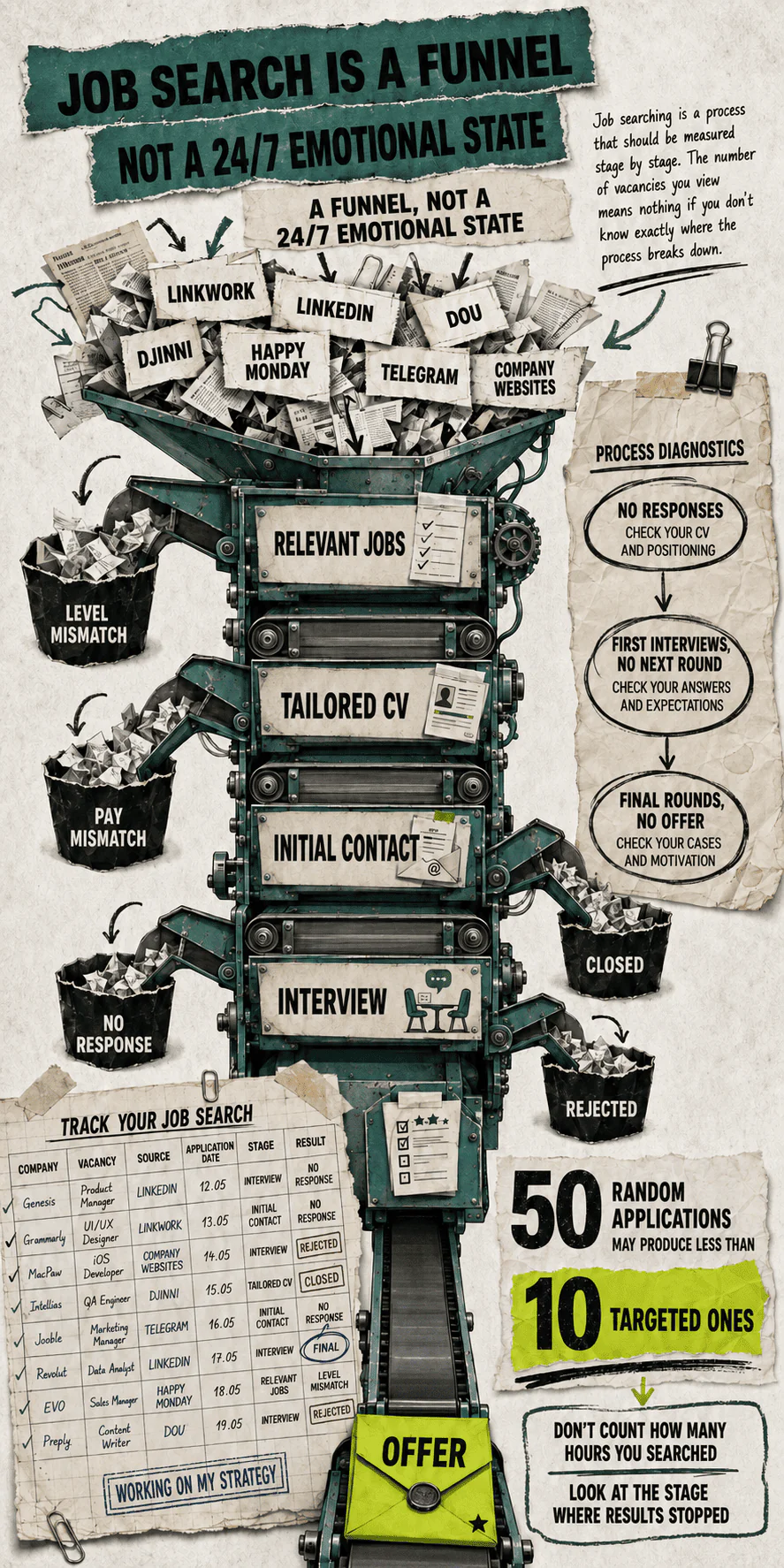
Maintain an application tracker. It is enough to record the company, position, link, source, date, CV version, contact person, salary range, next step, and outcome. This is not bureaucracy for the sake of attractive cells in a spreadsheet. Without tracking, candidates forget where they applied, message the same recruiter twice, and have no idea which channels are producing interviews.
Review the numbers after two weeks. If you have sent twenty carefully selected applications and received no contact at all, the problem is probably your CV, positioning, or level of fit. If you are getting initial interviews but no further progress, review your answers, salary expectations, and examples of results. If you reach final stages without receiving an offer, analyse the competition, your motivation, and the quality of your case presentation. Saying “the market is dead” is convenient because it requires you to change nothing except your facial expression.
The number of applications matters, but treating it as the main performance indicator is dangerous. Fifty random submissions may produce less than ten precise ones. A strong application is sent to a current vacancy, matches most of the key requirements, includes an adapted CV, and, where necessary, a short cover message. A weak application begins with “I have no experience in this, but I learn quickly” and ends with the expectation that the recruiter will value your honesty more highly than another candidate’s qualifications.
How to Apply Without Getting Lost Among Everyone Else
The first section of your CV should immediately show the target role, seniority, key specialisation, and strongest results. Do not begin the document with your home address, marital status, and the objective of “obtaining a worthy position in a stable company.” Employers are not holding a competition for the finest life intentions. They are looking for a person to perform a specific job.
Describe your experience through outcomes and scale. Instead of “managed social media,” state the platforms, audience size, growth in performance, or volume of content. Instead of “worked in recruitment,” name the types of roles, number of placements, and average time to hire. Instead of “worked with clients,” show portfolio size, retention, sales, or service level. If exact figures are confidential, use percentages, ranges, and context. An achievement without scale resembles a medal whose inscription has been left blank.
A cover letter should not repeat the CV. In two or three short paragraphs, explain why you chose the vacancy, which two parts of your experience are most relevant, and where the evidence can be viewed. Do not write that you have dreamed of CRM systems, budgeting, or personnel administration since childhood. Childhood has been through enough already. There is no need to drag it into recruitment.
If five to seven working days have passed since the application, one follow-up is acceptable. The message should include your name, the position title, the date of application, and a short question about the process. Do not write every day, send question marks, or call from different numbers. Persistence is valued in sales. Harassment remains harassment even when served with a generous portion of motivation.
How to Tell a Real Vacancy from an Empty Listing or a Scam
The first warning sign is not the presence of attractive language but the absence of verifiable information. A legitimate employer has a name, a website or functioning page, a clear product, corporate contact details, and people connected to the company. If an organisation conceals everything until the interview, promises to reveal the industry after registration, and communicates only through a newly created messenger account, it is not necessarily fraudulent. It may simply be a company working exceptionally hard to look fraudulent and succeeding brilliantly.
The second warning sign is that money is promised merely for being present while the actual work is described in a fog. “High income,” “simple tasks,” “friendly team,” “company-funded training,” and “career growth” communicate nothing without responsibilities, schedule, payment criteria, and employment format. The more generous the figure and the lower the requirements, the more carefully the model should be checked. The market can be unfair, but it has not yet learned to pay large numbers of beginners like directors.
The third warning sign is a request for payment from the candidate. Never transfer money for registration, access to a platform, mandatory insurance, a workplace, software, a security check, or the reservation of a vacancy. Educational services are an exception, but in that case you are looking at a course, not employment. Replacing one with the other is an old trick. The top hat has simply been replaced by a Telegram bot.
The fourth warning sign is a request for sensitive information before the company has been verified and an offer made. A first conversation does not require a full passport scan, bank card details, PIN code, SMS code, access to the Diia app, or the installation of remote-control software on your computer. Employment documents are provided at a clear stage to an official representative of the employer. If the recruiter is more interested in your banking app than your experience, the interview has already left the career track.
The fifth warning sign is that the job description keeps changing. You applied for a content manager role, sales appeared during the first call, payment processing was added during the second, and just before your start date you were asked to use personal accounts. Stop and request a written description of responsibilities, compensation, and employment terms. Candidate flexibility does not mean agreeing to take part in a professional game of “Guess What Your Job Is.”
Even a real company can publish a bad vacancy. Check the date, how often the listing is repeated, reviews, legal entity, address, people on LinkedIn, and whether the information matches across different sources. Ask why the position is open, who it reports to, what probation looks like, which criteria are used to assess performance, which currency the salary is quoted in, and whether the amount is before or after tax.
For office-based work in Kyiv, ask about practical conditions: the exact address, schedule, hybrid arrangements, shelter, procedures during air-raid alerts, backup electricity, communications, and the possibility of working remotely in an emergency. A coffee machine, beanbags, and biscuits do not constitute safety infrastructure, however hard the employer branding team may have worked. A reasonable employer answers these questions without irritation or theatrical offence.
Where to Find a Job in Kyiv Without Experience
Candidates without experience should not search only for vacancies containing the word Junior. Use terms such as assistant, trainee, intern, coordinator, support specialist, administrator, customer care, lead generation, content assistant, and sales assistant. Entry-level roles are often named after the function rather than the level, so one “no experience required” filter will remove some suitable opportunities.
Check LinkWork, Happy Monday, LinkedIn, Djinni for entry-level digital and IT roles, Jooble, and the websites of large companies, banks, retailers, telecom businesses, educational projects, and service teams. Look for internship programmes, graduate programmes, and trainee intakes. These programmes may open several times a year rather than remain permanently available, which makes alerts and a list of target employers more useful than repeating the same search every day.
Without experience, you need evidence that you are capable of working. A university project, volunteer case, internship, portfolio, independent research project, or completed test assignment demonstrates more than five lines about communication skills. Do not present an academic project as commercial work and do not invent clients. Lying rarely turns a beginner into an experienced specialist, but it can quickly turn them into a former candidate.
Can You Search for Remote Work While Living in Kyiv?
You can and should if your profession supports remote work. Restricting your search to Kyiv artificially reduces your options, especially in IT, marketing, design, content, HR, sales, analytics, support, and project management. On LinkWork, LinkedIn, Djinni, DOU, and Happy Monday, use the Remote filter together with Ukraine or Europe if the employer hires candidates based in Ukraine.
At the same time, Remote does not mean “work from anywhere, whenever you feel like it.” Clarify the country of employment, time zone, tax residency requirements, payment currency, contract type, equipment, communication reimbursement, and availability expectations. A vacancy may be remote while still requiring residence in Ukraine, occasional meetings in Kyiv, or working US hours. It is better to discover this before three interviews than after an attractive conversation about freedom.
What No Longer Works in a Job Search
One universal CV for every profession does not work. Passive waiting after creating a profile does not work. Mass applications without considering the requirements do not work. Believing that a recruiter will recognise your potential from a list of duties does not work. All these methods may occasionally produce a result, just as a broken clock shows the correct time twice a day, but they are not a strategy.
Endless preparation does not work either. Some candidates spend months improving their CV, taking another course, redesigning their portfolio, and reading interview advice without submitting any applications. Preparation becomes a tidy form of avoiding rejection. Your documents need to be strong enough for the market, after which they should be tested through real applications and improved according to employer responses.
Finally, searching without boundaries does not work. If you have not defined your minimum income, acceptable schedule, employment format, commute, industries, and preferred type of manager, every vacancy will look “generally interesting.” A month later, you will realise that you have spent time on processes you could never have accepted in the first place. Rejecting an unsuitable opportunity on the first day saves more energy than making a heroic exit during probation.
So Where Should You Actually Look for Jobs in Kyiv?
Work.ua and robota.ua should remain part of your system, but they should be removed from their position as the sole suppliers of reality. Add LinkWork for office-based and remote roles in HR, marketing, sales, support, administration, and other modern fields; LinkedIn for international companies, professional networking, and direct search; DOU and Djinni for IT and technology businesses; Happy Monday for digital, creative, management, and non-profit projects; Jooble for broad monitoring; and Telegram and Facebook for fast-moving postings and professional communities.
Company career pages will reveal openings at specific employers, government portals will provide access to the public sector, and the websites of international organisations will show positions that rarely reach ordinary job feeds. Referrals and direct contact add another layer, where the decision begins with trust in your professional reputation. No channel is perfect, but a combination of channels gives you a market much closer to the real one.
Finding a job in Kyiv has become more difficult not because there are no vacancies, but because they are distributed across different places, use different names, and demand greater precision from candidates. The market is not obliged to place every suitable opportunity in one attractive folder and deliver it with your breakfast. That is the bad news. The good news is that you do not need the entire market. You need one suitable job, and your chances of finding it rise sharply once you finally move beyond those two familiar browser tabs.