





AI Is Removing the First Rungs of the Career Ladder: Where Are Juniors Supposed to Get Experience Now?
The career ladder used to start at ground level. A newcomer might be asked to transcribe an interview, compile a competitor spreadsheet, build a simple screen, write five product descriptions, test a registration form, prepare a report, or add a small method to someone else’s code. The work could be tedious, but it was useful. You saw the raw inputs, made an awkward first attempt, received feedback, fixed the result, and gradually stopped being the kind of person who could destroy a quarterly report with one confident click.
Now AI stands between the newcomer and that work. It never asks for time off, has no qualms about suggesting twenty headline options, drafts a SQL query in a minute, and does not take offence when its answer is discarded. A company looks at this and asks an obvious question: why pay a person to produce a first draft when a machine can do it for next to nothing? Five minutes later, the same manager posts a junior vacancy demanding independence, business awareness, the ability to work with ambiguity, review AI output, communicate with stakeholders, and take responsibility for results. In other words, they want a beginner who has somehow already finished being one.
This is not a temporary quirk of poorly written job descriptions. It is a new structure emerging in the knowledge-work market. AI is compressing the layer of simple tasks that served for decades as an unofficial system of professional education. Universities explained theory, courses sold the feeling of progress, and employers provided a thousand small collisions with reality. Those collisions were where professional judgement developed. Productivity is now growing faster than the market’s ability to develop the people who will eventually be expected to manage that productivity.
If companies continue removing the lower rungs, they will discover a shortage of senior professionals in a few years. It will be a deeply moving moment. Executives will gather for a strategy session, draw a talent funnel on a whiteboard, and discover with professional astonishment that seniors do not hatch from job postings marked “urgent.” But a company’s future talent crisis does nothing to solve a candidate’s problem today. A junior needs experience now, not after the board of directors achieves enlightenment.
This article will therefore not promise that believing in yourself, maintaining a LinkedIn profile, and asking the universe for a job offer in exactly the right way will be enough. The market is under no obligation to compensate for a lack of practice just because someone has a positive attitude. We will examine which entry-level tasks AI is genuinely taking over, what counts as experience now, where to acquire it without holding a formal position, how to build a portfolio that can withstand questions, and how to use job postings as something more than lottery tickets. We will also explore why writing a brilliant prompt does not make someone a professional, even if it can occasionally help them look like one until the first follow-up question.
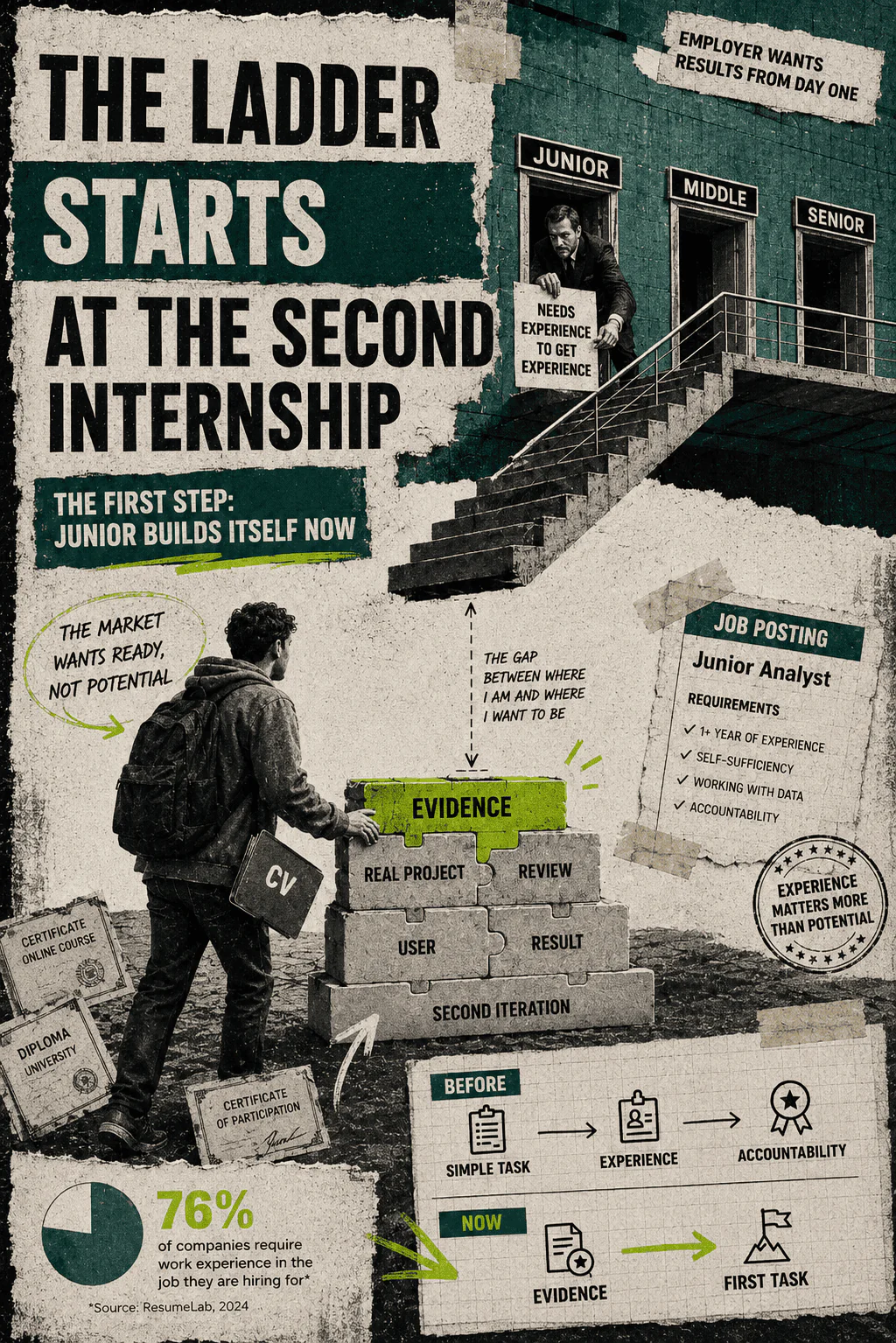
AI Has Not Destroyed the Career Ladder. It Has Moved the Starting Point to the Second Floor
Public debate tends to adopt one of two positions. In the first, AI is about to eliminate all office work, sending accountants, designers, developers, marketers, and lawyers off to grow lavender together. In the second, nothing particularly significant is happening because new technologies have always created new professions. Both positions are convenient: the first sells fear, while the second allows everyone to avoid changing anything. Reality is less comfortable because it requires us to distinguish between a profession, a role, a task, and the way work is organised.
AI rarely replaces an entire profession at the press of a button. It takes over individual operations, accelerates others, and raises the standards for what remains. A marketer is still responsible for the audience segment, proposition, budget, and interpretation of results, but part of the manual research and early-stage content production disappears. An analyst still has to frame the question, assess data quality, and make decisions based on the numbers, but routine SQL, formulas, and initial chart commentary take less time. A developer still owns the architectural context, integration, security, and maintenance, but a simple function, test template, or piece of documentation can now appear almost instantly.
The problem is that the operations being automated are not random. The first tasks to be compressed are those with a clearly defined output, plenty of available examples, a low cost for an individual mistake, and a result that can be checked quickly in digital form. These are precisely the tasks traditionally handed to beginners. They provided a safe training ground: a junior could make a mistake, a senior could review it quickly, and the company would still receive something useful.
A manager can now obtain a draft independently in a matter of minutes. Reviewing AI output also takes time, but often less than assigning the task to another person, explaining the context, and going through two rounds of feedback. In the short term, the economics are obvious. In the long term, it resembles saving money on roof repairs because it is not raining today. The company saves a senior employee’s time now, but removes the mechanism through which juniors learned to turn instructions into decisions.
This creates a new starting position. Employers no longer want to pay for the production of raw material, but they are willing to pay for the ability to determine what material is needed, select the right tool, verify the facts, integrate the result into a process, and explain the consequences. These actions used to form the upper part of a task, something a newcomer grew into. Now they belong to the minimum package. The career ladder has not disappeared. Its first visible rung is simply higher, and candidates are expected to bring their own stool.
What Exactly Is Disappearing From Junior Work?
Not all simple work is disappearing. Some of it remains because of confidentiality, regulatory requirements, poor data quality, the cost of errors, or plain organisational inertia. But its market value is falling while competition is growing. If one person using AI can produce the same output as three entry-level employees once did, a business will not hire three people simply because they would benefit from somewhere to learn.
Article drafts, descriptions, headline options, rewrites
Generates structures and text options, summarises sources, performs basic editing
Finds a strong angle, verifies facts, understands the audience, and takes responsibility for meaning and reputational risk
Competitor research, content plans, simple ads, reports
Clusters ideas, writes variants, summarises data, suggests hypotheses
Connects the campaign to product economics, selects a hypothesis, designs an experiment, and explains the result
References, banner variations, simple layouts, icons
Generates visual directions, interface copy, and layout variations
Researches the user’s problem, builds a system, checks accessibility, and defends the solution
Boilerplate code, simple functions, documentation, basic tests
Writes draft code, tests, migrations, and explanations, and identifies common errors
Understands the system, checks security, manages dependencies, and makes engineering trade-offs
Standard test cases, checklists, test-data generation
Creates scenarios, test data, and draft automated tests
Identifies risk, looks for unusual failures, reproduces defects, and evaluates their impact on users
Cleaning spreadsheets, formulas, queries, descriptive reports
Generates SQL and formulas, summarises datasets, and drafts commentary
Checks data provenance, defines metrics, identifies bias, and turns findings into decisions
Job descriptions, initial sourcing, template messages, interview summaries
Writes job descriptions, ranks profiles, and prepares communications and questions
Validates the need for a hire, assesses a person in the context of the team, and manages risk and the candidate experience
Consolidated spreadsheets, initial commentary, expense classification
Processes documents, suggests formulas, identifies anomalies, and prepares explanations
Controls assumptions, follows rules, assesses risk, and takes responsibility for the numbers
Searching for standard clauses, comparing contracts, drafting letters
Finds and compares wording and produces an initial review
Checks jurisdiction and currency, assesses consequences, negotiates, and takes responsibility for the advice
Knowledge-base responses, lead qualification, post-call emails
Handles standard conversations, summarises calls, updates the CRM, and writes follow-ups
Handles exceptions, maintains trust, diagnoses the real need, and decides when to escalate
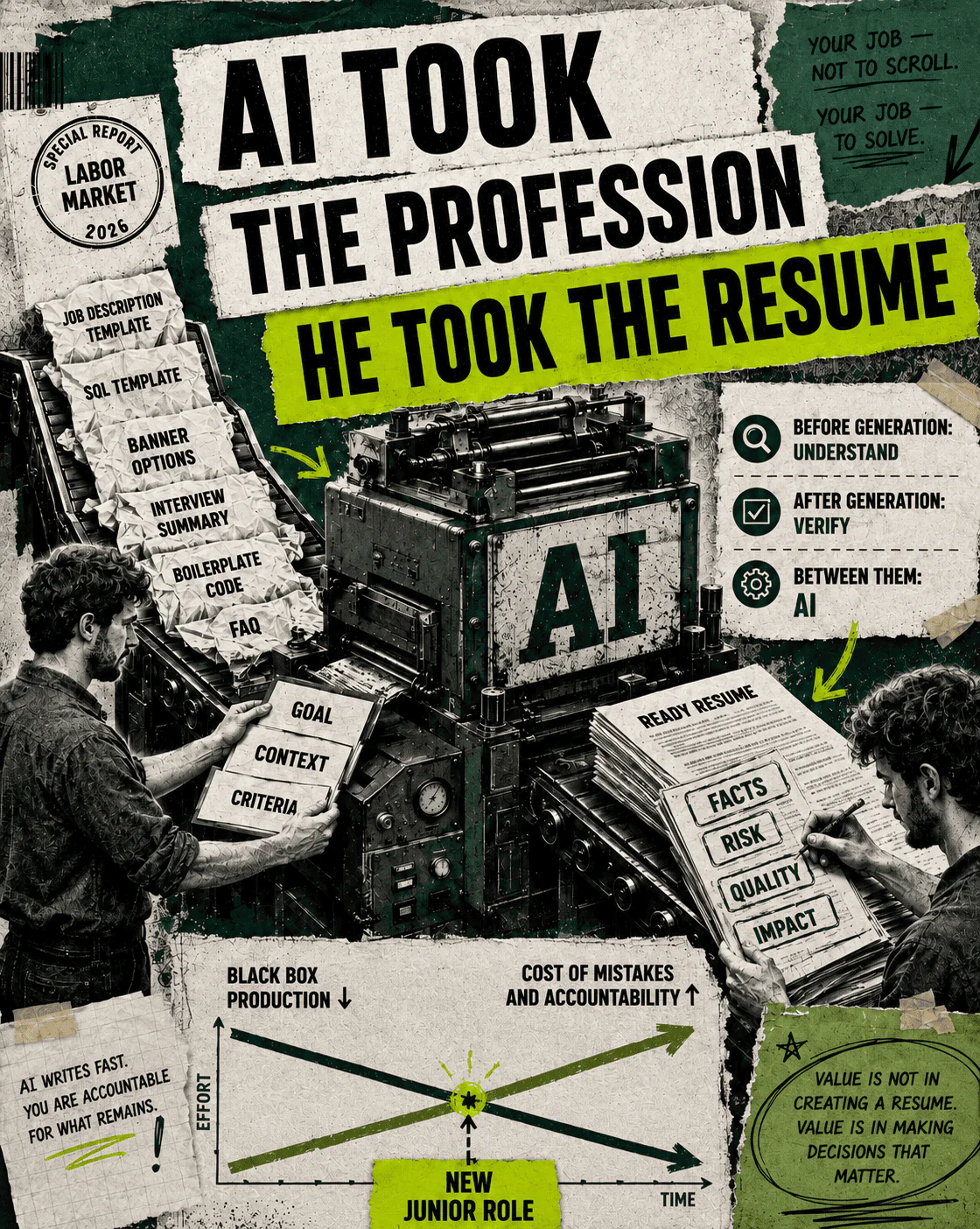
The overall pattern is visible without a microscope. AI takes over production of the first layer of the result. The work left to people happens before generation and after it: understanding the problem, gathering reliable context, defining criteria, checking the answer, reaching agreement with other people, and living with the consequences. This is not necessarily “creativity” in the romantic sense. Sometimes it means the tedious work of finding out why a figure in a report differs by 4.7 percent and which of three sources is wrong. But this is where professional value begins.
What the Data Says, and What We Would Very Much Like to Squeeze Out of It
The subject of AI and employment suffers from industrial-scale production of conclusions. A company publishes a study, the media turns a cautious correlation into a prophecy, a post author adds a photograph of an abandoned office, and the reader receives a ready-made heart attack. To avoid participating in this production cycle, we need to separate what has been observed, what has been forecast, and what has merely been assumed.
In its Future of Jobs Report 2025, the World Economic Forum surveyed more than a thousand employers representing over 14 million workers across 55 economies. They expect structural changes of all kinds to create around 170 million jobs and displace around 92 million by 2030, producing a positive net balance of approximately 78 million. But this is a forecast covering all structural forces, including demographic change, the energy transition, and geoeconomics, rather than a cheque written by artificial intelligence alone. Presenting these figures as proof that “AI will create more jobs than it takes away” is about as precise as predicting the weather in Kyiv from the planet’s average temperature.
The same report contains a more important finding for individual candidates: employers expect 39 percent of current skills to change or become obsolete by 2030. Seven out of ten companies identify analytical thinking as a core skill, while AI, big data, and technological literacy are among the fastest-growing areas. At the same time, 40 percent of employers anticipate reducing staff where AI can automate tasks. The market as a whole may therefore grow while one particular route into a profession becomes narrower. Macroeconomics never personally promised you a desk by the window.
A joint study by PwC and the World Economic Forum published in 2026, drawing in part on responses from more than 9,000 early-career workers across 48 countries, estimates that 37 percent of young people work in professions where AI is moderately or highly likely to transform tasks. In the most affected entry-level roles, the required skill set is changing approximately 2.2 times faster than in the least affected roles. Almost a third of respondents believe that no more than half of their current skills will remain relevant in three years. This is not evidence of mass layoffs, but it is a direct signal that the content of entry-level work is changing faster than educational programmes can keep up.
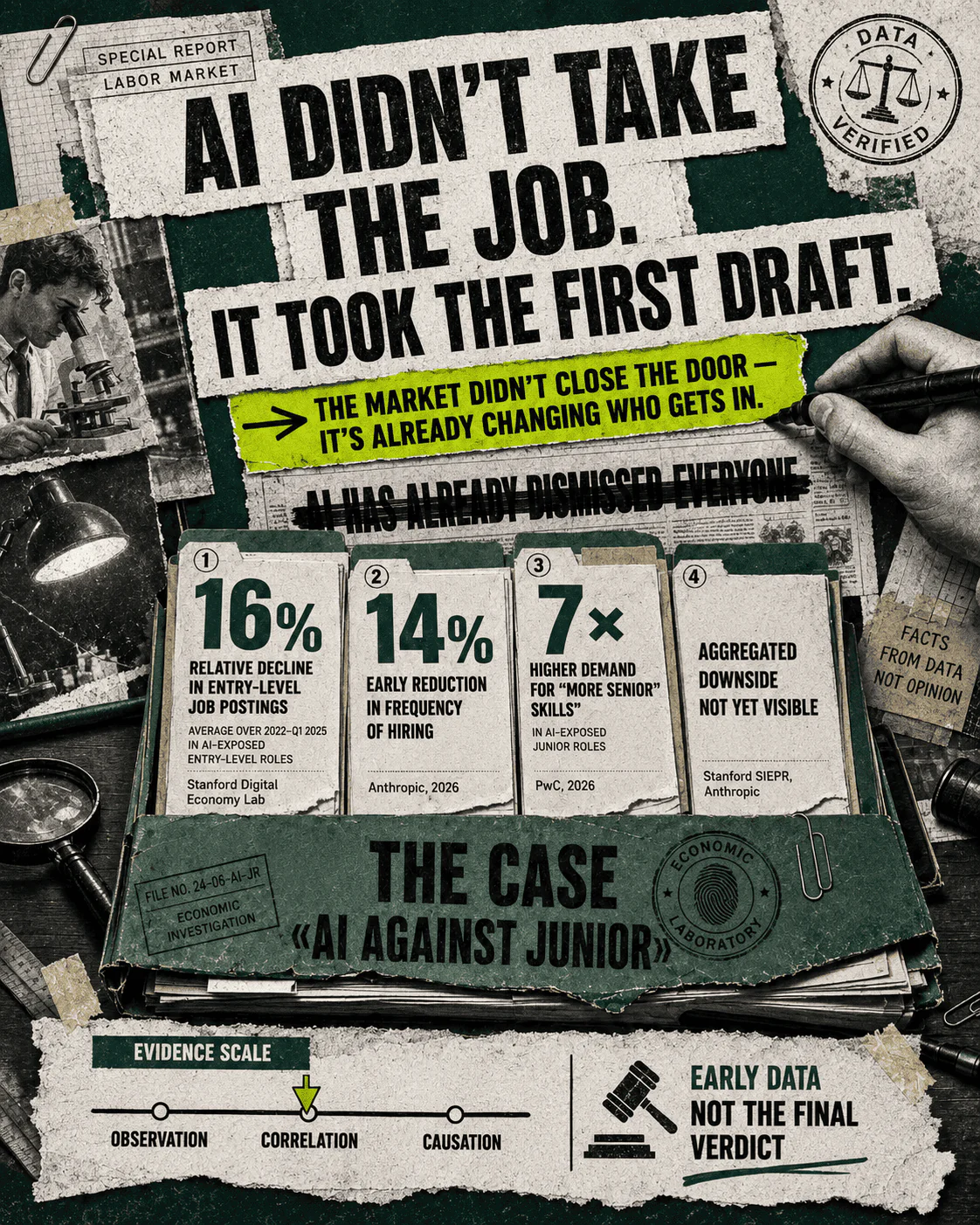
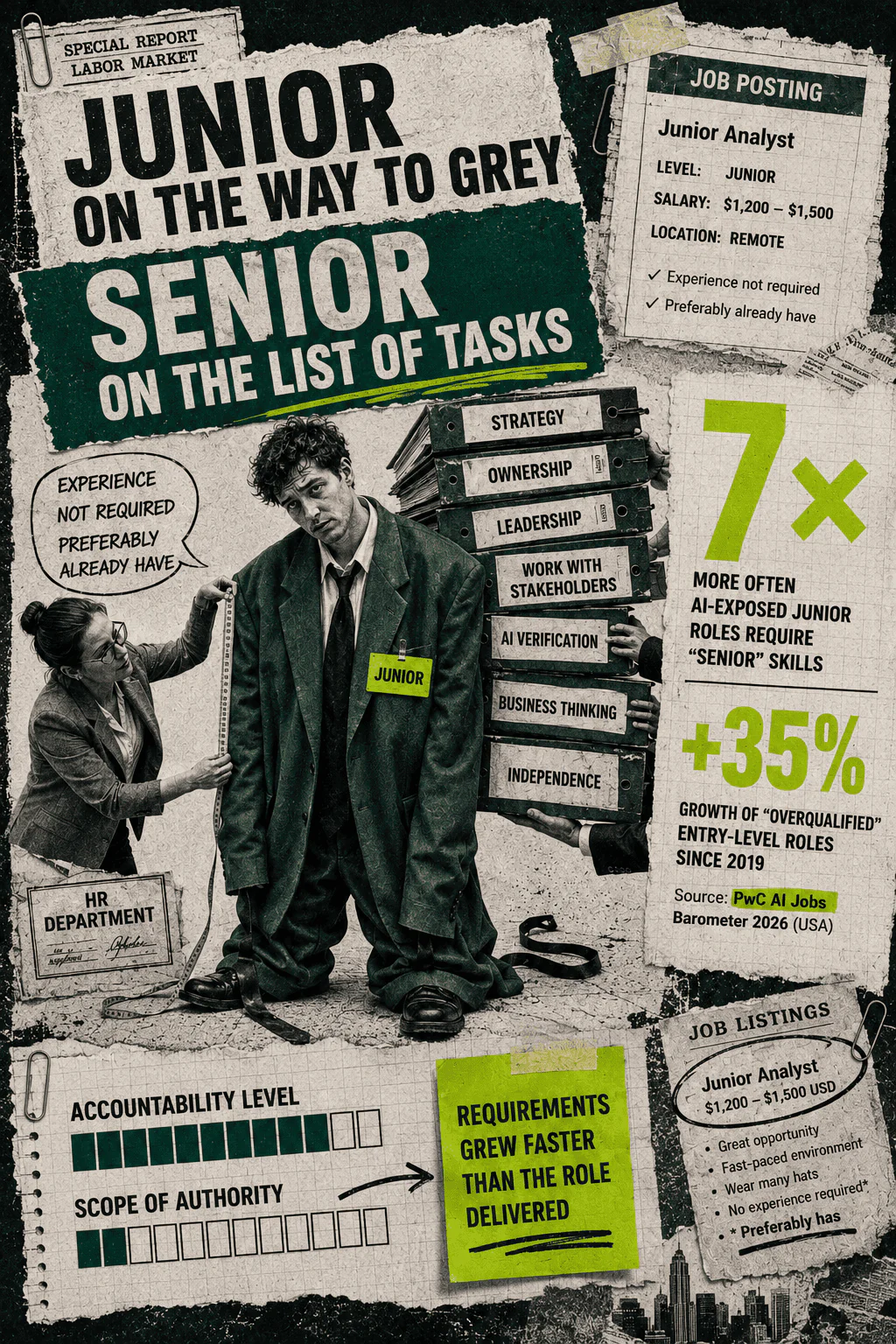
The PwC AI Jobs Barometer 2026 analysed more than a billion job postings. In the junior roles most exposed to AI, traditionally senior-level skills, including leadership and strategic thinking, appear seven times more frequently than in the least exposed roles. The number of these “grown-up” entry-level positions has risen by 35 percent since 2019. The phenomenon now has a respectable name: the seniorisation of entry-level work. In plain English, the employer wants an inexpensive beginner with expensive judgement.
There are more worrying figures as well. The Stanford Digital Economy Lab found a relative 16 percent decline in employment among workers aged 22 to 25 in the US occupations most exposed to AI, after accounting for company-level shocks. The same pattern did not appear among more experienced employees in those occupations or among young people working in less exposed fields. The authors also show that the decline is concentrated in areas where AI is used to automate people’s work rather than augment it.
Even this result cannot honestly be translated as “AI has destroyed 16 percent of entry-level jobs.” The study observes a difference between groups and carefully tests alternatives, but the market was simultaneously dealing with the aftermath of pandemic-era hiring, expensive capital, a slowdown in the technology sector, and changes to remote work. A 2026 review by Stanford SIEPR states directly that no significant aggregate effect of AI on employment is visible yet, although AI may be partly responsible for the difficult market facing recent graduates. The wording is dull, but it has one rare advantage: it does not lie.
Anthropic reached a similar combination of conclusions in a March 2026 study. The authors found no systematic rise in unemployment in the most affected occupations, but they did identify an early sign that hiring among people aged 22 to 25 was slowing. The rate at which people found new jobs in the most exposed roles fell by approximately 14 percent relative to 2022, although the result sits on the edge of statistical significance. The authors list alternative explanations: a person may have stayed in their existing job, entered a different profession, or returned to education.
This is how the market should be read: not as an apocalypse that has already happened, but as an early shift in the mechanism of entry. Overall employment has not collapsed. Senior professionals have not disappeared. New roles are emerging. But in professions where much of an entry-level employee’s value once came from digital routine, employers need fewer people who simply execute tasks and more people who can manage an assignment from beginning to end.
Ukraine requires one more caveat. Most major studies use data from the US, Europe, or global collections of job postings. Their percentages cannot be transferred directly to Kyiv, Lviv, Dnipro, Tbilisi, Almaty, or Chisinau. The underlying mechanism, however, transfers well: a digital first draft becomes cheaper anywhere the same models are available, while international clients compare a Ukrainian team not only with local competitors but also with an automated process.
A DOU survey on job searching in 2026 provides local context for the Ukrainian IT market. Among 3,777 respondents in Ukraine, interns and juniors were more likely than other groups to be looking for work: 77 percent had entered the market. Of those who were searching, 65 percent found a new position. These figures do not mean that beginners had the easiest time: the sample includes people who were already employed, those changing jobs, and professionals from different disciplines. They show something else: the entrance is not sealed shut, but the market is highly uneven. In UI/UX and product design, 71 percent of specialists were looking for work, and only about one in three found it. Success rates in AI, data, and DevOps were significantly above average.
The median job search in Ukraine lasted eleven weeks. Candidates submitted a median of fifteen applications and attended four interviews. At the same time, 53 percent completed take-home assignments. Among content, PR, social media, and brand specialists, 86 percent did them; the figure was 79 percent for marketers and 73 percent for UI/UX and product designers. In other words, the market does not merely ask for proof of skill. It regularly receives small pieces of free production work from candidates. Sometimes this is a reasonable assessment. Sometimes a company is collecting ideas through other people’s unpaid labour. We will return to that distinction.
A separate DOU article about junior hiring in 2026 records the shift in employers’ own words. Many junior roles increasingly expect at least one year of professional experience. Formal signals such as the name of a university are becoming weaker, while specific cases, an understanding of working processes, fundamental knowledge, the ability to deliver an initial result quickly, and responsible use of AI are becoming stronger. Educational and personal projects count when candidates can explain their role, decisions, and conclusions. That last condition matters more than it may appear: AI can create an artefact, but it cannot live through the history of your decisions for you.
Why Juniors Are Taking the Hit Even Though AI Helps Them More
This creates a paradox. In experiments, beginners often gain more productivity from AI than experts do. In a customer-support study discussed by Stanford SIEPR, an AI assistant increased overall productivity by around 15 percent, while less experienced workers saw gains of up to 30 percent. The strongest employees experienced no significant improvement. It would seem that companies should hire juniors in large numbers, give them AI, and happily calculate the margin.
But the productivity of an individual junior who has already been hired and the decision to hire another junior are not the same thing. If one junior using AI can handle more standard enquiries, the company may manage with its existing team. If a senior using AI can create the first draft quickly, there is no longer a need to pass that work to a junior. The technology simultaneously increases a beginner’s value within the process and reduces the number of places available at the entrance. Economics can accommodate contradictions without the slightest discomfort.
There are five reasons why the lower layer is shrinking in particular.
The first is the cost of coordination. Giving a task to a person means explaining the context, access requirements, format, deadline, criteria, and constraints. Someone then has to review the result, provide feedback, and wait for corrections. A good manager understands that this is an investment in the employee’s future independence. A manager facing a quarterly target sees forty minutes they do not have. AI receives instructions instantly, and if the result is poor, no one schedules a meeting “to align on expectations.”
The second reason is risk. An AI mistake feels manageable because the result formally remains under the control of an experienced employee. A beginner’s mistake requires both correction and teaching. Psychologically, this feels like a double cost, even though an AI error can also slip quietly through review and multiply at scale. Machines make mistakes confidently, quickly, and without an anxious expression, so organisations often notice the price later.
The third reason is output standardisation. If a task can be reduced to “take this input and produce a text, spreadsheet, design, or piece of code,” it is easier to automate. Juniors historically worked in precisely this area because they could not immediately be trusted with ambiguous outcomes carrying a high cost of failure. AI entered the profession through the same door as the beginner. It simply did not remain on probation.
The fourth reason is observability. Managers can see a completed artefact, but they cannot see a future capability nearly as clearly. A report produced today has an obvious value. A junior who may become a reliable mid-level professional two years from now is a forecast with an unpleasantly wide confidence interval. When budgets are tight, an organisation buys the measurable output and cuts an investment whose return will appear after the next reorganisation, possibly at another employer.
The fifth reason is the excess supply of candidates for popular knowledge-work roles. For years, courses, universities, and social media sold entry into IT, design, marketing, and analytics as a path to remote work and a respectable income. The supply of beginners grew. Employers can demand more because someone in the queue will have two internships, three projects, and the expression of a person who has dreamed of optimising a CRM since childhood.
The uncomfortable formula is this:
Key ideaThe more easily AI produces a standard result, the less an employer pays for the act of production itself and the more they demand for framing, verification, integration, and responsibility.
This formula applies to almost every knowledge-work profession. It does not mean that every junior must become a board-level strategist. It means that a candidate has to demonstrate at least one small but complete unit of professional responsibility. Not “I wrote ten posts,” but “I discovered that the audience did not understand the product, developed three hypotheses, tested them against the data, published two variants, measured click-throughs, and changed the message.” The text is merely the material. The experience lies in the connection between the decision and its consequences.
Experience Can No Longer Be Measured by the Number of Files Produced
The old everyday definition of experience was simple: a person had been doing something for a long time. It was always a weak definition. Someone could mechanically compile reports for three years and acquire the same year of experience three times. Now the definition breaks down completely because AI allows a person to produce more text, code, screens, and spreadsheets over a weekend than a junior once created in a month.
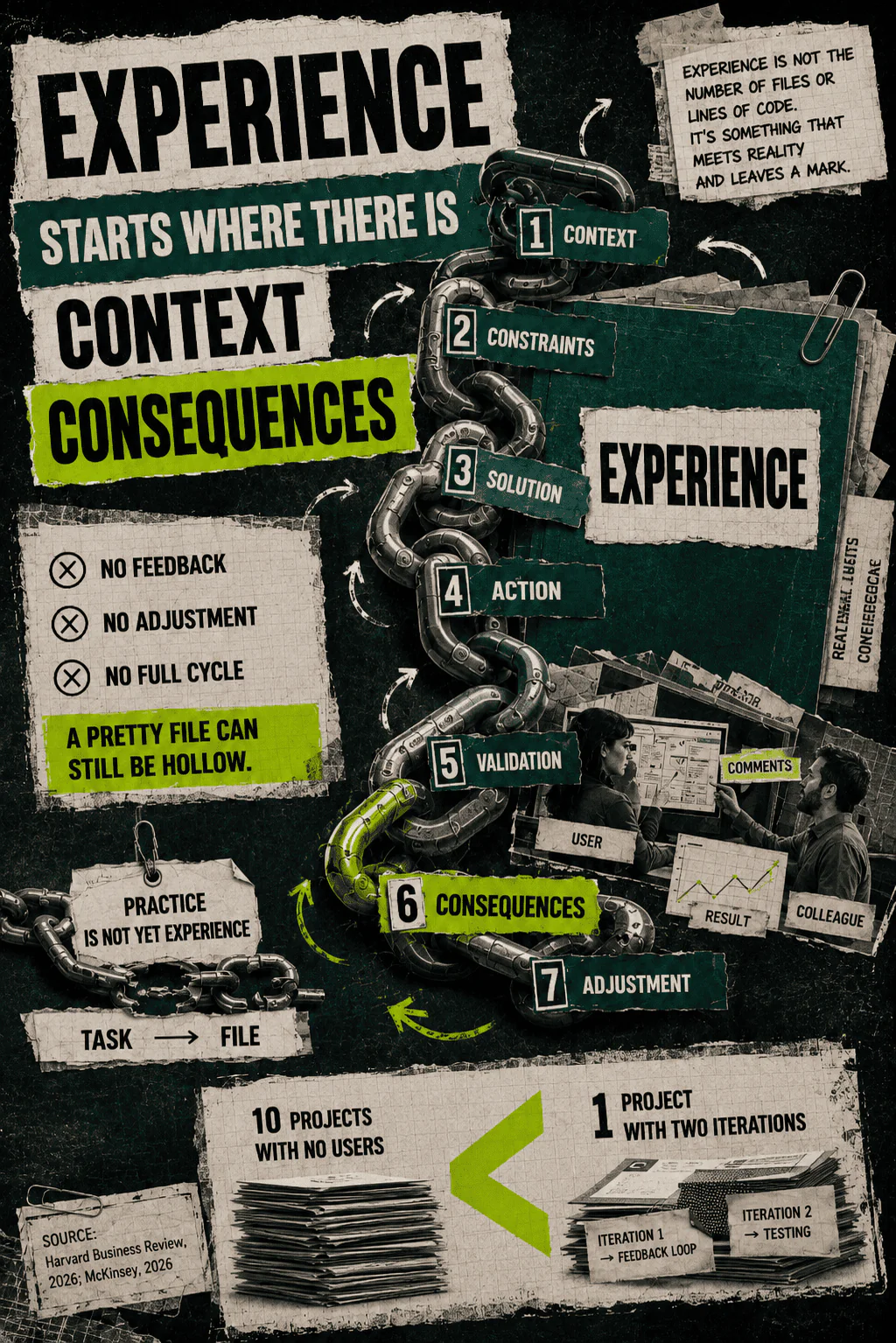
Employers do not need a large volume of activity traces. They need proof that the candidate can complete a full professional cycle:
Context answers who the task is for and why it exists. A constraint introduces reality: time, budget, data, rules, technical debt, and human interests. A decision records the choice made among alternatives. Action turns that choice into an artefact or process change. Verification separates what works from what merely looks good. Consequence reveals what happened after the intervention. Adjustment proves that the person can learn from their own mistake rather than from a motivational quote.
If a project lacks at least several of these links, it provides practice but offers weak evidence of experience. Designing a banking app without a bank, users, constraints, or testing is useful for practising an interface tool. Calling it a product case is more ambitious. Generating an online store with AI is useful for becoming familiar with the technology stack. Claiming that you “developed a scalable e-commerce platform” when the project’s only visitor is your cat is unwise. The cat may be a loyal user, but it will not pass the technical interview.
The Seven Layers of Real Experience
What proves real work, and what only imitates it
Who the user or client is, what problem they have, and why the task matters
“I wanted to make an interesting project”
The time, data, budget, rules, dependencies, and risks involved
Ideal conditions invented after the project was completed
Which alternatives were considered and why one was selected
The only option suggested by AI
What the candidate personally did and where they used tools or assistance
A link to a finished file with no history of the work
How the facts, code, usability, hypothesis, or quality were tested
“I looked at it and everything seemed fine”
What changed for the user, team, or metric
The number of screens, words, or functions produced
What proved wrong and what was changed after feedback
A story in which everything worked perfectly on the first attempt
This definition fundamentally changes the answer to the question of how a junior can acquire experience. Experience can be gained without formal employment, but it cannot be gained without reality. Reality begins where a task has an external owner, the result has a criterion, and a poor decision causes at least some consequences. That is why a volunteer project for a functioning organisation can be more valuable than a tenth course. That is why a small paid assignment worth $100 can teach more than a huge educational product. That is why a contribution to an open-source project with reviewer comments carries more weight than a repository no one has ever opened.
Formal employment nevertheless remains the strongest container for experience. It contains processes, dependencies, competing priorities, other people’s code, real clients, confidentiality, deadlines, and repetition. Alternative routes should not be romanticised, and a personal project should not be presented as equivalent to a year on a strong team. It is not. The candidate’s task is not to convince the market that they are equal. It is to narrow the gap enough for an employer to see an acceptable level of risk in making the first hire.
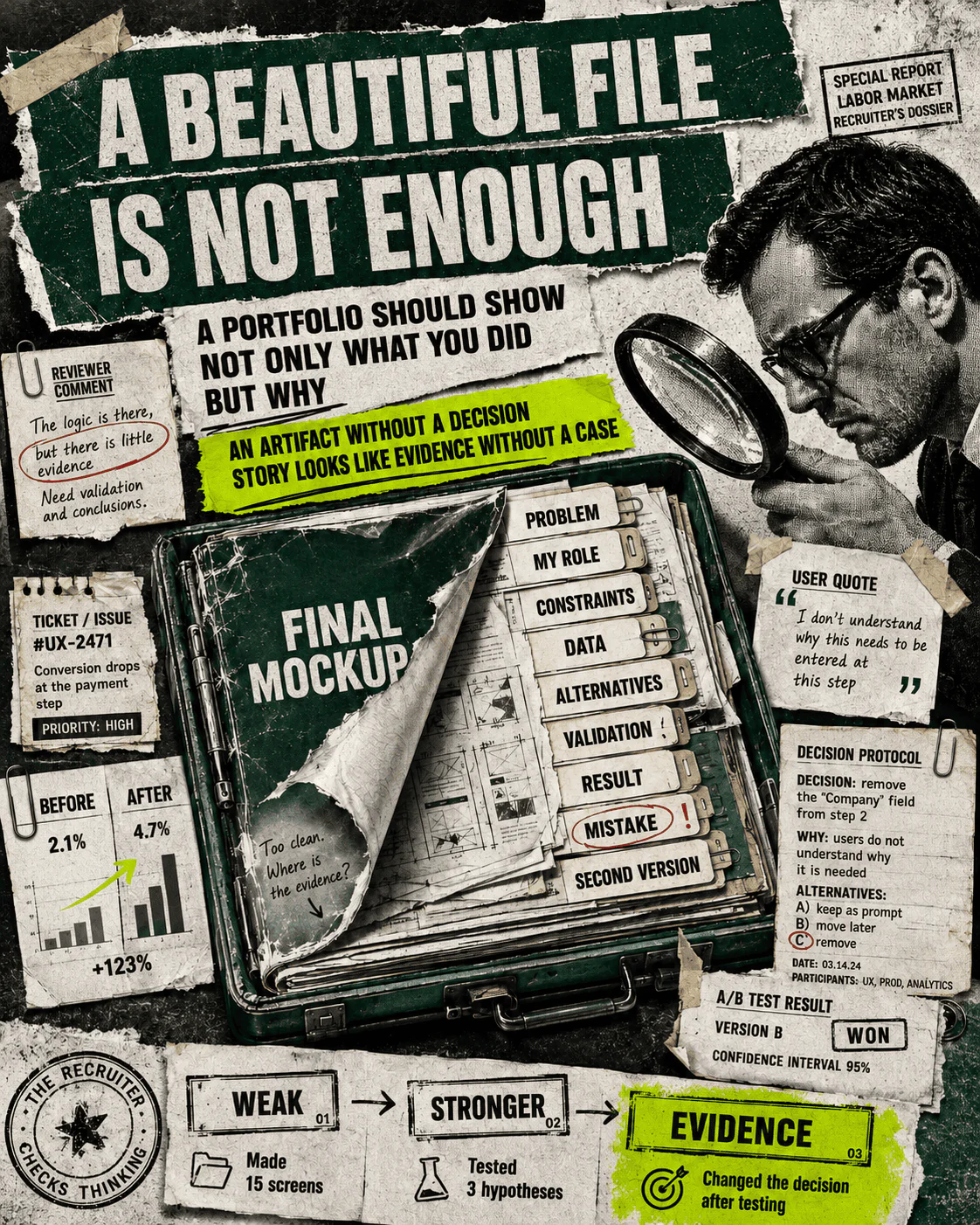
A portfolio must therefore stop being a museum of artefacts and become a record of decisions. A good case shows what the person noticed, what they knew at the time, what they did not know, which options they rejected, where they made a mistake, how they checked their work, and what changed. AI is not the enemy here. It can accelerate research, suggest options, write a draft, generate test data, and help identify weak points. But if the candidate cannot separate their own decision from the machine’s suggestion, the employer is not looking at an augmented professional. They are looking at the operator of an attractive machine.
The “Seniorised Junior”: Entry-Level Pay, Senior-Level Risk
The requirement that a newcomer “think like a senior” sounds particularly impressive in employers’ posts. Usually, it does not mean genius or fifteen years of experience. It means four more prosaic abilities: clarifying the task independently, noticing an obvious risk, refusing to deliver an unchecked result, and saying in time that you are stuck. These qualities were useful twenty years ago as well. In 2026, they have become a filter because producing a draft is no longer valuable enough on its own.
A real senior is not distinguished by typing speed or by the number of tools they know. They carry a map of consequences in their head. Change a field in a form, and the analytics may break. Rewrite a headline, and the legal promise may become broader. Remove a validation step, and support may receive a flood of enquiries. Choose an attractive metric, and the team may optimise the number while making the product worse. Experience teaches people to see these connections before they catch fire. AI is very good at proposing an action, but it does not live inside a particular organisation and does not remember its previous fires.
A junior cannot honestly possess such a complete map. A reasonable employer should therefore not demand the maturity of an expert. They can demand the foundation of the relevant meta-skill: acknowledging missing context, asking a question, stating an assumption, narrowing the scope of the solution, performing a check, and raising a risk flag. This is not senior-level work. It is the basic safety standard for someone who has been handed a powerful tool.
The problem begins when a company transfers responsibility to a junior without providing authority or mentorship. The vacancy promises “rapid growth,” while the actual job provides mid-level tasks, no access to decisions, and a manager who responds once every five days with an emoji. Such an employer is not building a new entrance to the career ladder. It is looking for a discount voucher for a professional. The market is genuinely raising the bar, but that does not turn every inflated vacancy into a law of nature.
Candidates should divide requirements into three groups. The first represents the true minimum: fundamentals, working tools, the ability to explain decisions, and basic communication. The second describes the preferred profile: domain experience, an additional technology stack, or familiarity with a particular platform. The third represents a hiring manager’s fantasy: a long collection of unrelated roles, complete independence, and years of proven responsibility at entry-level compensation. The first group should be answered with evidence, the second covered partly, and the third used as diagnostic information about the company.
What employers may really mean in junior job descriptions
| Wording in the Job Posting | What It May Really Mean | What the Junior Should Demonstrate |
|---|---|---|
| “Independence” | The manager does not want to break down every task | The ability to clarify the goal, suggest a plan, identify a blocker, and estimate a timeline |
| “Strategic thinking” | The work needs to connect with a business objective | An explanation of which metric or risk the decision affects |
| “Ownership” | The result cannot be abandoned once the file has been sent | Implementation checks, feedback, and adjustments |
| “AI-first mindset” | The company wants to accelerate its flow of work | A deliberate system for delegating to AI and checking the result, rather than a collection of prompts |
| “Ability to work with ambiguity” | Requirements will be incomplete and contradictory | A list of assumptions, questions, and completion criteria |
| “At least one year of professional experience” | The company needs someone familiar with real working consequences | A real project for an external client may narrow the gap, but will not always replace a formal year |
| “Cross-functional” | The role overlaps with adjacent disciplines, or the company is saving on headcount | One strong core skill plus evidence of working effectively across boundaries |
At an interview, you do not need to prove that you are already a senior in compact packaging. You need to demonstrate predictability. Employers are not primarily afraid that a junior will not know something. Even experts face too many unknowns. They are afraid that the person will fail to notice a gap, hide a problem, present an AI hallucination as fact, miss a deadline without warning, or be unable to explain how the work was done. A predictable beginner is easier to manage and becomes independent faster.
This changes self-presentation. “I learn quickly” is almost worthless because mass production of that phrase was mastered long before generative models arrived. A specific cycle is far stronger: “I did not know library X, so I built a minimal prototype in two days, compared three approaches on a test set, discovered a memory leak, requested a review, and replaced the solution. Here are the measurements before and after.” This is not an attempt to look omniscient. It proves that your lack of knowledge is manageable.
AI Gives Beginners Speed While Stealing Their Training
The main risk for juniors is not that AI will do the work better. The risk is that people will begin producing acceptable results before they have formed a model of the subject. From the outside, the process looks like growth: the text is cleaner, the code is longer, and the presentation is more polished. Internally, the opposite may be happening: the candidate constructs causal relationships less often and increasingly chooses whichever option from the machine sounds most convincing.
A Microsoft Research study presented at CHI 2025 collected 936 examples from 319 knowledge workers. Greater confidence in GenAI was associated with less reported critical thinking, while greater confidence in a person’s own ability to solve a task was associated with more. The authors also observed that critical work itself was shifting away from production and towards verifying information, integrating answers, and controlling the task. This is not laboratory proof that people’s brains are deteriorating. It is a sufficiently clear warning about the mechanics of dependency.
When an experienced professional receives an AI answer, they compare it against an internal model. They notice a strange assumption, a missing edge case, an impossible number, or wording that makes a broader legal promise than intended. When a beginner receives the same answer, they may have no reference point. Fluency is mistaken for quality, and confident phrasing is mistaken for truth. The result is the professional equivalent of a decorative fireplace: it looks warm, but it does not heat the house.
Full automation of an educational task is especially dangerous. If AI immediately writes the article, the candidate does not learn to construct an argument. If it immediately generates the code, the candidate does not develop a feel for structure and failure modes. If it immediately creates the design, the candidate does not understand how the solution grew out of user behaviour. They may learn to assess the result later, but assessment requires the same foundations they skipped. You cannot reliably check something you do not know how to build at least partly by hand.
None of this calls for a ritual rejection of AI. Employers already use it. Colleagues use it. Doing everything manually is not a moral achievement. Someone who spends three hours formatting a spreadsheet on principle is not defending the craft. They are giving the alignment function an expensive gift. The task is to establish the right learning sequence.
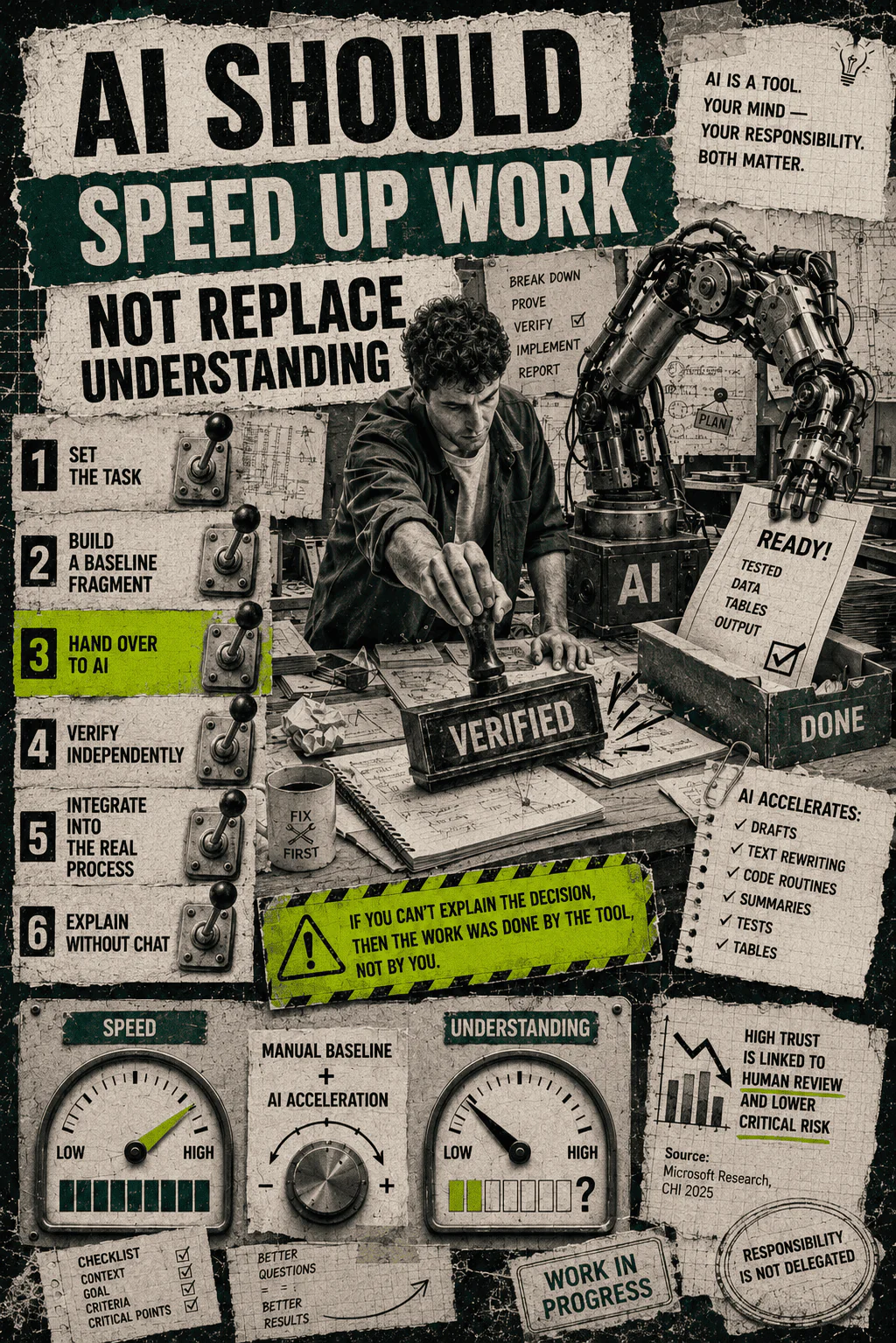
On the first pass, a junior should solve a small example independently and record the logic. AI can then be asked to suggest alternatives, accelerate repetitive operations, or test weak points. After that, the person must compare the options using predefined criteria, verify the sources, and explain the final decision without help from the chat. If the explanation collapses after the second “why,” the tool did the work while the candidate happened to be nearby.
A Protocol for Using AI to Build Skill Rather Than Conceal Its Absence
How to use AI without losing control of the work
Each stage shows what the person must own, where AI can help, and which question keeps the result honest.
One useful technique is a mandatory “cold review” the following day. Close the chat and reconstruct the solution: the original task, three key choices, two risks, the verification method, and the result. If your memory contains only the prompt and your delight at the attractive answer, no learning took place. Discovering that is unpleasant, but considerably cheaper than making the same discovery in front of three interviewers.
Another technique is red teaming. Once you receive a result, ask AI to attack it, but do not accept its criticism automatically. Write your own list of failure modes first and then compare. For an analyst, these may include sample bias, incorrect granularity, duplicates, and future-data leakage. For an editor, they may include unsupported claims, tonal conflict, legal promises, and repetition of meaning. For a developer, they may include security, race conditions, error handling, observability, and backward compatibility. Over time, the library of common failures should live in your head, not only in your chat history.
Employers are under no obligation to believe the words “I use AI responsibly.” Show the record: where the model was wrong, how you identified the error, what you checked with an independent source, which part you rewrote, and why. Screenshots of every prompt are usually unnecessary. They quickly turn the case into an archaeological excavation. What matters is a map of responsibility that makes it clear what the tool did and what the person was accountable for.
Where Juniors Should Get Experience Now
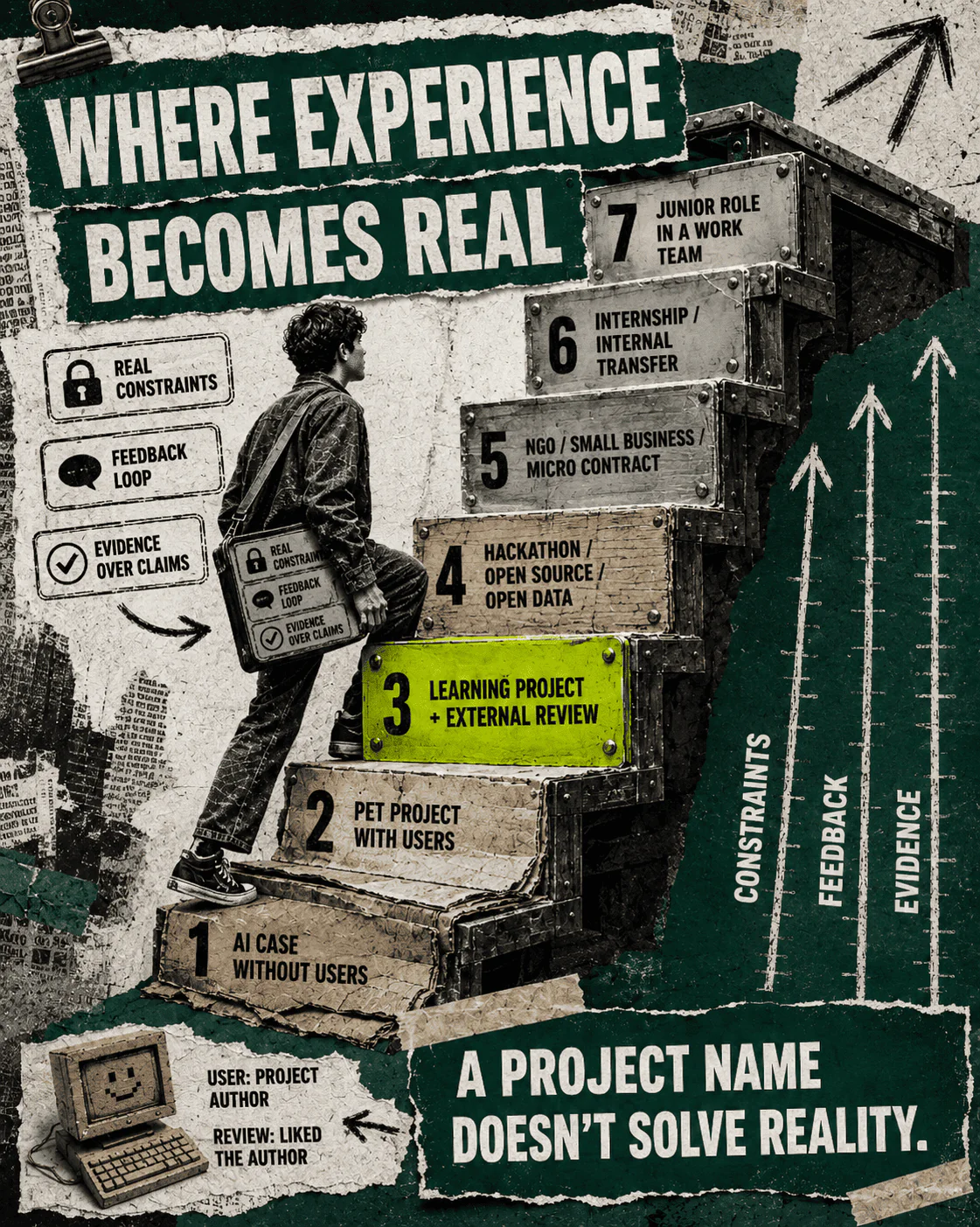
The short answer is: wherever real consequences still exist and feedback is available. Formal employment is the best option, but it is not the only one. The important thing is to assemble the right combination: at least one external client or user, at least one strong reviewer, at least one completed cycle, and several repetitions. A single source rarely provides everything.
An internship provides processes and a mentor but may leave the person inside an educational bubble. A volunteer project provides a real client but may suffer from chaos and a lack of professional review. Open source provides technical standards and a public history of decisions but does not always demonstrate a business result. Freelancing provides a client and money but can teach people to make quick compromises without strong feedback. A personal project provides autonomy but easily turns into theatre in which the author is simultaneously the client, user, researcher, and delighted focus group.
You need to build a portfolio of environments rather than search for one mythical perfect place.
Which experience actually helps a junior candidate get hired
Compare different sources of experience by real constraints, feedback quality, hiring value, main risk, and the best way to strengthen the case.
A narrow educational task that is never implemented
Ask for a production component and review
Chaos, lack of mentorship, exploitation
Set clear boundaries of responsibility and find an external mentor
The old role continues consuming your time
Agree on the project, owner, and transition criteria
Vague scope and endless unpaid work
Define the scope, deadline, deliverable, and right to use the case in writing
Choosing an abandoned project or making a cosmetic contribution
Select an issue involving a user, tests, and review
An attractive prototype with no follow-through
Continue the solution after the event and collect feedback
Low pricing, a weak client, and chasing ratings
Choose a task with measurable impact and limit free revisions
No real consequences
Add a user, open data, testing, and a second iteration
Self-assessment and invented metrics
Find five users, describe mistakes publicly, and complete another iteration
An illusion of competence
Use it only as a training draft
Paid Internship: The Best Entrance When It Contains Work Rather Than a Guided Tour
An internship is valuable not because of its name but because it provides access to a production system. The candidate should acquire a task owner, a repository or working environment, completion criteria, a review, and at least one small result that someone actually uses. If the programme consists of lectures, homework, and a final presentation, it is a course carrying a company logo. It may be a good course, but experience begins only when the participant collides with someone else’s system.
During an internship interview, ask what percentage of the time is spent on real tasks, who provides reviews, how many participants receive offers, whether an anonymised case can be described publicly, and what happened to the work produced by the previous cohort. These questions do not make a junior into a demanding celebrity. They show that the candidate understands the purpose of the exchange. You give the company your time and inexpensive labour; the company should provide context and learning. If only free labour remains on one side, it is not a career route. It is an exceptionally economical production department.
Internal Transfer: An Underrated Route for People Who Already Work Somewhere
For someone working in support, sales, operations, education, finance, or administration, an internal project is often the shortest route into a new role. The person already has trust, access to data, and knowledge of the business. They can automate a report, improve a knowledge base, analyse enquiries, redesign onboarding, conduct user research, or implement a small tool. This provides what educational cases lack: real constraints and people who must live with the result.
The transition needs to be structured as a project rather than as the silent addition of a second profession to the first salary. It needs an agreed owner, scope, allocated hours, metric, and date for deciding whether the transfer will continue. Otherwise, the employee becomes someone who answers customers during the day, builds analytics in the evening, and is still listed as an operator on their CV. The company receives digital transformation for the price of coffee, while the candidate receives exhaustion and the mysterious promise that “we will come back to this later.”
NGOs, Communities, and Small Businesses: Reality Without Corporate Packaging
Small organisations need websites, research, CRMs, email campaigns, financial models, content, design, automation, and analytics. They often lack the budget for a full team but have real users and real consequences. This can be a good training ground for a junior when the task is limited. Not “handle all marketing for a charitable foundation,” but “redesign the recurring donations page, conduct five interviews, implement two changes, and compare conversion over four weeks.”
Even an unpaid project should have a written agreement stating what is included, what is excluded, who will provide the data, how many rounds of revisions are allowed, whether an anonymised case can be published, and when the collaboration ends. Good intentions offer poor protection against scope creep. Someone arrives to build one landing page and discovers a month later that they have also become the newsletter administrator, poster designer, and spiritual guardian of the domain password.
Open Source and Open Data: Public Verification Instead of Self-Appointed Expertise
For a developer, analyst, technical writer, systems designer, or localisation specialist, an open project offers a rare advantage: the history of the work can be verified. The issue, discussion, pull request, comments, corrections, and final acceptance are all visible. A small fix accompanied by thoughtful analysis can be stronger than a huge repository created alone. Employers can see how the candidate enters someone else’s context and responds to feedback without disappearing into the fog.
Do not begin by rewriting the core of a popular library. Choose an active project with clear contribution guidelines, recent issues, and maintainers who are genuinely present. Fixing documentation, tests, localisation, accessibility, or a small defect can provide the full cycle. Once the contribution is accepted, ask the reviewer to identify what was weak. Then take on a related task and show that the same comment did not need to be repeated. That is learning, rather than collecting green squares.
Analysts can use open government and international data, but they still need to find a real consumer for the conclusion. They might examine trends in enquiries, prices, vacancies, grants, or service availability for a relevant professional community. A collection of charts does not create value by itself. There must be a question, a quality check, an explanation of limitations, and a decision the audience can make.
Freelancing and Microcontracts: Experience Involving Money, but Not Automatic Quality
Even a $100 contract introduces an important constraint: the client expects a result. Negotiations, scope, deadlines, revisions, and the risk of misunderstanding all appear. But freelancing does not guarantee professional growth. Someone can spend years producing cheap, repetitive materials, receive five stars for obedience, and move no closer to complex work. Generative AI has also hit the most standardised segments hardest. Research published in Organization Science and discussed by Brookings found that workers in affected categories received approximately 2 percent fewer contracts and experienced an income decline of around 5 percent after generative tools appeared. High ratings and previous experience did not provide complete protection.
A microcontract should therefore be selected for the quality of the task, not simply because it is paid. A good contract allows the person to clarify the problem, propose an option, receive data after implementation, and describe the result. A bad one demands a hundred nearly identical descriptions for a fee that makes the calculator begin to express sympathy. The first builds evidence of competence. The second teaches someone to compete with a model in the cheapest part of the process.
Educational and Personal Projects: Useful as Long as You Do Not Lie to Yourself About Their Nature
A personal project remains a valid entry route if external reality is added. Find a specific audience, conduct interviews, collect data, arrange testing, publish the result, and produce a second version. Five real users create more friction than a hundred imaginary personas. A user can fail to understand something obvious, use a function “incorrectly,” or simply refuse to want the product you spent three weeks making. Such a person is priceless.
Do not invent business metrics. If the project is not in production, you cannot write that the design “increased conversion by 28 percent.” You can say that in a moderated test, four out of five participants completed the scenario after the change, compared with two out of five before it. That is a small sample, and its limitations should be named. An honest weak metric is stronger than an impressive number born somewhere near the ceiling.
A Task Map: What to Do Instead of the Old “Educational Routine”
“Find a real project” is about as useful as saying “become an in-demand professional.” It needs to be translated into specific actions. The options below cover professions where work exists in digital form and is therefore changing particularly quickly under the influence of AI.
Turn an educational task into hiring evidence
Choose a field to compare a weak portfolio artefact with a project that creates real experience and measurable proof.
01 Copywriting View comparison
Ten articles on random subjects
Rewrite an email sequence for a real organisation after analysing audience questions
Opens, clicks, replies, unsubscribes, and qualitative feedback
02 Content and SEO View comparison
An AI blog with no readers
Build a semantic cluster for a narrow topic, update existing materials, and connect them with internal links
Indexing, positions, impressions, clicks, conversion actions, and limits of the measurement period
03 Social media View comparison
A content plan for an imaginary brand
Run a four-week test of three content hypotheses in a live account
Retention, saves, clicks, enquiries, and more than reach alone
04 Performance marketing View comparison
An attractive media plan
Run a small test budget with predefined stopping conditions
CAC or cost per target action, lead quality, and confidence range
05 UI/UX View comparison
A concept for a banking app
Identify a real problem in an NGO or service website and test it before and after
Task completion, errors, time, user quotes, and accessibility
06 Graphic design View comparison
A series of unrelated posters
Create a system of event materials across several formats and print constraints
Consistency, speed of adaptation, legibility, and actual use by the organiser
07 Development View comparison
Another to-do list
Fix a defect or add a limited function to a product people use
Issue, tests, review, monitoring, and the result after release
08 QA View comparison
A login-form checklist
Build a risk model and test a real open-source product
Reproducible defects, priority, risk coverage, and accepted issues
09 Data analytics View comparison
A dashboard built from a clean dataset
Answer an organisation’s question using messy data and a disputed metric
Data quality, assumptions, and the decision made from the analysis
10 Product management View comparison
A concept for a “dream app”
Find a problem, test demand without development, and run a small experiment
Interviews, behavioural signals, stopping criteria, and the decision to continue or stop
11 Project management View comparison
A plan for a perfect project
Coordinate a limited initiative involving three to five participants and an external deadline
Risks, scope changes, decision logs, deadline performance, and retrospective
12 HR and recruitment View comparison
A job-description template
Redesign a real vacancy and hiring funnel for a small team
Relevance of applications, time between stages, reasons for rejection, and candidate experience
13 Learning and development View comparison
A course presentation
Diagnose a gap, run a mini-programme, and check whether the skill is applied
Before and after, completion of a work task, and manager feedback
14 Finance View comparison
A textbook company model
Build cash flow and scenarios for a small project with real constraints
Accuracy of assumptions, scenarios, spending decisions, and variance from actual results
15 Legal support View comparison
A contract template
Under professional supervision, compare clauses in a real standard contract and map the risks
Currency of sources, risk map, and accepted changes, without practising independently
16 Operations View comparison
A theoretical process diagram
Measure a live process, remove a bottleneck, and write a working procedure
Cycle time, errors, returns, and compliance after the change
17 Customer support View comparison
A collection of ideal responses
Analyse anonymised enquiries and improve the knowledge base
Repeat enquiries, response time, escalations, and article usefulness
18 Sales View comparison
A script for an imaginary product
Conduct a series of real discovery conversations and update lead qualification
Reasons for rejection, movement between stages, note quality, and forecast accuracy
AI can be used in every one of these options. An editor may ask it to cluster questions but manually check the search results and customer conversations. An analyst may obtain a draft SQL query but test the granularity and compare the final result against a control sample. A designer may generate directions but still conduct the research and verify accessibility. A developer may receive code but write the criteria, tests, and rollback plan. The value lies not in ostentatiously rejecting the tool but in maintaining control over the entire chain.
One project with two iterations is better than five projects without consequences. The first iteration demonstrates an ability to act; the second demonstrates an ability to learn. The second is much harder to fake. AI can easily create a persuasive version of success, but real feedback leaves irregularities: the hypothesis failed, the user understood something else, the data was insufficient, or the solution had to be narrowed. These irregularities are professional fingerprints.
How to Turn a Project Into Evidence Rather Than a School Report
A recruiter will not conduct an archaeological expedition through your portfolio. They have minutes, and sometimes seconds, to determine whether the pictures conceal real competence. A case must therefore be concise at first glance and detailed when examined. The opening screen should state the task, role, constraint, action, and result. Research, alternatives, verification, and artefacts can follow.
A strong case does not begin with “about me” or a list of tools. It begins with someone else’s problem. The candidate then describes their own responsibility without hiding inside collective fog. “We developed” says nothing if it is unclear what you personally did. In team projects, identify your colleagues’ contributions and the boundaries of your own decisions. This does not diminish your achievement. On the contrary, it demonstrates the ability to exist among other people, which offices continue to regard as a useful trait.
Does your case prove experience or only show a polished screen?
A strong case explains the problem, role, constraints, decisions, evidence, mistakes, and limits of the result.
checks
Task
“Users abandoned the donation form when selecting a payment method”
Identifies a specific problem and the point where it occurred.
“We needed to improve the UX”
Describes a broad intention without identifying the actual problem.
Role
“I conducted interviews, built the prototype, organised testing, and handed the specification to the developer”
Separates the candidate’s work from the work of the wider team.
“We completely redesigned the product”
Makes it impossible to understand what the candidate personally did.
Constraints
“Two weeks, an existing payment provider, and no backend changes”
Shows the limits within which decisions had to be made.
Constraints are not mentioned
Makes the project look like an exercise completed without real pressure.
Data
Source, volume, period, quality, and gaps
Allows the reader to judge whether the evidence supports the conclusion.
Charts with no provenance
Uses visual authority without explaining where the information came from.
Alternatives
Two or three approaches and the reason the others were rejected
Demonstrates judgement rather than only presenting the final output.
One attractive final screen
Shows the destination without showing the decisions that led to it.
AI
Which operations were accelerated and which checks were performed by a person
Explains how AI supported the work and where human verification remained.
“The project was created with AI”
Names the tool without explaining the process, judgement, or checks.
Result
An observable change and honest limits on the conclusion
Shows what changed while avoiding claims the evidence cannot support.
Invented conversion figures or the number of files
Replaces meaningful outcomes with unsupported numbers or production volume.
Error
What failed and how it was corrected
Demonstrates reflection, adaptation, and the ability to revise a decision.
A story with no uncertainty or revisions
Creates a polished narrative that does not resemble real project work.
Evidence
A link, issue, review, anonymised report, testimonial, or test recording
Gives the reader something that can support or verify the story.
Only a render or presentation
Shows appearance without proving implementation, testing, or use.
Consider a junior copywriter. A weak case contains twelve flawlessly smooth articles generated on subjects ranging from cybersecurity to the health benefits of avocados. The employer sees evidence that the candidate can press Enter and possibly pay for a subscription. A strong case may consist of only one project: an organisation was receiving many questions about a complex service, so the candidate analysed eighty anonymised enquiries, identified five points people did not understand, rewrote the page and three emails, agreed the legal wording, conducted a comprehension test, and compared repeat questions one month later. Even if the reduction was a modest 12 percent and causality cannot be proved conclusively, the case demonstrates work with a real problem.
Now consider a junior developer. A weak case is yet another task manager with authentication, dark mode, and a README written by someone who never doubted the project’s greatness. A strong case could involve fixing slow loading in a small open product. The candidate reproduced the problem, measured the baseline, isolated the request, considered caching and a change in data structure, added a test, completed a review, documented the risk, and checked the metric after release. The code may contain fewer than one hundred lines. Those lines contain more experience than ten thousand lines without a user.
Junior analysts often present dashboards. This is almost always a dangerous area because visualisation tools create an impression of completion. A strong case begins with a question, such as why an organisation loses participants between registration and their first visit. The candidate describes the sources, identifies duplicates, agrees on the definition of an “active participant,” builds cohorts, communicates uncertainty, and proposes a change. One month later, they review not only the attractive percentage but also the data quality. The dashboard becomes an appendix to the decision rather than an altar of colourful columns.
Junior designers should stop competing over the number of screens. Employers care more about seeing how a solution changed after contact with users and constraints. Show the initial hypothesis, the problem uncovered in testing, the conflict with technical feasibility, the compromise, and the second test. If the screen became less impressive but more understandable, that is a good professional story. Design does not exist to make other designers emit approving noises.
Every case should have a short version of 150 to 250 words, a medium version covering several screens, and detailed appendices. This architecture respects the recruiter’s time while preserving material for the interview. Confidential information must be anonymised: names, personal data, precise commercial figures, and internal diagrams. If you do not have permission to publish, request written consent or create a private version for interviews. The ability to respect data boundaries is itself a sign of maturity.
Five Detailed Examples of Experience That Cannot Be Generated With One Click
Abstract advice evaporates quickly. Let us examine several realistic scenarios. These are not templates to be copied by replacing the company name. The value of each scenario lies in its contact with a particular reality. If one hundred candidates create the same “unique” case by following instructions, the market will receive another mass-produced item.
Example 1. Copywriter or Content Marketer: Reduce Confusion Instead of Simply Writing an Article
A small educational platform receives enquiries from prospective students. People ask who the programme is for, how long the course takes, and what happens after it ends. The website contains a long page, but the questions keep repeating. The junior proposes not to “write SEO copy,” but to investigate why the page fails to provide the answers.
With the owner’s permission, the candidate receives 120 anonymised enquiries covering three months, groups the questions, manually checks a sample after AI clustering, and identifies four gaps in meaning. They then compare the page’s wording with the language used by real people. The company describes the modules, while the audience is trying to understand the outcome and workload. It is the classic conversation between a business and its customer: one explains how the engine is built, while the other asks whether the car will reach the destination.
The candidate prepares a new structure, a comparison section, answers to objections, and two versions of the opening screen. AI helps consolidate the topics, suggests wording, and finds repetition, but every promise is verified with the programme owner. Over the four weeks after publication, clicks to the form, completed forms, and the proportion of repeated questions are compared. The change cannot be attributed to the text with complete certainty because traffic is limited and the season is changing. The case states this limitation directly.
At the interview, the candidate presents the initial signal, analytical method, disputed decisions, before-and-after versions, approval of promises, and metrics. They can explain that the detailed curriculum section had almost no effect on behaviour, while a specific estimate of the weekly workload proved more useful. This is content work rather than word production. The article, email, and screen are instruments of the solution, so AI does not erase the professional’s value.
Example 2. UI/UX Designer: Fix One Live Journey Instead of Drawing an App
A local community organisation accepts consultation requests through a mobile form. The coordinator notices that many people send a message instead of completing it. There is little data, analytics is only partly configured, and the developer can spare just eight hours. This is a real environment: insufficient information, limited resources, and a user who does not care about the beauty of your portfolio.
The junior designer first observes five people completing the form and conducts short interviews. They do not ask whether people “like the design,” because participants will generously say yes and then leave. Instead, the candidate gives them a task, watches their behaviour, and asks about their expectations. It becomes clear that users are confused by the consent wording, do not understand why a document is required, and fear losing their entries when navigating back.
With participants’ consent, AI is used for transcription, initial grouping of observations, and generating alternative microcopy without exposing personal data. The designer personally sets priorities, checks accessibility, develops a solution using the existing components, and agrees on the technical constraints. After implementation, they run another test with five new participants and compare completion of the journey. The sample is too small to declare a scientific victory, but it reveals specific errors and provides a basis for the next iteration.
The case presents one decision chain rather than twenty screens. It includes an uncomfortable detail: the first version of the helper text increased the amount of copy and made the journey worse on a small screen. The candidate shortens the text and changes when it appears. This mistake strengthens the case because it demonstrates the ability to prefer evidence over personal aesthetic attachment.
Example 3. Junior Developer: Change Someone Else’s System Safely Instead of Building Another App
A small open-source project has an issue: CSV imports fail for files using a particular encoding, and the error message provides no useful explanation. The task is limited but affects data, the interface, and the tests. The candidate reproduces the defect with a minimal example, reads the project guidelines, and describes a plan in the issue before writing code. Professional work has already begun: the person must enter someone else’s system of agreements rather than declare themselves supreme architect of their own repository.
AI helps identify possible causes, generate a set of test files, and propose an approach. The candidate checks the library documentation, creates tests for different encodings, limits the input size, considers corrupted data, and chooses a message that helps users correct the file. In the first pull request, a reviewer notes that the code loads the entire file into memory. The candidate rewrites the process to use streaming and adds another test.
After the change is accepted, the candidate updates the documentation and asks the maintainer whether the number of similar reports has fallen. Even if no exact metric is available, the public history shows the framing, error, feedback, and correction. At an interview, the candidate can explain not only the final code but also why an alternative was rejected. This project is stronger than another AI service that summarises PDFs and continues to exist only until the first free quota expires.
Example 4. Data Analyst: Cancel a Bad Decision Instead of Building a Dashboard
A small online service believes one advertising campaign is the best because it generated the most registrations. The owner wants to increase the budget by $500. A junior analyst receives an export of events and spending. They notice that the traffic source is assigned using the last click, some users register more than once, and the campaign generated many registrations but few activations.
The candidate first agrees with the owner on the target action and observation window. They then remove duplicates, build cohorts, compare the cost of activation, and check whether the difference is related to devices or timing. AI helps draft the queries and list possible sources of bias. Every total is checked against a control sample and the original reports. The “best” campaign proves to be one of the worst by cost per active user.
The real result is not the chart but the decision not to increase the budget and instead run a smaller test with correct tracking. Two weeks later, the analyst compares the data and discovers that part of the earlier difference resulted from an event-tracking error. The case honestly shows that the initial estimate of the effect was overstated. The ability to reduce a business’s confidence can sometimes be more valuable than the ability to draw a confident upward arrow.
Example 5. HR, Recruitment, or Operations: Reduce Candidate Loss Instead of Writing a Procedure
A small team hires specialists through an application form and several interviews. Candidates wait a long time for responses, the hiring manager forgets to submit assessments, and HR spends time sending reminders. The junior documents the process that actually exists rather than the one shown in the presentation. Using the last thirty candidates, they compile anonymised data on the time between stages, reasons for rejection, and cases where decisions were delayed.
The problem proves to be not the number of interviews but the absence of a decision owner after the technical stage. The candidate proposes a simple service-level agreement, an evaluation template, and an automatic reminder. AI helps summarise anonymised comments and draft message options, but the decision criteria are agreed with managers and access to the data is restricted. One month later, the median response time falls, the proportion of completed assessments rises, and rejection reasons become suitable for analysis.
The case must mention the compromise. The stricter SLA initially produced formal responses of poor quality, so the team added one short mandatory comment and a weekly review of disputed cases. This shows that a process cannot be improved with a single spreadsheet. People find ways around even a perfect procedure, sometimes before the document has finished drying in the corporate cloud.
These examples involve different professions but share the same structure. The problem belongs to someone other than the candidate, the constraints are real, AI occupies a known place, the result is checked by the outside world, and the first version is not sacred. If your project retains this structure, it can become a bridge to a first job without formal experience. If only the presentation remains, the bridge has merely been painted on the road.
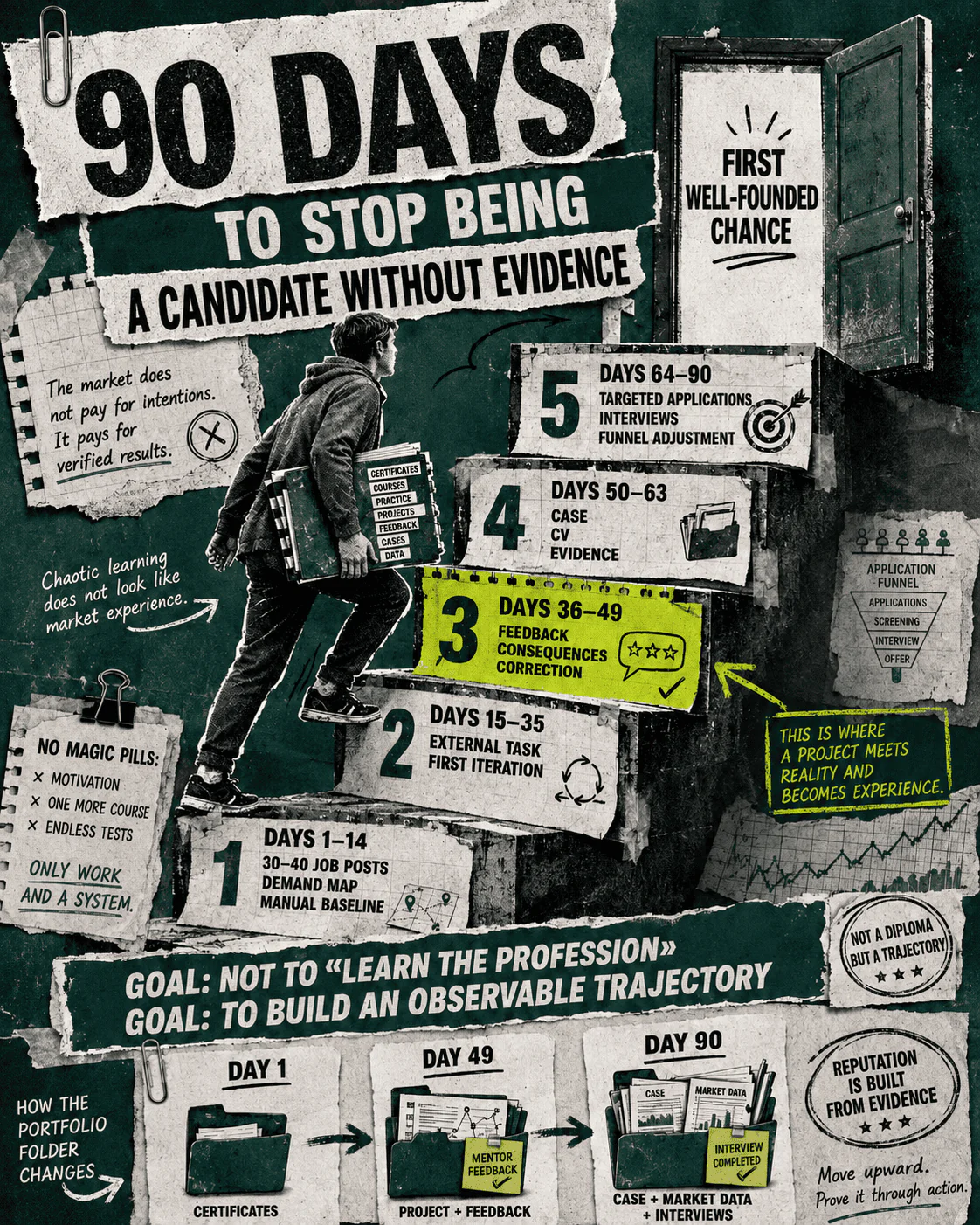
A 90-Day Plan: Create a Verifiable Trajectory Instead of “Learning a Profession”
It is impossible to become a mature professional from scratch in ninety days. It is possible to stop being a candidate with no evidence. That is a more modest and more useful goal. The three months are not intended for a content marathon or daily heroic posts. They are intended to produce four results: a map of demand, a basic foundation, one external project with a second iteration, and a manageable application system.
The plan below assumes fifteen to twenty hours per week. If only ten hours are available, the schedule will need to be extended. If the person works full-time, cares for relatives, or regularly faces infrastructure disruptions, the calendar must treat this as a constraint rather than a personal failing. A real plan differs from a motivational one because it contains an exhausted Tuesday.
From learning a role to proving that you can do the work
Ten checkpoints turn a broad career goal into a sequence of observable tasks, real evidence, and clear criteria for moving forward.
to build
evidence
01 Days 1–7 Choose one role and study demand Research
Choose one role and study demand.
A spreadsheet of 30–40 relevant vacancies, skill frequencies, and task types.
Five essential skills and three typical role outputs are understood.
02 Days 8–14 Assess the baseline Baseline
Assess the baseline.
A small task completed without AI, a list of gaps, and a learning plan.
The person can explain the fundamentals and knows exactly what they cannot yet do.
03 Days 15–21 Find an external task and reviewer Brief
Find an external task and reviewer.
An agreed brief, constraints, criterion, and right to publish the case.
There is a real task owner and a date for the first review.
04 Days 22–35 Conduct research and complete the first iteration Production
Conduct research and complete the first iteration.
Data, options, a decision, and a log of AI use and checks.
The result has been delivered to a user or client.
05 Days 36–49 Observe consequences and make corrections Reality check
Observe consequences and make corrections.
Feedback, a metric or observation, and a second version.
At least one change has been made in response to reality.
06 Days 50–56 Package the case Case study
Package the case.
Short, medium, and detailed versions with links to evidence.
An unfamiliar professional can understand the contribution in two minutes.
07 Days 57–63 Prepare the CV and profile Positioning
Prepare the CV and profile.
A one-page CV, profile, and three positioning versions for different vacancy clusters.
Every claim is supported by an example, with no invented percentages.
08 Days 64–77 Begin targeted applications Applications
Begin targeted applications.
20–30 tailored applications, direct contacts, and response tracking.
Conversion at each stage and reasons for rejection are understood.
09 Days 78–84 Rehearse interviews Interviews
Rehearse interviews.
Five decision stories, two mock interviews, and an analysis of weak areas.
The candidate can explain the project without AI and answer a chain of “why” questions.
10 Days 85–90 Adjust the strategy Adjustment
Adjust the strategy.
An updated case, CV, and list of skills and channels.
The decision is based on funnel data rather than one rejection.
Week One: Read Job Postings as Data
Most candidates browse job postings in a state of emotional pinball. This one requires three years of experience, that one mentions an unfamiliar tool, and the next looks perfect but was posted five days ago, which means life is over. An analytical mode is more useful. Collect thirty to forty vacancies within one geographic and professional cluster. Do not mix junior data analysts, product managers, and graphic designers simply because they all work on laptops.
Record the tasks, required tools, domain knowledge, experience, work format, language, company type, and signs of responsibility in a spreadsheet. Then normalise synonyms. “Stakeholder communication,” “client interaction,” and “requirements alignment” may describe the same cluster. Frequency will reveal the true minimum more accurately than the curriculum of a random course. If a skill appears in two vacancies out of forty, there is no reason to spend a month on it. If it appears in thirty and you are avoiding it, the market has already answered.
After the analysis, choose one primary profile and one adjacent one. For example, a content marketer with strong analytics, a UI/UX designer focused on research, a QA specialist with automation fundamentals, or a recruiter with HR analytics. Trying to become an analyst, developer, marketer, and product manager at the same time usually creates a candidate who has beginner-level knowledge of four professions and confidently qualifies for none of them.
Week Two: Establish a Manual Baseline
Complete a small professional task without generative assistance. This is not an exercise in asceticism. It is a diagnostic. An analyst defines a metric and writes a simple query manually. An editor constructs an argument and verifies three sources. A designer analyses a user journey and creates a low-fidelity prototype. A developer solves a limited problem and writes a test. An HR specialist analyses a short funnel and formulates questions.
Then introduce AI and compare. Where did it accelerate the work? Where did it suggest a better solution? What were you unable to verify? Which gaps were hidden by the polished answer? The result of the week should be a competency map, not a certificate. It should separately cover fundamentals, tools, domain knowledge, communication, and quality control. Study the narrow gaps connected to the selected vacancies and project.
Weeks Three to Seven: An External Project With Two Iterations
Find a task through acquaintances, a professional community, university, NGO, open-source project, current employer, or small business. The offer should be limited and clear: what you will investigate, what you will create, how much time it will take, what you need from the client, and what result can reasonably be expected. Do not promise revenue growth if you do not control sales. Promise research, an implementable component, and verification.
Before beginning, agree on access to data, feedback, and permission to publish the case. If a metric will appear later, record the date. If there will be no quantitative metric, use observable qualitative evidence: completion of a journey, acceptance of a change, the number of corrected errors, reviewer feedback, or meeting the deadline. Not everything valuable can be measured by conversion, but everything that can be proved needs to leave a trace.
Do not attempt to solve the client’s entire life during the first iteration. Limit the unit of work so that it can be implemented within two weeks. After receiving feedback, change the solution and document the difference. This is where the strongest interview material appears: “I initially thought X, the data showed Y, so I changed Z.” The employer hears that the candidate can abandon their first idea without holding a funeral.
Weeks Eight to Thirteen: Packaging and the Market
A CV should lead towards a role rather than retell a biography. Begin with the target specialisation and two or three demonstrated strengths. Describe projects using the formula “problem, action, verifiable result” rather than listing duties. Tools come after the ability to do something with them. Words such as “responsible,” “communicative,” and “quick learner” should appear only when accompanied by an example. Otherwise, they merely occupy space and produce mild professional numbness in the recruiter.
Apply in batches of eight to ten vacancies and then measure. No views or responses means the problem may lie in vacancy selection, the headline, the CV, or the channel. HR interviews without progress to the next stage suggest a problem with positioning, motivation, language, or expectations. Technical stages without an offer require a review of fundamentals, problem-solving, and explanation. Several rejections prove nothing, but twenty targeted attempts provide a signal.
Do not stop the project once applications begin. Continue making small improvements, contributing to the community, or taking on another task. Otherwise, the search becomes a job spent waiting for emails. The market can remain silent for weeks. During that time, candidates should produce new evidence rather than new reasons to refresh their inbox every seven minutes.
How to Use LinkWorkJob: Build an Entry Map Instead of Scrolling Through Vacancies
LinkWorkJob is useful to beginners not only as a place to find vacancies and apply online. The platform’s strength lies in combining job search filters with career content. Its Ukrainian version covers development, design, marketing, HR, administration, support, and customer service. Vacancies can be filtered by experience, including roles requiring no experience or around one year, as well as by work format, skills, languages, and salary in US dollars. In a market where “junior” sometimes means “already has a year of professional experience,” a separate experience filter is particularly practical.
The advantage of any job board disappears when it is used like a slot machine. Random applications create movement rather than results. LinkWorkJob should be turned into a research dashboard. First choose one role, a region or remote format, and two experience levels: no experience and around one year. Collect not only the titles but also the specific tasks, skills, format, language, and expected level of independence.
After twenty-five to thirty descriptions, the boundary between a formal junior vacancy and a genuine entry route will become visible. Roles marked “no experience required” may demand a strong portfolio and take-home assignment, while roles asking for a year of experience may differ only through familiarity with working processes. Your chosen profession may offer more office or hybrid work than fully remote opportunities. This matters in Ukraine: a candidate may spend years searching for the perfect remote job without noticing that the accessible entrance is in a local team where mentorship happens faster. Remote work is convenient, but for someone without a professional network, it can become solo sailing with instructions supplied in a PDF.
The next step is to create a gap matrix. List recurring requirements in the rows and four states in the columns: “I can do it and prove it,” “I can do it but have no evidence,” “I have superficial knowledge,” and “I cannot do it.” Prepare links and stories for the first group. Create an external result for the second. Address the third with focused learning and practice. Divide the fourth into essential and optional requirements. Do not try to learn every technology mentioned in every vacancy. Job descriptions often combine minimum requirements, preferences, and the dreams of a department that was given permission to make one hire instead of three.
Read the vacancy behind the wording
A vacancy description is not only a list of requirements. Repeated skills, vague experience rules, overloaded tool lists, and salary patterns reveal how the company understands the role.
signals
01 Market minimum A skill appears in 70–80% of selected vacancies Decode signal
A skill appears in 70–80% of selected vacancies.
It is a market minimum for the cluster.
Acquire a basic level and incorporate it into the project.
02 Differentiator A requirement is rare but connected to the desired industry Decode signal
A requirement is rare but connected to the desired industry.
It is a domain differentiator.
Create a small industry-specific case.
03 Evidence required “No experience required,” but a case and independence are expected Decode signal
“No experience required,” but a case and independence are expected.
Formal experience is optional; evidence is not.
Show a complete cycle with an external owner.
04 Apply anyway “At least one year of experience” for simple tasks Decode signal
“At least one year of experience” for simple tasks.
The company is protecting itself with standard wording.
Apply if you can perform most tasks and have a strong project.
05 Scope warning Ten unrelated tools Decode signal
Ten unrelated tools.
The role may be overloaded or the description may be copied from a template.
Clarify the actual daily work before completing a take-home assignment.
06 Compensation signal Salary is listed in dollars and is far below comparable roles Decode signal
Salary is listed in dollars and is far below comparable roles.
The company views the role as production rather than decision-making.
Assess the scope, mentorship, and prospects rather than accepting automatically.
07 Demand or turnover Many vacancies of the same type Decode signal
Many vacancies of the same type.
There is active demand or high turnover.
Compare companies, posting dates, and repetition of advertisements.
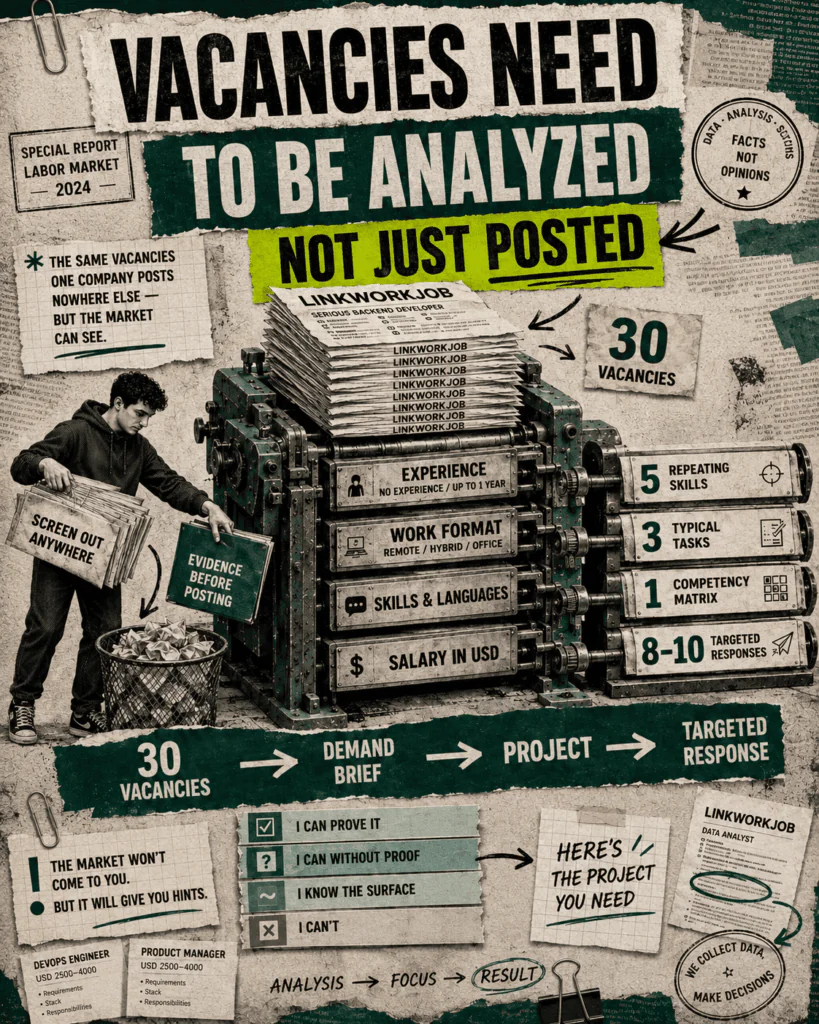
Career materials and stories on LinkWorkJob can be used as a layer of context, but decisions should be checked against current vacancies. Advice in an article becomes outdated more slowly than a particular technology stack, while an open role shows what a company is willing to pay for today. Combining these two layers is one of the platform’s advantages: a person can understand a trend and immediately test it against the market rather than moving from abstract inspiration to a job search a week later.
Once the market map is ready, establish a rhythm. Review new suitable positions twice a week instead of scanning the entire feed every hour. For every strong vacancy, prepare a short message connecting one employer task with one piece of evidence from your project. If the role requires customer-data analysis, do not say that you “love numbers.” Link to the case where you found a metric error and changed a budget decision. If the role requires content, show work with a similar audience and measurement rather than unrelated texts.
Filters for format, experience, skills, languages, and salary save time, but they should not become concrete walls. Applying to a role asking for one year of experience is reasonable when you understand the tasks, meet most essential requirements, and have an external case. Applying for a senior role with one weekend project is not bravery. It is poor calibration. A normal working range for a junior is to meet approximately 60–80 percent of the substantive requirements and explain how the critical gaps will be addressed.
LinkWorkJob also benefits Ukrainian and neighbouring audiences through clear localisation. Its interface, categories, and filters do not require candidates to translate their own market through unfamiliar terminology. Remote and office formats appear together, and salaries can be compared in dollars. The platform does not remove the need to use other channels, referrals, and direct contact. No website is required to deliver an offer to your door. Its value lies elsewhere: reducing noise, making demand observable, and providing a place for targeted action.
How to Navigate Hiring When AI Has Made Perfect CVs Cheap
Generative tools have improved the average quality of candidate packaging. A CV is easier to tailor, a cover letter is easier to write, and interview answers are easier to rehearse. Smoothness is therefore no longer a strong signal. When every second document is “results-oriented,” “successfully collaborates with cross-functional teams,” and “uses a data-driven approach,” recruiters begin looking for details that are difficult to produce without a real history.
The primary purpose of a CV is not to make a candidate look mature. It should quickly demonstrate alignment with a particular role. The headline states the specialisation, the short profile identifies a strong combination, projects show completed cycles, and skills are supported by those projects. If a tool appears in a separate list but nowhere in the work, it resembles a purchased book sitting on a shelf: perhaps it will be read one day.
Experience from another profession should not be discarded. This is particularly important in Ukraine, where many entry-level IT professionals are career changers. According to DOU data cited in its article on junior hiring in 2026, 59 percent of beginners came from other professions. A former teacher knows how to explain and structure learning. A support specialist understands customers and escalation. An accountant understands controls and consequences. A sales manager knows objections and CRMs. A volunteer coordinator can manage ambiguity. These skills do not replace the new hard skill, but they reduce the employer’s risk.
Translate previous experience into the language of the new role without inventing anything. “Worked with people” is almost useless. “Analysed the causes of 200 repeat enquiries, updated five knowledge-base articles, and reduced escalations” connects directly with analytics, content, and operations. “Organised events” is too broad. “Coordinated five contractors, managed a $3,000 budget, rebuilt the plan within a week after the venue changed, and conducted a retrospective” demonstrates project management. The previous job title may be irrelevant, but the cycle of responsibility remains valuable.
Cover Letter: Three Connections Instead of a Short Autobiography
A strong message connects the vacancy’s task, your evidence, and your motivation for that particular context. A message for a junior analyst might read: “The role requires data-quality checks and marketing insights. In a project for a small service, I identified duplicate registrations, recalculated the cost per active user, and helped cancel a premature budget increase. I have attached the case with the queries, assumptions, and verification process. I am interested in this position because your analysts work with the full campaign cycle rather than producing reports alone.”
There is no story about a childhood love of spreadsheets or admiration for the dynamic company. There is a reason to continue the conversation. AI can help shorten the letter, check the language, and adapt the wording. But if the model invents experience or motivation, the candidate is taking out a trust loan at a very high interest rate. Repayment begins at the first interview.
Interview: Show Your Thinking Before, During, and After the Answer
Interviews increasingly assess the process rather than the final result. This is logical: a result can be generated easily, while a chain of clarification and decisions is harder to maintain without understanding. Do not rush to answer a case question. First clarify the objective, user, available data, constraints, and cost of error. Then state your assumptions, suggest two approaches, select one, and explain how it would be tested.
If the question concerns an unfamiliar technology, do not conceal the gap behind verbal smoke. Say exactly what you know, what you do not know, and how you would verify it. Honesty does not guarantee an offer, but confident invention is very effective at guaranteeing rejection from a strong team. DOU identifies improper use of AI as a notable red flag: candidates submit fully generated take-home assignments but do not understand the solution. A system may survive a weak beginner. An unverifiable beginner who conceals weakness creates a more expensive problem.
Prepare five stories, each demonstrating a different quality: clarifying a difficult task, making and correcting an error, resolving conflicting constraints, responding to feedback, and using AI with verification. Do not memorise the text word for word. A rehearsed story breaks when the question changes and sounds as though someone has activated a corporate autoresponder inside the candidate. Remember the facts, sequence, and conclusion.
What the employer hears behind your answer
Select an interview stage to see what is actually being assessed, which junior behaviour builds trust, and which response creates risk.
checkpoints
Project discussion
Reality of the experience and personal contribution.
Specific context, boundaries of the role, an error, and verification.
Collective “we,” perfect success, and no source data.
Can the candidate separate personal decisions from the work of the wider team?
Case
Structure of thinking.
Clarifying questions, criteria, alternatives, and priorities.
An instant answer without asking about the objective.
Does the candidate define the problem before trying to solve it?
Technical question
Fundamentals and management of uncertainty.
Explanation of the basics, an honest gap, and a verification plan.
A confident mixture of terminology.
Can the candidate distinguish what they know from what they would need to verify?
AI question
Control of the tool.
Separation of tasks, independent checks, and an error log.
“AI always produces a good result if the prompt is correct.”
Can the candidate detect a plausible AI result that is still wrong?
Feedback
Ability to learn.
Clarifying the comment and changing the approach.
Defending every decision like a family heirloom.
Does the candidate treat feedback as new information or as a personal attack?
Candidate’s questions
Understanding of the working environment.
Interest in tasks, reviews, mentorship, and success criteria.
Asking only about holidays, compensation, and the promotion date before understanding the role.
Is the candidate trying to understand how work is done before evaluating the benefits around it?
A take-home assignment should be completed like a miniature case. Record assumptions, limit the time spent, list the sources and tools used, and describe the checks performed. If AI is permitted, state where it was used. If the policy is unclear, ask before beginning. Secret use of the tool is not clever efficiency when the company is explicitly testing independent command of the fundamentals.
After a rejection, request one specific signal: which piece of evidence or skill was missing for progression to the next stage. The company may not reply and is not obliged to provide free consultation. Even five substantive responses, however, are more useful than fifty guesses. Classify the reasons: role mismatch, fundamentals, communication, case quality, language, location, compensation, or a stronger candidate. Adjust only in response to a recurring signal. One rejection is not market research, even if it feels emotionally like an international conference.
Unpaid Practice, Take-Home Assignments, and Internships: Where Experience Ends and Exploitation Begins
When a junior needs an external project, the market quickly offers an unlimited number of “opportunities to prove yourself.” Some are genuinely useful. Others are ordinary jobs from which the payment has been carefully removed and the word “experience” added. A lack of formal employment does not eliminate the candidate’s right to evaluate the arrangement.
A reasonable take-home assignment is limited in time, connected with the role’s actual responsibilities, and either does not create ready-made commercial value or is paid if it does. The company explains the criteria, decision timeline, and AI policy. The candidate can ask questions, and the result is not placed into production without consent. The more the scope resembles a real client order, the stronger the case for requesting payment.
A dangerous assignment requires a full audit of the current product, a month-long campaign, a production-ready module, a lead database, or the design of an entire service. The company then requests the source files and disappears into professionally organised silence. Even when this is not deliberate theft, the process reveals the quality of management. Work there is unlikely to become clear and respectful immediately after the offer.
A skill assessment should not become unpaid client work
Open each case file to compare a reasonable hiring task with the signs that a company may be collecting production-ready work for free.
Limited, transparent, demonstrational, and directly connected with the role.
Production-ready output, unclear boundaries, unlimited revisions, or ownership transfer.
01 Assignment sign Scope Is the task limited or production-sized? Open file
Two to four hours or a limited component.
Fair testSeveral days of full production work.
Free workHow many hours should this take, and which part is intentionally outside the assignment scope?
02 Assignment sign Context Is enough information provided to assess the skill? Open file
Enough data is provided to assess the skill.
Fair testA deep audit of an active business is required.
Free workWhich information is necessary to evaluate the skill, and which business problems are outside the task?
03 Assignment sign Result Is the output demonstrational or ready to use? Open file
Demonstrational, anonymised, or incomplete.
Fair testReady for publication, sale, or implementation.
Free workWill the result remain demonstrational, or may the company use it in a live product or campaign?
04 Assignment sign Criteria Is success defined before the work begins? Open file
Provided in advance and connected with the role.
Fair test“Surprise us,” followed by endless revisions.
Free workWhat will be assessed, and how many revision rounds are included?
05 Assignment sign AI policy Are the tool rules clear before submission? Open file
Clearly permitted, restricted, or prohibited.
Fair testRules are revealed after submission.
Free workWhich tools are allowed, and how should AI use be documented?
06 Assignment sign Feedback Is there a deadline and a defined next step? Open file
A decision deadline and at least a short response.
Fair testThe company does not state the next step.
Free workWhen will a decision be made, and will every submission receive a response?
07 Assignment sign Rights Is ownership and permitted use clearly defined? Open file
It is clear who may use the work and how.
Fair testSource files and full ownership are demanded without payment.
Free workWho owns the files, and may the company reuse the work before hiring the candidate?
08 Assignment sign Scale Is the task reserved for shortlisted candidates? Open file
One stage following initial screening.
Fair testEvery applicant receives a separate real business task.
Free workAt what hiring stage is the assignment given, and how many candidates receive a separate task?
Volunteer projects also require boundaries. Unpaid does not mean available around the clock. Define the scope, number of iterations, communication channel, deadline, and right to end the work. If the organisation constantly changes the task, withholds data, and never implements the result, the experience soon stops growing. Only the skill of enduring chaos remains. Unfortunately, that skill is also in demand, but rarely well paid.
An internship should have educational value, a clear duration, and a realistic prospect. Ask who the mentor is, how much time they dedicate, what tasks interns perform, and which criteria determine the final decision. If a company recruits dozens of unpaid interns every two months but hires almost none of them, its business model may consist of endlessly producing hope. Hope is a highly renewable resource, especially when the suppliers are not paid.
Safety matters more than a portfolio. Do not send personal data to public AI services without permission and appropriate safeguards. Do not publish client databases, internal analytics, contracts, code, or confidential screens. Do not offer medical, legal, or financial conclusions without the necessary qualifications and supervision. Juniors may research a process, prepare a draft, and work with anonymised materials, but good intentions do not reduce the cost of mistakes in regulated fields.
When a project is paid, record the amount in dollars, scope, stages, number of revisions, and acceptance procedure. A clear written agreement is enough for a small contract. An advance payment or milestone structure reduces the risk. Any request to pay for “access to the job,” purchase a mandatory tool package from the employer, or transfer money for administration should end the conversation. Your first salary should not begin with a payment to the employer, however creatively the administrative fee has been named.
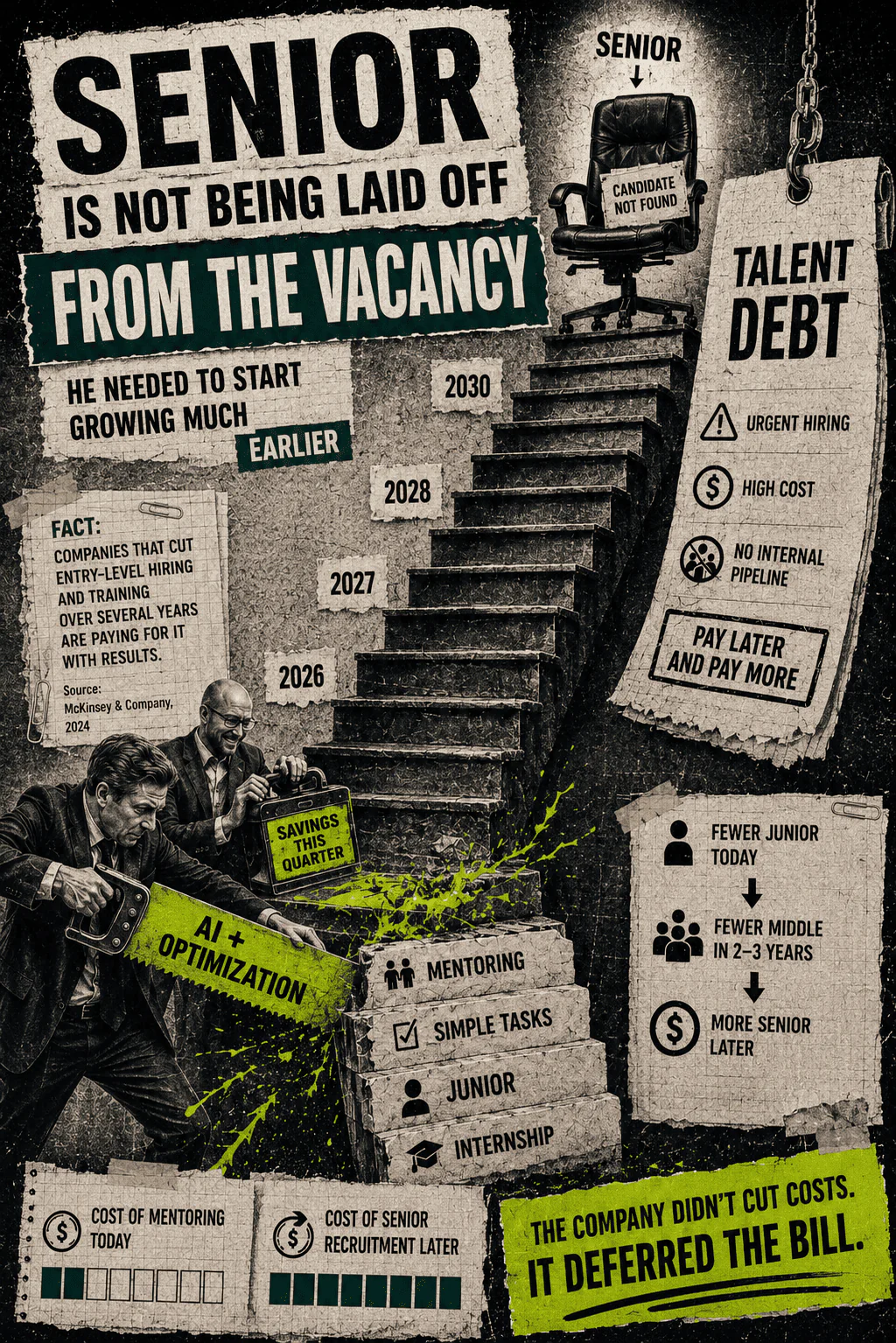
What Employers Must Change If They Want Seniors Five Years From Now
All responsibility can be placed on candidates: they can find their own client, mentor, project, data, feedback, and some way to reproduce a corporate environment. This is useful to an individual as a survival strategy. As a system, it is absurd. Seniors emerge from repeated work in a complex environment, access to decisions, and high-quality feedback. No personal project can fully replace years of that density.
A company that automates the entire entry-level layer and stops hiring beginners improves present efficiency at the expense of its future talent pool. Several years later, it will try to buy senior specialists on the external market. If many companies follow the same approach, that external market will also empty while costs rise. This is the classic tragedy of the commons: every employer assumes that the company next door will develop the professionals. The company next door is implementing the same strategy and preparing an identical presentation about the talent shortage.
In their research on the future of entry-level work, PwC and the WEF identify four areas of organisational responsibility: access to a first role, task design, the talent pipeline, and the connection between education and real skills. This is not social charity. Entry-level employees provide a channel for knowledge renewal, diversity of experience, and future leadership. But the investment works only when it is designed consciously rather than performed through the ritual hiring of two interns for a corporate blog photograph.
The first measure is to preserve tasks that provide feedback. Juniors do not need to produce manually everything AI can already handle. They need to frame the task for the model, review the result, compare it with a manual sample, identify an error, and correct it. The senior controls high-risk points rather than every comma. AI then becomes part of the learning loop.
The second measure is to divide responsibility rather than production alone. Instead of “write twenty descriptions,” a junior receives a small segment: understand the audience’s questions, create options, verify facts, obtain approval, publish, and analyse the response. Instead of “write a function,” they receive a limited issue with a test, review, and post-release observation. The scale remains safe, but the cycle becomes complete.
The third measure concerns mentorship as paid work. If reviews and teaching are not included in a senior employee’s workload, they will happen in the evening, badly, or never. Mentors need allocated hours, criteria, and recognition for the result. Otherwise, the company says that it develops people while evaluating mentors only by their individual output. Such a system quickly teaches seniors not to teach.
The fourth measure is to create different routes into the organisation. A graduate, career changer, internal candidate, and person returning after a break have different strengths. The internal candidate understands the domain, the career changer brings workplace maturity, the graduate may have current fundamentals, and the community participant brings verifiable projects. One CV template and a rigid “one year of professional experience” filter remove some strong candidates before any meaningful assessment occurs.
Flip the model, not just the task
Select any card to replace a weak junior-work practice with a practical operating model and see what the business gains from the change.
Click a card to reveal the alternative operating model.
The fifth measure requires metrics. A company should track not only task-completion speed but also time to independence, quality after review, repeated errors, internal transfers, retention, and the proportion of former juniors among mid-level employees. If AI accelerated current output by 20 percent but no one can own the system two years later, productivity was measured too early.
Employers must also distinguish automation from augmentation. Stanford research shows that the negative signal for young people is stronger in professions where AI replaces operations and weaker where it complements the person. This is not a moral order to preserve meaningless work. It is a reason to design roles in which beginners manage the tool and gain access to context instead of merely competing with it on speed.
What Universities and Courses Must Do: Stop Selling Artefacts as Experience
An educational programme built around reproducing a standard output loses value fastest. If the exam consists of writing a conventional text, creating a landing page, assembling a dashboard, or implementing a familiar application, AI can complete the assignment’s form. The tool can be prohibited, but that tests the student’s ability to obey a prohibition rather than their readiness for a modern working environment.
Education must assess framing, sources, assumptions, iteration, and defence of the decision. Students should receive messy data, a contradictory client, a limited deadline, team dependencies, and a mandatory review. Part of the work should be completed manually to build the foundation, and part with AI to understand modern productivity. The final defence should include a change in conditions: a new risk, another user, or an error in the data. If the person understands the solution, they will adapt. If they memorised the demonstration, the presentation will begin to sink slowly.
Partnerships with companies, NGOs, public institutions, and open-source communities matter more than another collection of recorded lectures. A real client creates consequences, but the educational organisation must protect students from becoming a source of free mass production. Projects should be limited, mentors prepared, rights to the result clear, and feedback quality measurable.
A certificate remains a weak signal when it is awarded for watching content and completing a quiz. It becomes stronger when supported by verifiable work: a public pull request, research with a methodology, an implemented change, a review from an external expert, and another iteration. A course does not have to promise employment. It must honestly show which part of the gap between education and the working environment it closes and which part the student will still need to bridge independently.
Questions Juniors Ask Most Often
Can I Find My First Job Without Experience in 2026?
Yes, but “without experience” is a misleading phrase. The real market sometimes hires candidates without formal professional experience, but almost always requires proof that they are ready to perform at least one limited work task. An educational project, open-source contribution, internship, internal project, volunteer assignment, or microcontract can provide that proof. A complete absence of practice, external review, and explainable decisions leaves the employer with nothing except faith in potential, and faith performs poorly in budget approvals.
Should I Apply If the Vacancy Requires One Year of Professional Experience?
Yes, if the tasks match your level, you meet most essential requirements, and you have a strong external case. The cover message should not pretend that a project literally satisfies the requirement. State directly that you do not have a formal year but have completed a similar cycle, and provide evidence. If the role requires independent responsibility for a critical system, one project will not bridge the gap. Calibration matters more than indiscriminate confidence.
How Many Personal Projects Does a Junior Portfolio Need?
One or two detailed cases are usually more valuable than six superficial ones. The first should demonstrate the main skill and a complete cycle; the second can show an adjacent context or teamwork. Quantity matters only after quality. If every project ends when the output is generated and never meets a user, six zeros still equal zero, even if the portfolio page becomes longer.
Do I Need to Tell the Employer That I Used AI?
You need to follow the company’s policy and disclose substantial use in a take-home assignment or project. The important thing is not to name the model but to explain the boundaries: which data was shared, what was delegated, how the output was checked, and who was responsible. Hiding AI is pointless if you cannot reproduce the logic. There is also no need to performatively list a hundred prompts. The employer is assessing whether the result remains under control.
How Can I Tell Whether AI Is Interfering With My Learning?
Check whether you can frame the task, construct a small solution, identify the risks, and explain the final choice without the chat. If removing the tool eliminates understanding rather than speed, the delegation happened too early. Return to a manual example, study the foundation, and then reintroduce AI for repetitive components. The goal is not independence from technology but independence of judgement.
What Matters More for a Junior: Fundamentals or Knowledge of AI Tools?
Fundamentals determine whether you can verify the tool. AI literacy determines how productively you can work in a modern team. The opposition is false. Employers gain nothing from someone who knows the theory but ignores the acceleration, just as they gain nothing from a model operator who cannot detect an error. When time is limited, first build the minimum foundation for the chosen role and then augment it systematically with AI.
Where Should I Look for a First Job or Internship in Ukraine?
Use several channels: specialised platforms, company websites, professional communities, referrals, university programmes, and direct contact after substantive research. LinkWorkJob allows vacancies to be filtered by experience, skills, work format, and salary in dollars, while also making it possible to compare professional directions. The key is not the number of open tabs but the quality of the selected cluster and the connection between each application and its evidence.
Should I Accept Low Pay in Exchange for My First Experience?
Sometimes lower starting compensation is rational when the job offers strong mentorship, real processes, safe responsibility, and a clear salary review after several months. Low pay without learning, with unlimited scope and a “do everything” role, is not an investment in a career. Compare not only the amount but also the speed at which transferable experience will accumulate. Agree on review conditions before starting because corporate memory is particularly weak where future pay rises are concerned.
Conclusion: The New Junior Must Bring Evidence of Accountability, Not Merely a Willingness to Work
AI is not eliminating professions in a single blow. It makes the first draft, standard processing, and repetitive operations cheaper. Along with them, part of the paid practice through which people once learned is disappearing. That is the real problem: not a machine uprising, but the dismantling of the informal school that used to exist inside work.
The market responds by making entry-level vacancies more mature. Juniors are expected to have not only command of the tool but also framing, verification, communication, domain context, and a small degree of responsibility. Some of these requirements are reasonable. Others are attempts to buy a mid-level professional at an entry-level price. Candidates need to distinguish between the two rather than treating every vacancy as sacred scripture.
Experience should now be counted neither in months nor in files. Its smallest unit consists of real context, a constraint, a personal choice, an action, external verification, consequences, and correction. AI can accelerate almost every element except living through the consequences. A strong junior therefore uses the model but can show where it was wrong, what they checked independently, and why the final decision belongs to them.
This experience will need to be acquired across several environments: an internship, internal mobility, an NGO, a small business, open source, open data, a hackathon, freelancing, or an educational project with external review. A personal project is useful when users and uncomfortable facts are allowed into it. Without them, it is a tidy model of professional life: suitable for practice but weak as evidence.
Job searching is also becoming an analytical task. On LinkWorkJob and other platforms, candidates should not submit endless applications. They should map demand, identify recurring requirements, build a gap matrix, choose projects that reflect the market, and measure their own funnel. A good CV connects every promise with an example. A good interview shows the decision process. A good take-home assignment records assumptions and demonstrates control over AI. All of this is harder than sending one hundred identical applications. That is precisely why it works better.
The conclusion for companies is even less comfortable. If they eliminate entry-level roles today, they will eventually have to buy experience that no one developed. Seniors are not a natural resource with infinite deposits. They emerge from many small decisions, good reviews, and gradually expanding responsibility. An organisation that automates routine work without redesigning learning does not become genuinely efficient. It takes on talent debt; the accounting system simply does not show the interest yet.
For juniors, the conclusion is simple and not especially gentle. The market no longer pays merely for the opportunity to learn through simple production work. You will have to build a significant part of the entrance bridge yourself. You do not need to pretend to be an expert, buy another pile of certificates, or compete with AI on generation speed. You need to find one small real problem, make a limited decision, test it against people and data, live through a mistake, correct the result, and preserve the evidence.
This does not guarantee a job offer within ninety days. No honest strategy can provide such a guarantee. It does something else: it transforms a candidate from an unknown risk into a person with an observable trajectory. In a world where an attractive result can be generated within minutes, an observable ability to think, verify, and take responsibility becomes a rare commodity.
The career ladder now begins higher. Stop standing underneath it with a certificate in your hand. Build your first rung somewhere reality has the power to tell you that you were wrong. Only then does it occasionally tell you that you have become a professional.
