




How a Copywriter Can Show They Write for Business, Not Just “Know How to Write”
A copywriter can no longer impress an employer with a folder full of pretty articles, social media posts, and landing pages alone.
In 2026, businesses care about something else: does the writer understand why the text exists, who it is written for, what problem it solves, and how it connects to money, leads, trust, sales, traffic, or at least a clear human explanation of the product?
Because businesses rarely wake up in the morning thinking:
“I want some text. Just text. Any text will do.”
Usually, a business needs content to:
- bring people to a website;
- explain a complex product in simple language;
- improve landing page conversion;
- warm up an audience before a purchase;
- support the sales team;
- strengthen trust in the brand;
- help users understand where to click and why they should care in the first place.
That is where a copywriter stops being “a person who writes nicely” and becomes a specialist who helps a business talk to customers in a way that actually works.
Why Beautiful Writing Is Not Enough for Employers
Beautiful writing is nice.
Clear writing is good.
Writing without corporate buzzwords is a small miracle.
But for an employer, that is not enough.
A company does not hire a copywriter because it wants to expand its collection of elegant metaphors. It needs someone who can work with real business tasks:
- explain a product;
- attract an audience;
- prepare users for a purchase;
- support marketing;
- help sales;
- improve communication;
- make a website clearer;
- turn chaotic expert thoughts into readable content.
A business does not look at text as a work of art. It sees text as a tool.
That does not mean style, voice, and language do not matter. They do. But they should serve the task.
You can write a beautiful article that nobody finishes.
You can create a witty landing page after which the user still has no idea what is being offered.
You can come up with an impressive slogan that the internal team loves, but the customer does not understand.
And the opposite is also true: you can write calm, simple, clear copy that:
- brings in leads;
- reduces repetitive support questions;
- helps sales managers sell;
- improves product understanding;
- keeps the user’s attention;
- works in search for months.
That kind of text is much closer to what a business needs.
Especially if it does not include phrases like “the brand unlocks the wings of synergy in the era of digital transformation.”
Especially then.
What Employers Want to Understand
When an employer looks at a copywriter’s portfolio, they are usually looking for answers to several questions:
- What kinds of tasks has this person written for?
- Do they understand the audience?
- Can they work with different formats?
- Can they explain their decisions?
- Do they see the connection between text and business results?
- Can they work with marketing, product, SEO, and analytics?
- Will everything need to be explained to them from scratch?
The bad news: if your portfolio is just a list of links, the employer has to guess what was difficult, important, and useful about each piece.
The good news: this is easy to fix.
What It Means to “Write for Business”
Writing for business does not mean writing dry, boring copy that sounds like an office chair supply contract.
It means writing with a clear understanding of the goal.
A business-focused copywriter does not think only about words. They think about the situation:
- who will read the text;
- where the person came from;
- what they already know;
- what they are afraid of;
- what they do not understand;
- what should happen after they read it;
- what next step the business needs;
- what tone fits the brand;
- where the text will be published;
- how success will be measured.
Text Solves a Task, Not Just Fills a Page
Weak approach
“I need to write a 5,000-character text.”
Strong approach
“I need to explain the benefits of the service to small business owners, reduce their fear of complicated setup, and lead them toward booking a demo.”
The difference is huge.
In the first case, the copywriter is thinking in terms of volume.
In the second, they are thinking in terms of the task.
A business does not need text for the sake of text. It needs text that does something.
For example:
- an SEO article attracts organic traffic;
- a landing page helps turn visitors into leads;
- an email campaign brings users back to the product;
- a social media post warms up the audience;
- a case study builds trust and proves experience;
- an FAQ reduces pressure on support;
- an instruction helps the customer understand the product faster;
- product copy reduces confusion inside the interface.
Text can be short. It can be long. It can be funny, calm, expert, sales-driven, educational, or explanatory.
The main thing is that it should match the task.
A Copywriter Understands the Product, Audience, and Channel
The same message cannot be written the same way for every platform.
What works on a landing page may fail in an email.
What looks good in a blog may not work in an ad.
What is appropriate in B2C may sound strange in B2B.
A copywriter who writes for business considers:
- product — what is being sold, what makes it different, where it is complicated;
- audience — who is reading, what matters to them, what doubts they have;
- channel — website, blog, email, social media, ads, presentation;
- funnel stage — is the person just discovering the product, comparing options, choosing, or ready to buy;
- brand tone of voice — whether humor is appropriate, how formal the language should be, which words do not fit;
- text goal — click, lead, trust, explanation, retention, sale.
A strong copywriter does not start with:
“I’ll make it sound nice.”
They start with questions.
For example:
- Who is this text for?
- What should the person understand?
- What do they already know?
- What is stopping them?
- What next step do we need?
- Where will the text be published?
- How will we know that the text worked?
Sometimes these questions are exactly what separates a strong candidate from someone who is simply waiting for a brief and hoping everything has already been figured out.
Good Text Can Be Connected to a Result
Not every piece of text leads directly to a sale. That is normal.
A blog article may work for traffic and trust.
A social media post may work for engagement.
An email may work for clicks.
An FAQ may reduce repetitive questions.
A landing page may generate leads.
A presentation may support sales.
The important thing is not to promise the impossible, but to honestly show the connection:
- the text was part of an ad campaign;
- the article was written around search demand;
- the landing page was updated to improve conversion;
- the email led users to a target page;
- the case study was used by the sales team;
- the instruction reduced repetitive questions;
- the content helped explain a new product.
A copywriter does not need to take credit for the entire business result.
But they do need to show what contribution the text made.
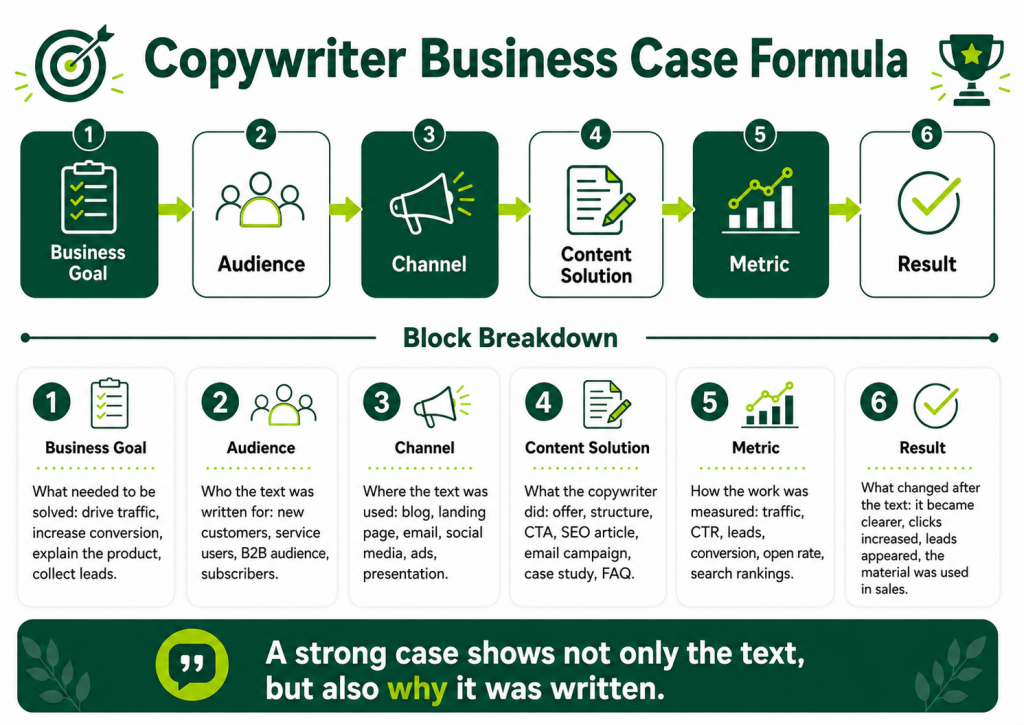
Which Business Tasks a Copywriter Can Solve
Many copywriters underestimate their experience because they describe it too narrowly:
- wrote articles;
- created posts;
- prepared email newsletters;
- wrote website copy;
- edited materials.
Technically, all of this may be true.
But it sounds as if the person simply moved words from their head into a document.
It is much stronger to show which business task each format solved.
Attracting Traffic
If you wrote SEO articles, service pages, category descriptions, blog materials, or expert publications, you may have helped a business bring people in from search.
Here it is important to show that you worked not just with text, but with search intent.
Weak wording
Wrote blog articles.
Strong wording
Prepared SEO articles for the company blog: built structures around search intent, adapted expert materials, and helped attract organic traffic on topics related to the product.
What to show in the portfolio
- article topic;
- target keyword or query;
- content structure;
- your role in preparation;
- published piece;
- search positions, if available;
- organic traffic, if available;
- growth in visits;
- comment from an editor or marketer;
- the fact that the article was reused in email campaigns or sales materials.
Warming Up the Audience
Not every user is ready to buy immediately.
Sometimes a person needs to:
- understand the problem;
- compare options;
- see examples;
- learn more about the product;
- get used to the brand;
- feel trust.
This is where articles, email campaigns, posts, case studies, guides, lead magnets, and expert materials work well.
Weak wording
Wrote email newsletters.
Strong wording
Created email campaigns to warm up the audience: worked on subject lines, offer structure, message segmentation, and transitions to target pages.
What matters here
- which segment the email was written for;
- what the goal of the email was;
- what next step was offered;
- which topics were tested;
- whether open rate and click rate were available;
- what changed after the email campaign;
- how the email fit into the overall communication flow.
Improving Conversion
Landing pages, lead capture pages, forms, CTA buttons, benefit blocks, and ad copy are all connected to conversion.
Here, businesses do not need copy that simply “sounds good.”
They need users to understand:
- what is being offered;
- why it is useful;
- how the company is different;
- why it can be trusted;
- what to do next.
Weak wording
Wrote landing page copy.
Strong wording
Developed landing page copy for ad campaigns: formulated offers, described product benefits, worked through trust blocks and CTAs to improve conversion.
What to show
- first screen before and after;
- changes to the offer;
- landing page structure;
- objection-handling blocks;
- CTA examples;
- A/B test results, if available;
- conversion before and after;
- comment from the marketing team.
Simplifying a Complex Product
Some products are hard to explain.
Especially in B2B, IT, fintech, education, HR tech, SaaS, analytics, automation, and other areas where a user can open a website and think:
“I am an adult person, but what is happening here?”
A copywriter helps translate complexity into human language.
This may include:
- homepage copy;
- product descriptions;
- knowledge base articles;
- FAQ sections;
- instructions;
- onboarding copy;
- presentations;
- commercial proposals;
- blog articles;
- sales scripts.
Strong wording
Rewrote copy for a complex B2B product: simplified feature descriptions, added use cases, and formulated benefits for different audience segments.
What can be shown here
Not only numbers, but also the quality of the solution:
- it was complex — it became clear;
- there were too many terms — use cases appeared;
- there were features — benefits appeared;
- there was chaos — structure appeared;
- sales managers started using wording from the text;
- support received ready-made explanations for customers.
Supporting Sales
A copywriter can be useful not only to marketing, but also to sales.
For example, they may prepare:
- commercial proposals;
- case studies;
- presentations;
- scripts;
- emails for sales managers;
- benefit pages;
- objection-handling materials;
- client FAQs;
- pricing descriptions;
- lead magnet copy.
Weak wording
Created texts for the sales department.
Strong wording
Prepared materials for the sales team: case studies, commercial copy, and objection-handling blocks that managers used in communication with potential clients.
This looks especially strong in a portfolio because it shows that your texts were not sitting in some beautiful folder.
Real people used them.
At work.
With clients.
No ceremonial document-opening moment, no fanfare — just real usefulness.
Strengthening the Brand
Not all content can be measured in leads on the same day.
Brand communication works over a longer period.
A copywriter can help a company:
- sound recognizable;
- speak to the audience in one tone of voice;
- explain values;
- strengthen expertise;
- make communication consistent;
- stand out from competitors;
- build trust.
Strong wording
Adapted the brand tone of voice for different channels: website, email campaigns, and social media. Helped make communication consistent and clear for the audience.
What to show
- examples of copy across different channels;
- tone of voice rules;
- before/after editing examples;
- fragments of a brand voice guide;
- examples of adapting one message for different platforms;
- team feedback.
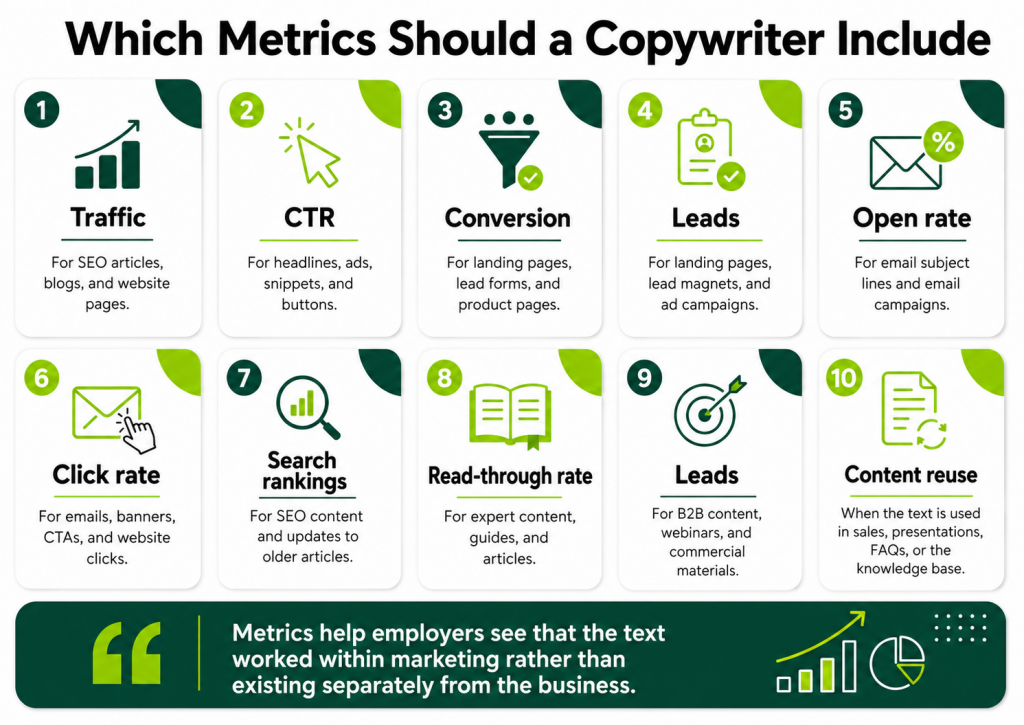
Which Metrics Copywriters Should Show
Copywriter metrics are not an attempt to prove that one text saved the entire business, increased sales, brought investors back, and reconciled marketing with sales.
Metrics are needed to show one thing:
you understand how text can be connected to results.
Organic Traffic
This is relevant for:
- SEO articles;
- blogs;
- service pages;
- category pages;
- expert content;
- informational materials.
What to mention
- growth in search traffic;
- number of views;
- share of organic traffic;
- dynamics after publication;
- topics that started bringing in users;
- the article’s contribution to overall blog traffic.
Example wording
Prepared a series of SEO articles for the blog. The materials were structured around search intent and published as part of a content plan aimed at growing organic traffic.
If you have numbers
One of the articles reached top positions for several target queries four months after publication and began bringing regular organic traffic to the website.
CTR
CTR matters wherever a person sees short copy and decides whether to click.
This applies to:
- ads;
- email subject lines;
- push notifications;
- snippets;
- banners;
- headlines;
- CTAs.
What to show
- which versions were tested;
- which headline performed better;
- how button copy changed;
- which hypotheses were tested;
- what CTR was before and after.
Example
Rewrote headlines and descriptions for ads, testing different angles: price, benefit, launch speed, and ease of use.
Conversion
Conversion is one of the clearest business metrics for landing pages, forms, product pages, and key user screens.
It applies to:
- landing pages;
- service pages;
- lead forms;
- product pages;
- registration pages;
- CTA blocks;
- ad landing pages.
What to show
- conversion change after copy updates;
- A/B test result;
- number of leads;
- growth in clicks to the form;
- lower bounce rate;
- better completion of the user journey.
Example
Rewrote the first screen of a landing page, the benefits block, and CTA copy. The new version was used in an ad campaign to test a clearer offer hypothesis.
Leads and Applications
If the copy is connected to lead generation, it is worth showing.
This applies to:
- landing pages;
- lead magnets;
- webinar pages;
- registration forms;
- B2B case studies;
- commercial pages;
- email sequences.
Example
Prepared copy for a lead magnet and landing page: described the value of the material, worked through CTAs, and added trust blocks to support lead collection.
If you do not have exact data
The material was used in a lead generation campaign and passed to the sales team as part of audience nurturing.
Open Rate and Click Rate
These metrics are important for email marketing.
Open rate shows how many people opened the email.
Click rate shows how many clicked a link.
What a copywriter may work on
- subject lines;
- preheaders;
- email structure;
- offer clarity;
- CTA strength;
- segment adaptation;
- testing different openings.
Example
Wrote email sequences to warm up users: prepared subject lines, message structures, CTA copy, and transitions to target pages.
Time on Page and Read Depth
These metrics are useful for articles, guides, expert materials, and media content.
They do not always show quality directly, but they help understand whether the material holds attention.
What to show
- average time on page;
- scroll depth;
- read-through rate;
- saves;
- shares;
- comments;
- return visits to the material.
Example
Prepared expert articles for the blog: turned expert interviews into structured materials with subheadings, examples, and practical blocks.
Search Positions
If you worked with SEO content, search positions matter.
What to mention
- target queries;
- ranking growth;
- reaching top positions;
- structure improvement;
- updating old materials;
- optimizing headings and meta descriptions;
- working with search intent.
Example
Updated old blog articles: changed the structure, added missing sections, clarified headings, and adapted materials to current search demand.
Content Reuse
This is an underestimated but very strong metric.
If your text was later used in sales, presentations, email campaigns, training, a knowledge base, or social media, that is a sign that it was useful.
Example
After the product page was updated, the sales team started using wording from the landing page in commercial proposals and client emails.
This may not look like “+47% to something important,” but for an employer it sounds convincing.
The text became a working tool.
How to Build a Copywriting Portfolio for Business
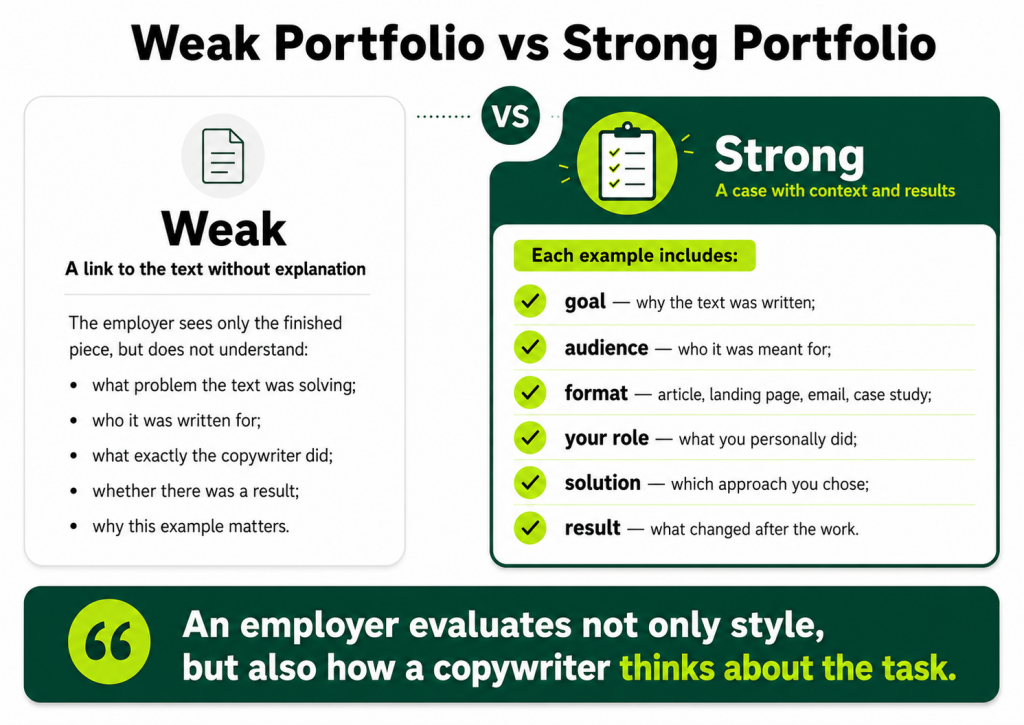
A business-focused copywriting portfolio is not just a warehouse of links.
A list of links without explanations makes the employer play a guessing game:
- What is this project?
- What was the task?
- What exactly did the candidate do?
- Is this their text, or were they just standing nearby?
- Why is this work important?
- Was there a result?
- Can this person be trusted with a similar task?
A strong portfolio saves the employer time.
It immediately shows:
- work format;
- task;
- context;
- your role;
- solution;
- result;
- level of thinking.
What to Add to Each Portfolio Example
Add a short description to each piece.
Not a three-screen novel.
Not an author’s confession before a blank page.
A clear structure is enough.
Mini Template for a Portfolio Piece
Project:
Briefly describe the company, niche, or product.
Format:
SEO article, landing page, email, social media post, case study, UX copy, presentation, commercial proposal.
Task:
What needed to be solved.
Audience:
Who the text was written for.
My role:
What exactly you did.
Solution:
How you approached the task.
Result:
Metrics, qualitative effect, or business value.
Link / screenshot:
What can be reviewed.
Example of a Weak Description
Article for a company blog about CRM.
What is wrong with this?
- It is unclear who the article was written for.
- There is no task.
- The author’s role is not visible.
- There is no connection to business.
- There is no result.
- The employer sees only the topic, not your work.
Example of a Strong Description
Project: B2B sales automation service.
Format: SEO article for the blog.
Task: Attract organic traffic around the topic of choosing a CRM for small businesses.
Audience: Small business owners and sales managers choosing their first CRM.
My role: Built the article structure, adapted expert comments, wrote the text, and prepared headings.
Solution: Made the material practical: added selection criteria, mistakes, a checklist, and an FAQ block.
Result: The article was published on the blog and used by the sales team as additional material for clients at the decision-making stage.
Now the employer does not just see “an article about CRM.”
They see a copywriter who understands the task, audience, format, and value.
How to Structure a Portfolio If You Have Many Works
Do not dump everything into one giant folder called:
“My texts final final definitely final.”
Divide your work by type:
- SEO articles and blog content;
- landing pages and lead pages;
- email campaigns;
- social media and brand content;
- case studies and B2B materials;
- UX and product copy;
- commercial proposals;
- editing and rewriting.
This makes it easier for the employer to find what is relevant.
If you are applying for a B2B SaaS copywriter position, do not lead with entertaining posts for a café, even if they are funny and still warm your heart.
Show what is closest to the vacancy.
What to Do If Some Work Is Under NDA
An NDA is not a death sentence for your portfolio.
You can show:
- anonymized task description;
- a fragment without the client name;
- solution structure;
- before/after without confidential data;
- screenshots with hidden details;
- process description;
- product type without the specific brand;
- qualitative result without numbers.
Example
I worked with a B2B platform in HR process automation. Because of the NDA, I cannot show the link or client name, but I can describe the task: product pages needed to be rewritten so users could understand tariff differences and use cases faster. I reworked the structure, added blocks with typical customer tasks, and simplified feature descriptions.
This is better than saying nothing.
How to Present a Copywriting Case Study
A copywriting case study is a story about a task, solution, and result.
You do not need to turn every text into a 40-slide presentation.
But having at least three to five strong case studies in your portfolio helps a lot.
Structure of a Strong Case Study
1. Project
Briefly explain what kind of business it was.
Example
An online school for professionals who want to move into digital marketing.
Or:
A B2B service for automating sales department workflows.
You do not need to reveal unnecessary details if you cannot.
But the reader should understand the context.
2. Business Task
Here it is important not to write “we needed a text,” but to describe the actual business task.
Examples
- improve landing page clarity;
- prepare the launch of a new course;
- attract organic traffic;
- explain a complex product;
- warm up the audience before a sale;
- collect demo requests;
- strengthen trust in the brand;
- help sales managers sell.
3. Problem Before the Work
What was getting in the way before?
For example:
- the copy was too generic;
- there was no clear offer;
- the product description was overloaded with terms;
- articles did not answer real audience questions;
- the landing page did not explain benefits;
- emails did not lead to the next step;
- materials looked disconnected;
- tone of voice differed across channels.
4. What the Copywriter Did
Show concrete actions:
- studied the audience;
- analyzed competitors;
- interviewed an expert;
- built the structure;
- rewrote the offer;
- added objection-handling blocks;
- strengthened CTAs;
- adapted the tone of voice;
- prepared an SEO structure;
- updated headings;
- wrote an email sequence;
- reworked the landing page;
- created an FAQ;
- prepared copy for an A/B test.
5. Which Decisions You Made
This is an important block because it shows thinking.
Not just:
“I wrote the text.”
But why you wrote it that way.
Examples
- made the first screen shorter because the audience was already coming from ads and knew the basic problem;
- added use cases because features alone did not explain value;
- moved the CTA higher because the page had a long nurturing flow;
- split the text into blocks for different audience segments;
- replaced abstract benefits with specific situations;
- added an FAQ to address common objections.
6. Result
The result can be quantitative or qualitative.
Quantitative result
- conversion grew;
- CTR increased;
- organic traffic grew;
- leads increased;
- search positions improved;
- open rate increased;
- click rate increased.
Qualitative result
- managers started using the copy;
- repetitive questions decreased;
- the team got unified messaging;
- the product became easier to explain;
- the material entered the knowledge base;
- the article became part of the funnel;
- the landing page was used in an ad campaign.
7. What Can Be Shown
Add:
- link;
- screenshot;
- text fragment;
- structure diagram;
- before/after;
- anonymized example;
- PDF file;
- presentation;
- client or manager comment.
Ready Example of a Copywriting Case Study
Project
B2B sales automation service.
Task
Update landing page copy for ad traffic and explain the product value more clearly to small businesses.
What it looked like before
The page had many feature descriptions, but lacked specific benefits, use cases, and a clear CTA.
The user saw a list of capabilities, but did not always understand how those capabilities connected to daily work.
What I did
- reworked the first screen;
- formulated a clearer offer;
- added a block with typical audience pain points;
- rewrote benefits through use cases;
- strengthened the trust block;
- prepared several CTA options;
- suggested a structure for an A/B test.
Why this approach
The audience consisted of small business owners and sales managers.
They needed to quickly understand not technical features, but practical value:
- less manual work;
- clearer deal tracking;
- faster lead processing.
Result
The new landing page version was used in an ad campaign.
The sales team also started taking wording from the page for client emails because it explained the product value more simply.
What can be shown
Fragments of the first screen, the benefits block, CTA examples, and an anonymized page structure.
What to Write in a Copywriter CV
A copywriter’s CV often looks weaker than the person’s actual experience.
Why?
Because the writer describes themselves through responsibilities instead of tasks and results.
How Not to Write
- Wrote articles.
- Created posts.
- Produced content.
- Worked with the website.
- Managed the blog.
- Wrote email campaigns.
- Edited texts.
- Completed editorial tasks.
This is not terrible.
But it is too generic.
Almost any candidate can write this. The employer does not understand your strength.
How to Write Stronger
Add:
- format;
- task;
- audience;
- channel;
- result;
- context;
- tools;
- your role.
Weak
Wrote articles for the company blog.
Strong
Prepared SEO articles for a B2B service blog: built structures around search intent, adapted expert materials, and helped grow organic traffic on commercially important topics.
Weak
Wrote landing page copy.
Strong
Developed landing page copy for ad campaigns: formulated offers, described product benefits, worked through trust blocks and CTAs to improve conversion.
Weak
Managed brand social media.
Strong
Prepared social media content for the brand: adapted tone of voice, wrote posts for different funnel stages, and strengthened the company’s expertise and audience engagement.
Weak
Wrote email newsletters.
Strong
Created email campaign copy for audience nurturing: worked on subject lines, offer structure, message segmentation, and transitions to target pages.
Which Skills to Highlight in a CV
Do not list every skill in the world.
A CV is not a holiday wish list.
Choose what matches the vacancy.
Hard Skills for a Copywriter
- commercial copywriting;
- SEO copywriting;
- content marketing;
- editing;
- tone of voice;
- landing page copy;
- email marketing;
- UX writing;
- product copy;
- ad copy;
- content strategy;
- keyword research;
- CMS experience;
- basic analytics;
- A/B testing;
- working with briefs;
- expert interviews;
- adapting text to channels;
- case study writing;
- B2B and B2C copywriting.
Soft Skills for a Copywriter
- ability to ask questions;
- understanding business context;
- attention to detail;
- ability to work with feedback;
- independence;
- responsibility for deadlines;
- ability to explain decisions;
- flexibility in tone of voice;
- teamwork with marketing;
- critical thinking;
- ability to handle edits calmly;
- ability to negotiate with experts.
The last point is especially important.
Sometimes the main skill of a copywriter is not writing the text, but getting a real answer from an expert instead of:
“Well, you just make it sound nice.”
How to Describe Achievements
A copywriter’s achievements are not only awards, prizes, or publications on famous platforms.
An achievement can be:
- traffic growth;
- conversion growth;
- improved CTR;
- successful email launch;
- landing page update;
- participation in a product launch;
- creating a content system;
- preparing sales materials;
- reworking complex communication;
- creating a knowledge base;
- reducing content preparation time;
- increasing engagement;
- improving blog structure;
- reuse of materials by the team.
Example Wording
- Prepared a series of SEO materials for the blog that became part of the organic traffic acquisition strategy.
- Reworked landing page copy for an ad campaign: clarified the offer, benefit structure, and CTAs.
- Created an email sequence to warm up new users and lead them to target pages.
- Participated in a new product launch: prepared copy for the website, email campaigns, and presentation.
- Rewrote product descriptions so users could understand tariff differences faster.
- Prepared customer case studies for B2B sales: structure, interviews, copy, approval.
- Updated old blog articles based on search intent and current audience questions.
- Developed a tone of voice for brand communication in email and social media.
How to Show Business Thinking in a Job Application
A copywriter’s application message is not the place for:
Hello, I’m interested in the vacancy. I’m attaching my CV.
This message is not bad.
It is just nothing.
Employers receive dozens of similar messages. If you want to stand out, show that you did not simply send your CV based on the principle:
“Maybe it lands somewhere.”
Do Not Just Send a Portfolio Link
A portfolio link without explanation is a weak move.
It is better to choose two or three works that are closest to the vacancy and briefly explain why you are showing them.
Example
Hello. I saw that the vacancy requires SEO articles, landing pages, and experience with a B2B audience. I’m attaching three relevant examples: an article for a SaaS blog, a landing page for an ad campaign, and a case study for the sales team. In each example, I described the task, audience, my role, and the result.
This kind of application immediately looks stronger.
Show That You Understand the Vacancy
Before applying, analyze the vacancy.
Look at:
- which text formats are needed;
- which audience the company works with;
- which channels are mentioned;
- whether SEO is involved;
- whether email is involved;
- whether B2B experience is required;
- whether analytics matters;
- whether work with experts is required;
- whether tone of voice is mentioned;
- what the company considers a result.
Then connect your experience to the company’s tasks.
Example
I see that you need a copywriter who will write for the blog, landing pages, and email campaigns. I have similar experience: I prepared SEO articles for a B2B blog, wrote landing page copy, and created email sequences to warm up the audience.
Connect Your Experience to the Company’s Tasks
Do not write only about yourself.
Show how your experience can be useful to the employer.
Weak version
I have four years of experience. I write articles, posts, landing pages, and emails.
Strong version
I can be useful in tasks where text should not just “fill the content plan,” but help users understand the product and move to the next step: a lead form, registration, demo request, or the next material.
Example of a Strong Application Message
Hello.
I’m applying for the copywriter position. I see that you need blog, landing page, and email communication copy, as well as an understanding of marketing tasks.
I have experience with similar formats: I prepared SEO articles for a B2B blog, wrote landing pages for ad campaigns, and created email sequences to warm up the audience. In my portfolio, I added not only links, but also short descriptions: task, audience, my role, and result.
I’m especially interested in tasks where a complex product needs to be explained in simple language and connected to a clear user action: a lead, click, registration, or sales inquiry.
I’d be happy to discuss which texts are most important for your team right now and where a fast result is needed.
This sounds like a person who understands the business task.
Not like a candidate sending the same message to everyone, including office manager roles and horror escape room scriptwriter vacancies.
What to Do If You Do Not Have Exact Numbers
One common copywriter problem is:
“I wrote the texts, but I do not have access to analytics.”
That is normal.
Not every company gives a copywriter access to Google Analytics, Search Console, CRM, ad accounts, and internal reports.
Sometimes the writer works through a manager, receives a task, submits the text, and only sees the mysterious:
“Thanks, approved.”
But not having numbers does not mean you have nothing to show.
Show the Context
If there are no metrics, show the task.
Example
The copy was written for a landing page that received paid social traffic. The main task was to explain the product quickly, reduce fear around complicated setup, and lead the user to a demo request.
This is already better than:
Landing page for a service.
Describe the Process
The employer wants to see how you think.
Show:
- which questions you asked;
- how you studied the audience;
- what was in the brief;
- what limitations existed;
- what you changed;
- why you chose that structure;
- how you worked with edits;
- how the copy was approved.
Example
Before writing the article, I studied common audience questions, competitor materials, and expert comments. Based on this, I built a structure where the problem was explained first, then possible solutions, and finally criteria for choosing the service.
Use Indirect Indicators
Indirect results also matter.
You can mention that:
- the text was published;
- the material was used in advertising;
- the article was added to an email campaign;
- the landing page was launched in a campaign;
- the sales team used the case study;
- the material entered the knowledge base;
- the copy was reused in a presentation;
- the client approved the style for future materials;
- the team used the structure as a template.
Example
After publication, the case study was used by managers in communication with potential clients as an example of solving a similar task.
Show Before and After
Before/after examples often say more than numbers.
You can show:
- old and new first screen;
- old and new CTA;
- old and new benefit block;
- fragment before editing and after;
- page structure before and after;
- example of complex copy and simplified version.
Before
Our service provides a wide range of functional capabilities for optimizing business processes in the field of customer communications.
After
The service helps teams respond to customers faster, avoid losing requests, and see the full communication history in one place.
The second version is simpler, clearer, and closer to business.
The first sounds like the copy interned at the Department of Fog.
How to Talk About Your Texts in an Interview
In interviews, copywriters often hear questions like:
- Tell us about your projects.
- How do you write copy?
- How do you know that a text is good?
- Which formats have you worked with?
- How do you handle edits?
- Do you have SEO experience?
- Can you write for business?
- How do you measure results?
You can answer these questions in different ways.
Weak Answer
I try to write clearly, interestingly, and correctly.
This may be true, but it sounds too generic.
Strong Answer
I start with the task: who the text is for, where it will be published, and what the user should do after reading. Then I study the product, audience, and channel, build the structure, and only then write. If I have access to data, I look at metrics: traffic, CTR, conversion, opens, and clicks. If there is no data, I evaluate the text based on the task, structure, clarity, and team feedback.
That sounds like a business approach.
How to Talk About a Project in an Interview
Use a simple structure:
- Context: what the project was.
- Task: what needed to be solved.
- Audience: who the text was written for.
- Your actions: what you did.
- Solution: why you chose that approach.
- Result: what came out of it.
- Takeaway: what can be applied to similar tasks.
Example
I worked on a landing page for an online course. The task was not just to describe the program, but to show the value of the course to people who wanted to change careers but were afraid they would not manage. I reworked the first screen, added a block with typical doubts, strengthened the learning outcome description, and rewrote the CTA. After that, the team used the page in an ad campaign and reused some of the wording in ads and emails.
How to Answer “How Do You Know a Text Is Good?”
Weak answer
When it is beautiful and I like it.
Better answer
A good text matches the task. For an SEO article, it matters whether it answers search intent and brings traffic. For a landing page, whether it clearly explains the offer and leads to a request. For an email, whether people open it and click the link. For product copy, whether the user understands what to do next.
This shows that you do not judge text only by taste.
How to Talk About Edits
Edits are a normal part of the job.
But businesses need to understand that you will not treat every comment as a personal tragedy in three acts.
Strong answer
I handle edits calmly when I understand the reason behind them. I usually clarify what exactly is not working: tone, structure, accuracy, emphasis, product fit, or audience expectations. If the edit is debatable, I can suggest two versions and explain which one fits the task better.
This sounds mature.
Mistakes That Make a Copywriter Look Like a Task Executor
Sometimes a copywriter works well, but presents themselves as if they only complete small assignments.
Let’s look at common mistakes.
Mistake 1. Showing Texts Without Context
A link to an article does not explain your work.
Add:
- task;
- audience;
- role;
- result;
- why the text was written that way.
Mistake 2. Using Generic Phrases
Phrases like “created quality content” say nothing.
Quality for whom? Where? Why? How was it measured? Who cried happy tears?
Be more specific.
Better
Prepared SEO articles for an online service blog: built structures, worked with expert comments, and adapted materials to search intent.
Mistake 3. Not Explaining Your Role
If the project was a team effort, say what exactly you did.
For example:
- built the structure;
- wrote the copy;
- edited;
- interviewed experts;
- adapted tone of voice;
- prepared the SEO block;
- rewrote CTAs;
- participated in an A/B test;
- coordinated with experts;
- updated old materials.
Mistake 4. Confusing a Business Approach With Aggressive Selling
Writing for business does not mean shouting in every text:
Buy now or the success train will leave without you!
A business approach is not pressure.
It is understanding the task.
Sometimes the text should sell.
Sometimes it should explain.
Sometimes it should calm the user down.
Sometimes it should teach.
Sometimes it should help the user not feel lost inside an interface.
Mistake 5. Taking Credit for Results That Are Not Yours
Do not write:
My copy increased company sales by 300%.
If you do not know for sure that the text caused that result, phrase it more carefully.
Better
The copy was part of a campaign after which the team recorded growth in leads.
Or:
I worked on the landing page as part of an A/B test where the new version showed better conversion.
Honesty sounds stronger than fantasy on steroids.
Mistake 6. Not Adapting the Portfolio to the Vacancy
The same set of works will not fit every vacancy.
If the company is looking for an SEO copywriter, show:
- SEO articles;
- structures;
- work with intent;
- traffic.
If it needs a landing page writer, show:
- offers;
- CTAs;
- before/after examples;
- conversion blocks.
If it needs a B2B copywriter, show:
- case studies;
- expert articles;
- complex products;
- sales materials.
Mistake 7. Being Afraid of the Word “Metrics”
Many copywriters think:
“I’m a humanities person. Leave me alone with my headlines.”
But metrics do not have to be scary.
It is enough to understand the basics:
- traffic — how many people came;
- CTR — how many clicked;
- conversion — how many completed the target action;
- open rate — how many opened the email;
- click rate — how many clicked through;
- positions — how visible the material is in search;
- leads — how many people left contact details;
- engagement — how the audience reacted.
A copywriter does not need to become an analyst who sees the Matrix in spreadsheets.
But understanding the connection between text and result matters.
Checklist: Does Your Portfolio Speak the Language of Business?
Use this list to check your portfolio.
Each Example Has Context
- The project is clear.
- The text format is named.
- The task is described.
- The audience is clear.
- The publication channel is stated.
- Your role is visible.
- There is a link, screenshot, or fragment.
The Business Task Is Visible
- The text is connected to traffic, leads, sales, trust, product explanation, or communication.
- It is clear why the text was needed.
- There is a description of the problem before your work.
- There is an explanation of what changed after your work.
There Is a Result
- Metrics are included if available.
- If there are no numbers, the qualitative effect is described.
- Before/after is shown where relevant.
- Reuse of the text is shown if it happened.
- You do not take credit for other people’s results.
The Copywriter’s Thinking Is Visible
- You explain why you chose the structure.
- You show work with the audience.
- You consider the publication channel.
- You mention tone of voice when relevant.
- You show work with experts, SEO, marketing, or product.
- You do not limit yourself to “wrote the text.”
The Portfolio Is Easy to Review
- Works are divided by format.
- The best examples are at the beginning.
- Weak extra works are removed.
- Each work has a short description.
- Links open properly.
- Screenshots are readable.
- NDA-protected work is described carefully.
Mini Cheat Sheet: Weak and Strong Wording
For a CV
Weak
Wrote website texts.
Strong
Prepared website copy based on product structure, target audience, and conversion goals.
Weak
Created blog articles.
Strong
Created SEO articles around search demand and organic traffic acquisition goals.
Weak
Wrote posts.
Strong
Adapted the company’s expert content for social media and different funnel stages.
Weak
Made email newsletters.
Strong
Wrote email sequences to warm up users and lead them to target pages.
Weak
Worked with landing pages.
Strong
Rewrote offers, CTAs, and benefit blocks for landing pages.
Weak
Created content.
Strong
Participated in preparing content for marketing campaigns, launches, and product communications.
How Junior Copywriters Can Show Business Thinking
If you do not have many commercial projects yet, that does not mean you cannot show your approach.
You can create educational or self-initiated case studies.
But it is important not to present them as real commercial results.
What You Can Do
- analyze a company landing page and suggest improvements;
- rewrite the first screen;
- build an SEO article structure;
- prepare an example email sequence;
- create a before/after example for complex copy;
- write a sample case study using public information;
- develop a tone of voice for a fictional brand;
- show how you analyze the audience;
- create a content plan around a business task.
How to Present Such a Case Honestly
This is a self-initiated training project. I chose the landing page of an online service and analyzed how the first screen, benefit block, and CTA could be improved. The goal is to show my approach to structure, offer clarity, and objection handling.
This format is completely acceptable for a beginner.
The main thing is not to write:
Worked with a major international brand.
If the brand has no idea about it.
What a Junior Copywriter Should Show
An employer understands that a beginner may not have strong metrics.
But they still want to see:
- accuracy;
- understanding of the task;
- ability to think;
- structure;
- work with the audience;
- healthy attitude toward edits;
- ability to explain decisions;
- interest in marketing;
- willingness to understand the product.
Even without much experience, you can look stronger than a candidate with ten links and no explanations.
How to Show That You Understand Marketing
A copywriter does not have to be a marketer, paid ads specialist, SEO expert, analyst, designer, and the person who fixes the office printer.
Although some job descriptions do give that impression.
But basic marketing understanding helps a lot.
What Is Worth Knowing
- what a target audience is;
- how a sales funnel works;
- the difference between cold and warm audiences;
- what an offer is;
- why CTAs matter;
- how SEO content works;
- why tone of voice matters;
- what a lead is;
- why landing pages exist;
- how email campaigns lead users to the next step;
- why the same text does not work for every channel.
How to Show This in a CV and Portfolio
Do not write:
I understand marketing well.
Show it through actions instead:
- wrote texts for different funnel stages;
- adapted messages to audience segments;
- prepared SEO structures around search intent;
- rewrote landing page offers;
- worked with CTAs;
- participated in ad campaign launches;
- wrote email sequences for audience warming;
- prepared content for retention;
- created materials for the sales team.
Example wording
Worked with texts for different funnel stages: SEO articles for audience acquisition, email campaigns for nurturing, landing pages for conversion, and case studies for sales support.
This is much stronger than simply:
I write sales copy.
How to Present SEO Copywriting Experience
SEO copywriting is not about stuffing keywords into text until the phrase “buy corporate English course Almaty cheap” appears in every other sentence and scares the reader.
Good SEO content answers the user’s query and helps the page be useful.
What an SEO Copywriter Should Show
- understanding of search intent;
- ability to build structure;
- work with headings;
- logical H2 and H3 hierarchy;
- keyword use without stuffing;
- work with meta titles and descriptions;
- updating old articles;
- competitor analysis;
- ability to write for people, not only search engines;
- understanding the connection between SEO and organic traffic.
How to Describe SEO Experience
Weak
Wrote SEO texts.
Strong
Prepared SEO articles for the blog: analyzed search intent, built structure, adapted expert comments, wrote headings and meta descriptions.
Even stronger, if there is a result
After old materials were updated, some articles started receiving more organic traffic and answering user questions more effectively.
What to Show in the Portfolio
- query or topic;
- article structure;
- target audience;
- search intent;
- text fragment;
- meta title;
- search result, if available;
- traffic growth, if available;
- before/after article update.
How to Present Landing Page Experience
A landing page is not just a page with nicely arranged blocks.
It is a user route.
A person arrives with an expectation, question, or doubt.
The copy should help them move through the path:
- Understand what is being offered.
- See why it is useful.
- Find proof.
- Resolve objections.
- Take the next step.
What to Show
- work with the first screen;
- offer formulation;
- benefit blocks;
- social proof;
- CTA;
- objection handling;
- page structure;
- copy adaptation for ad traffic;
- connection to conversion.
Example Description
Reworked landing page copy for an ad campaign: clarified the first-screen offer, added product use cases, strengthened the trust block, and prepared several CTA options for testing.
Mistake
Writing this in a portfolio:
Landing page for a company.
This is too little.
Better
Landing page for an online booking service. The task was to explain the product value to small businesses and lead users to a demo request. I rewrote the first screen, benefit block, CTAs, and FAQ.
How to Present Email Copywriting Experience
Email is not just “a message to remind people you exist.”
A good email campaign is built into the user journey.
It can:
- welcome;
- explain the product;
- bring the user back to an action;
- warm up;
- sell;
- educate;
- retain;
- remind;
- invite to a webinar;
- lead to a request.
What to Show
- email type;
- audience segment;
- email goal;
- subject line;
- structure;
- CTA;
- transition to a target page;
- open rate and click rate, if available;
- the role of the email in the sequence.
Example
Wrote an email sequence for new users of the service: the first email explained product value, the second showed use cases, and the third led to a demo. Worked on subject lines, preheaders, structure, and CTAs.
This example shows that you understand not only text, but the user journey.
How to Present Social Media Experience
Social media is often underestimated:
“Well, it’s just posts.”
No.
Posts can solve different tasks:
- increase awareness;
- explain the product;
- attract an audience;
- warm up;
- engage;
- show expertise;
- collect feedback;
- drive traffic to the website;
- support the brand.
How to Describe Experience
Weak
Managed social media.
Strong
Prepared social media content for the brand: adapted expert topics into short-form content, wrote posts to warm up the audience, increased engagement, and maintained a consistent tone of voice.
What to Show
- content pillars;
- post examples;
- publication goals;
- engagement;
- saves;
- comments;
- clicks;
- connection to campaigns;
- adaptation of expert materials;
- work with tone of voice.
How to Present B2B Copywriting Experience
B2B copywriting is often more complex than it seems.
There may be more than one buyer.
Several people may be involved in the decision.
The sales cycle is long.
The text needs to be not only clear, but persuasive for different roles.
What Matters in B2B
- clear explanation of value;
- specific use cases;
- objection handling;
- trust;
- case studies;
- proof;
- industry understanding;
- business value;
- sales support.
How to Describe Experience
Prepared B2B content for an automation service: articles, case studies, and landing page copy. Worked with experts, simplified technical descriptions, and translated product features into clear business benefits.
What to Show
- case studies;
- expert articles;
- landing pages;
- commercial copy;
- presentations;
- FAQ sections;
- sales materials;
- expert interviews;
- before/after examples of complex descriptions.
How a Copywriter Can Show They Are Useful to Business
The simplest way is to stop talking only about texts and start talking about tasks.
Not This
I wrote 30 articles.
But This
I prepared 30 SEO articles for the blog to cover audience informational queries and attract organic traffic on topics related to the product.
Not This
I made a landing page.
But This
I reworked landing page copy for ad traffic: clarified the offer, added trust blocks, and strengthened CTAs.
Not This
I wrote email newsletters.
But This
I wrote email sequences to warm up users and lead them to target pages.
Not This
I managed social media.
But This
I adapted the company’s expert content for social media and different funnel stages.
The meaning is the same.
The impression is completely different.
Final Takeaway
A copywriter who writes for business is not different because they use more smart words.
And not because every second sentence contains “conversion,” “funnel,” and “lead generation” until everyone around them slowly backs away toward the coffee machine.
They are different because of their approach.
They understand that text is a tool.
Every text has a task, audience, channel, context, and expected action.
Sometimes that action is a lead.
Sometimes it is a click.
Sometimes it is trust.
Sometimes it is explaining a complex product.
Sometimes it is helping sales.
Sometimes it is reducing chaos in communication.
To show this to an employer, a copywriter should present experience not as a list of texts, but as a set of solutions:
- what business task existed;
- who the text was written for;
- where it was used;
- what the writer did;
- why they chose that approach;
- what result came from it;
- what can be shown in the portfolio;
- how this experience connects to the future role.
A strong copywriter does not only show:
“Here are my texts.”
They show:
“Here are the tasks I helped solve with text.”
And that is what turns a portfolio from a folder of links into an argument for the employer.

