

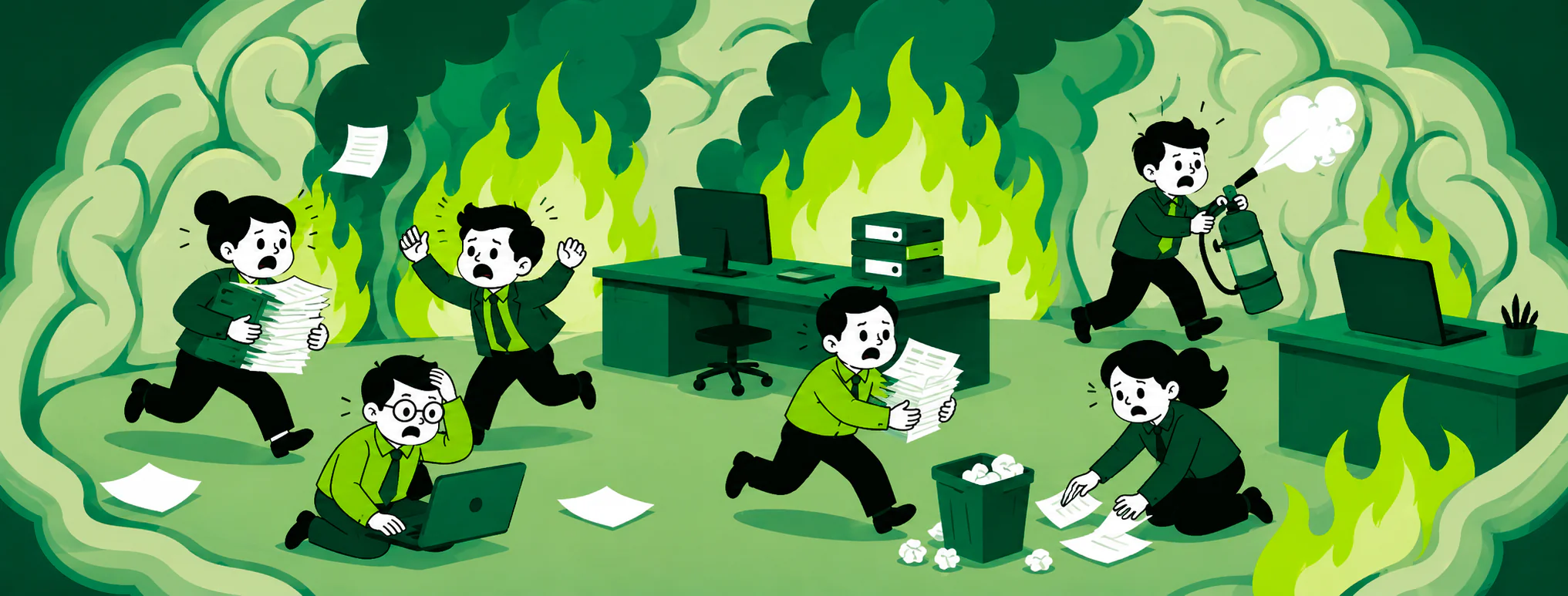
How to Avoid Burnout While Job Hunting in 2026
Job hunting is not simply “send a CV, go to an interview, get an offer, and gracefully step into your new life.” That would be nice, of course. But in reality, it often looks different: you open job boards, read the requirements, think, “Right, they need a one-person orchestra with a degree in wizardry,” send an application, wait, refresh your inbox, wait again, and then receive silence. Or a rejection. Or an interview invitation, followed by more silence.
At some point, a strange feeling appears: you have not done anything physically exhausting, but you have no energy at all. You do not want to open job sites. You do not want to edit your résumé. You do not want to answer recruiters. Even the word “interview” starts to sound like the name of a quest where the grand prize is a headache.
That is the risk zone: job-search burnout.
In 2026, job hunting has become faster from a technical standpoint, but not always easier emotionally. On one hand, there are AI tools, career platforms, CV templates, ATS systems, automatic notifications, and remote interviews. On the other hand, there is more competition, more applications for every role, more automated rejections, more uncertainty, and a stronger feeling that you are not dealing with the job market, but with a giant black hole called “We’ll be in touch.”
LinkedIn’s 2026 research notes that recruiters are using AI more actively in hiring, including candidate sourcing and initial screening, while many job seekers are also using AI for job search and interview preparation. This speeds things up, but it also makes the market noisier: there are more applications, competition feels more visible, and it becomes harder for candidates to understand where they were genuinely evaluated and where they simply did not pass a filter.
But here is the good news: burnout is not proof that something is wrong with you. It is a signal that your current job-search strategy is taking more energy than it gives back. And that means it can be changed.
This article is not about “pull yourself together.” Quite the opposite. It is about how to search for a job calmly, systematically, and without feeling like you have to pass a daily exam to prove you are a normal human being.
Why Job Hunting in 2026 Feels So Draining
Job hunting in 2026 is exhausting not because job seekers have become “weaker,” “lazier,” or “unwilling to work.” No. The process itself has simply become more psychologically demanding.
In the past, job hunting was often more linear: find a vacancy, send a CV, get a call, attend an interview, and receive an answer. Today the path can look like this: a vacancy on a website, a 12-screen application form, an automated test, a video interview, an assignment, another interview, a meeting with the manager, a pause, another pause, and then an email saying, “We’ve decided to put the role on hold for now.” And there you are, feeling as if you made it through an obstacle course, but someone carried away the finish line.
One reason job hunting is so draining is the high level of uncertainty. When you work on a task, there is usually a clear result: you made the presentation, sent the report, closed the ticket, prepared the layout. In a job search, the result does not always depend only on you. You can write a strong CV, prepare well for the interview, handle the conversation professionally, and still receive a rejection. Not because you are a bad specialist. The company may have chosen an internal candidate, changed its budget, found someone with more specific experience, or decided not to hire at all.
The second reason is silence. Questions like “Why don’t they respond to applications?”, “Why don’t recruiters reply?”, and “Why is there silence after the interview?” have become classics of the modern job search. And this silence is especially unpleasant because the brain starts filling in the gaps on its own. Usually not kindly: “Nobody needs me,” “My CV is bad,” “I’m not experienced enough,” “Something is wrong with me.”
The third reason is competition. Good vacancies receive many applications. Especially if the role is remote, hybrid, or comes with clear and attractive conditions. The more appealing the vacancy, the higher the chance that HR will receive dozens, and sometimes hundreds, of résumés. In that situation, even a strong candidate may not get a quick response.
The fourth reason is automation. ATS and AI tools help companies sort CVs, but for job seekers, this can feel like playing a game with invisible rules. You do not always know who actually reviewed your CV: a person, a system, or no one at all. That is why job hunting and burnout often go hand in hand: many actions, little feedback, a lot of waiting.
The fifth reason is the emotional weight. Work is not just a source of income. It is stability, self-esteem, plans, a sense of adulthood, the ability to live independently, pay rent, support loved ones, grow, travel, and not turn every grocery purchase into a math competition. So each rejection can feel not like “the company chose another candidate,” but like “the market rejected me completely.”
But it is important to separate these things: an employer’s rejection is not an assessment of your personality. It is a decision about one specific role, at one specific moment, under specific circumstances. Yes, that sounds less dramatic. It is also more accurate.
What Job-Search Burnout Actually Is
Job-search burnout is a state where the employment process starts consuming too much emotional, mental, and physical energy. You understand that you need to keep going, but everything inside you resists: you postpone applications, avoid vacancies, get irritated by recruiters’ messages, cannot prepare for interviews, and start doubting yourself and your future.
This is not ordinary tiredness after a busy day. Ordinary tiredness usually passes after sleep, a walk, a day off, or a proper dinner that includes something other than coffee and cookies. Burnout lasts longer. It affects motivation, self-esteem, concentration, and even the way you perceive your professional skills.
Emotional burnout during a job search often appears when a person stays in uncertainty for too long. Especially if the search has already lasted several months, there have been many applications, and there is still no offer. In that situation, the brain starts treating every vacancy as a potential threat: “Now I’ll have to try again, hope again, and then be disappointed again.”
This is where the trap begins. The more stress you feel during the job search, the harder it becomes to act effectively. You adapt your résumé less carefully, send more generic applications, prepare worse for interviews, react more sharply to questions, and take rejections harder. This lowers the effectiveness of the search, which makes the stress even higher. The cycle becomes: fatigue → weaker actions → weaker results → even more fatigue.
It is important to understand: burnout in a job seeker does not mean the person does not want to work. Often, it means the opposite. They want it very much, which is exactly why they are so affected by the process. The problem is not a lack of desire. The problem is overload.
You can think of job hunting as a marathon. If you start as if you are running 100 meters, you may be extremely active at first: send 50 applications, rewrite your CV five times, attend three webinars, subscribe to ten career channels, and buy a beautiful notebook called “My New Life.” And then the fuel suddenly runs out.
Because a long job search does not require a sprint. It requires a rhythm.
Burnout is not a weakness. It is an overheated system. And when a system overheats, you do not hit it with a stick. You cool it down, adjust it, and stop opening 47 tabs at the same time.
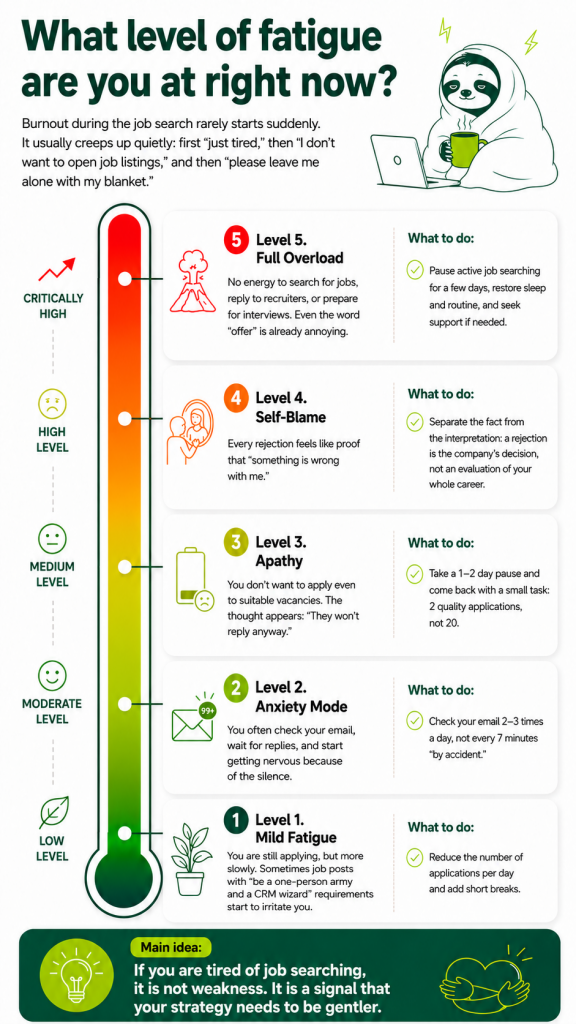
Key Signs You Are Tired of Job Hunting
The signs of job-search burnout do not always look like “I’m lying face down on a pillow and cannot get up.” Sometimes a person continues doing things, but internally they have been operating in emergency mode for a long time.
The first sign is that you keep postponing the search.
You used to open vacancies every day, and now you find no reason not to. Suddenly it becomes urgent to clean out emails from 2019, wash a mug, watch a video about penguin life, or organize the folder called “New Folder 7.”
Formally, you are busy. In reality, you are avoiding the job search because it has become a source of anxiety.
The second sign is that you do not want to apply, even to suitable roles.
You see a good position, but a voice inside immediately says, “They won’t reply anyway.” Or: “They probably already hired someone.” Or: “Now I’ll have to write a cover letter again, and I just can’t.” This is not laziness. It is a protective reaction from the mind, trying to reduce the number of disappointments.
The third sign is that you react too painfully to rejections.
One rejection can ruin the whole day. An automated email feels like a personal insult. Silence after an interview turns into an endless inner trial: “What did I say wrong? Maybe I should have smiled more? What if I looked strange? What if they realized I somehow ended up in this profession by accident?”
The fourth sign is that your self-esteem drops.
You start forgetting your strengths. You used to speak calmly about your projects, experience, and skills, but now it all seems like “nothing special.” Objectively, your experience has not disappeared. Long-term stress simply changes the lens: you start looking at yourself through a filter of rejection.
The fifth sign is apathy during the job search.
Even interview invitations no longer feel encouraging. Because an interview no longer feels like an opportunity, but like another stage that may end in silence again. A person starts thinking, “Why try if I don’t know how this will end anyway?”
The sixth sign is irritability.
A recruiter sends a standard message — annoying. A vacancy mentions “stress resistance” — annoying. A test assignment asks for “a small project that should only take a couple of hours” — especially annoying, because we all know those “couple of hours” that turn into a small dissertation.
The seventh sign is disruption in your daily routine.
Sometimes you search for jobs until two in the morning, and sometimes you do not open vacancies for several days. Sometimes you send 30 applications in one evening, and sometimes you cannot send a single one. This kind of chaos strengthens the feeling that the search has slipped out of your control.
The eighth sign is constant comparison with other people.
Someone posts, “I got my dream offer in two weeks,” and you immediately think, “So something is wrong with me.” But behind that post there may have been three months of preparation, strong networking, lucky timing, help from acquaintances, or simply a polished story with all the messy details removed.
The ninth sign is physical exhaustion.
Anxiety and stress do not live only in your head. They can show up as body tension, headaches, sleep problems, morning fatigue, or a tight feeling in the chest before an interview. If these symptoms are strong or do not go away for a long time, it is better to contact a mental health professional. Job hunting is important, but your health is more important than any vacancy, even one with free snacks and a “friendly team.”
Why Rejections Hit Self-Esteem So Hard
A rejection after an application or interview seems like a normal part of the job search. Everyone understands that. But understanding it logically and experiencing it calmly are two different sports.
Rejections hit self-esteem because work is closely tied to identity. When you say, “I’m a designer,” “I’m a marketer,” “I’m a manager,” “I’m an HR specialist,” and so on, you are not only describing your tasks. You are also describing how you see yourself. That is why a rejection can feel not like “we need a different profile right now,” but like “you are not good enough.”
But hiring is much more complicated than that. An employer may reject a candidate for dozens of reasons that have nothing to do with the candidate’s worth. For example, the company’s budget changed. The manager decided to hire someone with experience in a very specific niche. The vacancy was filled by an internal candidate. The requirements changed after the interview. The team is looking for someone with a different level of English. Salary expectations did not match. HR received too many applications and physically could not respond to everyone. Yes, it is unpleasant. But it is not the same as “you are a bad specialist.”
Receiving many rejections during a job search becomes especially hard if every application feels like a personal hope. You send a résumé, and your mind has already pictured the new office, the new laptop, a reasonable manager, the salary, vacation, and a life without the phrase “I just need to hang in there.” Then the rejection arrives. The brain loses not just a vacancy, but a small version of the future it had already started building.
That is why one way to stop taking rejections too painfully is to change the way you relate to applications. An application is not a declaration of love to a company. It is a professional touchpoint. You are showing: “I could be useful here.” The company responds or does not. That is all. There is no need to emotionally marry every vacancy before the first interview.
It is useful to count not only rejections, but also actions. For example, you sent 20 quality applications, received 4 responses, got 2 interviews, and completed 1 test assignment. That is data. Not a verdict. If there are few responses, you can improve your CV, keywords, cover letters, and vacancy selection. If you are getting interviews but no offers, it is worth working on self-presentation, answers, case examples, and questions for the employer. If there is silence after interviews, you can introduce a follow-up email rule after a few business days.
Self-esteem should not be built only on the market’s reaction. The 2026 job market is noisy, fast, and sometimes chaotic. Today you may not be noticed; tomorrow you may be invited to three interviews. Today a rejection, tomorrow an offer. If every external signal becomes an assessment of your personality, your emotional state will feel like an elevator in an office building on a Monday morning: up, down, up, down, and everyone feels slightly unwell.
How to Organize Your Job Search So You Do Not Burn Out
If you want to understand how to avoid burnout while job hunting, start not with motivation, but with a system. Motivation is unreliable. Today it is here; tomorrow it has gone for coffee with your discipline. A system keeps the process moving even when inspiration is nowhere to be found.
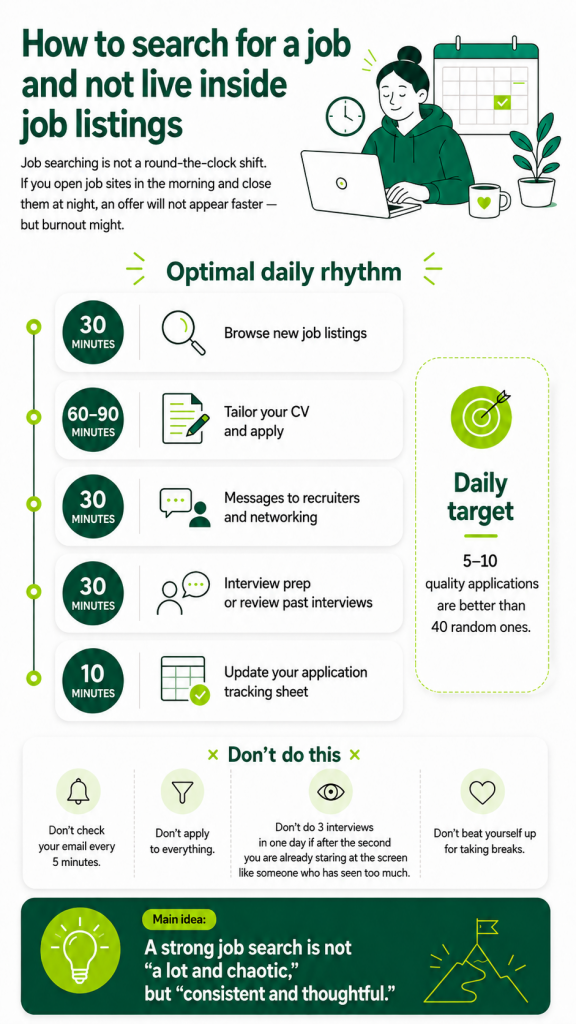
The first rule is: do not job hunt all day.
This may sound strange, especially if you are currently unemployed. It feels like: “Since I’m free, I should search from morning to evening.” But job hunting is emotionally demanding work. If you do it without limits, it spreads across the whole day and starts feeling endless.
It is better to set specific blocks. For example, 2–4 hours a day for active job search. During this time, you review vacancies, adapt your résumé, send applications, write to recruiters, and prepare for interviews. After the block — stop. Do not check email and messengers every 15 minutes. That creates a constant state of anxiety.
The second rule is: create a job-search plan.
Not an abstract “find a decent job,” but a concrete plan. For example:
Monday — update the CV for 2–3 types of roles.
Tuesday — send 5–7 quality applications.
Wednesday — write to 3 people from your professional network.
Thursday — prepare answers to common interview questions.
Friday — analyze your application tracker and improve the strategy.
This kind of plan turns chaos into a manageable process. You stop deciding from scratch every day what to do. That alone saves energy.
The third rule is: keep a career tracker or application spreadsheet.
It can be a simple table: company, vacancy, application date, status, contact, next step, comment. You do not need to build a spaceship in Notion if Google Sheets is enough. The main thing is to see the whole picture.
An application tracker helps you stay oriented. You understand where you have already sent your CV, where you are waiting for a response, where you need to follow up, which vacancies bring more replies, and which wording works better. This reduces anxiety because the process becomes visible.
The fourth rule is: decide how many applications to send per day.
There is no universal number, but for most people, 5–10 quality applications are better than 50 random ones. A quality application means the vacancy genuinely fits you, the résumé is slightly adapted, and the cover letter does not look like a lifeless “Hello, I am interested in your vacancy.”
If you send too many applications, you get tired quickly and start acting mechanically. If you send too few, the search may drag on. So it is better to choose a reasonable range based on your situation. For example, 5 applications a day for a targeted search, or 10–15 if the market is broad and there are many suitable vacancies.
The fifth rule is: separate tasks by energy level.
Not all actions are equally demanding. Browsing vacancies is one thing. Rewriting a CV is another. Preparing for an interview is a third. Attending an interview is basically its own type of cardio.
Do not put everything on the same day. If you have an interview in the morning, do not plan 20 applications and a large test assignment for the evening. After the interview, it is better to write a short note: what you were asked, what went well, what could be improved. Then recover.
The sixth rule is: work with the funnel.
Job hunting is not one application. It is a funnel: vacancies → applications → responses → interviews → final stages → offer. If something is failing, you need to improve that specific stage.
Many applications but no responses? Check the CV, keywords, fit for the vacancy, and ATS format.
There are responses but few interviews? Improve your cover letters and short self-presentation.
Many interviews but no offer? Analyze your answers, examples, salary expectations, and questions for the employer.
You reach the final stages, but they choose others? It may be about competition, niche experience, or your final self-presentation.
This approach restores a sense of control. You no longer think, “Nobody needs me.” You think, “Which stage of the funnel needs strengthening?” It sounds less tragic and much more useful.
How to Take Breaks Without Feeling Guilty
One of the biggest mistakes job seekers make is thinking rest must be earned with an offer. As in, first I find a job, then I can breathe. But if the search lasts several months, this approach turns life into an endless waiting room.
A break from job hunting is not a betrayal of your career. It is part of the strategy. Even a phone needs to be charged, and it has not gone through three interviews in a row or received an email saying, “We selected a candidate whose experience better matches our expectations.”
How can you rest during a job search without feeling guilty?
First, plan rest in advance. If you rest only when you can no longer move, that is not rest; that is an emergency landing. It is better to introduce regular pauses: one day a week without vacancies, an evening without email, a walk after an application block, a break after an interview.
Second, separate rest from avoidance. Rest is when you consciously recover. Avoidance is when you do not open job sites for the third day, but still feel anxious inside. The difference is the sense of control. If you scheduled a day off from job hunting, you are not “slacking off.” You are restoring your resources.
Third, stop seeing rest as wasted time. Recovery directly affects the quality of your search. A rested person writes better, speaks better, analyzes vacancies better, and handles interviews more calmly. An exhausted person may apply for a “Head of Sales for Aquarium Fish Food” role even though they are actually a UI designer. Simply because their eyes no longer see the difference.
Fourth, make a list of actions that genuinely restore you. Not everything that looks like rest gives energy. Sometimes “lying in bed with your phone for three hours” ends with you knowing all the news, seeing 12 other people’s success stories, and feeling worse. Try honestly writing down what helps you: sleep, walking, exercise, talking to a friend, cooking, a film, silence, cleaning, reading, music, a day without social media.
Fifth, stop explaining to everyone around you why you are resting. Job seekers often feel pressure: “So, did you find a job?”, “Where have you applied?”, “Why is it taking so long?”, “Maybe you’re just not searching properly?” Sometimes the best way to protect your mental health is to limit the number of people you report to. You are not required to turn your job search into a public series with weekly updates.
A career pause can also be normal if it is intentional. For example, you understand that you burned out after your previous job and cannot immediately switch into an active search. In that case, it is better to take a short recovery period than to rush into any vacancy and show up to interviews with the face of someone who mentally already lives under a blanket.
How to Handle Stress Before Interviews
An interview is one of the most stressful stages of the job search. Even experienced professionals can get nervous. And that is normal. An interview is an evaluation situation, and the brain does not always love those. Honestly, it does not love many things: uncertainty, rejection, sudden questions, and the phrase “Tell us about yourself.”
To understand how to stop feeling so nervous before an interview, it is important not to try to remove anxiety completely. A little nervousness is a normal reaction. The goal is not to become a stone Buddha on Zoom. The goal is to make anxiety manageable.
The first method is to prepare the structure of your self-presentation. You do not need to memorize a script like a school poem. It is better to have a plan: who you are, what experience you have, what tasks you have worked on, what results you can show, and why this role interests you. When there is structure, the brain panics less.
The second method is to prepare examples. Many interview questions test not theory, but experience: “Tell us about a difficult situation,” “How did you handle conflict?”, “How did you work with deadlines?”, “How did you make a decision?” Write down 5–7 work stories in advance that show your skills. One story can fit several questions.
The third method is to study the vacancy before the interview. Not just open it five minutes before the call and say, “Yes, I reviewed it.” Really understand the tasks, requirements, and possible pain points of the company. Then the interview becomes less of an exam and more of a conversation between two sides.
The fourth method is to prepare questions for the employer. This reduces the feeling that only you are being evaluated. You are choosing too. Ask about the tasks for the first months, success criteria, the team, processes, expectations for the role, and why the vacancy opened. Good questions show maturity and help you avoid ending up in a job where “everything is on fire, but we call it a dynamic environment.”
The fifth method is technical preparation. Check your internet, camera, sound, link, time, and time zone. It is very hard to speak calmly about professional achievements when, two minutes before the interview, you are trying to figure out why your microphone sounds like a submarine.
The sixth method is to use short techniques before the interview. For example: exhale slowly several times, walk for five minutes, write down three strengths on a piece of paper, and remind yourself: “I am not begging for charity. I am discussing professional cooperation.” It sounds simple, but it helps bring you back into an adult position.
If you are wondering how to cope with anxiety before an interview, try changing the wording. Not “I need them to like me,” but “I need to understand whether we are a good fit for each other.” Not “I must answer perfectly,” but “I need to clearly show my experience.” Not “If they reject me, everything is over,” but “This is one stage of the funnel.”
What should you do if you are tired of interviews? Set a limit. For example, no more than 2–3 interviews per week, if possible. After each interview, do a short review, but not a four-hour session of self-punishment. Write down what they asked, where your answer was strong, what could be improved, and which red flags you noticed. Then close the notes and return to life.
How do you stop being afraid of interviews? You do not have to stop completely. Courage is not the absence of nervousness. It is the ability to act while nervousness is still there.
How to Stay Motivated When There Is Still No Offer
The hardest period is when you have already done a lot, but there is still no offer. The CV is updated. Applications have been sent. Interviews have happened. Maybe even final stages. But there is no result yet. And that is when the question appears: how do you avoid losing motivation during a job search?
First, stop measuring progress only by the offer. Yes, the offer is the main goal. But if you count only the offer as a result, every day without one will feel like a failure. That is unfair and psychologically heavy.
Track intermediate indicators: how many quality applications were sent, how many responses you received, how many interviews were scheduled, what improvements were made to the CV, which questions you now answer better, and which companies showed interest. This is not self-deception. It is a normal way to see movement.
Second, update the strategy instead of simply pushing harder. If you have been doing the same thing for a long time without results, you do not always need to do more. Sometimes you need to do it differently. For example, change the type of vacancies, rewrite the résumé for specific roles, add a portfolio, strengthen your LinkedIn or another profile, write directly to hiring managers, use networking, or ask an HR acquaintance for feedback.
Third, separate what you can control from what you cannot. You control the quality of your résumé, the vacancies you choose, your preparation, communication, consistency, and skill development. You do not control the company’s budget, the number of competitors, internal politics, the recruiter’s response speed, or the sudden “we decided to pause the role.” If you try to control everything, you can burn out without even having a single interview.
Fourth, keep living a normal life. Job hunting should not swallow your entire identity. You are not only a candidate. You are a person with a body, friends, interests, food, sleep, humor, plans, favorite music, and the right to occasionally optimize nothing. When your whole life becomes “find a job,” every rejection feels like the end of the world. When life is broader, rejection is still unpleasant, but not destructive.
Fifth, use support. A conversation with a friend, career consultant, former colleague, or someone who is also job hunting can significantly reduce tension. The main thing is to choose people who will not say “just be more confident” with the face of a sage who has solved all of humanity’s problems in one phrase.
Sixth, remind yourself of facts. Not emotions, but facts. What projects have you worked on? What tasks have you solved? What results have you achieved? Which people valued your work? What can you do better now than a year ago? Self-esteem needs evidence. Especially during a period when the market responds with silence.
Seventh, do not make your dream job the only acceptable option. Sometimes a good career step is not the perfect vacancy from your imagination, but a solid role where you can regain stability, earn money, grow, and keep moving. A dream job can be a goal, but it should not become a filter that makes you reject every real opportunity.
Motivation during a job search is not built on endless enthusiasm. It is built on gentle consistency. You do not need to wake up every day thinking, “I will conquer the job market.” Sometimes it is enough to say: “Today I will take three reasonable actions and I will not destroy myself because the offer has not arrived yet.”
What to Do If Your Job Search Has Been Going On for Months
A long job search is one of the main factors behind burnout. Especially if, at first, you were sure everything would happen quickly. One month passes, then a second, then a third, and an anxious thought appears: “Why can’t I find a job for so long?”
There may be many reasons. Sometimes the market really is difficult. Sometimes salary expectations are higher than current demand. Sometimes the CV does not show value clearly. Sometimes the person applies to the wrong vacancies. Sometimes a specific skill is missing. Sometimes the problem is in the interview. Sometimes circumstances simply do not align. The important thing is not to guess forever, but to diagnose the situation.
Start with the CV. It should not simply look attractive. It should be clear. A recruiter needs to quickly see who you are, what you can do, what tasks you have handled, what results you achieved, and what role you fit. If the résumé looks like a list of duties copied from a job description, it is worth strengthening it with achievements and specifics.
Check whether you adapt your résumé for vacancies. In 2026, one universal document for every situation works worse. You do not need to rewrite everything each time, but it is important to move relevant experience higher, use clear keywords, and reflect the skills mentioned in the vacancy if you genuinely have them.
Look at your applications. If you send your résumé to roles where the match is 30%, responses may be rare. Sometimes a candidate thinks, “Well, maybe they’ll take me.” Maybe it will happen. But if the entire strategy is built on “maybe,” it quickly becomes exhausting. It is better to divide vacancies into three groups: definitely a fit, partly a fit, and want to try. The main focus should be on the first two.
Analyze interviews. If you are often invited but do not get offers, the CV is working, and the next step is to look at communication. Can you briefly talk about yourself? Do you give examples? Do you understand the role’s tasks? Do you avoid going into unnecessary details? Do you sound too unsure or, on the contrary, too chaotic? Do you ask questions?
If you have many interviews and no offer, it is useful after each interview not to grade yourself as “failure/success,” but to do a review. Which questions repeat? Where do you lose confidence? Which answers spark interest? At what stage do rejections happen most often? This is data for improvement.
Check salary expectations. Sometimes a candidate names an amount above the market for their current level and does not explain the value behind it. This does not mean you must immediately lower your expectations. But it is worth understanding the range and being able to justify your number. If you ask for above average, show why your experience supports it.
Use networking. Many people perceive networking as something unpleasant, as if they have to write to everyone saying, “Please hire me.” But healthy networking is simply professional communication. Writing to a former colleague, asking an acquaintance about the market, responding to a post, sharing that you are searching, asking for a referral — none of this is humiliating. It is one of the working channels.
If the search has lasted several months, it is important not to isolate yourself. Isolation increases anxiety. It starts to feel as if everyone around you is successful and you are the only one stuck. In reality, many people go through a long job search; they just do not all post about it publicly. People are more willing to share an offer than 87 unanswered applications. For some reason, a post saying “Nothing again today, but I ate soup” gets fewer likes.
Another important step is to add learning, but without panic. Do not buy five courses in a stressful rush and think no one will hire you without them. It is better to identify one skill that can genuinely strengthen your position and calmly fit it into your schedule. For example: a tool, a language, analytics, presentation skills, project management, AI tools, or communication. Small, systematic development is better than chaotic career shopping.
Most importantly: if the search drags on, do not conclude, “Something is wrong with me.” Conclude: “I need to diagnose my strategy, get support, and create a sustainable rhythm.” That is a completely different position.
How to Reduce Job-Search Stress Every Day
You cannot remove job-search stress completely, but you can reduce it. And not only through major decisions, but also through small daily actions.
Start with your daily routine. It sounds boring, but it works. If you go to bed at 3 a.m., wake up exhausted, drink coffee instead of breakfast, and immediately open rejection emails, your nervous system will not thank you. It will say something else, but let’s not quote it.
Create a morning buffer. Do not start the day with vacancies. Give yourself 30–60 minutes to properly wake up: water, food, shower, a walk, stretching, silence. Yes, this is not always possible. But when it is possible, it helps.
Limit email checking. For example, 2–3 times a day. Constantly refreshing your inbox creates the feeling that you are waiting for a verdict. And you are not waiting for a verdict. You are managing a career process.
Set realistic tasks. Not “find a job today,” but “send 5 quality applications today,” “prepare answers to 3 questions today,” “write to 2 contacts today.” The task “find a job” is too big and not fully within your control. The task “take 5 actions” is clear and achievable.
Separate work and personal space, if you can. Even if you are job hunting from home, it helps to have a specific place and time for it. Closed the laptop — the block is over. Otherwise the job search starts living everywhere: in the kitchen, in bed, in your head, in the shower, and in dreams where a recruiter somehow asks you about Excel on a flying bus.
Add physical activity. It does not have to be the gym or heroics. A walk already helps reduce tension. The body needs to process stress, not store it like an archive called “Rejections_final_version_last_for_real.”
Reduce information noise. Career channels are useful as long as they help. If after reading them you only feel panic that everyone is already using 28 AI tools while you still do not know what to name your résumé folder, take a pause.
Do not compare your path with other people’s posts. Social media shows the ending, not the whole process. You see “I got an offer,” but you do not see how many rejections there were, who helped, what experience the person had, or which circumstances aligned. Comparing your behind-the-scenes with someone else’s shop window is a bad deal.
Keep a list of small wins. Answered a difficult question? Win. Send a quality application? Win. Received feedback? Win. Improved your résumé? Win. Did not spiral after a rejection and went for a walk instead? Also a win, and a very mature one.
How do you job hunt calmly? Do not turn every day into a vote on your worth. Today you take steps. The market does not always answer immediately. That is unpleasant, but it does not erase your experience.
How to Handle a Rejection After an Interview
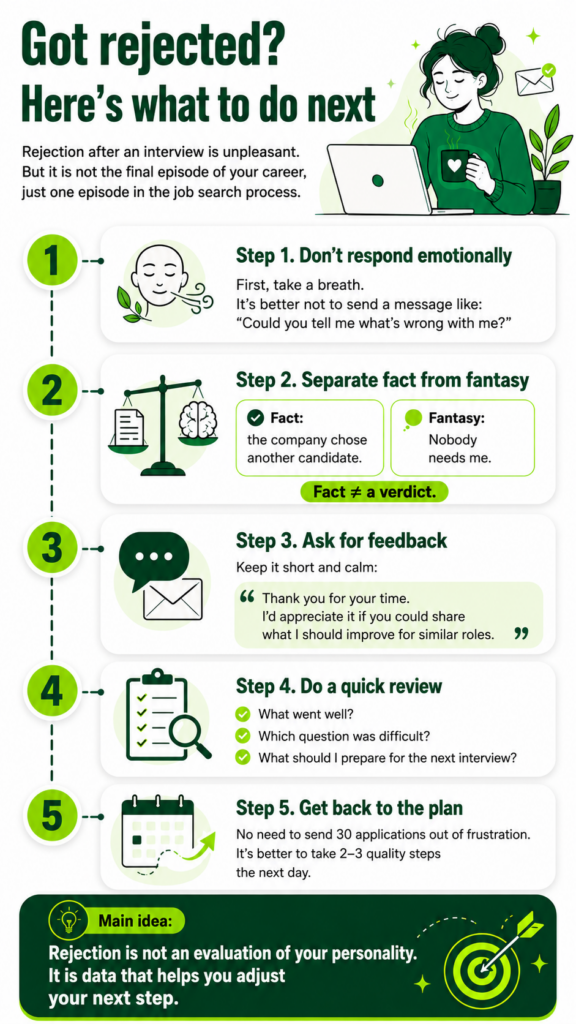
A rejection after an interview is especially unpleasant because you have already invested in the process. You spent time, prepared, had the conversation, and maybe even started hoping. Then the email arrives: “Thank you for your interest, but we’ve decided to move forward with another candidate.” Corporate translation: “No.” Does it hurt? Yes. Is it the end of the world? No.
The first thing to do is allow yourself a normal reaction. You do not have to act like a robot: “A rejection? Wonderful, another growth opportunity!” Sometimes you want to feel upset. That is normal. You are a person, not an HR bot.
Second, do not make instant conclusions. One rejection does not mean you failed the interview. Even several rejections do not mean you are a bad specialist. Maybe there were candidates who fit better. Maybe the vacancy changed. Maybe the company was looking for a different communication style. Maybe you really did miss something — and that can be improved.
Third, ask for feedback. They will not always respond, but you can try. Keep it short and calm: thank them for their time, say you enjoyed the conversation, and ask for 1–2 points you could improve. Do not argue, prove, or write “Why did you decide that?” as if you are in court. The goal is to get data.
Fourth, do your own review. What went well? Where did you stumble? Which questions were unexpected? What can be prepared better next time? Did you have doubts about the company? Sometimes rejection is not only a loss, but also a rescue from a role where, one month later, you would think, “Can I go back to job hunting? At least coffee was at home.”
Fifth, do not immediately rush into new applications from a place of pain. After a rejection, it is tempting to urgently prove to the market that you are fine. But actions taken in that state are often chaotic. It is better to pause, recover, and then return to the plan.
How do you recover after an unsuccessful interview? First, separate fact from interpretation. Fact: the company did not make an offer. Interpretation: “Nobody needs me.” Fact is not the same as interpretation. Stay with the facts.
Then restore your sense of grounding. Write down what you can do. Look at your past results. Talk to someone supportive. Do something physical: walk, shower, eat, sleep. After a rejection, the brain often demands analysis, but sometimes the body first needs soup. Or at least a decent sandwich.
And one more thing: do not store rejections as a collection of evidence against yourself. Rejections are part of job-search statistics. Yes, an unpleasant part. But they are not the personal biography of your inadequacy.
Why Employers Do Not Respond to Applications and What to Do About It
One of the most irritating questions is: why do employers not respond to applications? You send a CV. The vacancy seemed suitable. A day passes, then three, then a week. Silence. And you start thinking your résumé has flown into a career desert.
The reasons can vary. The vacancy received too many applications. The recruiter reviews candidates in batches. The company is considering internal referrals first. The role was put on hold. Your résumé did not meet key requirements. The ATS did not recognize important information. The application was too generic. Or yes, the company’s process is simply poorly organized.
What should you do?
First, do not expect a response from every application as if it is guaranteed. It is better to see applications as the top of the funnel. Some will remain unanswered. It is unpleasant, but normal in today’s market.
Second, improve relevance. The more precisely your CV matches the vacancy, the higher the chance of a response. You do not need to invent experiences you do not have. But you do need to show the experience you do have in words the employer understands.
Third, use keywords. If the vacancy lists specific tools, processes, or skills, and you have them, they should appear in the résumé. This helps both the human reviewer and the ATS.
Fourth, write short cover letters when appropriate. Not a three-page novel, but 4–6 sentences: who you are, why you fit, what relevant experience you have, and why the role interests you. A good letter will not save a weak résumé, but it can strengthen a solid one.
Fifth, try direct contacts. If the vacancy matters to you, you can find the recruiter or department manager and write briefly, professionally, and without pressure. For example: “Hello, I saw the vacancy, and my experience in X and Y seems relevant. I’ve submitted my application and would be happy to discuss it.” This does not guarantee a response, but it increases visibility.
Sixth, analyze the statistics. If you have sent 50 applications and received no responses at all, the problem is probably not “the market in general,” but the strategy: résumé, vacancy selection, role level, application format, salary expectations. That is not a reason to panic. It is a reason to adjust the system.
Why do recruiters not respond after interviews? Sometimes they are waiting for the manager’s decision. Sometimes there is another candidate. Sometimes the process is delayed. Sometimes the communication culture is weak. You can send a follow-up after 3–5 business days: calmly remind them about yourself and ask for a status update. If there is still no answer after that, move on.
Do not turn an employer’s silence into the central event of your life. Silence is also an answer, even if it is an impolite one. Your job is to keep managing your funnel.
Checklist: How to Job Hunt Without Burning Out
You can save this checklist and return to it whenever the job search starts turning into an emotional roller coaster again.
- Define your search goal.
Not “any job,” but which roles, level, format, salary range, and type of companies suit you.
- Update your CV for the 2026 job market.
Make it clear, specific, results-oriented, with key skills and a structure that works for ATS.
- Do not use one CV for everything.
Prepare 2–3 versions for different directions if you are considering different roles.
- Keep an application tracker.
Company, vacancy, date, status, contact, next step. Less chaos means less anxiety.
- Set a time limit.
For example, 2–4 hours of active search per day. Do not live inside vacancies around the clock.
- Define your application norm.
Better 5–10 quality applications per day than 40 random ones and the feeling that you are sending your CV into space.
- Take breaks without guilt.
Rest is part of productivity, not a reward after the offer.
- Prepare for interviews in advance.
Self-presentation, work examples, questions for the employer, understanding of the vacancy.
- After interviews, do a short review.
What went well, what to improve, which questions repeat, what to take into the next conversation.
- Do not treat rejection as an assessment of your personality.
A rejection is a decision about one specific role, not a verdict on your career.
- Ask for feedback.
You will not always get it, but sometimes one comment can improve your strategy.
- Pay attention to your body.
Sleep, food, movement, walks. Mental health does not live separately from physical health.
- Limit career noise.
Read useful content, but do not turn your feed into a source of panic.
- Use support.
Friends, colleagues, career consultants, professional communities. Do not carry everything alone.
- Review your strategy once a week.
What is working? Where is the weak point? What should change? Job hunting is a process, not a daily lottery.
- Do not put life on pause.
You are looking for a job, but you do not become “only a candidate.” Life should continue.
- Remember: long does not mean hopeless.
A long job search can be a stage, not a dead end.
Final Thoughts
How do you avoid burnout while job hunting in 2026? Do not try to be the perfect candidate 24/7. Do not turn every rejection into a drama about your worth. Do not search chaotically, in bursts, and on your last remaining energy. Do not live in the mode of “once I get an offer, then I’ll start sleeping, eating, and enjoying life normally.”
Job hunting is a project. An important, emotional, sometimes unpleasant project, but still a project. And any project needs strategy, boundaries, consistency, and recovery.
If you are tired of looking for a job, it does not mean you are weak. It means you have been under pressure for a long time. If you have no energy to search, maybe what you need is not another motivational quote, but a normal plan, a pause, and support. If you are tired of interviews, maybe it is time to slow down, review the mistakes, and stop going to interviews as if they are exams where your whole identity is being graded.
Work matters. But you matter more.
An offer is important. But not at the cost of complete emotional shutdown.
Job hunting without burnout means moving not faster than everyone else, but more sustainably. Taking steps, analyzing, resting, returning, improving the strategy, and remembering: your professional value does not disappear because someone did not respond to your application.
Even if it feels like the market is silent right now, this is not the end of the story. It is just a stage.
And stages pass.