


How to Explain a Career Break in a Job Interview
A career break is one of those topics that can make candidates nervous before the interview even starts.
Your inner HR detective immediately wakes up:
“They’ll notice the gap in my CV. They’ll ask about it. I’ll start justifying myself. My voice will shake. The chair will squeak. Somewhere in the distance, dramatic background music will begin.”
In reality, it is usually much calmer.
Employers see career breaks all the time. People change careers, take care of family members, recover from burnout, relocate, study, take time off after a difficult project, get affected by layoffs, start personal projects, or simply need longer than expected to find the right role.
A career break itself is rarely the real problem.
What can become a problem is an uncertain explanation, vague wording, or the feeling that the candidate is embarrassed by their own story.
This article will help you explain a career break in a job interview clearly and calmly, without turning the conversation into a confession, an apology, or a ten-minute monologue full of unnecessary details.
Why Recruiters Ask About Career Breaks
A question about a career break is not always driven by curiosity.
Most of the time, the recruiter is trying to understand a few practical things:
- what happened during that period;
- whether you are ready to return to a working routine;
- whether your skills are still up to date;
- whether there are any risks for the future role;
- how you explain complex stages of your career;
- how honestly and calmly you talk about yourself.
For an employer, predictability matters.
They need to understand that you are aware of your professional path, can speak about it in a mature way, and are ready to work now.
A good answer about a career break should address the main question:
“What has changed now, and why are you ready for this role?”
What the Employer Actually Hears
When a candidate says:
“I had a career break because I was dealing with family matters. Now I’m fully ready to return to work, and I’ve updated my skills according to the current market.”
The employer hears:
- this person answers directly;
- the reason is clear;
- the candidate does not panic;
- there is readiness to work;
- there is a connection to the current vacancy.
When a candidate says:
“Well… it just happened… there were circumstances… it’s hard to explain… I was kind of trying to find myself…”
The employer hears:
- this topic makes the candidate uncomfortable;
- the reason is unclear;
- the candidate did not prepare;
- there may be hidden risks;
- the conversation may require additional clarification.
Even if the real reason for the break was completely normal, an insecure explanation can damage the impression.
The Main Principle: Treat the Career Break as Part of Your Career
It is better to see a career break as a normal stage of your professional path.
Yes, it may require an explanation.
Yes, the recruiter may notice it.
Yes, the question may be asked directly.
But it is not a failure, not a black mark, and not a career disaster.
Your task is not to show a perfect biography. Your task is to show a clear professional story.
Many strong professionals have had periods without formal employment.
Markets change. Companies close departments. Projects end. People move countries, change fields, recover, study, or take a pause after intense workloads.
Employers usually do not expect a flawless CV with no gaps at all.
They expect clarity.
A Simple Formula for a Good Answer
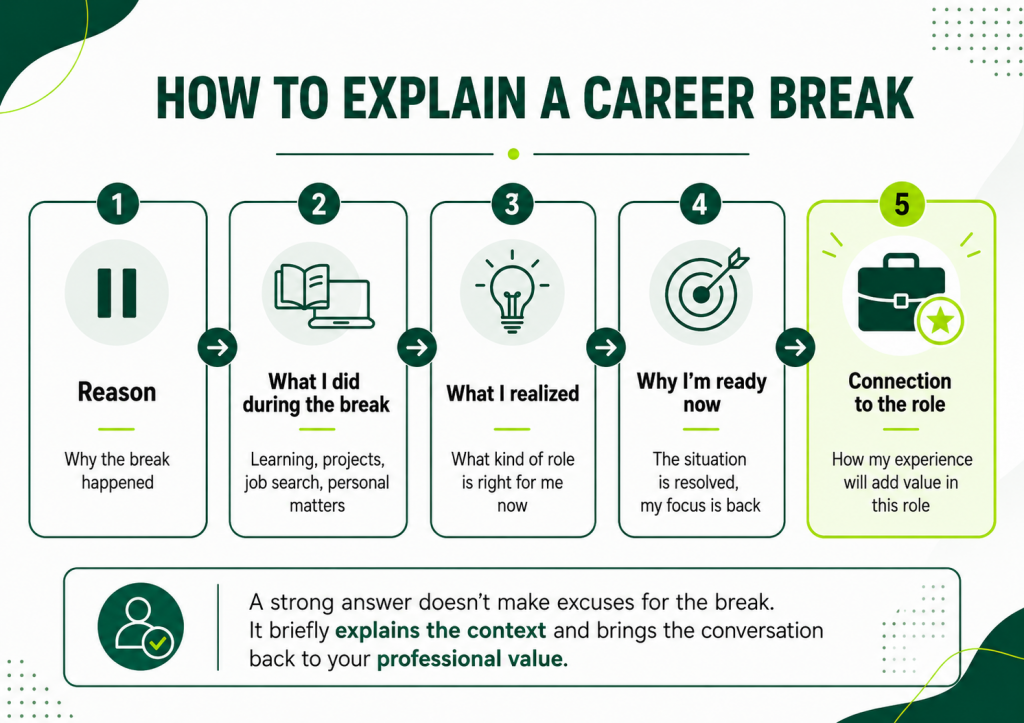
A convenient structure looks like this:
- Briefly name the reason for the break.
- Show that the period was understandable or intentional.
- Explain what you did to stay prepared.
- Bring the conversation back to the current vacancy.
Example
“After my previous project ended, I took a break to recover and choose my next step carefully. During that time, I updated my professional knowledge, followed the market, and reviewed roles that genuinely matched my experience. I’m now ready to return to work and looking for a position where I can use my experience in projects with clear responsibilities and well-defined goals.”
This answer sounds calm.
There are no unnecessary details, no drama, and no defensive tone.
What You Definitely Should Not Do
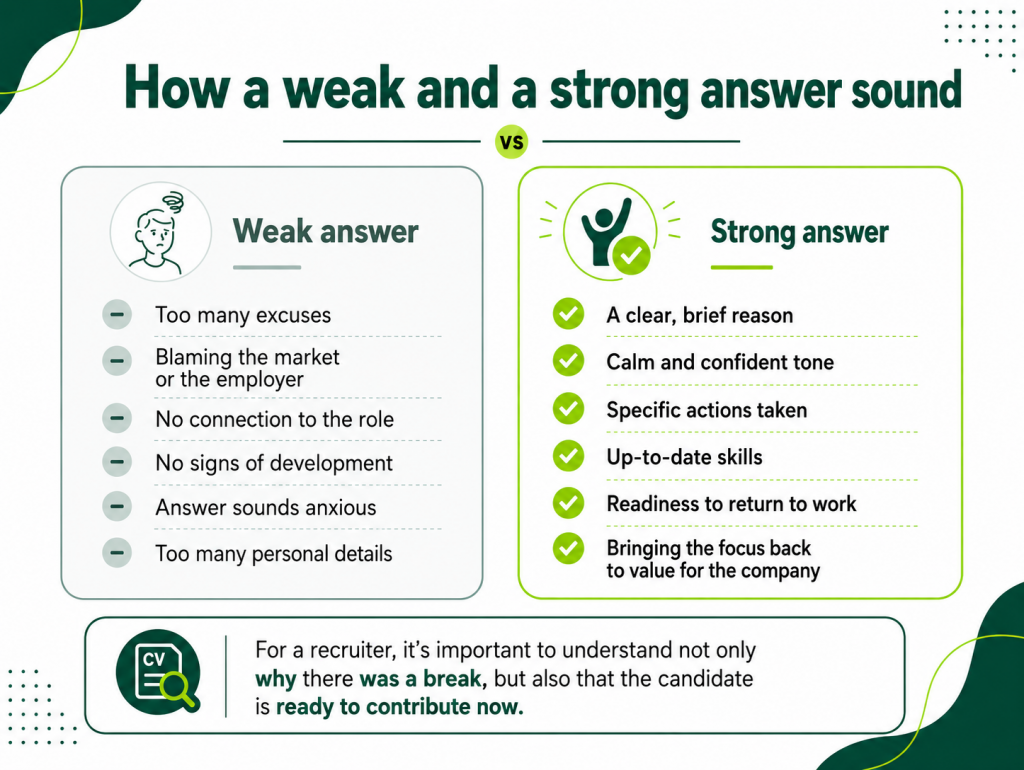
There are several common mistakes that make the topic feel heavier than it really is.
Mistake 1. Overexplaining for Too Long
When a candidate speaks too much, too fast, and with visible anxiety, the interviewer may start to feel that there is something more complicated behind the story.
Weak version
“I understand it looks strange that I had a break, but the circumstances just worked out that way. I was actually planning to return earlier, but then everything got delayed, then the market was difficult, then I was considering different options, then I realized I needed to prepare more…”
Too many turns.
Too little clarity.
Strong version
“After my previous job, I had a planned break. I was dealing with personal matters while also maintaining my professional skills. Those matters are now resolved, and I’m ready for full-time work.”
Short.
Calm.
Enough.
Mistake 2. Going Into Personal Details
An interview is a professional conversation.
You do not need to share every detail about your family situation, health, emotional state, conflicts, or private circumstances.
Weak version
“It was a very difficult time for me. A lot happened at once. I didn’t really know where to move next. There were problems at home, and relatives were involved…”
Strong version
“During that period, I was dealing with family matters that required my involvement. The situation is now resolved, so I’m returning to an active job search.”
Your boundaries remain intact.
The reason is clear.
The employer gets the context they need.
Mistake 3. Speaking Negatively About a Previous Company
Even if your previous employer really was difficult, the interview is not the best place for an emotional breakdown of everything that went wrong.
Weak version
“I left because everything was chaos there. Management didn’t understand anything, the processes were terrible, the team was burned out, and salary reviews existed only in words.”
Strong version
“After my time at that company ended, I decided to take a pause and choose my next project more carefully. Clear goals, mature communication, and the ability to deliver measurable results are important to me now.”
You are not hiding the fact that you made conclusions.
But you are not turning the interview into an employer review.
Mistake 4. Pretending the Break Did Not Happen
If your CV clearly shows a gap of several months or more, it is better to prepare an answer in advance.
Trying to avoid the topic usually looks weaker than explaining it calmly.
Weak version
“There wasn’t really anything there. The dates just worked out that way.”
Strong version
“Yes, there was a break between those roles. I used that time to recover after an intensive project and update my professional knowledge. I’m now considering positions where I can apply my accumulated experience.”
A direct answer always looks more confident.
Common Reasons for a Career Break and How to Explain Them
Reasons can be different.
There is no universal answer, but almost any normal life situation can be explained professionally.
The main thing is not to turn the explanation into a long story.
A Career Break Because the Job Search Took Longer Than Expected
This is one of the most common situations.
A person leaves a job, starts searching, but the search takes longer than planned.
This is especially familiar to candidates who do not want to accept the first available offer.
And that is normal.
How to explain it
“After my previous role ended, I decided not to accept the first available position, but to choose a role that genuinely matched my experience and future goals. The search took longer than I expected, but I used that period to prepare, analyze the market, and update my skills.”
What to emphasize
- you were not just waiting for a miracle;
- you analyzed the market;
- you made a thoughtful choice;
- you are ready to work now;
- this vacancy interests you for specific reasons.
Shorter version
“The search took longer than expected because I was choosing carefully. During that period, I updated my skills, studied current market requirements, and I’m now ready to return to work.”
What to avoid
Do not say:
“There were no decent jobs on the market.”
Better:
“I considered different options and realized that it is important for me to find tasks where my experience will be genuinely useful.”
That sounds more mature.
A Career Break After a Layoff
Layoffs have long been a normal part of the labor market.
Projects close, teams are restructured, budgets change, and companies optimize costs.
The candidate’s task is to speak about it calmly.
How to explain it
“My previous role ended because the team was reduced. After that, I took time to look for a suitable position, updated my CV, reviewed my career goals, and started actively considering vacancies where my experience could be useful.”
Why this works
The answer contains a fact.
There is no resentment.
There is movement forward.
More confident version
“The company was reviewing the team structure, and my position was affected by the restructuring. I used this period to update my skills and focus on roles where I can work with clear tasks and measurable results.”
What to avoid
Do not go into the details of the company’s internal decisions:
“They hired too many people first, then realized they had no budget, then started laying everyone off even though we had warned them…”
That is unnecessary in an interview.
Better to keep the wording neutral:
“The position was closed as part of team changes.”
A Career Break Because of Burnout
Burnout is a common reason for taking a pause, especially after intense projects, overtime, constant deadlines, and the familiar mode of “just a little more and things will get easier.”
Usually, things did not get easier.
The coffee just got stronger.
You can talk about burnout, but carefully.
The employer needs to understand that you have recovered and are choosing your next role consciously.
How to explain it
“After a long and intensive work period, I realized I needed a pause to recover. I used that time to restore my routine, rethink my work priorities, and prepare calmly for the next stage. I’m now ready to return to work and intentionally looking for a role with clear expectations and responsibilities.”
What not to do
Do not describe your emotional state, conflicts, symptoms, or difficult internal experiences in detail.
An interview is not a therapy session, even if the recruiter is very nice and nods with understanding.
What to emphasize
It is useful to add what has changed:
- you have recovered;
- you understand your work boundaries better;
- you are ready for the role;
- you have a clearer idea of what work format suits you;
- you can discuss expectations in advance.
Short answer example
“I took a pause after a very intensive work period. I’ve recovered, updated my professional knowledge, and I’m ready for full-time employment. It is important for me to understand expectations, tasks, and priorities clearly from the start.”
This sounds honest and professional.
A Career Break Because of Family Circumstances
Family circumstances are one of the most understandable reasons for a career break.
Here, it is important not to disclose more than necessary.
How to explain it
“During that period, I was dealing with family matters that required my involvement. The situation is now resolved, so I’m ready to return to work full-time.”
If the break was long
“I had an extended career break due to family circumstances. In recent months, I’ve been actively returning to the professional context: I updated my CV, studied current vacancy requirements, refreshed my knowledge, and started a targeted job search.”
What to show
The employer should understand that:
- the circumstances no longer interfere with work;
- you are ready for the schedule;
- your skills are current;
- you understand the expectations of the role.
What to avoid
You do not need to explain who was ill, who moved where, how responsibilities were divided in the family, or how many times you had to deal with documents.
This is enough:
“Family circumstances required my involvement. The matter is now resolved.”
A Career Break Because of Relocation
Relocation often affects work: documents, daily life, adaptation, a new job market, time zones, language, financial matters.
This is an understandable reason if explained briefly.
How to explain it
“The break was related to relocation and adaptation. I needed time to handle organizational matters and understand what work format I wanted next. I’m now fully ready for a new role and considering positions where my experience will be useful.”
If you changed markets
“After relocating, I took time to adapt, study the job market, and update my CV. I now understand which roles fit me and I’m ready for a full working routine.”
Good emphasis
Show that you did not simply relocate, but prepared to return:
- updated your CV;
- studied current requirements;
- improved your language, tools, or skills;
- figured out your schedule;
- became ready for stable work.
A Career Break Because of Learning
Learning is one of the easiest reasons to explain if it is connected to your professional direction.
How to explain it
“I took a break to focus on learning and update my knowledge. During that time, I completed courses, worked through practical assignments, and prepared several portfolio pieces. I now want to apply this knowledge in real work tasks.”
If the learning was self-directed
“During that period, I was learning independently: studying current materials, completing practical tasks, and refreshing my professional foundation. I’m now looking for a role where I can combine my previous experience with new knowledge.”
What to add
If you have something to show, show it:
- certificate;
- training project;
- portfolio;
- test assignment;
- notes, breakdowns, or cases;
- updated profile;
- list of tools you studied.
Learning sounds convincing when there are specifics behind it.
Weak version
“I studied different things, watched videos, read articles.”
Strong version
“I updated my knowledge of key tools, completed several practical projects, and prepared a portfolio that I can share.”
A Career Break Because of a Career Change
Changing direction requires an especially clear explanation.
The employer needs to understand that it was an intentional step, not a random turn like “I saw a course ad and woke up as a completely new person.”
How to explain it
“I took a break to move into a new professional direction. During that time, I studied market requirements, completed training, worked on practical projects, and understood which tasks genuinely fit me. I’m now looking for a role where I can use both my previous experience and new skills.”
What to show
- why you chose this direction;
- which skills transferred from your previous experience;
- what you learned;
- what you actually built or completed;
- why you are ready to work now;
- what value you can bring.
Example
“Previously, I worked with client tasks and communication. During the break, I studied a new direction and prepared practical cases. I’m interested in developing in a role where structure, responsibility, and the ability to bring tasks to completion are important.”
This answer connects the past with the future.
A Career Break Because of Freelance or Project Work
Sometimes it looks like a candidate had a break, although they were actually working on projects.
It simply was not structured as traditional full-time employment.
How to explain it
“Formally, there was a break between full-time roles, but during that period I worked on project-based tasks. These were short-term projects where I focused on specific outcomes: preparing materials, setting up processes, communicating with clients, and completing agreed tasks.”
What to prepare
- list of projects;
- short description of tasks;
- results;
- links to work;
- recommendations;
- numbers, if available;
- explanation of your role.
How to show it in your CV
You can add a separate section:
Project Work / Freelance / Consulting
Then include the period, type of tasks, and 2–4 achievements.
Example answer
“I was not in a full-time role, but I worked on projects. This helped me maintain a working rhythm, strengthen my independence, and better understand which tasks interest me in my next permanent position.”
A Career Break Because of a Personal Project
A personal project can be a strong reason if you can present it as experience, not as a mysterious story called “we almost launched, but the market wasn’t ready.”
How to explain it
“During that period, I was working on a personal project. I was responsible for planning, testing hypotheses, communication, preparing materials, and organizing the process. The project gave me practical experience, but now I want to return to team-based work and apply these skills in a more stable role.”
What matters
You do not need to prove that the project became a successful business.
What matters is showing that you gained experience in:
- planning;
- working with limited resources;
- decision-making;
- communication;
- analyzing results;
- self-organization;
- responsibility.
Weak version
“I tried to launch a project, but nothing worked out.”
Strong version
“I was launching a personal project, testing hypotheses, and organizing the process. The project did not become my main direction, but it gave me useful experience in independent work and decision-making.”
A Career Break Because of Health
Health is a topic that requires maximum care.
You are not obligated to disclose diagnoses, treatment details, or private medical information.
The employer only needs to understand that you are ready to work now.
How to explain it
“I had a career break for health reasons. The issue is now resolved, I’m ready for full-time work, and I’ve returned to an active job search.”
If you want to add more confidence
“During that period, I focused on recovery. I now feel ready for a working routine, have updated my professional materials, and am considering positions where I can apply my experience.”
What to avoid
You do not need to share your medical history in detail.
Even if you want to explain everything “honestly,” those details can shift the conversation in a direction that does not help you get an offer.
A short answer is enough.
Your personal medical information belongs to you. In an interview, the important point is your readiness to work, not the details of the past period.
A Career Break After Parental Leave or Childcare
Returning after taking care of a child is a normal part of a career.
It is important to show that you are ready for the working routine and have updated your professional context.
How to explain it
“I had a break related to childcare. I’m now ready to return to work, have updated my professional knowledge, studied current market requirements, and am considering roles where I can use my previous experience.”
If you partially returned during that period
“During that period, I was not in a full-time role, but I maintained professional interest: I studied materials, followed changes in the industry, and completed some individual tasks. I’m now ready for full-time employment.”
What to emphasize
- readiness for the schedule;
- relevance of your skills;
- understanding of the market;
- motivation to return;
- organizational readiness.
Strong wording example
“For me, this is a conscious return to work. I have updated my knowledge, understand the current requirements of the role, and am ready to take on tasks.”
A Career Break Because the Search Took a Long Time After Leaving a Job
Sometimes a person leaves a job and expects to find a new one quickly, but the market turns out to be more difficult.
There are interviews, test tasks, waiting periods, rejections, and gaps between stages.
Suddenly, eight months have passed.
The key is not to sound as if you were simply waiting.
How to explain it
“The search took longer than I planned. I considered roles selectively, attended interviews, analyzed feedback, and adjusted my CV. During that time, I gained a clearer understanding of which tasks fit me best, and I’m now focused on positions where my experience can be most useful.”
Good emphasis
Show that the search was active:
- applications;
- interviews;
- feedback;
- CV updates;
- interview preparation;
- learning;
- test assignments;
- portfolio work.
What not to say
“Nobody hired me.”
Better:
“The search took longer than expected, so I reviewed my strategy and focused on more relevant vacancies.”
How to Explain a Career Break Longer Than One Year
A break longer than a year requires a more prepared answer.
Here, it is important not only to name the reason, but also to show how you returned to the professional context.
Answer structure
- What caused the break.
- What you did during that time.
- How you updated your knowledge.
- Why you are ready now.
- Why this vacancy interests you.
Example
“I had an extended career break due to personal circumstances. During that period, I was not in a full-time role, but I gradually returned to the professional context: I studied current requirements, updated my skills, prepared my CV, and attended interviews. The circumstances are now resolved, I’m ready for full-time employment, and I’m considering roles where I can apply my previous experience.”
What can strengthen the answer
- updated portfolio;
- recent training project;
- completed test task;
- short list of updated skills;
- recommendations from previous roles;
- clear understanding of the role you want.
The longer the break, the more important it is to show the bridge between your previous experience and your current readiness.
How to Explain Several Career Breaks in Your CV
Several breaks may look concerning if the candidate does not explain them clearly.
But again, presentation makes the difference.
How to say it
“There were several breaks in my career, connected to different life circumstances and transitions between projects. I now understand which work format suits me, and I’m looking for a stable role where I can develop long-term.”
If the breaks were connected to project work
“Some periods look like breaks because I was working on projects. These were short-term tasks that were not always structured as full-time employment. I now want to move into a more stable work format.”
If the breaks were connected to “finding yourself”
The phrase “I was finding myself” is better translated into the language of professional decisions.
Weak version
“I spent a long time trying to find myself and tried different things.”
Strong version
“I tried different work formats and eventually understood which tasks fit me best. My focus is clearer now: I’m looking for a role with defined responsibilities and the opportunity to grow in my chosen direction.”
How to Explain a Career Break Before the Interview
Sometimes it is worth briefly mentioning the break in your CV or cover letter, especially if the pause was long.
Option for the CV
You can add a separate line:
Career Break | 2024–2025
Possible explanations:
- family circumstances;
- learning and preparation for returning to work;
- project work;
- relocation and adaptation;
- professional development.
Example
Career Break | 2024–2025
Relocation, adaptation, and professional skill development. During this period, I completed training, prepared a portfolio, and returned to an active job search.
Option for the Cover Letter
“My CV includes a career break related to family circumstances. The situation is now resolved, I’m ready for full-time work, and I’m considering positions where I can apply my experience to tasks similar to those described in your vacancy.”
When it is worth mentioning the break in advance
This can be useful if:
- the break was longer than a year;
- the reason is easy to explain;
- you want to answer the question before the interview;
- you have a strong section about learning, projects, or returning to work;
- your CV looks incomplete without context.
When you can skip it
If the break was short, for example 2–4 months, you often do not need to highlight it separately.
It is enough to prepare an answer in case the question comes up.
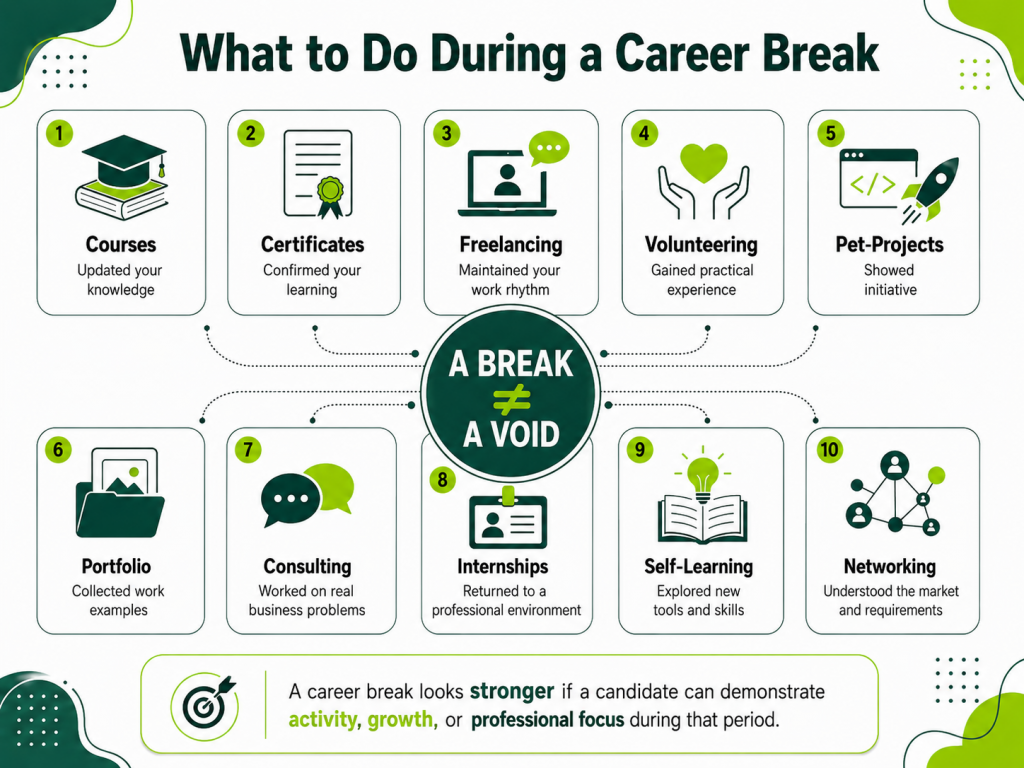
How to Talk About a Career Break If You Did Nothing Professional During It
This also happens.
A person genuinely rested, recovered, handled personal matters, dealt with everyday issues, or came back to themselves after a difficult period.
You do not need to urgently invent “strategic self-development with deep market analytics” if the main achievement was finally sleeping normally again.
You can say it honestly and calmly.
Example
“During that period, I was dealing with personal matters and recovery. Closer to returning to the market, I updated my CV, studied current requirements, and started preparing for interviews. I’m now ready for a working routine and understand which roles interest me.”
Why this is acceptable
Employers care more about your readiness now than about the perfect productivity of every month of your break.
But before the interview, it is still worth doing at least some basic preparation:
- update your CV;
- read recent job descriptions;
- review key tools;
- prepare examples from your experience;
- go through typical interview questions;
- define your career goal.
Even if the break itself was fully personal, your return should look prepared.
What to Say If the Recruiter Pushes Too Hard
Sometimes the question is asked normally.
Sometimes the interviewer starts digging deeper than necessary.
Your task is to maintain boundaries.
Calm answer
“It was a personal period that has now ended. I’m ready to work and can tell you in more detail how my experience fits your vacancy.”
If they ask for health details
“I prefer not to discuss medical details. I’m now ready for full-time work and understand the expectations of the role.”
If they ask for family details
“These were family circumstances that required my involvement. The matter is now resolved, and I’m ready for the working schedule.”
If they return to the topic several times
“I understand your question. The break did happen, the reason is now resolved, and I’m ready to work. Let me explain in more detail which tasks I can take on in this position.”
This politely brings the conversation back to the professional topic.
How Not to Sound Guilty
Many candidates turn the break into a problem themselves.
They start apologizing, overexplaining, and lowering their own value in advance.
Phrases to avoid
- “I understand this looks bad…”
- “This is probably a disadvantage…”
- “Unfortunately, I had a break…”
- “I dropped out of the market…”
- “I’ll have to catch up…”
- “I haven’t worked for a long time, so I don’t know if I’m suitable…”
Better alternatives
- “During that period, I had a career break.”
- “I’m now ready to return to work.”
- “I updated my professional knowledge.”
- “I understand the current requirements of the role.”
- “My previous experience is relevant to this vacancy.”
- “I’m ready to take on tasks.”
Example replacement
Weak
“I understand the break looks strange, but I really am ready to work.”
Stronger
“I had a career break, and that period is now over. I’m ready for full-time work and understand which tasks I want to take on next.”
How to Connect the Career Break to Your Motivation
The employer needs to understand not only your past, but also your future.
After explaining the break, always show why the current role interests you.
Formula
“The break was connected to [reason]. I’m now ready to work and looking for a role where I can [your value to the company].”
Example
“The break was connected to relocation and adaptation. I’m now ready to work and looking for a role where I can use my experience in structured task management, communication, and delivering results.”
Another example
“After the layoff, I took time to review my career goals. I now understand that I want to develop in a role where responsibility, independence, and clear business tasks are important.”
This moves the conversation from the past to the future.
What to Do Before the Interview If Your CV Has a Career Break
Preparation solves half the problem.
The other half is a normal voice and not looking like “I’m about to be exposed.”
Step 1. Write down the real reason
No polished wording.
Just for yourself.
For example:
- burnout;
- relocation;
- caring for a family member;
- long job search;
- learning;
- childcare;
- freelance attempt;
- personal project;
- recovery;
- layoff.
Step 2. Reduce it to one sentence
Example:
“The break was connected to relocation and adaptation.”
Or:
“The break was connected to family circumstances.”
Or:
“After the layoff, I took time to find a suitable role.”
Step 3. Add your readiness now
“The situation is now resolved, and I’m ready for full-time work.”
Step 4. Add a professional bridge
“During that time, I updated my knowledge, studied current requirements, and prepared to return to the market.”
Step 5. Connect it to the vacancy
“This role interests me because it includes tasks that are close to my previous experience.”
Final answer
“The break was connected to relocation and adaptation. All organizational matters are now resolved, and I’m ready for full-time work. During that time, I updated my CV, studied current market requirements, and focused on roles where I can use my experience in structured task management and communication.”
Universal Answer Templates
Below are ready-made versions you can adapt to your situation.
Short universal answer
“Yes, I had a career break. It was connected to personal circumstances that are now resolved. I’m ready for full-time work and have already updated my professional knowledge according to current market requirements.”
Answer for a break after leaving a job
“After my previous role ended, I took time to find a suitable position. I wanted to choose a role where my experience would be genuinely useful. I’m now actively considering vacancies and ready to return to the working process.”
Answer for a break after a layoff
“My previous position was closed as part of company changes. After that, I used the time to update my CV, analyze the market, and prepare for the next stage. I’m now looking for a role where I can apply my experience and deliver clear results.”
Answer for a break because of burnout
“After an intensive work period, I took a pause to recover. I’m now ready for a working routine, have updated my professional knowledge, and am choosing my next role consciously, with clear expectations and tasks.”
Answer for a break because of family circumstances
“During that period, I was dealing with family matters that required my involvement. The situation is now resolved, so I’m ready to return to full-time work.”
Answer for a break because of learning
“I took a break to update my knowledge and prepare for the next professional stage. During that time, I completed training, worked on practical assignments, and now want to apply these skills in real work tasks.”
Answer for a break because of relocation
“The break was connected to relocation and adaptation. The organizational matters are now resolved, I understand which work format suits me, and I’m ready for full-time employment.”
Answer for a break because of a personal project
“During that period, I was working on a personal project: planning tasks, testing hypotheses, and organizing the process. I now want to return to team-based work and use that experience in a more stable role.”
Answer for a break because of freelance work
“Formally, there was a break between full-time roles, but during that period I worked on project-based tasks. I now want to move into a permanent role where I can be more deeply involved in the team’s work and continue developing.”
Answer for a long break
“I had an extended career break due to personal circumstances. That period is now over. I have updated my professional knowledge, studied current requirements, and I’m ready for full-time work.”
How to Explain a Career Break If You Are Worried About Age
Sometimes candidates worry that a career break will strengthen age-related stereotypes:
“They’ll think I’m behind.”
“They’ll decide it’s hard for me to adapt.”
“They’ll choose someone younger.”
This is exactly where it is important to speak through the relevance of your skills.
Good answer
“During that period, I updated my professional knowledge and followed changes in my field. I now understand the current requirements of the role and am ready to apply my experience to relevant tasks.”
What to prepare
- recent work examples;
- list of tools you have used;
- proof of learning;
- understanding of modern processes;
- readiness for a new work format;
- examples of adapting to change.
Age itself is rarely discussed directly in interviews.
The relevance of your experience is discussed all the time.
How to Explain a Career Break If You Are Worried About Salary Questions
Sometimes a break is connected to the fact that a person spent a long time looking for a job with suitable compensation.
You can talk about this carefully.
Weak version
“I didn’t want to agree to a low salary.”
Strong version
“I was considering positions where the tasks, level of responsibility, and conditions matched. It is important to me that the new role is stable and mutually suitable for both the company and me.”
This way, you do not look like a person who evaluates a vacancy only by the number.
Although let’s be honest: everyone evaluates it by the number too.
It is just better to phrase it more broadly in an interview.
How to Explain a Career Break After a Failed Probation Period
This is a delicate situation.
If there was a short employment period followed by a break, the recruiter may ask what happened.
It is important to be honest, but not self-deprecating or accusatory.
Example
“The company and I realized that the expectations for the role and the actual tasks were different. After that, I took time to choose my next position more carefully. It is important for me now to discuss responsibilities, expectations, and success criteria in advance.”
What this answer shows
- you can acknowledge a mismatch;
- you made conclusions;
- you do not blame everyone around you;
- you are more careful when choosing a role.
What to avoid
Do not say:
“They misunderstood me.”
Better:
“The role expectations did not match the actual tasks.”
That sounds calmer.
How to Explain a Career Break After a Workplace Conflict
If your departure was connected to a conflict, do not describe the conflict in detail.
It is better to talk about a mismatch in expectations, processes, or working approaches.
Example
“I realized that the work format and approach to processes in that team were not the right fit for me. After leaving, I took a pause to choose my next role more consciously. Clear tasks, transparent communication, and the ability to take responsibility for results are important to me now.”
Why this works
You do not make the previous company the main character of the conversation.
The main character is your professional choice.
How to Answer: “Why Were You Not Working for So Long?”
Sometimes the question sounds blunt.
It is easy to get tense in that moment.
But it is still better to answer calmly.
Option 1
“During that period, I had personal circumstances that required time. They are now resolved, I’m ready to work, and I’m actively returning to the professional context.”
Option 2
“The search for a suitable role took longer than I expected. I used this period to analyze the market, update my skills, and prepare for the next stage.”
Option 3
“I consciously took a pause after an intensive work period. I’ve now recovered, understand my professional goals, and am ready for full-time employment.”
How to strengthen the answer
Add one sentence about the vacancy:
“This position interests me because it includes tasks that are close to my previous experience.”
That way, you do not stay stuck in the past.
How to Answer: “Haven’t You Lost Your Qualification?”
This question may be asked directly or indirectly.
The answer should be specific.
Strong answer
“I understand the question. To keep my skills up to date, I studied vacancy requirements, updated my knowledge of key tools, and completed practical assignments. My previous experience remains relevant, and I have already prepared for the new requirements.”
Another version
“During the break, I updated my professional foundation and understand which tools and approaches are currently expected from candidates. I’m ready to share work examples and explain in more detail how my experience fits your tasks.”
What you can provide
- portfolio;
- test task;
- training project;
- list of tools;
- recommendations;
- short plan for entering the role.
How to Answer: “Why Did You Decide to Return Now?”
This question checks readiness and motivation.
Example
“The circumstances now allow me to return to work fully. I have prepared for the search, updated my professional materials, and understand the direction I want to move in next.”
More specific version
“I have resolved the personal matters that required my attention and am now ready for stable employment. I’m interested in tasks where I can apply my experience, work with clear goals, and see results.”
Good final emphasis
“I’m not just returning to the market. I understand which role I’m looking for and why it fits me.”
How to Answer: “What Were You Doing During the Break?”
Here, balance matters.
You do not need to list every month, but you should show useful activity.
Answer structure
- Main reason.
- What you did additionally.
- How you prepared to return.
- Why you are useful now.
Example
“The main reason for the break was personal. At the same time, I followed the market, updated my knowledge, reviewed my CV, and prepared for interviews. I’m now ready to work and understand which tasks I want to take on next.”
If there were projects
“During that period, I worked on several project-based tasks, so I did not fully step away from the professional environment. I now want to move into a permanent role and be more deeply involved in a team’s work.”
If there was learning
“I completed training, worked through practical assignments, and updated my professional foundation. I now want to apply this knowledge in real tasks.”
How Not to Overdo the Positivity
Sometimes candidates try to turn every break into a story of incredible growth.
It can sound strange.
“It was the best period of my life. I completely rethought my career, became a new person, and now I’m ready to conquer the world.”
Beautiful, maybe.
A little too theatrical for an interview.
Better:
“This period helped me recover, review my goals, and choose the next step more calmly.”
That is enough.
The employer is not expecting an inspirational speech.
They need a clear story and confidence that you are ready.
How to Answer If the Break Was Forced
Sometimes a pause is not planned: the market slows down, a project closes, the search takes longer, or personal circumstances pile up at the same time.
You can say that directly.
Example
“The break turned out longer than I planned. It was affected by personal circumstances and a longer search for a suitable role. The situation has now changed, I’m ready to work, and I’m focused on vacancies where my experience will be relevant.”
What works here
You do not pretend everything was perfect.
But you show control over the current situation.
How to Answer If You Worked Informally
If you had informal tasks during the break, one-off projects, helped acquaintances, or gave consultations, you can mention it carefully.
Example
“During that period, I did not have full-time employment, but I completed individual project-based tasks. They helped me maintain a working rhythm and refresh my skills. I’m now looking for a permanent role.”
What not to do
Do not exaggerate the scale.
If you completed three small tasks, do not turn them into “a full-cycle consulting practice.”
Recruiters know how to ask follow-up questions.
Sometimes too well.
How to Prepare Your CV After a Career Break
The interview begins with the CV.
If the CV looks clean and structured, the question about the break already feels less tense.
What to do
- Check the chronology.
- Remove date confusion.
- Add project work if you had any.
- Update the skills section.
- Add a short summary.
- Include relevant achievements.
- Prepare a portfolio or work examples.
- Define your career goal.
Example summary
Specialist with experience in operational and project-based tasks. Returning to full-time work after a career break, with updated professional knowledge and a focus on roles where structure, communication, and results matter.
If the break was long
Add a section:
Professional Development During Career Break
- updated knowledge of key tools;
- practical assignments;
- project work;
- portfolio preparation;
- market and vacancy requirement analysis.
How to Prepare LinkedIn or a Job Platform Profile
If you use professional platforms, your profile should support your story.
What to update
- profile headline;
- experience description;
- “About” section;
- skills;
- portfolio;
- recommendations;
- job search status;
- projects.
Example description
Returning to active work after a career break. I have updated my professional knowledge, studied current market requirements, and am considering roles where I can apply my experience in structured task management, communication, and results delivery.
Important nuance
Your profile should sound confident.
Do not start with:
“Trying to return after a long break…”
Better:
“Returning to active work after a career break.”
The difference is small.
The impression is different.
How to Practice Your Answer Before the Interview
It is better to say your answer about the break out loud several times.
In your head, it almost always sounds better than in reality.
In reality, there are “uh,” “well,” “kind of,” “basically,” “to be honest,” and a sudden desire to retell your entire biography starting from 2011.
Exercise
- Write your answer in 4–5 sentences.
- Cut it down to 3 sentences.
- Say it out loud.
- Remove unnecessary details.
- Add a final sentence about your readiness to work.
- Record yourself.
- Remove the anxious tone.
Good answer length
Optimal: 30–60 seconds.
If the recruiter wants more details, they will ask.
What to Do If You Start Answering Badly
Sometimes a candidate gets nervous and starts rambling.
That is normal.
You can stop and rephrase.
Rescue phrase
“Let me put it more simply: the break was connected to personal circumstances, they are now resolved, and I’m ready for full-time work.”
Or:
“In short, it was a period of recovery and preparation for the next stage. I’m now ready to return to work.”
This phrase helps you regain control of the answer.
Weak vs Strong Answers
Situation: Break after leaving a job
Weak answer
“I couldn’t find anything for a long time. The market was terrible, and there were no decent vacancies.”
Strong answer
“The search took longer than I expected. I used this period to update my CV, analyze the market, and focus on roles where my experience is genuinely relevant.”
Situation: Family circumstances
Weak answer
“There was a lot going on. It’s hard to explain. Family problems.”
Strong answer
“During that period, I was dealing with family matters that required my involvement. The situation is now resolved, and I’m ready for full-time work.”
Situation: Burnout
Weak answer
“I just couldn’t work anymore. I was completely fed up with everything.”
Strong answer
“After an intensive period, I took a pause to recover. I’m now ready for a working routine and am choosing a role with clear expectations more carefully.”
Situation: Learning
Weak answer
“I studied, watched different videos, tried to figure things out.”
Strong answer
“I took a break to update my knowledge. During that time, I completed training, worked through practical assignments, and prepared materials I can share.”
Situation: Relocation
Weak answer
“The move ruined everything. It was difficult, and it took me a long time to get back to normal.”
Strong answer
“The break was connected to relocation and adaptation. The organizational matters are now resolved, I’m ready to work, and I understand which employment format suits me.”
Checklist: How to Explain a Career Break
Before the interview, check yourself.
- I can explain the reason for the break in one sentence.
- I do not go into unnecessary personal details.
- I do not speak negatively about my previous company.
- I do not apologize for the break.
- I can explain what I did during that period.
- I understand why I am ready to return now.
- I can connect my experience to the vacancy.
- I updated my CV.
- I prepared examples of work or achievements.
- I practiced my answer out loud.
- I can calmly answer follow-up questions.
- I know where my personal boundaries are.
Checklist: What Else to Prepare
If the break was long, prepare materials that strengthen your position.
- Updated CV.
- Short professional summary.
- Portfolio or work examples.
- List of current skills.
- Description of project work.
- Certificates or proof of learning, if available.
- Recommendations from previous roles.
- Answer to “Why now?”
- Answer to “What did you do during the break?”
- Answer to “Why are you interested in our vacancy?”
How to Move the Conversation Back to Your Strengths
After answering about the break, do not just wait for the next question with the facial expression of “well, now please decide my fate.”
It is better to add a transition:
“Speaking about my experience, the most relevant points for this vacancy are…”
Then name 2–3 strengths.
Example
“The break was connected to family circumstances. The situation is now resolved, and I’m ready to work. Speaking about my experience, the most relevant strengths for this role are task management, communication with different teams, and the ability to bring projects to completion.”
This shows that the topic is closed.
Now you are moving to value.
What to Do If the Employer Still Has Doubts
Sometimes after your answer, the recruiter may ask:
“How quickly will you be able to get back into a working rhythm?”
Prepare a calm answer.
Example
“I understand that adaptation is important after a break. I have already updated my knowledge, studied market requirements, and am ready to get involved quickly. In the first weeks, it will be important for me to align on tasks, expectations, and processes so I can reach stable results.”
If they ask about speed
“I’m ready for the working schedule. To get started quickly, I’ll need context on tasks, priorities, and success criteria.”
If they ask about skill relevance
“I have updated my professional knowledge and understand the current requirements of the role. I’m ready to complete a test task or discuss relevant cases from my previous experience in more detail.”
How to Show That You Are Ready to Work
Readiness is not only the phrase “I’m ready.”
It can be shown through specific actions.
What shows readiness
- you know which role you are looking for;
- your CV is updated;
- your skills are refreshed;
- you are attending interviews;
- you understand vacancy requirements;
- you can explain your experience;
- you are ready to discuss schedule;
- you have work examples;
- you understand what team format suits you;
- you can start within a clear timeframe.
Example phrase
“I’ve already returned to an active job search, updated my professional materials, and am attending interviews. I’m now ready to consider offers and start work within an agreed timeframe.”
How to Answer If You Are Not 100% Confident Yet
Sometimes a person is ready to return, but still feels anxious inside.
That is normal.
You do not need to explain your entire internal process in the interview.
You can speak through preparation:
“I understand that returning after a break requires adaptation. That is why I updated my knowledge in advance, studied vacancy requirements, and prepared examples from my experience. I’m ready to enter the role gradually, but actively.”
That is a mature position.
How to Explain a Career Break to a Hiring Manager in the Final Interview
At the final interview, the question may sound different.
The hiring manager is usually less interested in the formal reason and more interested in the risks for the team.
They may be thinking:
- how quickly this person will get into the tasks;
- whether they can handle the workload;
- whether they will leave again in a couple of months;
- whether their experience is still current;
- how the candidate handles responsibility.
Answer for a hiring manager
“The break was connected to personal circumstances, and they are now resolved. I understand that stability is important for the team, so I assessed my readiness for a working routine in advance. I’m ready to get involved in tasks, quickly align on priorities, and take responsibility for results.”
If the manager asks about workload
“I’m ready for the working rhythm. At the start, it is important for me to clearly understand priorities, expectations, and the communication format so I can reach the required level of results faster.”
How to Explain a Career Break Without Feeling Judged for the Past
An interview does evaluate your previous experience, but the decision is not based only on the past.
The employer looks at your current usefulness.
A career break is part of your biography.
But offers are given for something else:
- skills;
- experience;
- motivation;
- maturity;
- readiness to solve tasks;
- communication;
- aligned expectations;
- clear potential.
Do not give the break the central place in the interview.
It is one question, not your entire professional identity.
Mini Interview Scenario
Here is what a good dialogue can look like.
Recruiter
I see that you had a career break of about a year. What was it related to?
Candidate
Yes, I had a career break due to personal circumstances. That period is now over, and I’m ready for full-time work.
Recruiter
What were you doing professionally during that time?
Candidate
Closer to returning to the market, I updated my CV, studied current vacancy requirements, reviewed key tools, and prepared examples from my experience. I’m now attending interviews and focusing on roles where I can use my previous experience.
Recruiter
Why are you interested in our vacancy?
Candidate
The tasks described in the vacancy are close to my experience: structured work, communication with different stakeholders, and a focus on results. I had similar tasks in my previous roles, so I understand how I can be useful.
Short.
Calm.
Professional.
Frequently Asked Questions
Should I tell the truth?
Yes, but in a professional form.
The truth does not have to include every personal detail.
You can honestly say:
“The break was connected to personal circumstances.”
That is enough.
Can I say I was learning if I studied irregularly?
Yes, if it is true.
It is better not to exaggerate.
Good wording:
“I spent part of the time updating my knowledge and preparing to return to the market.”
Should I mention the career break in my CV?
If the break is long, it can sometimes be useful to mention it.
If it is short, you can simply prepare an answer.
What counts as a long career break?
Questions usually appear when the pause is visible in the dates: several months or more.
But much depends on the field, role level, and overall logic of the CV.
Can a career break hurt my chances?
It can, if the candidate is not ready to explain it.
If the explanation is calm and the experience is relevant, the break rarely becomes the deciding factor.
What matters more: the reason for the break or readiness now?
Readiness now.
The reason explains the past.
Readiness shows the future.
Final Answer Formula
Remember this simple structure:
“I had a break because of [short reason]. The situation is now [over / resolved / stable]. I’m ready to work, and during this time I [updated my knowledge / prepared / worked on projects / studied the market]. This vacancy interests me because [connection to experience].”
Example
“I had a break because of relocation and adaptation. The organizational matters are now resolved, and I’m ready for full-time work. During that time, I updated my CV, studied current market requirements, and focused on roles where I can use my experience in structured task management. This vacancy interests me because it includes similar tasks and a clear area of responsibility.”
Conclusion
A career break does not need to be hidden, dramatized, or explained as if you are standing before a career court.
It is a normal stage that can be presented calmly and professionally.
The key is to prepare a short answer, avoid unnecessary details, and show that you are ready to work now.
Employers do not look only at a gap in your CV. They look at how you explain your path, how confidently you speak about yourself, and what value you can bring to the team.
A good explanation of a career break is built on four things:
- an honest short reason;
- a calm tone;
- proof of readiness;
- connection to the current vacancy.
If you can say:
“Yes, there was a break. Here is why. I’m ready now. Here is how I can be useful.”
Then the topic stops being a weak point.
After that, the conversation can move where it should: to your experience, your tasks, and your future work.
That is exactly where you want to lead the interview.