

How to Find a Remote Job While Based in the CIS Region
Remote work stopped being something from the “lucky IT people get to sit at home in slippers and earn money for looking thoughtfully at a monitor” category a long time ago. In 2026, it is a full-fledged work format with its own rules, competition, screenings, interviews, deadlines, calls, chats, tasks, edits, and that one Friday evening message: “Team, quick question.”
The good news is that finding a remote job while living in the CIS region is absolutely possible.
The bad news: simply writing “I want remote work” in your CV no longer works.
Employers have become more selective, there are more candidates, and remote vacancies often collect dozens or even hundreds of applications in the first few days.
So the goal is not just to find remote vacancies. The goal is to find decent vacancies, understand which companies are actually a good fit for you as a candidate based in the CIS region, prepare your CV for a remote format, apply like a real person rather than a mailing-list bot, pass the online interview, and avoid situations where instead of a job you are offered “paid access to a task database first.”
Let’s break it down step by step: where to search, how to choose vacancies, what to write in your CV, how to apply, what to ask during the interview, and which red flags are better to spot before you are already sitting in the work chat wondering who your manager is.
Why Finding Remote Work Has Become Harder in 2026
Something interesting happened to remote work. At first, many people saw it as a perk: if a company allowed employees to work from home, that meant it was modern, flexible, almost a dream.
Then remote work became widespread. After that, the market calmed down, employers recalculated their processes and started asking more mature questions.
Not “can this person sit at home with a laptop,” but:
- How do they manage tasks without constant supervision?
- Can they write clearly?
- Can they clarify missing information on their own?
- Do they disappear after receiving a task?
- Do they understand how to work with deadlines?
- Can they use work tools properly?
- Can they show results, not just activity?
- Can they work with AI tools, automation, and digital services?
- How much can they be trusted in a distributed team?
In an office, a lot was solved through presence. A person is sitting at a desk, so it looks like they are working. In remote work, that magic disappears. Nobody sees how heroically you opened your laptop at 9:58. What they see is tasks, communication, deadlines, and results.
That is why searching for a remote job in 2026 is not only about “where to find a vacancy.” It is about how to prove to an employer that you are easy to work with at a distance — especially when the team, manager, or clients may be in another city, country, or time zone.
And this brings us to the first important idea: remote work is not the absence of an office. It is a format where independence, clear communication, and accountability matter especially strongly.
You can be a strong specialist and still be a poor fit for remote work if everything falls apart without constant reminders. And you can be not the loudest candidate in an interview, but still get the offer if you show that you can think, clarify, document agreements, and bring tasks to completion.
What Types of Remote Work Are Available to Candidates Based in the CIS Region
When a job seeker looks for work online, they often imagine one big category: “remote.” But within it, there are different formats. And those differences affect everything: schedule, salary, expectations, level of freedom, time zones, legal setup, and even how calmly you can drink tea between tasks.
Fully Remote Work
This is a format where the company is ready from the start to work with an employee or contractor who is not tied to an office. The vacancy may be listed as remote, fully remote, work from home, online work, or distance work.
Here, it is important to clarify the details. Fully remote does not always mean “work whenever you want.” The company may have a fixed schedule, mandatory daily calls, working hours in a specific time zone, reporting, and clear communication rules.
For candidates based in the CIS region, time zone expectations matter a lot. A role may be remote, but still require overlap with Europe, the Gulf region, the US, or another market. This does not make the vacancy bad, but it should be clear before you enter the hiring process.
A good sign is when the vacancy already explains how remote work is organized: what tools the team uses, how tasks are assigned, how meetings are held, and which time zone the team works in.
A bad sign is when the vacancy only says “remote,” and when you ask about processes, the employer replies, “We’ll figure it out later.” Sometimes “we’ll figure it out” means you will be the one figuring it out. Alone.
Hybrid Work Disguised as Remote
Sometimes a vacancy looks remote, but turns out to be hybrid. For example, the company writes “remote work is possible,” and later it turns out that you need to come to the office once a week, attend in-person team meetings once a month, or be based in a specific city.
This is not necessarily bad. Hybrid is convenient for some people. But if you are based in the CIS region and are looking for a job without relocation, these details should be clarified right away.
Phrases worth double-checking:
- “remote format can be discussed”;
- “work from home is possible after probation”;
- “flexible format”;
- “office attendance is not required, but being nearby is preferred”;
- “occasional in-person meetings are needed”;
- “candidate should be able to visit the office if necessary.”
Behind these phrases, there may be genuine flexibility. Or it may be an office job temporarily pretending to be remote.
Remote-First Companies
Remote-first companies are companies where remote work is built into the processes. Not like this: “everyone is in the office, and you are somewhere on your kitchen chair with a laptop.” But like this: tasks, documents, meetings, decisions, and communication are organized from the beginning so the team can work in a distributed format.
These companies are often more comfortable for candidates based in the CIS region, because they are used to distributed teams, asynchronous communication, online onboarding, and cooperation across locations.
They usually have better documentation, task trackers, written communication, and process transparency. There are fewer situations where an important decision was made “near the coffee machine,” and the remote employee found out about it three days later by accident.
If you are choosing between two offers, a remote-first format is often more comfortable for real remote work.
Project-Based Remote Work
Some companies hire specialists for a project: launch a website, set up advertising, complete design tasks, conduct an audit, implement a CRM system, describe processes, or build a support team.
Project-based work can be convenient if you are based in the CIS region and want to work with clients or teams from different markets without immediately committing to long-term employment. It can also help you build a portfolio, collect cases, and gain experience with international or distributed teams.
But here it is especially important to document the terms: scope of work, deadlines, payment, stages, revisions, accesses, and responsibilities of both sides.
A project without a contract and clear boundaries can easily turn into a series called “Just One More Tiny Edit.” And that series usually has endless seasons.
Remote Work for Beginners
Remote work without experience also exists, but competition is higher.
It is harder for an employer to trust a candidate who cannot yet show strong cases, so they look at other signals:
- educational projects;
- internships;
- volunteer experience;
- personal projects;
- courses with solid practical assignments;
- test tasks;
- portfolio;
- careful communication;
- ability to learn quickly.
If you have little experience, your task is not to prove that you “really want to grow.” Everyone writes that. Your task is to show that you have already done something with your own hands and understand basic work logic.
Where to Look for Remote Vacancies
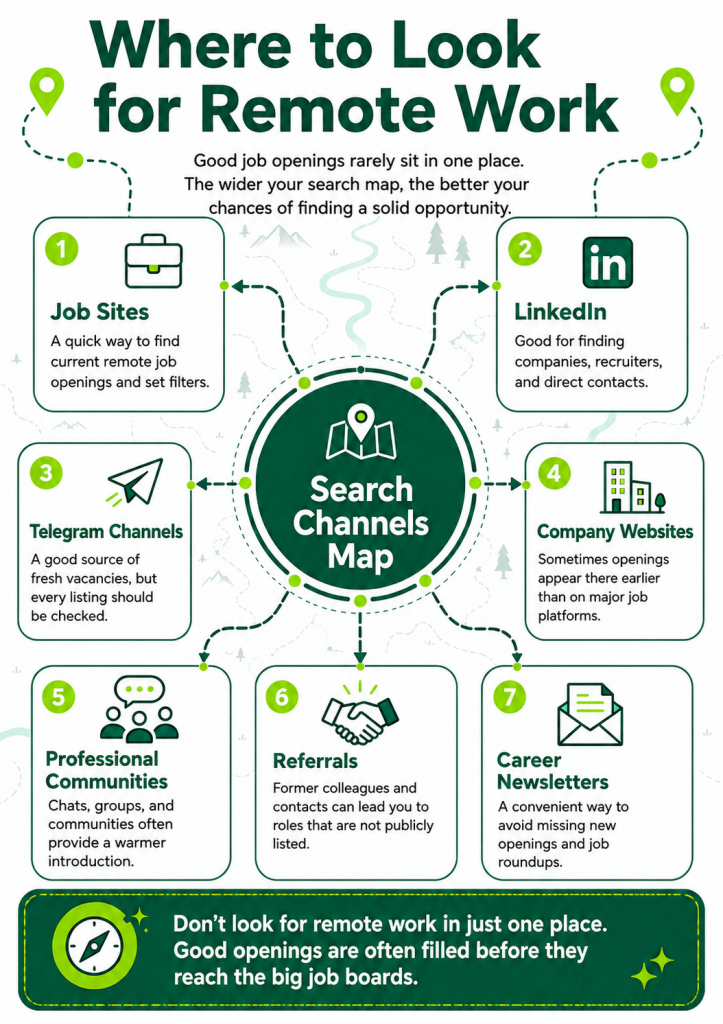
The biggest mistake in searching for remote work is using only one channel.
For example, opening one job site, typing “remote work,” applying to 15 vacancies, and deciding a week later that the market does not exist.
The market exists. It is simply distributed. Good vacancies may appear on company career pages, in Telegram channels, on LinkedIn, in professional communities, through referrals, on local job platforms, and even in posts from team leads.
That is why it is better to build your remote job search as a system.
Job Sites and Career Platforms
Job sites are the most obvious channel. They make it easy to filter vacancies by format, field, experience, salary, country, and schedule.
What matters:
- use different search terms: “remote work,” “work from home,” “online work,” “distance work,” “remote,” “fully remote”;
- save search filters;
- set up notifications;
- apply quickly, especially to fresh vacancies;
- do not limit yourself to the first page of results;
- check when the vacancy was posted or updated;
- check whether the company accepts candidates from your location.
For candidates based in the CIS region, location filters can be tricky. Some companies write “remote,” but only consider candidates from specific countries. Others are open to hiring globally, but require certain time zone overlap. Always check this before investing time in a long application or test task.
Competition on job sites is high because everyone goes there. It is like the central job market: noisy, crowded, everyone is holding a CV, and someone is already negotiating an offer.
But this channel should not be ignored. It simply should not be your only one.
LinkedIn and Professional Social Networks
LinkedIn is useful not only for international vacancies. Many companies use it to find specialists, post jobs, check profiles, and communicate directly with candidates.
For candidates based in the CIS region, LinkedIn is especially useful because it allows you to show your profile beyond local job boards. A well-filled profile can help you be found by recruiters who are open to remote cooperation.
For LinkedIn to work, your profile needs to be filled out. Not perfectly, not like a museum of career achievements, but clearly:
- who are you?
- what can you do?
- which areas do you work in?
- what projects have you worked on?
- what tools do you use?
- what work format are you considering?
- where are you based?
- which time zones can you work with?
- how can someone contact you?
A common mistake is having an empty profile and expecting a recruiter to sense your potential through your profile photo. Recruiters have seen a lot, of course, but telepathy is still rarely part of HR competencies.
On LinkedIn, you can search for vacancies directly, follow companies, add recruiters, comment on professional posts, and write short messages to hiring managers.
A good message does not look like this:
“Hello, do you have a job?”
It looks like this:
“Hello. I saw that your team is looking for a specialist for a remote role. I’m based in [country/region] and can work with [time zone/overlap]. I have experience with similar tasks: [1–2 specific points]. I’d be happy to discuss it if my profile looks relevant.”
Short, calm, and without pressure.
Telegram Channels with Vacancies
Telegram remains a strong channel for finding remote work for candidates based in the CIS region. Vacancies appear there quickly, especially in IT, marketing, design, support, HR, sales, project management, and related digital fields.
The advantages of Telegram:
- vacancies appear quickly;
- there is often a direct contact;
- you can find smaller companies and startups;
- there are many niche channels.
The disadvantages:
- vacancy quality varies;
- many posts are duplicated;
- conditions are often described briefly;
- employers need to be checked more carefully;
- questionable offers do appear.
If you search for remote work through Telegram, create a separate folder with channels and check it regularly. But do not apply to everything in a row. Especially if the vacancy promises “income from $3,000 with no experience, 2 hours a day, full training, only a phone required.” Usually a phone really is required. So people can later call you with new “opportunities.”
Company Career Pages
Many candidates forget about direct searches through company websites. And they should not.
If you are interested in a specific company, go to its career page. Sometimes vacancies appear there earlier than on job sites. Sometimes the company does not post everything on external platforms at all, because it receives candidates directly or through referrals.
For candidates based in the CIS region, it is worth paying attention to whether the company mentions global hiring, remote-first culture, contractor agreements, relocation options, or accepted locations.
How to use this channel:
- make a list of companies where you would like to work;
- check their career pages;
- look for location notes in vacancies;
- follow their social media updates;
- see which HR specialists or team leads post about hiring;
- save relevant vacancies;
- send targeted applications.
This method is slower, but higher-quality. You are not just looking for “any remote job.” You are choosing companies where the format, product, team, and tasks may actually suit you.
Professional Communities
Professional communities include chats, forums, groups, private clubs, channels, and local communities in specific fields.
In these places, vacancies often look less formal, but the contact can be warmer. For example, a manager writes: “Looking for a remote designer, need someone with B2B experience.” Or an HR specialist posts a vacancy in a specialized community where the right audience is already present.
For candidates based in the CIS region, communities can be especially useful because they often share opportunities that do not reach large job boards. Some roles are closed through networks before they ever become public.
For this channel to work, it is important not to show up only at the moment when you need to say, “give me a job.” It is better to be a participant: read, ask questions, answer, share experience, show cases.
Networking is not when you write to a stranger once: “Recommend me somewhere.” It is when people already have an impression of you as a competent professional.
Referrals
Referrals remain one of the strongest ways to find a job. Especially a remote one. It is easier for an employer to trust a candidate when someone from the team or professional circle can already say: “Yes, this person is reliable, gets tasks done, and doesn’t disappear in chats.”
What you can do:
- tell former colleagues that you are looking for remote work;
- write to people you know in your professional field;
- update your LinkedIn status;
- ask for recommendations from people you worked well with;
- briefly explain what roles you are considering;
- mention your location and comfortable time zones if relevant.
Important: do not send everyone a long dramatic story about your job search. It is better to keep it short and specific:
“Hi. I’m currently considering remote roles in [field]. I’m based in [country/region] and can work with [time zone/overlap]. I’m interested in tasks related to [type of tasks]. If your team or someone you know has something relevant, I’d be grateful for a referral. I can send my CV and portfolio.”
That makes it easier for the person to understand how to help.
How to Understand Whether a Vacancy Really Fits a Remote Format
Not every vacancy with the word “remote” is actually suitable for normal remote work. Sometimes behind a nice description there is chaos, no processes, strange payment terms, or the expectation that you will be available 24/7 because “you’re at home anyway.”
Before applying, it is worth quickly checking the vacancy.
What to Look for in the Description
A good remote vacancy usually answers several questions:
- What tasks need to be done?
- What experience is required?
- What tools are used?
- What is the work format?
- What is the schedule?
- What is the team like?
- Who is the manager?
- How does the selection process work?
- What are the payment terms?
- Is there a contract or contractor agreement?
- How is the probation period organized?
- Are candidates from your location considered?
- Which time zone does the team work in?
The description does not have to be perfect. But if a vacancy consists of phrases like “looking for an active person for a friendly team, high income, details in DM,” it is better to slow down.
A good description does not hide behind fog. It does not need to be a literary masterpiece, but it should give you an understanding of what awaits you.
Phrases That Should Make You Cautious
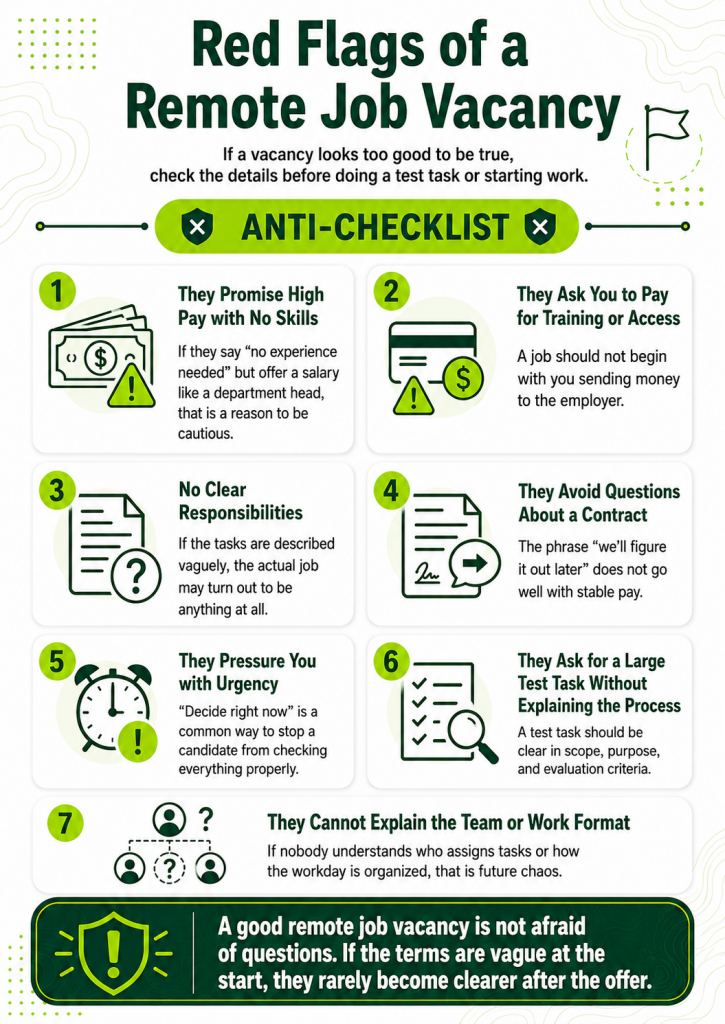
Some phrases are a reason to turn on your internal checker. Not panic, not close the vacancy immediately, but check.
For example:
- “unlimited income”;
- “payment after training, training is paid”;
- “looking for people with no experience, we’ll teach you everything, high income from the first week”;
- “2–3 hours a day, salary like a department head”;
- “you need to buy access first”;
- “details only after registration”;
- “large test task, payment is not discussed”;
- “we are a startup, so the first period is unpaid, but there are great prospects”;
- “we hire globally,” but no one can explain how payment or cooperation works.
Sometimes normal things can stand behind these phrases. For example, a startup may genuinely offer project work with bonuses. But if the terms are vague and they already want money, documents, access, or a large amount of unpaid work from you, it is better to step away from the screen and breathe the air of freedom.
How to Tell Fully Remote Work from “Sometimes You Can Work from Home”
Ask directly:
- “Is this a fully remote position or hybrid?”
- “Do I need to be located in a specific city or country?”
- “Do you consider candidates based in the CIS region?”
- “Are there any mandatory offline meetings?”
- “Which time zone does the team work in?”
- “What schedule is expected?”
- “Are there fixed hours when I need to be available?”
- “How do meetings and task assignments work?”
- “How does the company organize onboarding for remote employees?”
- “How is cooperation formalized for candidates based in another country?”
A normal employer answers these questions calmly. If someone gets irritated already at the clarification stage, imagine what work communication will look like in a month.
Remote work requires clarity. The less clarity you have before the offer, the more surprises you will have after it.
How to Prepare a CV for Remote Work
A CV for remote work should answer not only the question “what can you do,” but also “can this person be trusted with tasks at a distance?”
The employer wants to see that you are not just a specialist, but someone who can work without constant supervision, maintain communication, and show results.
Skills That Are Important to Show
For remote work, the following are especially important:
- independence;
- ability to manage tasks;
- written communication;
- accountability for deadlines;
- experience with online tools;
- ability to document agreements;
- transparency in the work process;
- ability to ask questions on time;
- digital literacy;
- ability to work with AI tools, if relevant to your profession;
- ability to work across locations and time zones.
You do not need to write a huge “personal qualities” block in your CV: responsible, stress-resistant, communicative, quick learner, punctual, kind to cats. The last one is important, of course, but the employer needs proof.
Instead of “responsible,” write:
“Managed tasks from initial brief to release, independently clarified requirements and agreed deadlines with the team.”
Instead of “communicative”:
“Worked in a distributed team, communicated through Slack/Telegram, documented decisions in shared documents and a task tracker.”
Instead of “can work remotely”:
“Organized tasks in Jira/Notion/Trello, participated in weekly calls, and prepared short progress updates.”
How to Describe Independent Work Experience
If you already have remote experience, make sure to show it. Even if the format was only partially remote.
For example:
“Worked in a distributed team of 8 people; tasks were assigned through a task tracker, and communication took place in work chats and weekly calls.”
“Independently managed a pool of tasks for client projects: clarified inputs, agreed deadlines, and submitted results for review.”
“Supported clients online: processed requests, documented statuses in the CRM, and escalated complex cases to specialized team members.”
“Prepared design mockups for a remote development team, handed over files, described screen states, and answered implementation questions.”
If you have not worked remotely before, look for elements that follow the same logic:
- independent task ownership;
- working with documents;
- online communication;
- project-based work;
- coordination with other departments;
- client management;
- CRM work;
- reporting;
- task coordination without constant supervision.
You can write:
“Although my main experience was office-based, part of the processes were handled online: tasks were documented in the CRM, reports were prepared in shared documents, and communication with clients and the team took place through messengers and email.”
This is honest and shows that you understand the work format.
How to Show Results, Not Just Responsibilities
Remote vacancies often receive many applications. That is why a CV made only of responsibilities looks dull:
“Managed social media.”
“Worked with clients.”
“Handled recruitment.”
“Did design.”
“Wrote texts.”
These phrases are not bad. They just do not help the employer choose you.
It is better to add context and results:
“Managed social media for a B2B project: prepared the content plan, assigned tasks to the designer, and analyzed post engagement.”
“Processed customer requests in online chat and CRM, helped reduce repeat requests through ready-made response templates.”
“Closed vacancies in digital roles: conducted initial screening, coordinated interviews, and supported candidates through to the offer stage.”
“Designed interfaces for a user account area: prepared mockups, described states, and handed over solutions to the development team.”
“Wrote SEO articles for an HR blog: worked with briefs, structure, keywords, and editorial revisions.”
The formula is simple:
what you did + for whom/why + using what + what result or area of responsibility you had.
What to Add to Your CV If You Have Not Worked Remotely Before
If you are looking for remote work without experience in the remote format itself, do not pretend you have that experience. It is better to show readiness through evidence.
Add:
- educational projects;
- personal projects;
- internships;
- volunteering;
- portfolio;
- cases;
- work samples;
- tools you can use;
- collaboration format;
- a short explanation of how you organize tasks.
For example:
“Ready for a remote format: I work with Notion, Google Docs, Trello, Figma, and Zoom; I can document tasks in writing and provide regular progress updates.”
For a beginner, this is already better than simply writing “I want to work remotely because it’s convenient.”
How to Strengthen Your Profile Before Applying
A CV is the foundation. But for remote work, it is often not the only deciding factor.
The employer wants to quickly understand whether they can see your work, check your thinking style, and look at examples of your results.
Portfolio, Cases, and Work Samples
A portfolio is not only for designers. It is useful for almost all digital specialists.
A marketer can show:
- campaign structure;
- a content plan example;
- test results;
- analytics;
- approach description.
An HR specialist can show:
- recruitment funnel;
- example of candidate communication;
- onboarding process description;
- vacancy closing cases.
A support specialist can show:
- response template examples;
- request handling logic;
- complex case descriptions;
- knowledge base improvements.
A manager can show:
- project plan;
- task structure;
- status table;
- team coordination description.
A copywriter can show:
- articles;
- landing pages;
- email sequences;
- posts;
- SEO texts.
A developer can show:
- GitHub;
- README;
- demo;
- role description in the project;
- technologies.
Important: a portfolio should not be a giant warehouse of everything you have ever done. It is better to have 3–6 strong examples with explanations than 40 files named “final_definitely_last_new2.”
LinkedIn or a Professional Profile
A professional profile helps the employer assemble the picture faster. Especially if you are based in the CIS region and applying to remote teams that may be distributed across different countries.
What is worth adding:
- clear headline;
- short summary;
- experience;
- key skills;
- projects;
- portfolio link;
- contacts;
- status showing that you are open to remote roles;
- location and time zone, if relevant;
- preferred work format.
A profile summary can be simple:
“I help digital teams build clear communication with clients and users. I have worked with CRM systems, online chats, knowledge bases, and internal support processes. I am based in [country/region] and considering remote roles in product and service teams.”
There is no need to sound pompous. “I create synergy of meanings in the era of digital transformation” may sound beautiful, but after reading it, the natural question is: what tasks does this person actually do?
Short Self-Presentation
For applications and interviews, prepare a short text about yourself. Not 12 minutes long, not starting with your childhood, not beginning with “ever since school, I realized…” Keep it short.
Structure:
- Who are you?
- What experience do you have?
- What tasks have you worked on?
- What format are you looking for?
- Where are you based, if location matters?
- Why are you a good fit?
Example:
“I am a project manager with experience managing digital projects. I coordinated tasks between clients, designers, developers, and marketing, worked with task trackers, deadlines, and reporting. I am based in [country/region] and considering remote roles because I am used to managing communication online and documenting agreements in writing.”
For a designer:
“I am a UX/UI designer working on interfaces for web services and user account areas. I can not only create mockups, but also describe state logic, prepare files for development, and discuss solutions with the team. I am looking for remote work in a product or project-based team.”
For support:
“I am a customer support specialist with experience in chats, CRM systems, and knowledge bases. I can quickly understand a request, communicate calmly with users, and escalate complex cases to the team. I am interested in a remote format with clear processes and team communication.”
This kind of prepared text will be useful in a cover letter, on LinkedIn, in Telegram, and during interviews.
Recommendations and References
If you have former managers, clients, or colleagues who can confirm your experience, ask for a short recommendation. Do not wait for someone to spontaneously write a career hymn in your honor.
You can ask like this:
“Hi. I’m updating my profile and looking for remote work. I’d be grateful if you could write a short recommendation about our joint project: what tasks I handled and how I was useful to the team.”
A good recommendation does not have to be long. The main thing is that it confirms specifics: tasks, results, collaboration, responsibility.
How to Apply for Remote Vacancies
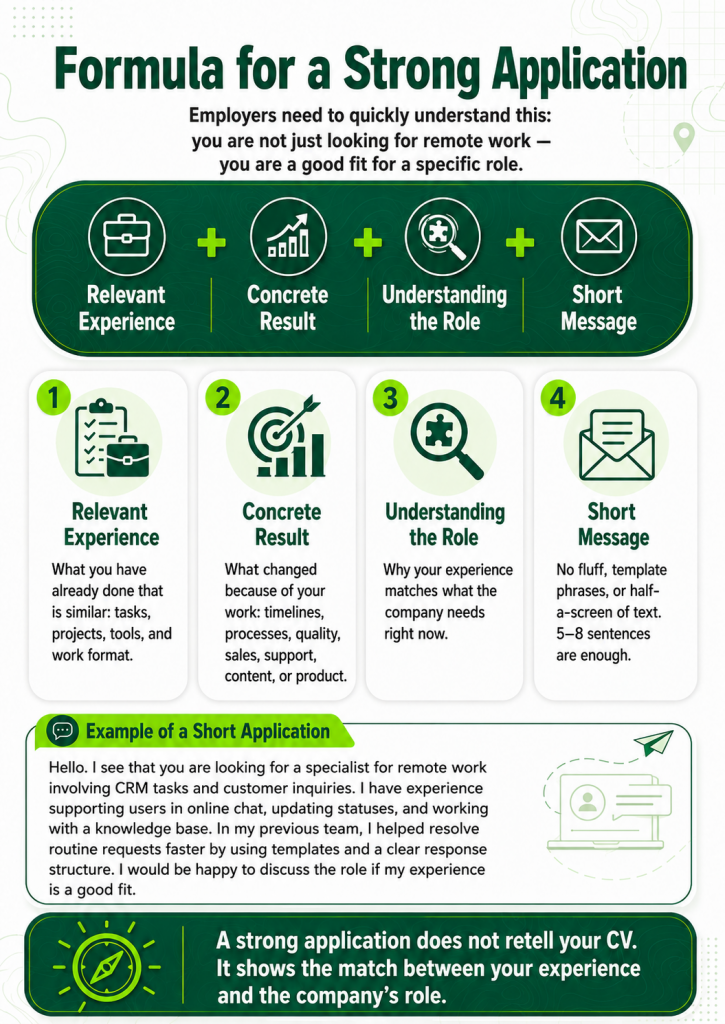
An application is not a button that sends your CV into outer space. It is a small pitch of your relevance.
The employer receives many applications. Some candidates do not fit at all. Some do fit, but it is not clear from their CV. Some send the same text to everyone. Your task is to make it clear in the first 20–40 seconds that you read the vacancy and understand why you are applying.
Why Mass Applications Work Worse
A mass application usually looks like this:
“Hello. I’m interested in the vacancy. Please consider my CV.”
This is not a disaster. But if the vacancy is competitive, this kind of application gets lost easily.
The problem with mass applications is that they do not answer the employer’s main question: why exactly are you a good fit for this role?
Especially in remote work, where there are more candidates. If a company is ready to hire without office location limits, the geography becomes wider. And that means competition becomes wider too.
That is why it is better to send 10 targeted applications than 70 identical ones. Yes, it sounds less heroic. But it works better.
How to Adapt an Application to a Vacancy
Before applying, quickly analyze the vacancy:
- Which tasks are repeated?
- Which tools are important?
- What experience is required?
- What does the company emphasize?
- What is the work format?
- What qualities are clearly expected?
- Does the vacancy mention location or time zone requirements?
Then show the match.
For example, the vacancy says:
“Looking for a support specialist, experience with online chats, CRM, knowledge base, remote format, shift schedule.”
In the application, you can write:
“Hello. I’m interested in the support specialist vacancy. I have experience working with online chats and CRM systems: I processed user requests, documented statuses, and helped update the knowledge base. The remote format works for me: I can work on a shift schedule and maintain communication in work chats.”
This is no longer a template. It is a response to a specific vacancy.
What to Write in a Cover Letter
A cover letter for remote work should be short. You do not need to retell your whole CV. You do not need to write “I have dreamed of working specifically at your company since childhood” if you learned about the company 11 minutes ago.
A good structure:
- Greeting;
- Why the vacancy interests you;
- 2–3 matches with the requirements;
- A short example of experience;
- Location/time zone note, if relevant;
- Portfolio link, if available;
- Readiness to discuss.
Example:
“Hello. I would like to apply for the remote content manager vacancy. I have experience preparing materials for websites and social media, working with editorial plans, and publishing through CMS platforms. In previous projects, I independently gathered information, aligned texts with the team, and tracked publication deadlines. I am based in [country/region] and comfortable working in a remote format. I have attached my portfolio. I’d be happy to discuss it if my experience looks relevant.”
For a manager:
“Hello. I’m interested in the project manager vacancy. I have experience coordinating digital tasks between clients, design, and development. I have worked with task trackers, deadlines, statuses, and regular reporting. The remote format suits me: I am used to documenting agreements in writing and keeping tasks transparent for the team.”
For a junior specialist:
“Hello. I would like to apply for the junior specialist vacancy. I do not have much commercial experience yet, but I have completed several educational projects and can show work samples. I can work with [tools], learn new tasks quickly, and am ready for a remote format with regular communication. I’d be happy to complete a test task if one is part of the process.”
The goal is not to look perfect. It is to look clear.
How to Quickly Explain Why You Are a Good Fit
Use this formula:
“Your vacancy requires X. I have experience with X/Y/Z. Here is an example.”
For example:
“The vacancy states that it is important to manage several projects in parallel. I have experience coordinating 4 client projects at the same time: I documented tasks, updated statuses, tracked deadlines, and delivered results to clients.”
Or:
“You are looking for someone who can work in Figma and hand mockups over to developers. I prepared interfaces for a web service, described screen states, and collected team comments in one file.”
This sounds more convincing than “I am stress-resistant and learn quickly.”
How to Pass an Interview for a Remote Job
An online interview for a remote job checks not only your professional skills. It is already a small test of remote work in itself.
Did you join on time? Do your camera and sound work? Can you explain your thoughts in a structured way? Do you avoid interrupting despite the delay? Can you ask questions? Are you not looking for your CV in a folder called “new folder 7” during the call?
All of this shapes the impression.
What HR Checks
HR usually looks at several things:
- Does your experience fit the vacancy?
- Why are you looking for a job?
- What format do you need?
- What are your salary expectations?
- Are you ready for the schedule?
- How do you communicate?
- Are you reasonable and adequate?
- What is your motivation?
- Do you understand the remote format?
- Are your location and time zone suitable for the team?
For remote vacancies, HR often additionally asks:
- Have you worked remotely before?
- How do you organize your day?
- How do you feel about calls?
- How do you handle situations when something is unclear?
- Which tools have you used?
- Do you have proper conditions for working from home?
- Which time zone is comfortable for you?
- Are you comfortable working with a distributed team?
It is better to answer specifically.
Not like this:
“I work fine from home.”
But like this:
“I usually plan my tasks for the day, document statuses in the tracker, and clarify questions in advance if the inputs are incomplete. The remote format is comfortable for me because I can handle most tasks through written communication and short calls. I am based in [country/region] and can work with [time zone/overlap].”
What the Manager Checks
The manager usually looks deeper:
- How do you think?
- How do you solve tasks?
- How well do you understand the profession?
- Can they trust you with an independent area of work?
- How do you react to uncertainty?
- Can you admit mistakes?
- How do you interact with the team?
- What level of initiative do you have?
During the interview, it is important not just to say “I did this.” It is better to talk through situations.
Answer structure:
- What was the task?
- What were the inputs?
- What did you do?
- Who did you interact with?
- What was the result?
- What would you improve now?
For example:
“We had a task to speed up customer request processing. I noticed that the team often answered similar questions manually. I collected recurring requests, prepared response templates, and suggested updating the knowledge base. After that, it became easier for new employees to get involved in the work, and some standard responses took less time.”
This shows thinking, not just a job title.
How to Show That You Are Easy to Work with Remotely
In remote work, being “easy to work with” is a major advantage. Sometimes it matters no less than your professional level.
Show that you:
- do not disappear;
- communicate task status;
- warn about risks in advance;
- can ask questions;
- do not wait until a problem becomes a fire;
- write clearly;
- respect the team’s time;
- can work without micromanagement;
- can collaborate across locations and time zones.
Phrases you can use:
“If the task lacks input, I first collect my questions and clarify them in one message so I don’t interrupt the team point by point.”
“I am comfortable working with a clear task brief, but if the inputs are incomplete, I can suggest options and align the direction.”
“I try to document agreements in writing so the team has a shared understanding.”
“If I see that a deadline may shift, I warn the team in advance and suggest options.”
These things sound simple, but for a remote team they are very important.
Questions to Ask the Employer
An interview is not an exam where the employer is the professor and you are the student holding a ticket. You are choosing too. Especially when it comes to remote work, where poor processes can quickly turn your home into a branch of chaos.
Ask:
- How is the team’s working day organized?
- Are there fixed availability hours?
- What tools are used for tasks and communication?
- How does onboarding work?
- Who assigns tasks?
- How is work performance evaluated?
- Are there regular meetings?
- How does the team handle time zone differences?
- Do you consider candidates based in the CIS region?
- How is cooperation formalized for remote employees or contractors?
- How is salary paid?
- How does the probation period work?
- What would be considered a successful result in the first 1–3 months?
These questions show maturity. You do not just want to “work from home.” You want to understand the work system.
How to Check a Company Before Accepting an Offer
Remote work can be a great opportunity for candidates based in the CIS region. But checking the employer is a mandatory step. Not out of paranoia, but as basic professional hygiene.
Before agreeing to an offer, test task, or sharing personal data, check the basics.
How to Check Reviews
Reviews are useful, but you need to read them with a cool head. Any company can have negative reviews. Sometimes they are fair, sometimes emotional, sometimes outdated, sometimes written after a conflict.
Do not look only at the rating. Look at recurring themes:
- payment delays;
- unclear responsibilities;
- overtime;
- management chaos;
- toxic communication;
- mass layoffs;
- unpaid test tasks;
- deception around conditions;
- problems with formalization.
If one person wrote “I didn’t like the manager,” that is a signal, but not a verdict. If ten people write that salaries are delayed and responsibilities change every week, that is no longer just someone’s mood.
What to Clarify About Contract and Payment
Before starting work, you need to understand:
- how cooperation is formalized;
- the payment amount;
- the currency or equivalent;
- payment frequency;
- whether there is a probation period;
- whether the test task is paid;
- taxes and commissions;
- which documents are needed;
- who provides accesses;
- how tasks are documented;
- what happens if the cooperation ends;
- whether the company can legally and practically work with a candidate based in your country.
Be especially careful with phrases like:
- “start for now, we’ll formalize it later”;
- “let’s do the first month without a contract and see”;
- “payment after the client accepts the whole project”;
- “no contract is needed, we pay everyone”;
- “we have a family atmosphere, why all the formalities?”
A family atmosphere is wonderful. But it is better to receive payment through clear agreements, not family promises.
Signs That It Is Better to Refuse
It is better to refuse or at least pause if:
- the employer cannot explain the tasks;
- there is no clear information about the company;
- you are promised high income with no skills;
- they ask for money for training, access, or formalization;
- they request personal documents without explanation;
- the test task is too large and unpaid;
- they refuse to discuss a contract;
- conditions keep changing;
- questions are answered with irritation;
- they pressure you to decide quickly;
- they ask you to start “tonight because it’s urgent”;
- communication already looks chaotic during hiring;
- no one can explain how payment to your country will work.
Hiring is the company’s storefront. If the storefront is already messy, the warehouse inside is usually not better.
Mistakes That Prevent You from Finding Remote Work
Sometimes a person searches for remote work for a long time and thinks the problem is the market. Sometimes the market really is difficult. But often, repeated mistakes get in the way.
Searching Only for the Word “Remote”
Use different search queries:
- remote work;
- work from home;
- online work;
- distance work;
- remote vacancies;
- fully remote;
- remote-first;
- distributed team;
- global remote;
- remote contractor.
Different companies use different wording. If you search for only one phrase, you can miss many suitable options.
Sending One CV to Every Vacancy
A CV should be adapted. Not fully rewritten every time, but adjusted to the role.
If the vacancy is for customer support, bring support, CRM, communication, and request handling to the front.
If the vacancy is for project management, highlight coordination, deadlines, tasks, team communication, and reporting.
If the vacancy is for content, emphasize writing, editing, CMS, SEO, and content planning.
The employer should not have to search for relevance like mushrooms in the forest.
Not Showing Remote Skills
Many candidates describe their professional experience, but do not show that they can work online. For remote work, this is a disadvantage.
Add tools, communication format, distributed work experience, independent task ownership, and written documentation of agreements.
Applying Too Late
Fresh remote vacancies collect applications quickly. If you see a relevant vacancy two weeks after it was posted, you still have a chance, but it is lower.
Set up notifications. Check channels regularly. Keep your CV and portfolio ready so you do not have to assemble everything at night in “I’ll just do it quickly” mode.
Being Afraid to Write Directly
Sometimes a candidate sees a company, but waits for the perfect vacancy to appear on a job site by itself. You can write directly — carefully, briefly, and professionally.
For example:
“Hello. I am a [role] and work with [tasks]. I saw that your team is developing [area]. I’m based in [country/region] and would be happy to be useful if you have remote roles in this area. I’m attaching my CV and portfolio.”
Not everyone will reply. That is normal. But some opportunities appear exactly through this kind of contact.
Not Preparing for an Online Interview
An online interview is also a work meeting. Check your sound, camera, internet, background, documents, CV, portfolio, and laptop charger.
Yes, it sounds obvious. But every HR specialist has seen a candidate spend 15 minutes connecting, then speak from the darkness, then look for headphones, then disappear because “the laptop decided to update.” Technology loves drama. It is better not to give it the leading role.
[Link to article about passing online interviews]
Agreeing to Everything Out of Fear
When the search drags on, it is tempting to accept any offer. But remote work with poor conditions can burn you out faster than an office with an uncomfortable chair.
If the vacancy looks questionable, the terms are vague, the payment is unclear, and the manager communicates strangely, it is better to continue searching.
The goal is not just to find remote work. The goal is to find work where you can work normally, receive payment, and not wake up thinking: “I wonder what surprises the work chat has prepared for me today.”
How to Search for Remote Work Systematically
A chaotic search is exhausting. Today you apply to 20 vacancies, tomorrow you do nothing, the day after tomorrow you forget where you sent your CV, and a week later you do not remember who replied.
It is better to manage your job search like a small project.
Step 1. Define Your Roles
Do not search simply for “remote work.” Define 2–3 roles that fit you.
For example:
- marketer;
- content manager;
- SMM specialist;
- HR manager;
- recruiter;
- support specialist;
- project manager;
- account manager;
- UX/UI designer;
- frontend developer;
- analyst;
- operations manager.
The clearer the role, the easier it is to search for vacancies and adapt your CV.
Step 2. Prepare a Base CV
Create one strong version of your CV, then adapt it to different vacancies.
Your base CV should include:
- clear headline;
- short summary;
- relevant experience;
- results;
- tools;
- work format;
- portfolio links;
- contacts;
- location and time zone, if relevant.
For remote work, add a separate emphasis on independence, online communication, and tools.
Step 3. Collect Search Channels
Create a list:
- job sites;
- LinkedIn;
- Telegram channels;
- company career pages;
- professional communities;
- recruiter contacts;
- former colleagues;
- companies you want to contact directly.
You do not need to check everything every 20 minutes. But you do need consistency.
Step 4. Set Up an Application Tracker
Keep a simple table:
- company;
- vacancy;
- application date;
- channel;
- status;
- contact;
- location or time zone requirements;
- next step;
- comment.
This helps you stay organized. Especially when the number of applications grows.
Statuses can be simple:
- application sent;
- replied;
- interview scheduled;
- test task;
- awaiting decision;
- rejected;
- offer;
- not suitable.
A job search is not chaos if you can see it.
Step 5. Adapt Applications
Before sending, check:
- Does the CV match the vacancy?
- Are the necessary key skills included?
- Is it clear why you fit?
- Did you add a short cover letter?
- Did you check the company?
- Did you check whether your location and time zone fit?
One good application can take 10–20 minutes. That is normal. Better that than 2 minutes on an application no one remembers.
Step 6. Analyze the Results
If you sent 30 applications and received no replies, do not immediately think nobody needs you. Check the system.
Possible reasons:
- the CV is too generic;
- the vacancies are not the right ones;
- competition is too high;
- there is no portfolio;
- the cover letter is weak;
- the experience is unclear;
- salary expectations do not match;
- the profile does not look ready for remote work;
- you are applying too late;
- location or time zone requirements do not match;
- the vacancies are questionable.
Do not fix everything at once. Work on one block at a time. Updated the CV — send a new set of applications. Added a portfolio — check again. Changed the cover letter — see whether replies increase.
What Matters in a CV for Different Fields
Remote work is available to candidates based in the CIS region across different fields. But the emphasis in the CV will differ.
IT
Show:
- technologies;
- projects;
- role in the team;
- GitHub or portfolio;
- documentation;
- code review experience;
- work with task trackers;
- product understanding;
- independence in tasks.
For IT, it is especially important that the profile is not just a list of technologies. The employer wants to understand what you did with those technologies.
Not:
“React, Node.js, PostgreSQL.”
But:
“Developed the user account interface in React, worked with APIs, participated in discussions of component architecture, and fixed bugs after QA.”
[Link to article about GitHub]
Design
Show:
- portfolio;
- project task;
- your role;
- process;
- limitations;
- result;
- teamwork;
- preparation of mockups for development.
Not just beautiful images, but the logic behind decisions. Especially if it is product or UX/UI design.
A good case answers these questions:
- What was the task?
- Who were the users?
- What did you suggest?
- How did you align it?
- What was the outcome?
- What did you hand over to development?
Marketing
Show:
- channels;
- campaigns;
- analytics;
- content;
- funnels;
- results;
- tools;
- ability to work with hypotheses.
In marketing, specifics are especially valued. Not “handled promotion,” but:
“Launched email sequences for lead nurturing, prepared copy, segmented the database, and analyzed open rates and click-throughs.”
If you cannot disclose numbers, write carefully:
“Improved campaign structure and prepared regular reporting for the team.”
HR
Show:
- which vacancies you closed;
- which fields you worked with;
- recruitment funnel;
- screenings;
- interviews;
- communication with hiring managers;
- adaptation;
- onboarding;
- HR processes.
For remote HR, it is important to show that you can manage candidates online, not lose statuses, and keep communication transparent.
Support
Show:
- support channels;
- CRM;
- online chats;
- knowledge bases;
- speed and quality of handling requests;
- complex cases;
- work with templates;
- escalations;
- communication with product or technical teams.
Remote support is not “just answering people.” It is the ability to calmly understand problems, document information, and avoid turning the chat into emotional tennis.
Management
Show:
- projects;
- teams;
- deadlines;
- budgets, if possible;
- coordination;
- risks;
- reporting;
- communication;
- results.
For a remote manager, it is especially important to show a system: how you assign tasks, track deadlines, update statuses, work with conflicts, and handle uncertainty.
How to Talk About Salary in Remote Work
Money can become awkward in remote work. Especially if the company is from another country, the currency is different, the formalization format is unclear, and the vacancy says “salary based on interview results.”
But payment must be discussed. Calmly and professionally.
When to Discuss Salary
If the vacancy does not include a salary range, you can clarify it during the first contact:
“Could you please tell me what salary range is planned for this position? I’d like to understand whether expectations match before the next stages.”
This is a normal question. It saves time for both sides.
If you are asked about expectations, name a range rather than one random number from the air.
For example:
“I am considering offers in the range of X to Y, depending on the tasks, workload, formalization, and bonus structure.”
This leaves room for discussion.
What to Consider Besides the Amount
In remote work, salary is not the only thing that matters. Clarify:
- schedule;
- workload;
- overtime;
- formalization;
- payment currency;
- payment frequency;
- payment method available for your country;
- probation period;
- vacation;
- sick leave;
- paid days off;
- equipment;
- compensations;
- training;
- salary review.
Sometimes an offer with a slightly smaller amount, but normal processes, stable payment, and a reasonable team is better than “more money” where every day feels like a survival quest.
How to Avoid Scammers When Searching for Remote Work
Remote work attracts not only normal companies, but also people who want to make money from job seekers. That is why it is important to check offers.
Main Red Flags
- High income without skills.
- Paid access to work.
- Paid training as a mandatory condition.
- Unclear responsibilities.
- A request to open a card, wallet, or account in your name.
- Money transfers through your accounts.
- Promises of “income from day one” without clear work.
- Pressure and urgency.
- Refusal to answer questions.
- Vague agreements.
- Request to send documents before the conditions are explained.
Be especially careful with offers related to money transfers, betting, account registrations, “payment processing,” or “financial intermediary” tasks. If you do not understand exactly what you will do and why your personal data is needed, it is better not to continue.
How to Handle Test Tasks Safely
A test task is a normal part of hiring. But it should be reasonable.
A normal test task:
- matches the role;
- takes a limited amount of time;
- has clear criteria;
- does not look like a real large piece of work;
- does not require access to your personal accounts;
- does not ask for confidential data.
A questionable test task:
- takes several days;
- looks like a full commercial project;
- provides no feedback;
- is sent to everyone in bulk;
- is followed by the company disappearing;
- can be used in the business immediately.
You can clarify:
“Could you please tell me the approximate scope of the test task and whether payment is provided if it takes more than a few hours?”
This is a normal question. If the reply is: “Our candidates don’t ask such questions,” congratulations — you have already received useful information about the company.
Checklist: How to Find a Remote Job While Based in the CIS Region
Define 2–3 suitable roles.
Update your CV for a remote format.
Add tools, results, and independence to your CV.
Prepare a portfolio or work samples.
Fill out LinkedIn or another professional profile.
Add your location and time zone if relevant.
Prepare a short self-presentation.
Create a list of job sites, Telegram channels, communities, and companies.
Set up notifications for remote vacancies.
Check fresh vacancies regularly.
Check whether the company accepts candidates from your location.
Apply in a targeted way, not in bulk.
Write a short cover letter.
Show the match with the vacancy requirements.
Keep an application tracker.
Prepare for online interviews.
Check sound, camera, and internet in advance.
Ask questions about schedule, processes, payment, contract, and time zones.
Check the company before a test task or offer.
Do not agree to vague conditions.
Analyze which applications get replies.
Update your job search strategy every 1–2 weeks.
FAQ: Common Questions About Remote Work
How do you find a remote job in 2026?
Start by preparing your CV for a remote format. Show not only your professional skills, but also independence, ability to work online, written communication, tools, and results. Then use several search channels: job sites, LinkedIn, Telegram channels, company career pages, professional communities, and referrals. Apply in a targeted way and adapt your CV to specific vacancies.
Where can you look for remote work if you are based in the CIS region?
You can search on career platforms, LinkedIn, Telegram channels, professional communities, company websites, and through referrals. It is better not to limit yourself to one channel. A strong strategy is to track fresh vacancies, write directly to interesting companies, and maintain professional contacts at the same time.
Can you find remote work without experience?
Yes, but competition will be higher. If you have little experience, show educational projects, internships, volunteering, personal work, test tasks, or a portfolio. Employers need to see not only desire, but proof of skills. Even a small project is better than an empty phrase like “ready to learn.”
What should you write in a CV for remote work?
Include relevant experience, results, tools, team collaboration format, work with tasks, CRM systems, task trackers, documents, analytics, or other systems. Separately show independence, responsibility for deadlines, and ability to communicate online. If relevant, mention your location, time zone, and availability for remote cooperation.
Do you need a cover letter for a remote vacancy?
Yes, especially if the vacancy is competitive. A cover letter should not be long. Five to eight sentences are enough: why the vacancy interests you, which experience matches the requirements, which example you can provide, and where the employer can see your portfolio.
How do you understand whether a remote vacancy is normal?
A normal vacancy clearly describes tasks, requirements, work format, schedule, selection stages, and conditions. The employer calmly answers questions about formalization, payment, probation, time zones, and processes. If there is little information, conditions keep changing, and you are being rushed or asked for money, that is a warning sign.
Which skills are important for remote work?
Independence, written communication, responsibility, ability to work with tasks, meeting deadlines, digital literacy, attention to agreements, basic command of online tools, and ability to quickly understand new processes. In 2026, the ability to use AI tools for work is also becoming increasingly important if it applies to your field.
How can you increase your chances of getting a reply?
Apply quickly, adapt your CV to the vacancy, use keywords from the description, show concrete results, and add a short cover letter. Do not send the same text to everyone. The employer should quickly see why you fit this specific role.
How should you prepare for an interview for a remote job?
Check your equipment, prepare your CV and portfolio, study the vacancy and the company. Prepare answers about your experience, work format, tools, independence, communication, location, and time zone. Also prepare questions for the employer about schedule, processes, tasks, payment, and formalization.
How do you avoid scammers when searching for remote work?
Check the company, website, social media, reviews, legal information, payment terms, and contract. Do not pay for access to work, do not agree to unclear financial operations, do not send documents without an explanation of why they are needed, and do not complete large unpaid tasks without transparent conditions.
The Main Point
Finding remote work while based in the CIS region is not a myth and not a random stroke of luck. But it requires a system. You can simply open a job site and wait for the perfect offer to jump into your hands. You can also wait for a cup of coffee to brew itself. Sometimes you want to believe, but it is still better to press a couple of buttons.
To find remote work, you need to build a clear profile, show relevant experience, use different search channels, write targeted applications, check companies, and ask the right questions.
In 2026, employers are not just looking for people who want to work from home. They are looking for specialists who can be trusted with tasks without constant supervision. People who can think, write clearly, meet deadlines, work with tools, and not disappear when a task becomes important.
If you show this in your CV, application, and interview, your chances will grow noticeably. After that, the task is to choose not just remote work, but a good job: with clear tasks, a reasonable team, transparent payment, and the feeling that you work from home rather than live inside an endless work chat.