


How to Move Into IT Sales From Traditional Sales: Skills, CV, and a Practical Action Plan
Moving into IT sales can feel like standing in front of a door with a keypad.
Everyone around you says the same things: “It’s promising,” “international clients,” “remote work,” “SaaS,” “CRM,” “pipeline.” And if you come from traditional sales, one question often appears immediately:
Will anyone even consider me without a technical background?
The good news: yes, they will.
Not because IT companies suddenly started hiring anyone who wants a higher salary. The reason is simpler: sales are still sales. A client needs to understand the value of a product, compare options, ask questions, feel confident, and make a decision.
If you can lead a conversation, understand a client’s needs, handle objections, document agreements, and bring a deal to a result, you already have a strong base.
The less comfortable news: writing “I want to work in IT” on your CV will not be enough.
IT Sales is not a magic elevator where you press the button labeled higher salary and arrive at a floor full of job offers. You need to reframe your experience, understand the roles, improve your English, learn how sales funnels work, get comfortable with CRM, understand B2B logic, and learn how to speak to IT companies in their language.
This article explains how to move into IT sales from traditional sales, which roles to start with, what to learn, how to adapt your CV for IT Sales Manager positions, and how to pass an IT sales interview without using “I learn fast” as your only argument.
Why IT Sales Has Become a Logical Direction for Sales Professionals
IT sales does not attract only people from the tech industry.
Many candidates come from banking, real estate, retail, B2B services, telecommunications, education, logistics, insurance, and other commercial fields.
And that makes sense.
IT companies need people who can:
- find clients;
- write business messages;
- schedule meetings;
- ask the right questions;
- explain product value;
- handle objections;
- move a deal through stages;
- document everything in CRM;
- follow up after the first “we’ll think about it”;
- close deals without pressure or theatrical persistence.
In other words, they need commercial specialists, not mythical people in hoodies who speak only in code.
Why Sales Experience Is Already a Strong Foundation
If you have worked in traditional sales, you probably already have many skills that are relevant to IT sales:
- you understand that clients do not buy a “feature”; they buy a solution to a problem;
- you know how to ask clarifying questions;
- you understand that rejection is part of the job;
- you are used to targets, KPIs, and reporting;
- you can explain a product in human language;
- you know that most deals are not closed after one touchpoint;
- you can work with different types of clients.
This matters more than many candidates think.
A common mistake is undervaluing past experience because the product was not technical. Candidates think: “I didn’t sell IT products, so it doesn’t count.”
It does count. The real question is how you present that experience.
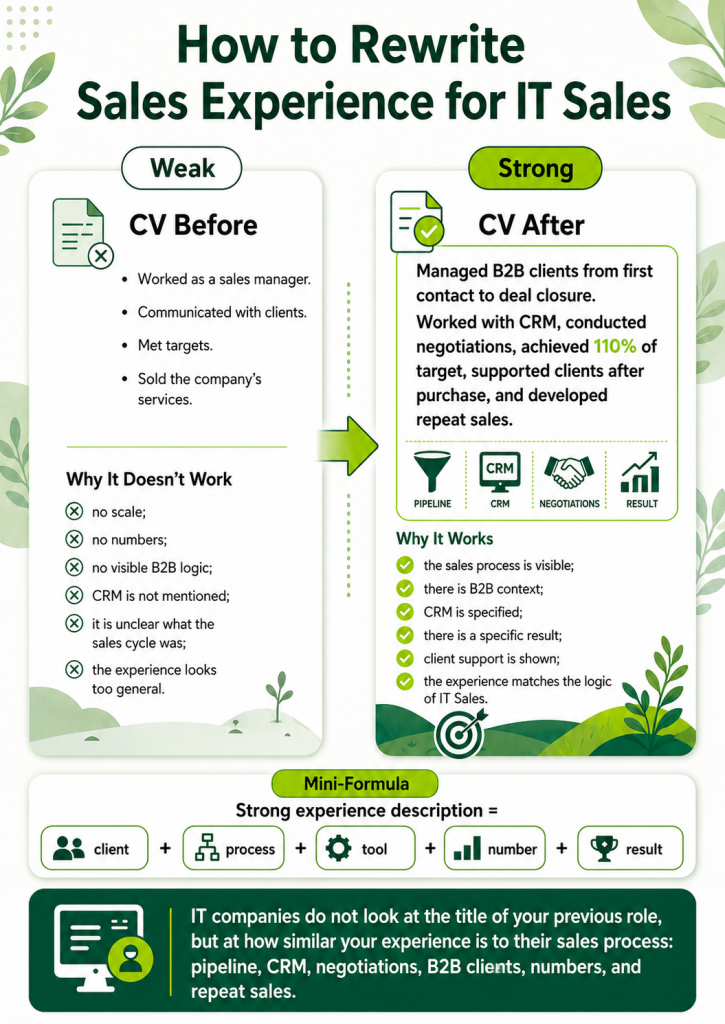
Weak Version
I sold company services, communicated with clients, and met sales targets.
Stronger Version
Managed clients from first contact to closed deal, worked in CRM, identified client needs, conducted negotiations, achieved 105–120% of the sales target for six consecutive months, supported clients after purchase, and developed repeat sales.
The difference is not about “prettier words.”
The second version shows the logic of IT sales:
- funnel;
- customer journey;
- result;
- CRM;
- relationship development;
- measurable performance.
Why You Do Not Need to Be a Programmer
For most IT sales roles, you do not need to write code, understand algorithms, or discuss frameworks during lunch.
Nobody expects an IT Sales Manager to explain product architecture at CTO level.
What employers do expect is that you understand:
- what problem the product solves;
- who needs it;
- why the client may struggle without this solution;
- how the product differs from alternatives;
- how to explain the value in simple language;
- when to bring in a technical specialist.
An IT Sales Manager does not have to be a developer.
But they do need to avoid vague phrases like:
“It’s some kind of platform for something digital.”
You need to understand the product well enough to explain why it matters to the client.
Why English and Structure Often Matter More Than a Technical Mindset
IT sales often involves communication with international clients.
Even if the company is located in Kazakhstan, Georgia, Armenia, Uzbekistan, or another country in the region, its clients may be in Europe, the United States, the Middle East, or Asia.
That is why English for IT sales is not a decorative line on your CV.
It is a working tool.
You may need to:
- write a cold email;
- reply on LinkedIn;
- hold a short discovery call;
- clarify a client’s business need;
- schedule a demo call;
- send a follow-up;
- discuss budget, timeline, and expectations.
You do not need perfect BBC pronunciation.
But if you cannot explain your background, ask a client basic questions, or maintain business correspondence, many vacancies will become unavailable immediately.
How IT Sales Differs From Traditional Sales
IT sales is not a different planet. But the rules are different.
In traditional sales, you can often rely on personal contact, a quick conversation, and a relatively simple product.
In IT sales, there is usually more structure, analysis, written communication, B2B logic, and long-term nurturing of the client.
The Sales Cycle Is Usually Longer
In many traditional sales roles, a client can make a decision quickly:
- They see the offer.
- They compare the price.
- They talk to a sales manager.
- They buy.
In IT sales, the sales cycle is often longer.
The client may need to:
- understand whether the product fits their problem;
- discuss the solution internally;
- compare vendors;
- evaluate the budget;
- attend a demo;
- speak with technical specialists;
- approve a contract;
- check security, integrations, and support terms.
Sometimes a deal takes weeks.
Sometimes it takes months.
Sometimes a client disappears three times, returns, asks for a presentation, disappears again, and then writes a quarter later:
“We’re ready to discuss the next step.”
This is where IT sales requires someone who does not live by the rule “no reply means delete the contact.”
You need pipeline management, follow-ups, and CRM discipline.
There Is More B2B Communication
In many IT companies, sales are made to businesses, not private individuals.
That means you are not dealing with one buyer only. You may communicate with several people who influence the decision:
- CEO;
- founder;
- marketing director;
- HR director;
- CTO;
- procurement manager;
- project manager;
- head of sales;
- operations manager.
Each person has a different concern.
The CEO thinks about business growth.
The CTO thinks about technical implementation.
The CFO thinks about budget.
The end user thinks about convenience.
The procurement manager thinks about contract terms.
In B2B IT sales, it is important to understand not only who pays, but also who influences the decision.
Product Value and Client Pain Matter More
In traditional sales, energy, confidence, and a good script can sometimes carry the conversation.
In IT sales, this approach is less reliable.
A client may ask:
- How does the product integrate with our current system?
- Which business tasks does the platform solve?
- How is SaaS different from custom development?
- What are the limitations?
- How long will implementation take?
- Who will use the product?
- Which metrics may improve after launch?
If the manager answers:
“We offer a high-quality solution and an individual approach,”
the client mentally closes the tab.
In IT sales, you need to speak through the client’s task.
Weak Version
Our platform helps businesses work more efficiently.
Stronger Version
If your team currently loses leads between website forms, spreadsheets, and individual sales managers, a CRM can bring all requests into one pipeline, show the status of each client, and give management visibility across every stage of the deal.
This sounds like a conversation about value.
CRM and Funnel Management Matter More
In IT sales, CRM is not just a place where managers enter contacts on Friday evening so the team lead stops asking.
It is a working system.
CRM usually stores:
- lead source;
- contact status;
- deal stage;
- email history;
- call notes;
- next steps;
- probability of closing;
- deal value;
- reason for lost deals.
A sales pipeline shows where the client is:
- new lead;
- qualification;
- meeting;
- demo;
- proposal;
- negotiation;
- contract;
- closed won;
- closed lost.
If a manager does not maintain CRM properly, the team loses context.
A client may receive the same email twice. A lead may freeze. A manager may lose the forecast. A deal may go to a competitor.
English Is Needed More Often
For IT sales roles, English is often expected at B1+ to B2 and above.
It is especially important for roles connected with:
- SaaS sales;
- international clients;
- outbound sales;
- LinkedIn outreach;
- cold email;
- demo calls;
- IT outsourcing;
- IT outstaffing;
- international markets.
English does not have to be perfect.
But it must be functional.
A simple check:
Can you speak for two or three minutes in English about:
- who you are;
- what you did in sales;
- why you want to move into IT;
- what results you achieved;
- how you work with clients;
- why this specific company interests you?
If yes, you already have a base.
If no, English needs to move from passive knowledge to active working skill.
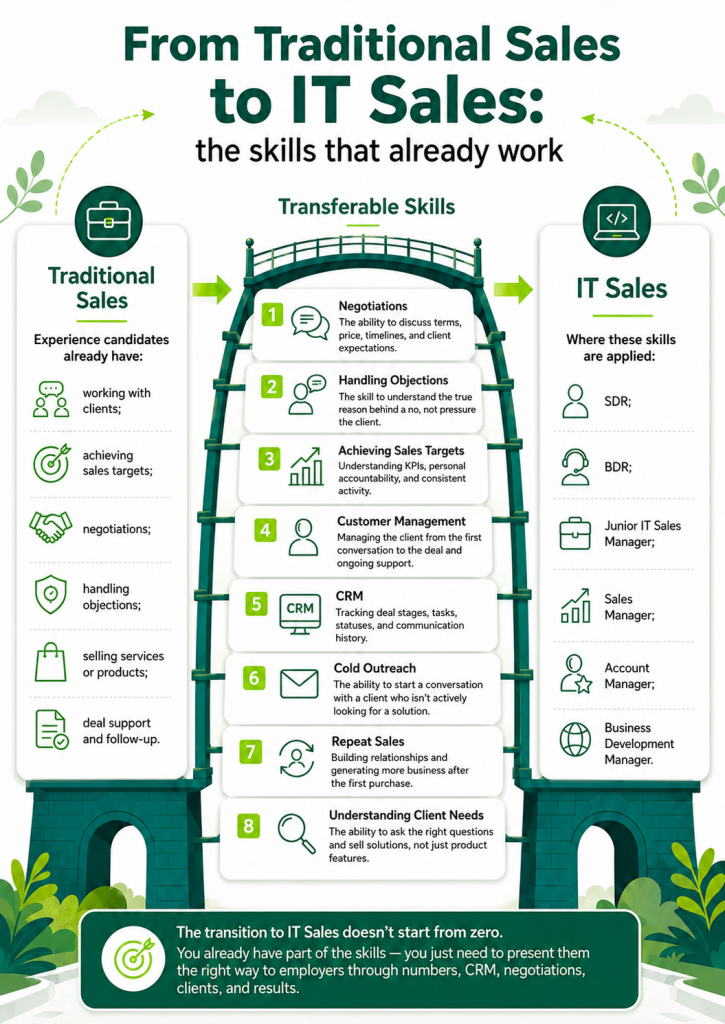
Which Traditional Sales Skills Transfer Into IT Sales
Moving into IT Sales does not mean throwing away your past experience and starting as a beginner with no background.
Your task is the opposite: show the employer that you are not new to sales.
You are new specifically to the IT environment.
These are two different things.
Asking the Right Questions
A good sales professional does not start with a 40-slide presentation.
They ask questions:
- What problem is the company trying to solve?
- What have you already tried?
- Why does the current solution fail?
- Who will make the decision?
- Which timeline matters?
- What budget is being considered?
- What would count as success?
In IT sales, this is especially important.
Without questions, you will not understand what the client actually needs:
- SaaS platform;
- custom development;
- integration;
- automation;
- support;
- team outsourcing;
- consultation.
Negotiation Skills
If you can discuss terms without panic or personal offense, that is a strong advantage.
In IT sales, negotiations may cover:
- price;
- implementation timeline;
- scope of work;
- payment format;
- support level;
- pilot period;
- renewal terms;
- responsibilities of both parties.
Employers value candidates who do not collapse when they hear:
“It’s too expensive.”
They also do not want someone whose only response is:
“I can ask for a discount.”
A stronger response works through value:
“Let’s look at what you are comparing the cost with. If we look only at the license price, the solution may seem more expensive. If we include team time saved, process transparency, and reduced lead losses, the calculation changes.”
Handling Objections
In traditional sales, you have probably heard:
- it is expensive;
- it is not relevant for us;
- send us information;
- we already work with another provider;
- there is no budget;
- we will return to this later;
- we need to think.
In IT sales, these objections also exist. They just sound different:
- we already have our own system;
- we are not sure it will integrate;
- the team is not ready for implementation;
- we do not have resources for migration;
- security needs to review the solution;
- we need approval from the CTO;
- we do not see the ROI.
The skill is the same:
do not argue, do not pressure, do not lecture. Find the real reason.
Client Management
If you worked with clients after payment, not only before payment, that experience is especially valuable for Account Manager and Customer Success-adjacent roles.
IT often involves:
- renewals;
- upsell;
- cross-sell;
- long-term client development.
A client may start with a basic plan and upgrade a few months later.
They may begin with one team and later expand the product to other departments.
They may order an MVP and expand the product a year later.
Sales do not end with the first deal.
Cold Calls and Cold Messages
Many candidates are afraid of the phrase cold outreach, although the concept is familiar:
you reach out to a client who has not yet requested a commercial offer.
In IT, this is often done through:
- LinkedIn;
- email;
- professional communities;
- company databases;
- events;
- partner contacts.
The main difference is that cold messaging in IT is usually shorter, more specific, and less promotional.
Weak Version
Good afternoon! Our fast-growing company offers innovative solutions for your business. We provide an individual approach to every client and guarantee high-quality services.
Stronger Version
Hi Mark, I noticed your team is hiring sales reps across three regions. Companies at this stage often struggle with lead routing and CRM visibility. We help sales teams centralize inbound leads and track pipeline performance in one dashboard. Would it be relevant to compare your current process with a simpler setup?
The second version is not universal for every case, but it has three important elements:
- observation;
- pain hypothesis;
- specific value.
Working With Sales Targets
IT companies need people who understand that a sales target is not just a scary number from management.
It is a system of actions.
A target can be broken down into:
- number of leads;
- reply rate;
- meeting conversion;
- demo conversion;
- proposal conversion;
- average deal size;
- sales cycle length;
- closing rate.
If you can show how you worked with numbers, your CV becomes stronger.
Resilience After Rejection
There is a lot of rejection in IT sales, especially in SDR and BDR roles.
Clients do not reply.
They reply with one word.
They reschedule meetings.
They choose competitors.
They disappear after demos.
They open your email and remain silent so expressively that it feels like the email was sent to a museum of silence.
Resilience matters.
But resilience does not mean:
“I never feel disappointed.”
It means you return to the system:
- analyze;
- adjust your approach;
- test new messages;
- maintain CRM;
- avoid turning each rejection into a personal drama.
What May Be Missing When Moving Into IT Sales
Traditional sales experience is a strong foundation.
But IT companies also look for several specific areas that may need development.
English for IT Sales
If your English is weak, do not present it as “somewhere between B2 and C1” if in reality you can confidently say only:
“Hello, my name is…”
and then hope for a miracle.
It is better to assess your level honestly and train practical scenarios:
- self-introduction;
- explanation of past experience;
- product explanation;
- questions to a client;
- post-meeting email;
- follow-up;
- budget discussion;
- meeting rescheduling;
- requirement clarification.
For a local IT company, B1+ may be enough.
For international sales, B2 is often expected.
Understanding IT Products
You do not need to know every technology.
But you should understand the basic types of IT businesses.
SaaS
SaaS means software sold by subscription.
Examples include:
- CRM;
- analytics tools;
- HR platforms;
- marketing automation tools;
- project management systems.
The client pays regularly and uses the product online, while the company develops the platform and supports users.
IT Outsourcing
An outsourcing company sells development services for a client’s specific task:
- website;
- mobile app;
- internal system;
- integration;
- platform;
- MVP.
Here, the goal is not to sell “developer hours.”
The goal is to sell the team’s ability to solve a business problem.
IT Outstaffing
Outstaffing means providing specialists to a client’s team:
- developers;
- QA engineers;
- designers;
- DevOps engineers;
- analysts.
Here, speed of hiring, quality of specialists, work format, legal terms, and retention matter.
Product Company
A product company develops its own product:
- SaaS;
- app;
- platform;
- service.
Sales may be inbound, outbound, partner-based, or partly self-service.
B2B Logic
If you come from B2C, you need to rebuild your thinking.
In B2C, one person often makes the decision.
In B2B, a group of people may influence it.
In B2C, emotion can play a major role.
In B2B, emotion still exists, but it hides behind spreadsheets, budgets, risks, and approvals.
In B2B, you need to understand:
- who uses the product;
- who pays;
- who influences the decision;
- who blocks it;
- who signs the contract;
- what risks the company sees;
- what business result is expected.
CRM Discipline
If CRM in your previous company was used only “for reporting,” this can become a problem in IT.
IT sales teams often look at:
- how complete contact cards are;
- whether statuses are up to date;
- the quality of notes after calls;
- the date of the next action;
- lost deal reasons;
- pipeline forecast;
- activity by lead.
CRM is not bureaucracy. It is the team’s memory.
LinkedIn Outreach
For many IT sales roles, LinkedIn is a key channel for finding clients.
You need to know how to:
- find relevant people;
- understand job titles;
- write short messages;
- avoid sounding like a bot;
- continue a conversation without pressure;
- move a contact toward a call;
- record the result in CRM.
Weak Version
Hello! I would like to present our services. Can we schedule a call?
Stronger Version
Hi Anna, I saw that your company is expanding the support team in Europe. If ticket volume is growing, your team may be looking at automation or better routing. We work with teams facing that stage. Open to a quick exchange?
Short Business Emails
Many sales managers from traditional sales write too much.
In IT, long cold emails are painful to read.
A cold email should be:
- short;
- specific;
- free of corporate filler;
- clear about why you are reaching out;
- based on a value hypothesis;
- built around a simple call to action.
Do not start with a three-paragraph history of your company.
The client did not open your email to read a corporate autobiography.
Pipeline Management
A pipeline is not just a list of clients.
It is a funnel that shows where every deal stands.
For example:
- Lead found.
- Contacted.
- Replied.
- Qualified.
- Discovery call.
- Demo.
- Proposal.
- Negotiation.
- Closed won / closed lost.
Employers want to see that you can manage deals, not merely “communicate with people.”
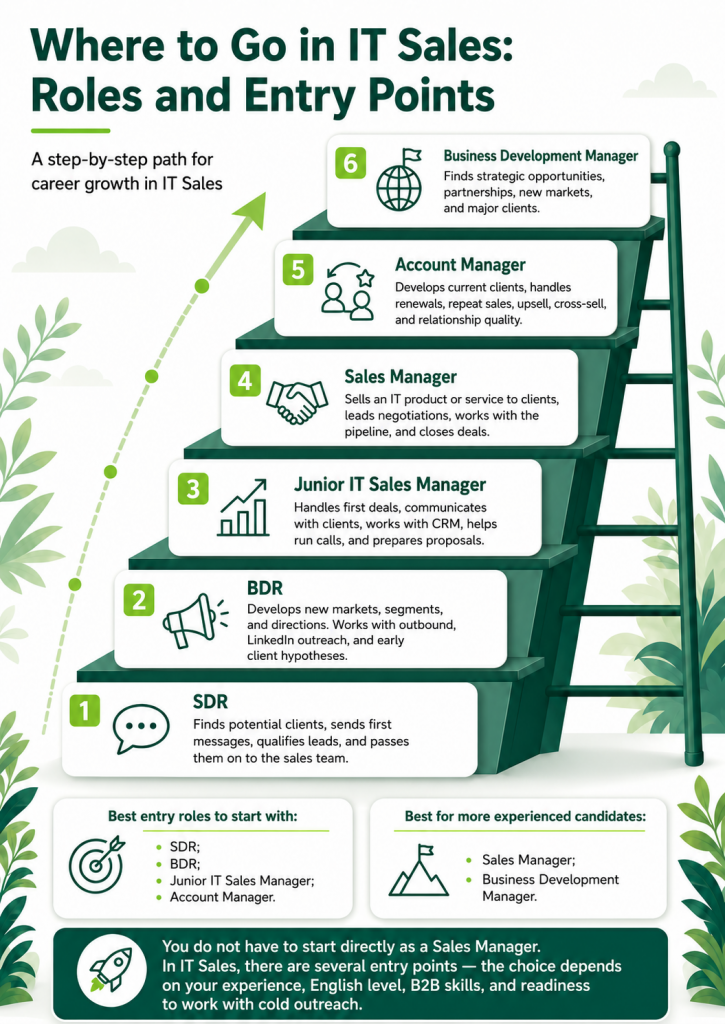
Which Roles to Start With in IT Sales
Not all IT sales vacancies are the same.
Job titles may vary, but several roles appear often.
IT Sales Roles Overview
| Role | What They Do | Best For | What to Show |
| SDR | Finds leads, writes cold messages, qualifies prospects, books meetings | Candidates ready for high activity, research, and outreach | Activity, CRM, English, rejection resilience |
| BDR | Develops new markets, segments, partnerships, and outbound channels | Candidates with B2B experience and interest in business development | Market research, communication, LinkedIn outreach |
| Junior IT Sales Manager | Leads clients through the funnel, supports negotiations, works in CRM | Candidates with sales experience but no IT background | Sales experience, numbers, funnel logic, fast product learning |
| Account Manager | Manages current clients, renewals, and relationship development | Candidates strong in client service and long-term relationships | Retention, upsell, communication, expectation management |
| Business Development Manager | Finds new opportunities, markets, large clients, and partners | Candidates with strong B2B, English, and negotiation experience | Strategic thinking, market understanding, pipeline, negotiation |
SDR: Entry Through Lead Search and Qualification
SDR stands for Sales Development Representative.
This role often suits people who want to enter IT sales without previous IT experience.
An SDR usually:
- finds potential clients;
- writes cold emails;
- does LinkedIn outreach;
- qualifies leads;
- books meetings for Sales Managers or Account Executives;
- maintains CRM;
- tests different messages and segments.
This is not a “junior assistant” role.
A strong SDR creates business opportunities.
This Role Fits People Who:
- are not afraid of rejection;
- like short business communication;
- are ready to work with numbers;
- can quickly research a market;
- want to understand IT sales from the inside.
BDR: Market and Business Development
BDR stands for Business Development Representative.
This role is close to SDR, but it is often more focused on new markets, directions, partnerships, or client segments.
A BDR may:
- research new markets;
- find companies in target segments;
- contact decision-makers;
- test outbound campaigns;
- look for partnership opportunities;
- pass qualified leads to the sales team.
If you have B2B sales experience, negotiated with companies, or helped develop a client base, BDR can be a logical entry point.
Junior IT Sales Manager
Junior IT Sales Manager roles fit people who already have sales experience but do not yet have an IT background.
In this role, you may:
- handle inbound requests;
- work with small and medium-sized businesses;
- conduct first calls;
- prepare commercial proposals;
- participate in demo calls;
- maintain CRM;
- support the client until the deal is closed.
Here, it is important to show that you are not simply trying to “get into IT.”
You already understand the basic differences between IT sales and your previous sales environment.
Account Manager
An Account Manager in IT works with existing clients.
Their tasks include:
- maintaining relationships;
- monitoring client satisfaction;
- renewing contracts;
- finding upsell and cross-sell opportunities;
- coordinating communication between the client and the internal team;
- solving issues before they become serious problems.
This role works well for people who have experience with long-term client relationships:
- corporate sales;
- banking;
- insurance;
- telecommunications;
- B2B services;
- education;
- logistics.
Business Development Manager
Business Development Manager is usually a more senior role.
It is not always the easiest entry point.
A BDM is often needed when a company is looking for:
- new markets;
- large clients;
- partners;
- non-standard sales channels;
- strategic opportunities.
If you are strong in B2B, can speak with executives, understand markets, speak English confidently, and can handle long negotiations, you can consider BDM roles.
If your experience is still limited, it is usually better to start with SDR, BDR, or Junior IT Sales Manager roles.
What to Learn Before Applying
Before sending your CV to IT companies, build a basic knowledge base.
Not at the level of getting another degree.
At the level of a confident business conversation.
Minimum IT Sales Vocabulary
You should understand these terms:
- SaaS — subscription-based software;
- B2B — sales to businesses;
- B2C — sales to private customers;
- CRM — a system for managing clients and deals;
- pipeline — the deal funnel;
- lead — a potential client;
- lead generation — the process of finding leads;
- qualification — checking whether a client is a good fit;
- ICP — ideal customer profile;
- buyer persona — a typical buyer representative;
- discovery call — a call to understand the client’s needs;
- demo call — product demonstration;
- follow-up — a message after contact;
- outbound sales — active client search;
- inbound sales — work with incoming requests;
- cold outreach — cold contact through email, LinkedIn, or other channels;
- value proposition — the value a product offers to the client.
What ICP Means
ICP stands for Ideal Customer Profile.
It describes the type of company that is the best fit for the product.
For a CRM, this could be:
- a B2B company;
- a sales team of 10+ people;
- several lead generation channels;
- deals longer than two weeks;
- a manager who needs pipeline visibility;
- current tracking through spreadsheets or an outdated system.
If an SDR writes to everyone, they waste time.
If they understand ICP, they look for companies that may genuinely need the product.
What Lead Qualification Means
Not every contact is a good lead.
Qualification answers these questions:
- Does the client have a relevant problem?
- Do they match the ICP?
- Is there a budget?
- Who makes the decision?
- What is the timeline?
- Is there real pain?
- Can the product solve it?
Weak Lead Logic
The company looks large, so let’s write to them.
Stronger Lead Logic
The company is actively hiring a sales team, works across three markets, and uses several lead channels. They may need CRM, lead routing automation, and better pipeline visibility.
What a Discovery Call Is
A discovery call is a conversation where the manager understands the client’s situation.
The goal is not to sell immediately.
The goal is to understand:
- what is happening on the client’s side;
- what problem they have;
- why it matters;
- what they have already tried;
- what limitations exist;
- who is involved in the decision;
- which selection criteria matter.
Good Discovery Questions
- How is your lead handling process organized now?
- Where do leads usually get lost?
- What would be a good result three months after implementation?
- Who else is involved in choosing the solution?
- Which tools do you already use?
- What is a must-have, and what would be a nice addition?
Basic IT Terms to Know
You do not need deep programming knowledge.
But it is useful to understand basic terms:
- API — a way for systems to exchange data;
- cloud — cloud infrastructure;
- integration — connecting different systems;
- platform — a digital product or environment;
- subscription — recurring payment model;
- dashboard — a visual panel with data;
- automation — reducing manual work through technology;
- MVP — minimum viable product;
- deployment — product launch or implementation;
- support — help for users after launch.
If you hear these words during an interview and do not panic, the conversation becomes much easier.
How to Adapt Your CV for IT Sales
The main mistake candidates make is sending the same CV to IT companies that they used for traditional sales roles.
As a result, the employer sees:
- worked with clients;
- met the plan;
- consulted customers;
- sold services;
- conducted negotiations;
- stress-resistant.
This is too general.
A CV for IT sales should show that your experience can be transferred into IT Sales.
What to Change in the CV Title
Weak Version
Sales Manager
Stronger Versions
Sales Manager / Junior IT Sales Manager
B2B Sales Manager | CRM | Negotiations | Lead Generation
SDR / BDR Candidate with B2B Sales Experience
You do not have to call yourself an IT Sales Manager if you have never worked in IT.
But you can show the direction and the relevant skills.
What to Write in the Summary
Weak Version
Communicative and responsible sales manager. I learn fast and want to grow in IT.
Stronger Version
Sales professional with experience in B2B communication, managing clients from first contact to closed deal, working in CRM, and achieving sales targets. Currently transitioning into IT Sales, where I can apply my experience in negotiations, lead generation, client qualification, and long-term relationship development. Studying SaaS Sales, outbound, pipeline management, and core IT sales processes.
Which Achievements to Show
IT companies like numbers.
Not because everyone there is a robot, but because numbers show scale.
Show:
- target achievement;
- number of clients;
- average deal size;
- sales growth;
- conversion rate;
- client retention;
- repeat sales;
- sales cycle length;
- number of meetings;
- number of outbound contacts;
- CRM experience;
- acquisition channels;
- client base size.
Examples
- Achieved 105–120% of the sales target for six consecutive months.
- Managed 80+ B2B clients in CRM.
- Increased repeat sales by 18% through regular work with existing clients.
- Conducted 25–30 first-stage negotiations per week.
- Worked with a sales cycle from two weeks to three months.
- Closed deals with an average value starting from $2,000.
- Participated in launching a new lead generation channel through partner referrals.
Which Keywords to Add
Use IT sales terms if they genuinely connect to your experience:
- B2B sales;
- lead generation;
- cold outreach;
- CRM;
- pipeline;
- sales funnel;
- qualification;
- discovery call;
- negotiation;
- follow-up;
- account management;
- retention;
- upsell;
- cross-sell;
- customer needs;
- value proposition.
Do not overload the CV with every term at once.
A CV should not look like you opened an IT sales glossary and decided to insert the entire alphabet.
Example: Reframing Experience
Before
Worked as a sales manager. Consulted clients, sold services, met sales targets, and prepared reports.
After
Managed B2B clients from first contact to closed deal: identified needs, presented solutions, handled objections, negotiated terms, and recorded deal stages in CRM. Achieved 105–120% of the sales target for six consecutive months. Maintained relationships with existing clients and developed repeat sales.
Example for B2C Experience
Before
Worked in retail sales, consulted customers, and sold electronics.
After
Consulted customers on complex products, identified needs, compared solution options, handled objections related to price and functionality, achieved personal sales targets, maintained a client base, and developed repeat purchases and referrals.
This is not IT Sales yet.
But it already shows transferable skills:
- product explanation;
- client needs;
- objections;
- targets;
- repeat sales.
How to Write a Cover Letter for IT Sales
A cover letter should not be long.
Its purpose is to connect your previous experience to the vacancy.
Weak Version
Good afternoon! I really want to get into IT because it is a promising field. I do not have experience, but I learn fast, handle stress well, communicate easily, and am ready to develop.
This sounds honest, but weak.
Stronger Version
Good afternoon,
I would like to apply for the Junior IT Sales Manager position. I have four years of experience in B2B service sales: I managed clients from first contact to closed deal, worked in CRM, conducted negotiations, and achieved 110%+ of the sales target during the last two quarters.
I am currently transitioning into IT Sales and studying SaaS Sales, outbound, pipeline management, discovery calls, and lead qualification. I have adapted my previous experience to B2B sales in IT and am ready to start in a role where activity, systematic lead work, and fast product understanding are important.
This type of letter shows:
- motivation;
- relevant experience;
- preparation;
- connection to the role.
How to Prepare for an IT Sales Interview
An IT sales interview checks more than your past experience.
It checks whether you can connect that experience to a new environment.
Question: Why Do You Want to Move Into IT Sales?
Weak Answer
IT pays better and offers remote work.
This may be true, but for the employer it sounds like you do not care what you sell.
Stronger Answer
I want to move into IT Sales because I am interested in B2B sales of complex products, where it is important to understand the client’s problem, manage a longer sales cycle, and sell a business solution rather than just a service. In my previous field, I already worked with clients, negotiations, CRM, and sales targets. I am now building my knowledge of SaaS, pipeline management, and outbound sales to transfer this experience into IT.
Question: How Are IT Sales Different From Your Previous Sales Experience?
Strong Answer
IT sales often involve a longer sales cycle, more decision-makers, and a stronger role for client qualification. It is important to understand the business problem more deeply, explain the product through value, maintain CRM properly, and work consistently with follow-ups. English and communication with international clients are also often important.
Question: How Do You Handle Rejection?
Weak Answer
I try to convince the client.
Stronger Answer
I clarify the reason for the rejection, record it in CRM, and check whether it makes sense to continue the conversation. If the client says it is too expensive, I ask what they are comparing the cost with. If they say it is not relevant, I clarify whether it makes sense to return to the topic later. If the product is not a fit, I do not pressure the client, but I keep the context for future contact.
Question: How Do You Learn a New Product?
Strong Answer
I study the product through the client’s perspective: what problem it solves, who it is built for, which pains it addresses, what alternatives exist, and what objections may appear. Then I review company materials, demos, case studies, competitors, and typical client questions. I need to be able to explain the product in simple language, not just repeat a technical description.
Question: How Would You Write a Cold Email?
Weak Answer
Hello, we offer the best IT solutions for your business.
Stronger Answer
I would start with the client segment and a pain hypothesis. For example, if a company is actively hiring a sales team, it may be facing growing pressure on CRM and lead processing. The email should be short: observation, possible problem, product value, and a simple question about relevance.
Question: What Is Your English Level?
Do not exaggerate.
Stronger Answer
My level is B1+/B2. I can handle business correspondence, pass interviews, and conduct a basic discovery call. I am currently practicing sales vocabulary: cold emails, follow-ups, qualification questions, objections, and negotiation phrases.
This sounds more mature than saying “my English is good” and then struggling to build three sentences.
Common Mistakes When Moving From Traditional Sales Into IT
These mistakes are not always dramatic, but they are costly.
Because of them, candidates may apply for months and think:
“IT companies only hire their own people.”
In reality, the problem is often in positioning.
Mistake 1. Saying “I Want IT Because It Pays More”
Money matters. Everyone understands that.
But the employer wants to see more than financial motivation.
Weak Version
I want to work in IT because it is promising and salaries are good.
Stronger Version
I want to move into IT Sales because I am interested in B2B sales of complex products, international communication, and solutions that influence business processes.
Mistake 2. Pretending to Be More Technical Than You Are
You do not need to act like a technical expert.
If you learn three terms and start confidently saying:
“cloud API integration of a platform-based SaaS solution,”
but cannot explain it in simple words, the interviewer will notice.
Stronger Version
I do not claim to have developer-level technical expertise, but I understand the basic logic of SaaS, CRM, API, and integrations from the client value perspective. I am ready to learn the product quickly and involve the technical team when deeper expertise is needed.
Mistake 3. Not Adapting the CV
A general sales CV often does not show potential for IT Sales.
Add:
- CRM;
- B2B;
- sales funnel;
- lead generation;
- negotiations;
- numbers;
- English;
- client segments;
- sales cycle length;
- sales channels.
Mistake 4. Applying Only for Sales Manager Roles
If you want to move into IT sales without IT experience, do not ignore SDR and BDR positions.
The title may sound less impressive.
But it is a normal entry point.
Through SDR or BDR roles, you can quickly understand:
- how the market works;
- which clients the company needs;
- how outbound works;
- how CRM is maintained;
- which messages get replies;
- how lead qualification works.
Mistake 5. Not Studying the Product Before the Interview
This is one of the most common mistakes.
A candidate says:
“I really want to work for your company.”
Then the interviewer asks:
“What did you understand about our product?”
And the candidate replies:
“Well, you offer IT solutions for business.”
That phrase could describe half the market.
Before the interview, study:
- what the company sells;
- who it sells to;
- what the main value is;
- who the clients are;
- who the competitors are;
- which roles are open;
- which market the company serves;
- which case studies are available on the website.
Mistake 6. Treating IT Sales Like Fast Phone Sales
In IT, the approach “call, read the script, close the deal” rarely works.
You need:
- client research;
- personalization;
- qualification;
- deal management;
- understanding of each stakeholder’s role;
- follow-up;
- patience;
- CRM discipline.
Mistake 7. Not Showing Numbers
The phrase “successfully sold” does not say much.
Show scale:
- how many clients;
- what target;
- what percentage of target achievement;
- what conversion rate;
- what average deal size;
- what sales cycle;
- how many meetings;
- how many repeat sales.
Mistake 8. Failing to Explain the Career Transition
You will almost certainly be asked why you are changing fields.
Prepare the answer in advance.
Formula
Past experience → strongest part of that experience → why IT Sales is logical → what you have already done for the transition → what role you are looking for.
Example
I have five years of experience in B2B service sales. I managed clients from first contact to closed deal, worked in CRM, achieved sales targets, and developed repeat sales. I want to move into IT Sales because I am interested in complex products, international clients, and value-based selling. I am already studying SaaS, outbound, pipeline management, and discovery calls, and I have adapted my CV for SDR and Junior IT Sales Manager roles.
A 30-Day Plan for Moving Into IT Sales
You cannot become an expert in every area of IT in 30 days.
And you do not need to.
The goal of the first month is to build a foundation, reframe your experience, and start getting relevant responses.
Week 1: Understand the Roles and the Market
Goal
Understand where you are going.
What to Do
- Study vacancies for IT Sales Manager, SDR, BDR, and Account Manager.
- Write down repeated requirements.
- Note where English is required.
- Check which CRMs appear often.
- Compare SDR and Sales Manager responsibilities.
- Choose two or three roles to focus on.
Mini Task
Open 20 vacancies and make a table:
| Requirement | How Often It Appears | What I Already Have | What I Need to Improve |
| CRM | 15 | Worked with Bitrix24 | Learn HubSpot / Pipedrive |
| English B2 | 12 | B1+ | Practice sales calls |
| Cold outreach | 10 | Had cold calling experience | Learn LinkedIn / email outreach |
| B2B sales | 14 | 3 years of experience | Rewrite clearly in CV |
This gives you a real picture instead of an anxious fantasy like:
“Everyone there knows how to code and has a senior badge.”
Week 2: Learn the Basics of IT Sales
Goal
Understand the language of the field.
Study
- SaaS;
- B2B sales in IT;
- outbound sales;
- inbound sales;
- lead generation;
- CRM for sales;
- pipeline;
- discovery call;
- demo call;
- qualification;
- ICP;
- cold email;
- LinkedIn outreach;
- follow-up.
Practice
Write in your own words:
- What is SaaS?
- How is SDR different from BDR?
- What is a discovery call?
- What is ICP?
- What does a pipeline look like?
- How is IT outsourcing different from a product company?
If you can explain these concepts to someone outside IT, you are moving in the right direction.
Week 3: Rewrite Your CV and LinkedIn
Goal
Make your experience understandable to an IT company.
Update
- title;
- summary;
- experience;
- achievements;
- skills;
- English level;
- CRM;
- keywords;
- cover letter.
IT Sales CV Checklist
Check whether your CV has:
- a clear title connected to IT Sales;
- B2B or transferable sales experience;
- experience described through actions and results;
- numbers;
- CRM;
- work with a sales funnel;
- negotiations;
- lead generation;
- client work;
- English;
- achievements from recent roles;
- a short summary;
- no empty filler phrases.
Week 4: Apply and Interview
Goal
Enter the market.
What to Do
- Send 30–50 targeted applications.
- Adapt your CV for different roles.
- Write two or three versions of your cover letter.
- Practice answers to interview questions.
- Prepare your story about the career transition.
- Run a mock interview in English.
- Track application results.
Important
Do not judge the market by the first five applications.
IT Sales is also a funnel.
Your job search works the same way:
- sent application;
- got a view;
- got a reply;
- passed screening;
- passed interview;
- received a test task;
- received an offer.
If you send many applications and get few views, the problem may be the CV.
If you get views but no invitations, the problem may be relevance or summary.
If you get interviews but no offers, analyze your answers, English, product understanding, and motivation.
Who Will Find It Easier to Move Into IT Sales
Not everyone starts from the same position.
For some people, the transition will be shorter. For others, it will take longer.
B2B Sales Professionals
If you have already sold to businesses, you have a strong base.
You understand:
- longer sales cycles;
- approvals;
- several decision-makers;
- trust-building;
- contracts;
- price and terms negotiation.
This is close to IT Sales.
Client Managers
If you supported clients, developed relationships, handled renewals, and worked with repeat sales, Account Manager roles may fit you well.
Especially if you can:
- maintain contact;
- hear client dissatisfaction early;
- solve issues;
- see opportunities for upsell;
- work with long-term relationships.
Sellers of Complex Services
If you sold consulting, education, logistics, financial services, advertising, outsourcing, or corporate solutions, you already have experience explaining an intangible product.
That is closer to IT than it may seem.
People With English
English dramatically expands your job options.
It gives access to:
- international IT companies;
- remote IT sales roles;
- SaaS sales;
- outbound to foreign markets;
- BDR roles;
- Account Manager roles with foreign clients.
People Who Managed Long Deals
If you can work with a client for weeks or months, maintain contact, and lead negotiations in stages, that is a major advantage.
People Who Can Work With CRM
CRM discipline is important in IT.
If you have already managed deals in CRM, updated stages, and worked with reporting, make sure this is visible in your CV.
People Who Are Comfortable With Cold Outreach
SDR and BDR roles are often connected with outbound.
If you can handle cold contacts, write messages, call, search for client angles, and avoid dramatizing rejection, you may enter IT Sales faster.
How to Understand Which IT Company Fits You
Not all IT companies are the same.
For a transition, it is important to choose an environment where your experience will look relevant.
Product Company
A product company is a good fit if you are interested in one product, its development, clients, pricing plans, retention, and user growth.
Advantages
- the product is usually easier to understand deeply;
- you can focus on one platform;
- there are often ready-made materials;
- processes are usually more structured.
Challenges
- you need to understand the product market;
- English requirements may be high;
- funnel metrics often matter a lot.
IT Outsourcing
IT outsourcing is a good fit if you are strong in service sales, negotiations, and non-standard client tasks.
Advantages
- service sales experience transfers well;
- client needs discovery is highly valued;
- there is a lot of B2B communication.
Challenges
- you need to understand the development process;
- deals may be long;
- clients often compare teams and budgets.
IT Outstaffing
IT outstaffing may suit people who can sell expertise, people, speed, and reliability.
Advantages
- close to B2B services;
- communication is important;
- client management experience transfers well.
Challenges
- you need to understand specialist roles;
- competition is high;
- the client evaluates not only price, but also hiring quality.
Startup
A startup may fit people who like movement, uncertainty, and are ready to do more than the vacancy description says.
Advantages
- faster growth is possible;
- more influence on processes;
- it may be easier to enter without a perfect background.
Challenges
- less structure;
- more independence required;
- responsibilities may change quickly.
Mature IT Company
A mature IT company may fit people who value processes, onboarding, a clear funnel, and a strong team.
Advantages
- onboarding usually exists;
- roles are clearer;
- experienced colleagues are available;
- there are more materials.
Challenges
- competition is higher;
- requirements are stricter;
- interviews may have several stages.
What to Write on LinkedIn When Moving Into IT Sales
LinkedIn matters in IT Sales not only as a CV.
It also shows whether you understand business communication online.
Profile Headline Options
- B2B Sales Manager transitioning to IT Sales | CRM | Lead Generation | Negotiation
- Junior IT Sales / SDR Candidate | B2B Sales Experience | English B2
- Sales Manager | B2B | CRM | Pipeline | Interested in SaaS Sales
About Section Example
I am a sales professional with experience in B2B communication, client management, CRM, negotiations, and achieving sales targets.
Currently, I am transitioning into IT Sales and focusing on SaaS Sales, outbound prospecting, lead qualification, discovery calls, and pipeline management.
My previous experience helps me understand client needs, work with objections, and build long-term business relationships.
What to Add to Your Profile
- sales experience with numbers;
- CRM;
- English level;
- client industries;
- achievements;
- interest in IT Sales;
- key skills;
- openness to SDR, BDR, and Junior Sales roles.
Practical Examples: How to Reframe Past Experience
If You Come From Banking Sales
Before
Sold banking products to individuals and companies.
After
Consulted clients on financial products, identified needs, explained complex service terms in simple language, handled objections related to cost and risk, achieved sales targets, and maintained a client base in CRM.
If You Come From Real Estate
Before
Sold real estate, showed properties, communicated with clients.
After
Managed clients through a long decision-making cycle: identified selection criteria, presented property options, handled objections related to budget and terms, supported the client until the deal, and coordinated communication between parties.
If You Come From Retail
Before
Worked as a sales consultant and sold electronics.
After
Consulted clients on technically complex products, identified needs, compared solution options, explained functionality in simple language, achieved personal sales targets, and developed repeat purchases.
If You Come From B2B Services
Before
Sold services to companies.
After
Developed B2B clients, conducted first-stage negotiations, identified business needs, prepared commercial proposals, managed deals in CRM, worked with a sales cycle from two weeks to three months, and achieved 110%+ of the sales target.
If You Come From Call Center Sales
Before
Made calls and sold services using a database.
After
Worked with a high volume of outbound contacts, conducted initial client qualification, recorded results in CRM, tested different arguments, handled objections, and moved interested clients to the next stage of the funnel.
Checklist Before Applying for an IT Sales Vacancy
Before clicking “Apply,” check the following.
CV
- The title shows a clear connection to IT Sales.
- B2B or transferable sales experience is visible.
- Experience is described through actions and results.
- Numbers are included.
- CRM is mentioned.
- Negotiation experience is shown.
- Client work is clear.
- Lead generation or outbound is included where relevant.
- English level is listed.
- There are no empty template phrases.
Vacancy
- You understand which role is open: SDR, BDR, Sales Manager, or Account Manager.
- You have read the requirements.
- You know what the company sells.
- You understand who the company sells to.
- You can explain why your experience fits.
- You adapted the summary for the role.
Cover Letter
- It is short.
- It includes relevant experience.
- It has one or two numbers.
- It explains the reason for the transition.
- It connects your background to the vacancy.
- It does not say: “I dream of getting into IT at any cost.”
Interview Preparation
- You have a self-introduction ready.
- You can explain why IT Sales.
- You have an example of handling an objection.
- You have an example of a successful deal.
- You have an example of working in CRM.
- You can speak briefly about yourself in English.
- You studied the company’s product.
FAQ: Common Questions About Moving Into IT Sales
Can I Move Into IT Sales Without a Technical Degree?
Yes.
For most entry-level IT Sales roles, a technical degree is not required.
More important skills are:
- understanding clients;
- asking questions;
- negotiating;
- working in CRM;
- understanding product value;
- explaining complex things simply;
- learning fast without pretending to be a technical expert.
How Can I Get Into IT Sales Without IT Experience?
Start with roles such as:
- SDR;
- BDR;
- Junior IT Sales Manager;
- Account Manager.
What to Do
- Learn basic IT Sales terms.
- Rewrite your CV in IT sales language.
- Show transferable sales skills.
- Add numbers and CRM experience.
- Improve your English.
- Apply for roles where your previous experience can be useful.
Which Role Is Best for Starting?
Most often:
- SDR — if you are ready to find leads and write cold messages;
- BDR — if you are interested in new markets and outbound;
- Junior IT Sales Manager — if you already have solid sales experience;
- Account Manager — if you are strong in client support and relationship management;
- Business Development Manager — if you have B2B experience, English, and complex negotiation skills.
Do I Need English for IT Sales?
Yes.
English significantly increases your chances.
For local companies, B1+ may be enough.
For international roles, B2 and above is often needed.
English is especially important if the role involves:
- LinkedIn outreach;
- cold email;
- demo calls;
- international clients;
- SaaS sales;
- IT outsourcing;
- remote work.
What Matters More: Sales Experience or IT Knowledge?
At the start, strong sales experience may matter more than deep technical knowledge.
But you still need to build a basic IT Sales foundation:
- SaaS;
- CRM;
- pipeline;
- lead qualification;
- discovery call;
- outbound;
- ICP;
- B2B sales in IT.
The ideal combination is simple:
you already know how to sell, and you are ready to quickly understand the IT product.
Do I Need to Know Programming?
No.
Programming is usually not required for IT Sales.
But you need to understand the product at the level of client value.
You should be able to explain:
- what the product does;
- who needs it;
- what problem it solves;
- when to involve a technical specialist.
Can I Move Into IT Sales From B2C?
Yes, but you will need to reframe your experience more carefully.
Focus on:
- communication;
- target achievement;
- objection handling;
- product explanation;
- activity;
- CRM;
- customer service;
- readiness to move into B2B logic.
How Long Does the Transition Take?
If you have strong sales experience, functional English, and an adapted CV, you may get first interviews within a few weeks.
If you need to improve English, CRM, and understanding of IT Sales, preparation may take several months.
The main factor is not the calendar.
The main factors are:
- quality of positioning;
- number of targeted actions;
- relevance of applications;
- interview preparation.
Which CRMs Should I Know for IT Sales?
Common tools include:
- HubSpot;
- Salesforce;
- Pipedrive;
- Zoho CRM;
- Bitrix24;
- Monday Sales CRM.
You do not need to know all of them.
But you should understand CRM principles:
- leads;
- deals;
- stages;
- tasks;
- notes;
- follow-ups;
- pipeline;
- reasons for lost deals.
What If I Have No Cold Sales Experience?
You can show related experience:
- outbound calls;
- database work;
- client search;
- referrals;
- partner channels;
- messaging new clients;
- reactivating old contacts.
At the same time, study cold email and LinkedIn outreach.
For SDR and BDR roles, this is especially important.
Final Takeaway
Moving into IT Sales from traditional sales is realistic.
But it does not happen through the phrase:
“I want to work in IT.”
It happens through clear positioning.
An employer needs to see that you are not starting your career from zero.
You already know how to sell, manage clients, handle rejection, explain value, meet targets, and record results.
Now you need to transfer those skills into a new environment:
- IT Sales;
- SaaS Sales;
- B2B sales in IT;
- CRM;
- pipeline;
- cold outreach;
- discovery calls;
- international communication.
Your main task is to stop saying:
“Please hire me, I learn fast.”
A stronger position sounds like this:
“I have a sales foundation. I understand which skills I can transfer into IT Sales. I am already learning product and B2B logic, I know how to work with clients, I am ready to grow through SDR, BDR, Junior IT Sales Manager, or Account Manager roles, and I can bring value to the company from the start.”
With this mindset, moving into IT sales becomes not a leap into the unknown, but a natural career step.