




What Questions Do Salespeople Get Asked in an Interview — and How Should You Answer Them?
A sales interview is rarely a sweet little chat along the lines of, “So, tell us, do you like people?”
Although, yes, that can happen too.
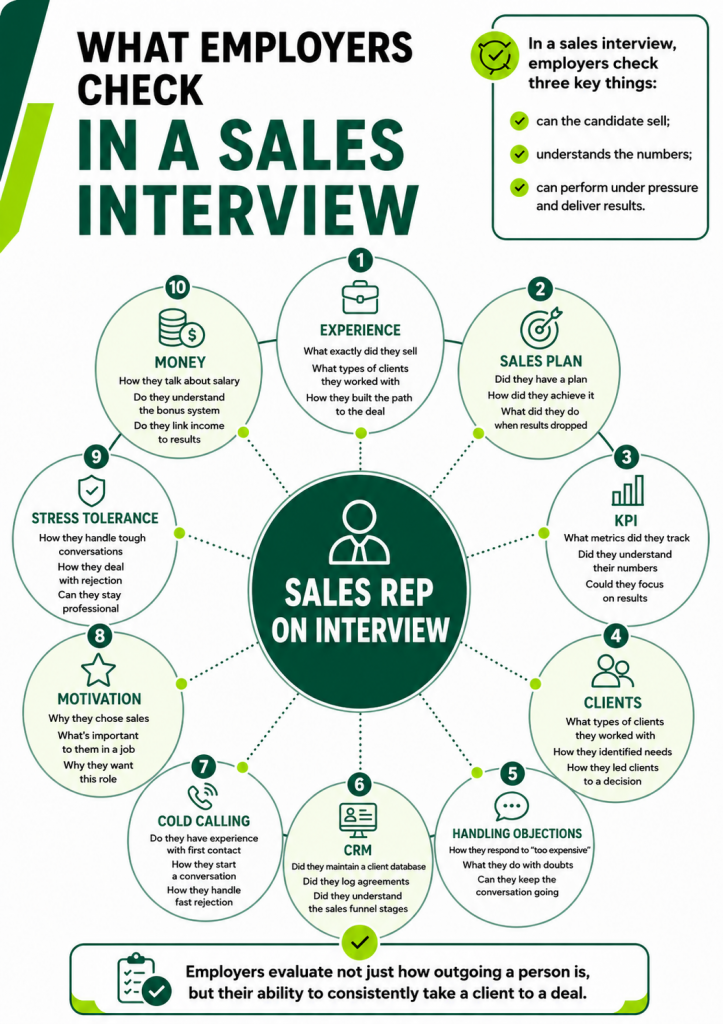
Most of the time, the interview is checking something else entirely: whether you can talk to customers, stay focused on results, handle rejection without falling apart, understand your numbers, and explain your experience clearly rather than vaguely.
An employer does not want to see “a sociable person.” They want to see a candidate who understands how a deal happens: from the first contact to payment, repeat purchase, or long-term client relationship.
In this article, we will break down what questions salespeople are usually asked in interviews, why employers ask them, how to answer confidently, and what mistakes can ruin even solid sales experience.
Quick Answer: What Do Salespeople Usually Get Asked?
In a sales interview, candidates are usually asked about:
- previous experience;
- the product they sold;
- customers and sales channels;
- sales targets and KPIs;
- average deal size, conversion rate, and sales cycle;
- cold calls and inbound leads;
- handling objections;
- CRM and discipline;
- difficult customers;
- failed deals;
- motivation;
- salary expectations;
- reasons for leaving the previous job;
- readiness to learn a new product.
The key idea: a strong answer is not built around the phrase “I’m good with people.” It is built around specifics: what you sold, who you sold it to, how you sold it, what results you achieved, and what you learned.
What Employers Are Really Checking in a Sales Interview
A sales interview is more complex than it looks. The questions may sound simple, but behind them there is almost always a hidden assessment.
When a recruiter asks, “Tell me about a difficult customer,” they are not just collecting dramatic stories from the world of customer service. They are checking how you handle pressure, whether you avoid blaming the customer, and whether you can bring the situation to a solution.
When a Head of Sales asks, “What was your target?” they are not interested only in the number. They want to see whether you understand how your work was measured, whether you tracked your performance, and whether you can talk about results in a mature professional way.
The Employer Is Checking Several Things
1. Can You Sell, Not Just Talk?
Sales is not endless cheerful talking with a smile in your voice. A good salesperson knows how to:
- understand the customer’s problem;
- explain the value of the product;
- handle hesitation;
- suggest the next step;
- move the contact toward a result.
You can be a very pleasant person and still be bad at sales.
You can also be calm, with no theatrical charisma, and still close deals confidently.
The interview helps the employer separate one from the other.
2. Do You Understand the Stages of a Deal?
A strong candidate can explain the customer journey:
- first contact;
- needs discovery;
- solution presentation;
- objection handling;
- agreement on terms;
- closing the deal;
- follow-up contact;
- customer retention.
Even if your previous job was simpler, it is important to show that you understand the logic of sales.
3. Have You Worked With a Sales Target?
Questions about sales targets are asked in almost every sales interview.
Sales is tied to numbers, and the employer needs to understand how you treat a target: as a guideline, a punishment, a game, a source of stress, or a working tool.
Weak answer:
“There was a target, but I don’t really remember it. Everything kept changing anyway.”
Strong answer:
“We had targets for revenue and number of deals. I tracked my progress weekly, because by the end of the month it is usually too late to fix the situation quickly.”
4. How Do You React to Rejection?
Rejection is a normal part of sales.
A customer may not answer, refuse, choose a competitor, disappear after a presentation, say “too expensive,” “not right now,” “I’ll think about it,” or the legendary “we’ll get back to you.”
The employer wants to see whether rejection breaks you.
A salesperson should not treat every refusal as a personal tragedy.
5. Can You Work With a CRM?
For an employer, CRM is not a boring spreadsheet where sales managers record their suffering.
It is a way to see the pipeline, forecast sales, control follow-ups, and avoid losing customers.
If a candidate says, “I don’t like CRM, I keep everything in my head,” somewhere in the sales department a manager’s mood quietly drops.
6. Can You Talk About Numbers?
A good candidate remembers at least the basic metrics:
- sales target;
- percentage of target achieved;
- average deal size;
- number of deals;
- number of calls or meetings;
- conversion rate;
- sales cycle;
- size of the customer base;
- share of repeat sales.
You do not have to know everything down to the decimal point.
But not remembering any numbers at all is a warning sign.
General Interview Questions for Sales Representatives
General questions are usually asked at the beginning of the interview. They help the employer understand your experience, motivation, and communication style.
“Tell Me About Yourself”
This is one of the most common questions sales candidates hear in interviews.
It is also one of the most dangerous ones, because many candidates start telling their full life story, from school competitions to their favorite TV show.
The employer does not need your entire personal archive. They need a short professional route.
How to Answer
Use this structure:
- who you are professionally;
- what customers or products you worked with;
- what results you achieved;
- why this vacancy interests you.
Example of a Strong Answer
“I have worked in sales for three years, mostly with inbound leads and repeat customers. I sold services with different price points, managed customers from the first consultation to payment and repeat purchase. In my previous role, I was responsible for meeting my personal target, working in CRM, and upselling. Now I am looking for a role where I can develop stronger negotiation skills and work with more complex customers.”
Common Mistake
“I’m sociable, responsible, and stress-resistant. I like people and want to grow.”
It sounds pleasant, but it is too generic.
Almost any candidate could say the same thing, including someone who first heard the word “pipeline” yesterday.
“Why Did You Choose Sales?”
This question checks motivation.
The employer wants to understand whether you came into sales intentionally, or whether you simply saw a vacancy promising “unlimited income” and decided to test the limit.
Weak Answer
“I was told you can earn a lot in sales.”
This may be honest, but it lacks professional meaning.
Strong Answer
“I like that in sales, the result depends on what you do: how you understand the customer, how you explain the product, and how you move the conversation to the next step. Money matters too, of course, but I’m interested in the combination of communication, analysis, and results.”
“What Do You Like About Sales?”
Do not answer only with “communication.”
It is better to show that you enjoy the process.
Good Answer
“I like understanding the customer’s situation and choosing arguments for a specific case. In sales, you can see which actions work: how conversion changes, which objections repeat, where the customer loses interest. That gives you a chance to improve your approach.”
“What Does a Successful Sale Mean to You?”
Many candidates answer, “When the customer buys.”
That is not wrong, but it is too short.
Sales is broader than the act of payment. A successful sale is a deal where the customer understands the value, receives a suitable solution, and the company gets a result without deception or pressure.
Example
“For me, a successful sale is not just a payment. It is a situation where the customer understands what they are buying and why. It is especially valuable when the customer returns, recommends the company, or is ready to discuss additional services.”
“What Are Your Strengths as a Salesperson?”
Here it is important not just to list qualities, but to support them with an example.
Weak Answer
“I’m persistent, sociable, and responsible.”
Stronger Answer
“One of my strengths is bringing a customer back into the conversation after hesitation. For example, when a customer said ‘it’s expensive,’ I did not argue about the price. I clarified what they were comparing the offer with, what budget they had, and what task mattered most to them. After that, the conversation often became much more specific.”
Questions About Sales Experience
Questions about experience help the employer understand how similar your previous background is to the tasks in the new role.
“What Exactly Did You Sell?”
Answer specifically:
- product or service;
- who you sold to;
- average deal size;
- sales model;
- what the process looked like.
Example
“I sold services to private customers: consultations, service packages, and additional options. Most leads came through inbound requests, but I also worked with repeat sales from the existing customer base. The average deal size depended on the package. Most customers chose the mid-range option after the consultation.”
“Was It B2B or B2C Sales?”
B2B means selling to companies.
B2C means selling to individual consumers.
Employers ask this because the approaches are different.
In B2B, the following are often important:
- a longer sales cycle;
- several decision-makers;
- negotiations;
- commercial proposals;
- multiple touchpoints;
- objections about budget and timing.
In B2C, the following are often important:
- fast response time;
- clear product explanation;
- trust;
- working with emotions;
- quick follow-up;
- service quality.
Example Answer
“My experience was mostly B2C, although some customers came from small companies. In B2C, I learned to identify needs quickly and explain value in simple language. I understand that in B2B, the sales cycle can be longer, so I am ready to develop the skill of longer negotiations.”
“Did You Work With Cold Leads or Inbound Requests?”
The employer wants to understand how familiar you are with proactive client acquisition.
Inbound leads are customers who contacted the company themselves.
Cold sales mean you contact a customer who was not expecting your call.
Example Answer If You Have Cold Calling Experience
“Yes, I have experience with cold calls. I worked with a database, recorded results in CRM, noted reasons for refusal, and planned repeat touchpoints. The most important thing for me is to explain the purpose of the call quickly and avoid pressure if the customer is clearly not interested.”
Example Answer If You Do Not Have That Experience
“I have not worked directly with cold calls, but I understand the logic: a short first contact, a clear reason for reaching out, a question to identify interest, and a recorded result. I have experience with inbound leads, where it is also important to understand the need quickly and not lose the customer after the first conversation.”
“What Was Your Sales Cycle?”
The sales cycle is the time from first contact to purchase.
Do not answer, “It varied.”
That may be true, but it is not useful.
Better Answer
“On average, it took from one day to one week from the first request to payment. Some deals closed quickly after the first consultation, while others required several follow-ups. I recorded the next contact date so I would not lose those leads.”
“What Was Your Average Deal Size?”
If you cannot name the exact number, give a range.
Example
“The average deal size was approximately from X to Y, depending on the service package. Most customers started with the basic option, while upsells appeared after the consultation, once it became clear that the customer had broader needs.”
“How Many Customers Did You Manage at the Same Time?”
This question checks workload and organization.
Example
“I could have around 30–40 customers in active work at different stages: new leads, consultations, waiting for a decision, follow-up, and payment. To avoid confusion, I maintained statuses in CRM and checked follow-up tasks every day.”
“What Sales Channels Did You Use?”
Sales channels can vary:
- inbound requests from the website;
- phone calls;
- messengers;
- social media;
- email;
- referrals;
- repeat customer base;
- partners;
- offline locations;
- exhibitions and events.
Example
“The main channels were inbound leads and the repeat customer base. There were also requests through messengers. I tried to move every conversation quickly toward a clear next step: a consultation, a cost estimate, or payment.”
Questions About Sales Targets, KPIs, and Results
Questions about sales targets often create tension in an interview. Especially if you did not hit the target every month.
But the employer does not need a superhero who closed 300% of the target every month with one eyebrow.
They need someone who understands metrics and knows how to work with results.
“What Was Your Sales Target?”
Prepare your answer in advance.
Recall whether you had:
- a revenue target;
- a target for number of deals;
- a call target;
- a meeting target;
- a new customer target;
- a repeat sales target.
Example
“The target was based on revenue and number of payments. We also tracked activity: calls, processed leads, and repeat contacts. I looked not only at the final monthly result, but also at weekly intermediate indicators.”
“Did You Hit Your Target?”
You do not need to pretend every month was perfect.
Sales can be affected by seasonality, weak lead flow, product changes, market decline, holiday periods, or new pricing.
A strong answer shows not only the fact, but also how you worked with the situation.
Example
“On average, I met the target. There were months when I exceeded it, and there were periods when results dropped because the number of leads was lower. During those months, I worked more with the repeat customer base, followed up with customers faster after consultations, and analyzed reasons for refusal.”
“What Did You Do When the Target Was Not Being Met?”
This is one of the most important questions in a sales interview.
The employer wants to see whether you take responsibility or immediately look for someone to blame.
Poor Answer
“Well, if there are no leads, what am I supposed to do? Marketing didn’t do its job.”
Even if marketing really was sleeping in the corner with a “do not disturb” sign, it is better to sound more professional in an interview.
Strong Answer
“First, I looked at where exactly the drop was happening: not enough leads, weak conversion, customers taking too long to decide, or too many price objections. Then I changed my actions: returned to old contacts, followed up faster, clarified reasons for refusal, and tested different arguments. It did not always close the gap completely, but it helped manage the situation.”
“What Metrics Did You Track?”
Good Answer
“I tracked the number of leads, calls, consultations, payments, conversion from request to deal, average deal size, and reasons for refusal. For me, it is important to see not only the final amount, but also the stage where the customer drops off.”
“What Was Your Lead-to-Deal Conversion Rate?”
If you know it, name it.
If you do not know it, honestly explain which metrics you tracked.
Example
“I cannot name the exact percentage right now, but we tracked the path from request to payment. I saw how many customers reached the consultation stage, how many paused, and how many returned after follow-up.”
It is better to honestly say, “I cannot name the exact number,” than to invent a figure.
An invented number can come back like a boomerang, and very quickly.
“What Was Your Best Sales Result?”
Do not limit yourself to “I closed many deals.”
Tell a short story.
Structure
- what period it was;
- what the task was;
- what you did;
- what result you achieved;
- why it worked.
Example
“My best result was in a month when I exceeded my personal target through repeat customers and upsells. I reviewed the base of customers who had already used the service but had not purchased the extended package. I prepared short arguments for different situations and made a series of follow-up contacts. Some customers came back, and that gave a noticeable increase to the monthly result.”
Questions About Customers and Objections
Questions about objections are asked to almost every salesperson.
And it makes sense: customers rarely appear with the phrase, “Hello, please take my money, I am fully ready.”
More often, the customer hesitates, compares, delays, argues, or checks whether they can get it cheaper.
“How Do You Handle the Objection ‘It’s Too Expensive’?”
This is a classic.
The important thing is not to argue with the customer or try to prove that they understand nothing about true greatness.
Weak Answer
“I say that our quality is better.”
Everyone says that.
Even when nobody has explained what “quality” actually means.
Strong Answer
“I first clarify what the customer is comparing the price with: a competitor, their budget, or their expectation. Then I bring the conversation back to the customer’s goal and show what is included in the price. If needed, I offer another package or the next step, but I do not start with a big discount immediately.”
“What Do You Do If the Customer Says ‘I’ll Think About It’?”
“I’ll think about it” can mean anything:
- too expensive;
- did not understand the value;
- needs approval;
- afraid to make the wrong choice;
- comparing with a competitor;
- simply wants to end the conversation.
The salesperson’s task is not to guess, but to clarify carefully.
Example Answer
“I do not argue with ‘I’ll think about it.’ I clarify what exactly the customer wants to think over: price, terms, timing, format, or comparison with another option. If the reason is clear, I can respond more precisely. If the customer genuinely needs time, I agree on a specific date for the next contact.”
“How Do You React to a Rude Customer?”
The employer is checking your composure.
Strong Answer
“I try not to respond to emotion with emotion. First, I let the customer speak, then I bring the conversation back to the facts: what happened, what issue needs to be solved, and what options are available. If the customer crosses a line, I keep a polite tone and follow the company’s rules.”
“How Do You Bring a Customer Back After a Refusal?”
It is important to show that you do not pressure the customer, but work with the reason for refusal.
Example
“First, I record the reason for refusal in CRM. If the refusal is not final, I agree on a follow-up contact. For example, if the customer says there is no budget right now, I can return in a month or suggest a more suitable format. If the refusal is connected with not understanding the value, I clarify the task and give a more precise explanation.”
“How Do You Identify a Customer’s Needs?”
A good salesperson does not begin with a long presentation.
They ask questions first.
Examples of Questions to Ask the Customer
- What is the main task right now?
- What have you already tried?
- What did not work in the previous option?
- What deadlines matter?
- Who makes the decision?
- What would be a good result for you?
- What criteria will you use to choose?
Interview Answer
“I do not start with a presentation. I start with questions. I need to understand the customer’s task, previous experience, selection criteria, and limitations. After that, it is easier to show not everything at once, but the specific product features that relate to the customer’s situation.”
Questions About Cold Calls and Active Sales
Cold calls are a topic that divides candidates into two camps.
Some calmly say, “Yes, I’ve done that.”
Others look as if they have been asked to jump out of a plane without a parachute.
“Do You Have Cold Calling Experience?”
Answer honestly.
A manager will quickly understand from the details whether you really have experience or not.
If You Have Experience
“Yes, I worked with a cold database. I called new customers, briefly introduced the company, clarified interest, recorded the result, and planned the next contact. I understand that the main skill in a cold call is to explain value quickly and avoid dragging out the conversation if the customer is not ready.”
If You Do Not Have Experience
“I have not had direct cold calling experience, but I am ready to learn. I have experience making first contact with customers through inbound requests and messengers. I understand that cold calls require a short structure, a calm reaction to rejection, and discipline in repeated touchpoints.”
“How Do You Start a Conversation With a Cold Customer?”
You do not need to perform a theatrical script.
Show the logic.
Example
“I start briefly: who I am, which company I represent, and why I am calling. Then I ask a question that helps me understand whether the customer may be interested. I do not like long introductions, because a cold customer does not owe me five minutes of listening to a presentation.”
“How Do You Get Past a Receptionist or Administrator?”
This question is more common in B2B sales.
Strong Answer
“I try to speak respectfully and specifically. I explain what I am calling about, who I need to reach, and why it may be relevant to the company. I do not try to deceive the administrator, because that quickly damages the contact.”
“How Many Calls Are You Ready to Make Per Day?”
Do not name a fantasy number if you are not ready to do it.
It is better to connect quantity with quality.
Example
“I am ready to work with the required call volume if the goal, database, and rules for recording results are clear. For me, it is important to focus not only on quantity, but also on the quality of the contact: who answered, what level of interest there was, when to return, and why the customer refused.”
“How Do You Record Call Results?”
Answer
“After the call, I record the customer status, a short summary of the conversation, the reason for refusal or interest, the next step, and the follow-up date. If this is not done immediately, the details start blending together by the next day.”
Questions About CRM, Pipeline, and Discipline
CRM is a favorite topic for managers and not always a favorite topic for sales reps.
But in an interview, it is better not to say that CRM ruined your life.
“Which CRMs Have You Worked With?”
Name the systems if you remember them.
If they were internal company systems, say so.
Example
“I worked with CRM systems for recording leads, statuses, tasks, and communication history. I also used spreadsheets and internal company systems. For me, the most important thing is not the name of the tool, but the habit of managing the customer so that the card clearly shows what is happening and what the next step is.”
“How Do You Maintain a Customer Card?”
Good Answer
“In the customer card, I record contact details, lead source, customer need, deal stage, conversation summary, objections, agreements, and next contact date. I try to write briefly, but clearly enough that a colleague could understand the situation too.”
“How Do You Plan Follow-Up?”
A follow-up is a repeated contact after the first conversation, presentation, or customer pause.
Answer
“I always try to end the conversation with a specific agreement: when to return, through which channel, and what to send to the customer. Then I create a task in CRM. Without follow-up, some warm customers are simply lost.”
“How Do You Understand Where Customers Drop Off?”
Strong Answer
“I look at the pipeline stages: how many customers reached the consultation, how many received an offer, how many left after hearing the price, and how many did not respond after the first contact. If many customers are lost at one stage, it means I need to change the arguments, response speed, or quality of the offer.”
“Why Is It Important to Update CRM Regularly?”
Answer
“CRM helps avoid losing customers, shows the pipeline, and supports sales planning. If a manager updates it irregularly, the company does not understand the real situation, and the manager forgets agreements. Memory is useful in sales, but CRM is more reliable.”
Behavioral Interview Questions for Salespeople
Behavioral questions usually start with:
“Tell me about a time when…”
They are used to check real experience, not theory.
It is better to build your answer using this formula:
Situation → Action → Result → Lesson
“Tell Me About a Time When a Customer Refused, but You Managed to Bring Them Back Into the Conversation”
Example Answer
“A customer refused after the consultation and said they had found a cheaper option. I clarified which option they were comparing us with and what was included in the competitor’s offer. It turned out that the competitor did not include several services that were important for the customer’s task. I calmly showed the difference and suggested a format that fit the budget. The customer did not buy immediately, but returned a few days later and placed the order.”
“Tell Me About a Failed Deal”
Do not turn the answer into a confession or an accusation.
Poor Answer
“The customer was strange, didn’t understand what they wanted, so the deal fell through.”
Strong Answer
“There was a deal where the customer spent a long time choosing between several options. I did not clearly capture the decision criteria and followed up too late. As a result, the customer chose a competitor. After that, I started agreeing on the next step faster and clarifying which criteria the customer would use to make the decision.”
“Tell Me About a Time When You Did Not Meet the Target”
This is not a trap if you answer calmly.
Example
“There was a month when I did not meet the target. Conversion after consultations dropped: customers took a pause and did not come back. I looked at the reasons for refusal and realized that I was following up too late. The next month, I started recording follow-ups immediately after the conversation and returning to the customer faster. That improved the result.”
“Tell Me How You Learned a New Product”
The employer wants to understand how quickly you will adapt to the new role.
Answer
“I study a product through three things: company materials, customer questions, and real sales cases. First, I understand the basic features. Then I look at which customer problems the product solves. Separately, I write down common objections. This creates not just dry product knowledge, but an understanding of how to explain the product to customers.”
Interview Questions for Sales Candidates With No Experience
An interview for a sales role with no experience is structured differently.
The employer understands that the candidate does not have a long history of deals and KPIs. So they assess potential.
What Employers Will Evaluate
They will look at:
- motivation;
- ability to learn;
- readiness to communicate a lot;
- reaction to rejection;
- clear speech;
- attention to detail;
- discipline;
- interest in the product;
- ability to ask questions;
- realistic expectations.
“Why Do You Want to Work in Sales?”
Weak Answer
“I want to try it and see if it works out.”
Strong Answer
“I am interested in work where there is a clear result and a connection between actions and income. I understand that sales is not only communication, but also discipline: learning the product, managing customers, working with refusals, and meeting targets. I am ready to learn and build experience step by step.”
“How Do You React to Rejection?”
Answer
“Rejection is unpleasant, but I understand that in sales it is part of the process. The important thing is not to take it personally, but to understand the reason: the price does not fit, there is no need, the timing is wrong, or the customer did not understand the offer. If the reason is clear, it can be worked with.”
“What Will You Do If a Customer Asks a Question You Do Not Know the Answer To?”
Strong Answer
“I will not make anything up. I will say that I need to clarify the information, record the question, and come back with an answer. It is better to spend time checking than to give the customer an incorrect promise.”
“Why Do You Think This Job Is Right for You?”
Base your answer on related experience: administration, consulting, working with people, study projects, part-time jobs, or organizing processes.
Example
“I have experience communicating with people and handling different requests. I can explain things calmly, ask questions, and bring tasks to completion. I understand that in sales I will need to develop negotiation skills and objection handling, but I already have a foundation for that.”
Questions for Administrators, Account Managers, and Related Roles
Not every vacancy is called “Sales Representative.”
Sometimes sales is part of the role of an administrator, consultant, coordinator, or account manager.
In such interviews, the employer pays more attention to service, politeness, accuracy, and the ability to offer additional services in a careful way.
“How Do You Greet a Customer?”
Answer
“First, I greet the customer, clarify the request, and help them understand where to go next. For me, it is important that the customer quickly understands who to contact, how long it will take, and what will happen next.”
“How Do You Sell an Additional Service?”
Weak Answer
“I just offer it, maybe they’ll agree.”
Strong Answer
“I offer an additional service when it is connected to the customer’s request. First, I explain why it may be useful, then I give the customer a choice. It is important that this does not look like pressure, but like a clear and relevant addition.”
“How Do You Respond to a Complaint?”
Answer
“First, I listen to the customer and clarify the details. Then I explain what I can do immediately and what needs to be passed to a manager or another specialist. With complaints, it is important not to argue with the customer’s emotions, but to move quickly toward a solution.”
“How Do You Stay Polite Under Heavy Workload?”
Answer
“I try to keep my tasks organized and not transfer irritation to the customer. When the flow is heavy, it is important to speak briefly and clearly, and not promise more than can realistically be done.”
How Salespeople Should Answer Interview Questions: The Formula for a Strong Answer
In a sales interview, it is better not to answer with long, vague monologues.
Sales likes clarity.
Use this formula:
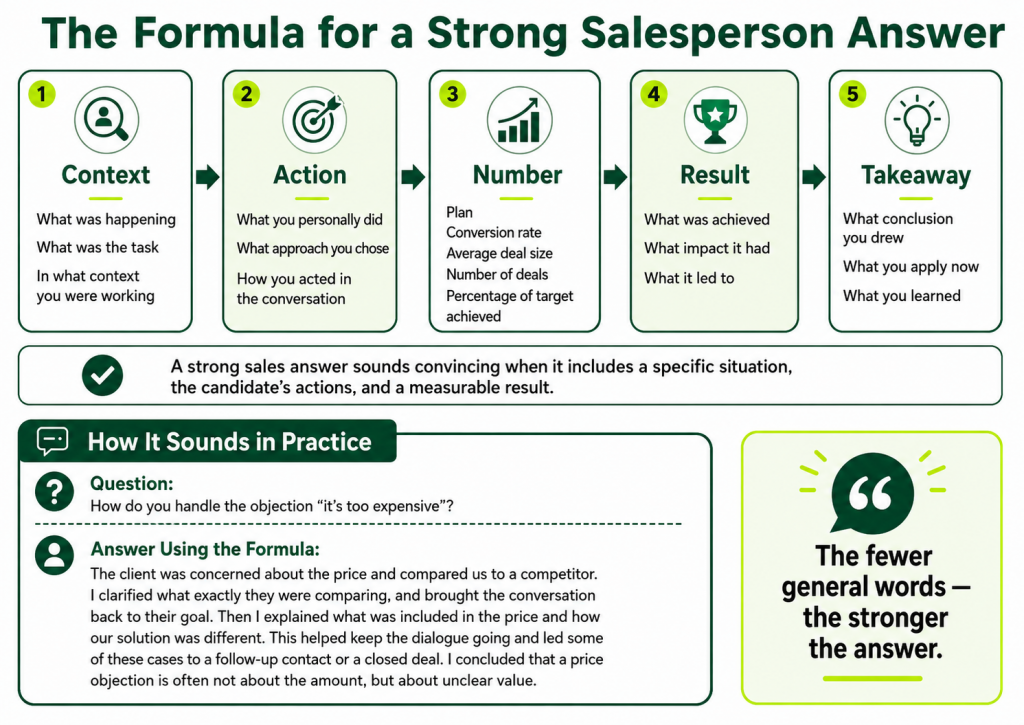
Context → Action → Number → Lesson
How It Works
Context: what the situation was.
Action: what you personally did.
Number: what result or metric you achieved.
Lesson: what you learned or how you apply it now.
Example
Question
How do you handle the objection “it’s too expensive”?
Strong Answer
“I first clarify what the customer is comparing the price with: a competitor, their expectation, or their budget. Then I return the conversation to the customer’s task and show what is included in the price. In my previous role, this approach helped keep the dialogue going and turn some refusals into a follow-up contact or a deal. I learned that a price objection is not always about price — often, the customer simply does not see the value yet.”
Another Useful Formula
For behavioral questions, use:
Situation → My Action → Result → What I Changed Afterward
This works especially well for questions about difficult customers, failed deals, and missed targets.
Examples of Strong Answers to Common Questions
Below is a block you can use as a foundation for preparation.
Do not memorize the answers word for word. A salesperson who sounds like an answering machine creates mild concern.
It is better to adapt the structure to your own experience.
“Why Sales?”
“I like that in sales, the result becomes visible fairly quickly. You can understand which actions work, which arguments are stronger, and where the customer hesitates. I am interested in work where I need to communicate, analyze, and lead the conversation to a specific result.”
“How Do You Work With Objections?”
“First, I clarify what exactly stands behind the objection. If a customer says ‘too expensive,’ it may be a comparison with a competitor, a limited budget, or a lack of understanding of the value. After clarifying, I explain the offer through the customer’s task, not just by listing advantages.”
“Did You Meet Your Target?”
“In most months, I met the target. There were periods when results dropped, and then I looked at which stage the problem was happening: not enough leads, weak conversion, long customer decision-making, or too many refusals. After that, I changed my actions: worked with the repeat customer base, returned to customers faster, and recorded reasons for refusal more accurately.”
“What Do You Do If a Customer Refuses?”
“I record the reason for refusal and assess whether it is final or not. If now is not the right time for the customer, we can agree on a follow-up contact. If the refusal is because of price or misunderstanding of the product, I clarify the details and give a more precise explanation. If the customer is clearly not interested, I do not pressure them or damage the relationship.”
“What Was Your Most Difficult Sale?”
“The most difficult sale was a deal where the customer compared us with competitors for a long time and postponed the decision several times. I identified the main decision criteria, prepared a comparison of the terms, and agreed on a specific decision date. The deal did not close immediately, but I understood how important it is to record the next step after every contact.”
“Why Did You Leave Your Previous Job?”
Speak calmly and avoid attacking your former employer.
Example
“I gained good experience in my previous role, but I wanted to develop further in more complex sales and work with a different level of customers. That is why I started looking for a position with more growth opportunities and a clearer development system.”
“How Much Do You Want to Earn?”
In sales, talking about money is normal.
Feeling awkward about it would be strange: you did not come here to sell air for smiles.
Answer
“I am looking for total income in the range of X–Y, considering base salary, bonuses, and realistic target achievement. I would like to understand how the motivation system works: what percentage is paid, what KPIs are used, and what average income managers have after onboarding.”
“Why Do You Want to Work With Us?”
Show that you have studied the company.
Weak Answer
“You have an interesting company and a promising vacancy.”
Strong Answer
“I am interested in your product and the way you work with customers. I looked at how you describe the service and who it is intended for. I think my experience in consultative sales could be useful here, because it is important not just to accept a request, but to explain the value and lead the customer to a decision.”
Mistakes Candidates Make in Sales Interviews
Interview mistakes are often not catastrophic, but they create doubt.
And doubt in hiring is like an open browser tab with bad reviews: technically you can close it, but the anxiety is already there.
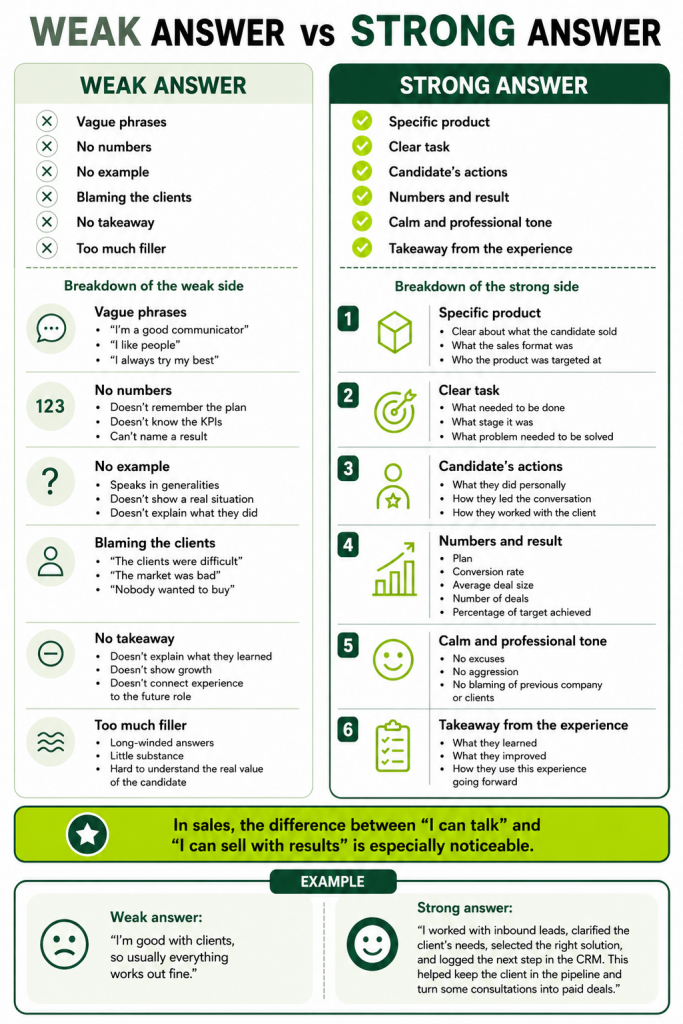
Mistake 1. Saying Only “I’m Sociable”
Sociability without results is just the ability to talk for a long time.
Poor Answer
“I easily find common ground with people.”
Better Answer
“I know how to ask questions and quickly understand what matters to the customer. For example, I often started consultations by clarifying the task, budget, and selection criteria, so I would not present unnecessary information.”
Mistake 2. Not Knowing Your Numbers
A salesperson without numbers looks as if they participated in the process but did not manage it.
Before the interview, recall:
- target;
- performance against target;
- average deal size;
- number of deals;
- conversion rate;
- number of calls;
- sales cycle;
- reasons for refusal.
Mistake 3. Blaming Customers, the Market, or the Previous Company
Yes, customers can be difficult.
Yes, the market can behave strangely.
Yes, sometimes a target looks like it was invented by someone in a state of excessive optimism.
But in an interview, it is important to show maturity.
Poor Answer
“The target was unrealistic, customers understood nothing, and management only demanded results.”
Better Answer
“The target was challenging, especially during a period of lower lead volume. I tried to compensate for that by working with the repeat customer base and following up faster.”
Mistake 4. Saying That Sales Is “Just Communication”
Sales is not just communication.
It is work with needs, value, objections, timing, money, and decisions.
Better Answer
“Communication matters, but it does not sell by itself. You need to understand the customer’s task, offer a suitable solution, and move the conversation to the next step.”
Mistake 5. Exaggerating Your Experience
In sales, experience is easy to check through details.
If someone says they managed major deals but cannot explain the cycle, stages, customer roles, and reasons for refusal, trust drops quickly.
Mistake 6. Not Asking the Employer Questions
An interview is not an interrogation under a lamp.
You are choosing the company too.
If a candidate asks nothing, the employer may think the candidate does not care where they work.
What Questions Should You Ask the Employer in a Sales Interview?
A candidate’s questions show maturity.
A good salesperson is interested not only in base salary and commission, but also in how the sales system works.
Questions About Targets and Expectations
- What is the sales target during the probation period?
- What are the expectations for the first month?
- What does a successful result look like after three months?
- Is the target based on revenue, deals, activity, or several indicators?
- Is there seasonality?
Questions About Leads and Channels
- Where do leads come from?
- Are there cold calls?
- What share of leads are inbound?
- Will I need to find customers myself?
- Which channels work best?
Questions About the Product
- How does product training work?
- Is there a knowledge base or scripts?
- Which objections come up most often?
- What usually differentiates the product from competitors?
- Which customers buy best?
Questions About CRM and Processes
- Which CRM is used?
- How are deal stages recorded?
- Is there a follow-up process?
- How does the manager review the pipeline?
- What reports need to be maintained?
Questions About Money
- How is the bonus calculated?
- Is there a cap on bonuses?
- When is commission paid?
- What happens to the bonus if a deal is refunded or cancelled?
- What is the average income of managers after onboarding?
Questions About the Team
- How many people are in the sales department?
- Is there a mentor at the start?
- How does onboarding work?
- What qualities help managers succeed in your team?
- Why is the vacancy open?
Important nuance: do not ask all the questions one after another as if you arrived with a tax audit.
Choose the 5–7 most important ones.
How a Sales Representative Should Prepare for an Interview
Preparing for a sales interview is not about memorizing beautiful phrases.
It is about collecting facts about yourself.
Step 1. Write Down the Products You Sold
For each product, note:
- what it was;
- who you sold it to;
- what the average deal size was;
- what the sales cycle was;
- which objections came up;
- which arguments worked.
Step 2. Recall Your Numbers
Prepare at least approximate data:
- sales target;
- target achievement;
- best result;
- average deal size;
- number of deals;
- number of customers;
- conversion rate;
- number of calls or meetings;
- size of the customer base.
If you do not have exact numbers, use ranges.
Step 3. Prepare Three Stories
You need stories about:
- a successful sale;
- a difficult customer;
- a failed deal or missed target.
Each story should be short and clear.
Step 4. Study the Company
Look at:
- what the company sells;
- who it sells to;
- what its website looks like;
- which products or services are main;
- how it explains value;
- who its competitors are;
- what reviews customers leave.
Step 5. Prepare Questions for the Employer
Write down questions about:
- target;
- leads;
- CRM;
- bonuses;
- training;
- probation period;
- expectations.
Sales Interview Preparation Checklist
Before the interview, check yourself.
What You Need to Recall
- What products or services you sold.
- What customers you worked with.
- Whether it was B2B or B2C.
- What sales channels you used.
- What the average deal size was.
- What the sales cycle was.
- What your target was.
- How often you met KPIs.
- Which CRMs you know.
- Which objections came up most often.
- What the reasons for refusal were.
- What your most difficult sale was.
- What your best result was.
- Why you left your previous job.
- What your salary expectations are.
- What you want to ask the employer.
Mini-Test: Are You Ready for a Sales Interview?
Answer honestly.
- Can you describe your experience in one minute?
- Do you remember your sales target?
- Can you name at least an approximate average deal size?
- Do you have an example of a difficult deal?
- Can you explain how you handle the objection “it’s too expensive”?
- Do you know which CRMs you used?
- Can you talk about a failed deal without blaming others?
- Have you prepared questions for the employer?
- Have you studied the company’s product?
- Do you understand why you want this specific vacancy?
If your answer is “yes” to 7–10 questions, you are well prepared.
If you answered “yes” fewer than five times, it is worth preparing more deeply.
A sales interview loves specifics and quickly notices fog.
FAQ: Common Questions About Sales Interviews
What questions are salespeople most often asked in interviews?
Most often, employers ask about sales experience, target achievement, customers, objections, CRM, cold calls, motivation, reasons for leaving, and real results.
What do employers ask sales candidates with no experience?
They check motivation, readiness to communicate with customers, reaction to rejection, ability to learn, understanding of the role, and basic communication skills.
How should you answer a question about not meeting a sales target?
It is better to honestly explain the reason, show your actions, and share your conclusions. Do not blame only the market, customers, or your previous company.
What numbers should you know before the interview?
Sales target, percentage of target achieved, average deal size, number of deals, calls, meetings, leads, conversion rate, sales cycle, and size of the customer base.
What should you ask the employer in a sales department interview?
Ask about the target, leads, CRM, product training, bonus system, average deal size, sales cycle, probation period, and expectations for the first months.
What questions are asked about cold calls?
You may be asked whether you have cold calling experience, how many calls you made per day, how you started the conversation, how you reacted to rejection, and how you recorded the result.
What should you say if you have no sales experience?
You can rely on experience communicating with people, customer service, administration, study projects, part-time jobs, consultations, or situations where you had to explain and persuade.
What mistakes do salespeople make in interviews?
Common mistakes include not knowing their numbers, answering with generic phrases, exaggerating experience, poorly understanding the product, being unable to explain how they work with customers, and not asking the employer questions.
Final Takeaway
A sales interview checks more than a confident voice and a pleasant smile.
The employer looks deeper: how you think, how you work with customers, whether you know your numbers, whether you can handle rejection, and whether you understand that sales is a process.
To perform better in the interview, prepare specific details:
- what you sold;
- who you sold it to;
- what targets and KPIs you had;
- which objections came up;
- how you worked with CRM;
- which deals were successful;
- which situations were difficult;
- what conclusions you made.
A good sales candidate’s answer does not sound like self-promotion. It sounds like a practical analysis of real experience.
No unnecessary drama.
No excuses.
No fantasies about “I always hit 500% of the target.”
Calmly, specifically, and like an adult.
And yes: if you can explain your experience as clearly as a good product to a customer, the interview already becomes your first successful sale.

