



What Should an IT Specialist Write in a Cover Letter in 2026?
A cover letter in IT is still very much alive in 2026. Yes, sometimes recruiters skip it. Yes, a recruiter may open your CV before reading your message. Yes, on some job platforms, applying feels as quick as ordering coffee with no sugar.
And still, a short cover letter often does one important thing: it quickly explains why your experience fits this specific team.
A CV shows your career path.
A cover letter explains the connection between you, the vacancy, and the employer’s needs.
This is especially important if you are:
- a junior IT specialist with limited commercial experience;
- a developer, QA engineer, analyst, DevOps engineer, PM, or designer with several different projects in your CV;
- changing roles within IT;
- applying for a remote position;
- targeting an international company, product team, outsourcing company, or startup;
- tired of sending applications into silence large enough to host a data center.
In this article, we will break down what an IT specialist should write in a cover letter in 2026, how to make your application short, natural, and convincing, which mistakes weaken the impression, and how to adapt your message for different IT roles, from frontend developer to project manager and DevOps engineer.
Do IT Specialists Still Need a Cover Letter in 2026?
The short answer
Yes, if the vacancy genuinely matters to you.
A cover letter for an IT role is not something you write just to tick a box. It works as a short professional bridge:
vacancy → your experience → proof → value for the team → link to your CV, GitHub, or portfolio
A good cover letter does not beg for attention. It saves the recruiter and hiring manager time.
When someone opens your application, they should immediately understand:
- which role you are applying for;
- what experience you already have;
- what tasks you have worked on;
- which technologies, tools, or processes you know;
- why you fit this particular vacancy;
- where they can verify your skills.
Why cover letters still matter
There are more applications in IT now, more automation, and more candidates using AI to write CVs and cover letters.
That created an odd effect: there are more cover letters, but fewer letters that feel precise, human, and relevant.
Many applications look like this:
Hello. I am interested in your vacancy. I am responsible, quick to learn, and want to grow in your company.
This kind of message could fit almost any opening: frontend, QA, accountant, coffee shop manager, or the person in the office who negotiates with the printer. That is the main problem.
In 2026, an IT cover letter should show relevance. In other words, it should clearly connect your experience with the company’s task.
When you should definitely write a cover letter
It is worth preparing a cover letter if:
- the vacancy is competitive;
- the company is genuinely interesting to you;
- your experience only partially matches the role, and you need to explain the connection;
- you are a junior candidate and want to show projects;
- you are changing direction, for example, from QA to business analysis or from development to project management;
- your CV includes a career gap, transition, or unconventional path;
- you are applying for a remote IT role;
- you are writing directly to a recruiter on LinkedIn or Telegram;
- you want to stand out among candidates with a similar tech stack.
When a short message is enough
Sometimes a full cover letter is unnecessary. For example, if the recruiter contacted you first, the role has simple requirements, and your CV fully matches the position.
In that case, a short message is enough:
Hello, Anna. Thank you for sharing the vacancy. The Backend Developer role looks interesting to me: for the past three years, I have worked with Python, PostgreSQL, and REST API, and I have experience with third-party integrations and query optimization. I would be happy to discuss the details and I am attaching my CV.
This format works especially well for LinkedIn, Telegram, Djinni, and direct recruiter messages.
Why Generic Cover Letters Almost Never Work
A generic cover letter does not give the recruiter any new information.
If the letter only says:
- “I want to grow”;
- “your company is interesting to me”;
- “I have strong communication skills”;
- “I learn quickly”;
- “I am ready to consider your offer”;
then the recruiter has to search for meaning in the CV on their own. Sometimes they will find it. Sometimes they will open the next application.
An IT cover letter should answer one simple question:
Why is this candidate suitable for this vacancy?
If the answer is clear within 15–20 seconds, the letter is already doing its job.
How a Cover Letter Differs from a CV
A CV shows facts
A CV answers questions such as:
- where you worked;
- which roles you held;
- which tech stack you used;
- which projects you worked on;
- which achievements you had;
- which skills you listed;
- where you studied;
- which certificates you have.
A CV is the map of your professional path.
A cover letter explains your choice
A cover letter answers a different question:
Why did you apply here?
It connects your experience with the tasks in the vacancy.
For example, a backend developer’s CV may say:
Python, Django, PostgreSQL, Redis, REST API, Docker, Celery.
In the cover letter, it is better to show how this experience was used:
I am applying for the Backend Developer position. In my latest project, I worked with Python, Django, PostgreSQL, and Redis, building APIs for a user account area and optimizing database queries. Based on the vacancy description, I see that experience with high-load services and integrations is important for your team, which is close to the tasks I handled in a fintech product team.
Here, the connection becomes clear: vacancy, experience, task, value.
The main mistake
A weak cover letter repeats the CV in paragraphs.
A strong cover letter selects the most relevant part of the CV for a specific vacancy.
Your CV is the entire shop window.
Your cover letter highlights the right shelf.
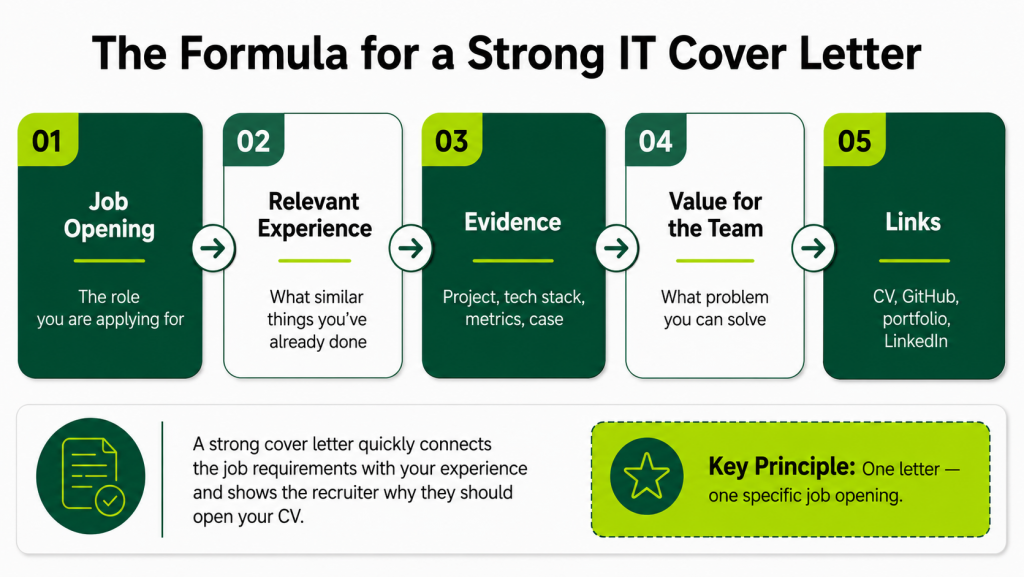
The Formula for an IT Cover Letter
Universal structure
Use a simple formula:
Role → relevant experience → proof → value for the team → link
Here is what each part means:
- Role: which position you are applying for.
- Relevant experience: what you have already done that is close to this role.
- Proof: a project, metric, tech stack, case, GitHub, or portfolio.
- Value for the team: which problem you can help solve.
- Link: CV, GitHub, LinkedIn, portfolio, or case studies.
What this looks like in practice
Hello. I am applying for the Frontend Developer position. For the past two years, I have worked with React, TypeScript, and REST API, building user account interfaces and admin panels for a B2B product. In one project, I redesigned the request creation form: we reduced the number of required steps and lowered the number of user errors during completion. I would be happy to discuss how my experience could be useful to your frontend team. I have attached my CV and GitHub.
This letter includes:
- the role;
- the tech stack;
- the product context;
- a specific task;
- a result;
- an invitation to continue the conversation.
And it does not turn into an autobiography with school memories, a first keyboard, and a tragic introduction to JavaScript.
The Ideal Cover Letter Length
For a job platform
The optimal length is:
- 2–3 short paragraphs;
- 5–8 sentences;
- around 800–1,200 characters.
That is enough to show relevance without overloading the recruiter.
For LinkedIn or Telegram
Keep it shorter:
- 3–5 sentences;
- the role;
- 1–2 strong arguments;
- a link to your CV, GitHub, or portfolio.
Example:
Hello, Maria. I saw the QA Engineer vacancy and would like to apply. I have experience testing web applications, working with Postman, SQL, and bug reports in Jira. In my latest project, I was responsible for regression testing of the user account area and checking integration with a payment service. I am attaching my CV and would be happy to discuss the role.
For email
An email can be slightly more formal.
Subject line:
Application for Backend Developer Position — First Name Last Name
Email body:
A short message + CV attached + link to GitHub or LinkedIn.
What to Include in an IT Cover Letter
1. A specific role
Clearly state which position you are applying for.
Weak:
I want to work at your company.
Better:
I am applying for the Junior QA Engineer position.
Even better:
I am applying for the Junior QA Engineer position in your web product team.
This immediately gives the recruiter context.
2. A short explanation of your interest
Your interest should be connected to the role’s tasks.
Weak:
I really liked your company.
Better:
The vacancy caught my attention because it includes testing web applications, APIs, and integrations, which closely matches my current experience.
Weak:
I want to grow in IT.
Better:
I want to grow in backend development because I have already worked with APIs, databases, and server-side logic in educational and commercial projects.
3. Relevant experience
Choose 1–2 parts of your experience that match the vacancy.
If the vacancy is about React, TypeScript, and interfaces, write about React, TypeScript, and interfaces.
If the vacancy is about SQL, requirements, and client communication, write about SQL, requirements, and communication.
If the vacancy is about CI/CD, Docker, and monitoring, write about CI/CD, Docker, and monitoring.
The letter should feel tailored to the role, not like an export of every skill you have collected during your career.
4. Technologies and tools
Mention the stack selectively.
For a developer, this may include:
- JavaScript;
- TypeScript;
- React;
- Node.js;
- Python;
- Java;
- PostgreSQL;
- Docker;
- REST API.
For QA, this may include:
- Postman;
- SQL;
- Jira;
- TestRail;
- Selenium;
- Playwright;
- Cypress;
- Charles;
- DevTools.
For an analyst, this may include:
- SQL;
- BPMN;
- UML;
- Jira;
- Confluence;
- Figma;
- API;
- user stories;
- acceptance criteria.
For a project manager, this may include:
- Jira;
- Confluence;
- Scrum;
- Kanban;
- backlog;
- roadmap;
- risk management;
- delivery;
- stakeholder management.
For DevOps, this may include:
- Linux;
- Docker;
- Kubernetes;
- CI/CD;
- GitLab CI;
- Jenkins;
- AWS;
- Azure;
- Google Cloud;
- Terraform;
- Prometheus;
- Grafana.
5. A result or contribution
Even a short cover letter becomes stronger when it includes a result.
Examples:
- reduced endpoint response time;
- lowered the number of synchronization errors;
- made regression testing faster;
- described requirements for a new version of a form;
- delivered an MVP on time;
- configured a pipeline for staging and production;
- improved error visibility through monitoring;
- redesigned a request interface;
- automated part of manual checks.
A result can include a number, but the number is not mandatory.
If you have numbers, great:
Reduced endpoint response time from 1.8 seconds to 0.6 seconds.
If you do not have numbers, describe your contribution:
Added logging for ambiguous scenarios and made it easier to identify synchronization errors.
6. A link that proves your experience
In IT, a cover letter becomes stronger when there is somewhere to go next:
- GitHub;
- GitLab;
- portfolio;
- LinkedIn;
- Behance;
- Figma;
- case studies;
- project demo;
- CV.
But the link should lead to something meaningful.
If your GitHub is empty, the link does not build trust. An empty GitHub looks like a fridge in a rented apartment: technically, it exists, but it brings very little joy.
How to Start a Cover Letter
Strong openings
A good opening gives context immediately.
Examples:
Hello. I am applying for the Frontend Developer position. I have experience building interfaces with React and TypeScript for a B2B product.
Hello. I would like to apply for the QA Engineer vacancy. I have worked with web applications, APIs, test documentation, and SQL queries for data validation.
Hello. I am applying for the Project Manager position. In IT projects, I have managed development, design, and QA teams, working with timelines, backlog, and client communication.
Weak openings
Avoid phrases such as:
- Good day;
- I am interested in your vacancy;
- I am a young and ambitious specialist;
- I have been interested in computers since childhood;
- I saw your vacancy and decided to try.
The phrase “decided to try” is especially risky. The employer is looking for a specialist, not a lottery participant.
How to sound natural
A natural tone does not mean adding jokes to every line.
It is enough to write in normal human language:
I am applying for the Backend Developer position. Based on the vacancy description, I see that APIs, integrations, and PostgreSQL are important for your team. This matches my experience: for the past two years, I have worked on the backend of a B2B service and improved the request processing module.
This sounds confident, specific, and free from corporate fog.
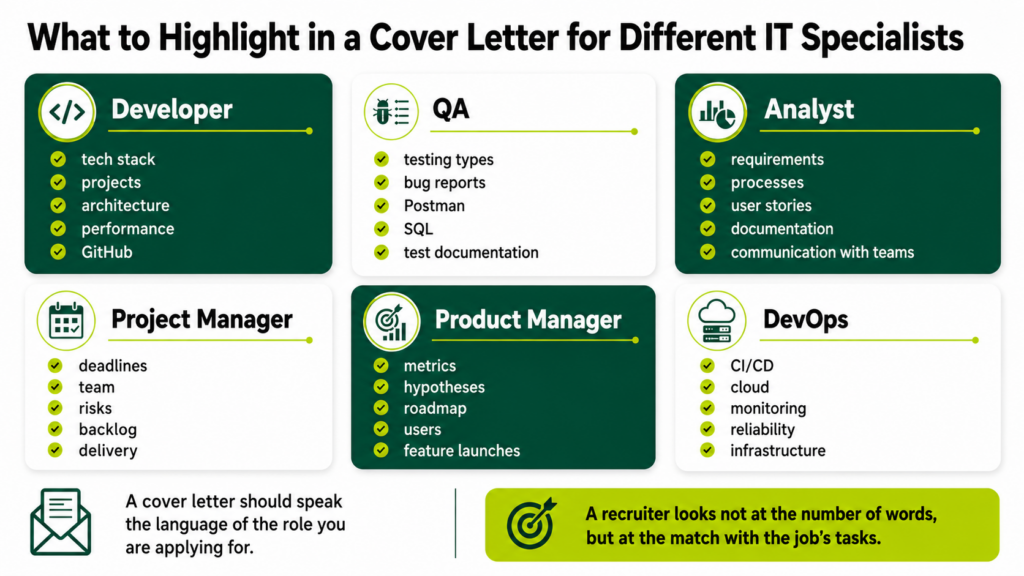
How Developers Should Write Cover Letters
Frontend Developer
A frontend developer should show:
- tech stack;
- type of interfaces;
- work with APIs;
- attention to UX;
- responsiveness;
- performance;
- involvement in product tasks;
- GitHub or demo.
Example:
Hello. I am applying for the Frontend Developer position. For the past two years, I have worked with React, TypeScript, and REST API, building interfaces for user accounts and internal admin panels. In one project, I redesigned the request creation form: I simplified the user flow and reduced the number of completion errors. I would be happy to discuss how my experience could be useful to your frontend team. I have attached my CV and GitHub.
Backend Developer
A backend developer should write about:
- APIs;
- databases;
- queues;
- integrations;
- performance;
- architectural decisions;
- logging;
- reliability;
- working with load.
Example:
Hello. I am applying for the Backend Developer position. I have experience building APIs, working with PostgreSQL, queues, and integrations with external services. In my latest project, I contributed to improving the order processing module: I rewrote part of the logic, reduced synchronization errors, and added logging for ambiguous scenarios. I would be happy to discuss the technical details in an interview.
Fullstack Developer
A fullstack developer should avoid spreading attention across too many things. Show the frontend + backend connection through a task.
Example:
Hello. I am applying for the Fullstack Developer position. I have worked with React, Node.js, PostgreSQL, and REST API, building functionality from the interface to the server-side logic. In one project, I implemented a request management module: the frontend form, API, data storage, and basic error handling. This kind of task is close to your vacancy, where you need a specialist who understands product logic from both sides.
Mobile Developer
A mobile developer should show:
- platform;
- stack;
- type of application;
- work with APIs;
- publishing experience;
- performance;
- user flows.
Example:
Hello. I am applying for the Mobile Developer position. I worked on an Android app for a booking service, where I handled profile screens, API integration, and error processing under unstable connection conditions. I see that user flows and app stability are important in your vacancy, so my experience may be relevant to your team.
Junior Developer
A junior developer does not need to pretend to be a miniature senior.
It is better to show:
- stack;
- educational and pet projects;
- GitHub;
- understanding of the role;
- attention to detail;
- readiness for code review;
- specific tasks already completed.
Example:
Hello. I am applying for the Junior Frontend Developer position. I work with HTML, CSS, JavaScript, and React, and I have built several educational projects with responsive layout, forms, and API integration. On GitHub, I pinned a project with search and data filtering, where I described the stack, setup, and my role. I would like to join a team where clean layout, readable code, and real user interfaces matter.
Senior Developer
A senior developer should write about more than the tech stack. Scale, decisions, product impact, and team contribution matter.
Show:
- task complexity;
- architectural contribution;
- performance impact;
- code review;
- mentoring;
- stable solutions;
- participation in technical discussions.
Example:
Hello. I am applying for the Senior Backend Developer position. In recent years, I have worked with Python, PostgreSQL, Redis, and microservice architecture in a product team. I contributed to redesigning the request processing module: we optimized queries, added monitoring for critical scenarios, and reduced incidents during peak loads. Based on the vacancy description, I see a focus on backend service reliability, so my experience may be useful to your team.
How QA Engineers Should Write Cover Letters
Manual QA
A Manual QA engineer should show more than “I tested a website.” Describe the types of checks and the work context.
Mention:
- web or mobile applications;
- test documentation;
- bug reports;
- regression testing;
- smoke testing;
- API;
- Postman;
- SQL;
- Jira;
- communication with developers.
Example:
Hello. I am applying for the QA Engineer position. I have worked with web applications, test documentation, bug reports, Postman, and SQL queries for data validation. In my latest project, I was responsible for regression testing of the user account area and checking integrations with a payment service. I can be useful to a team where it is important to quickly identify problematic scenarios and describe defects clearly for developers.
Automation QA
An Automation QA engineer should show the automation stack and type of coverage.
Example:
Hello. I am applying for the Automation QA Engineer position. I have experience automating UI and API tests, working with Playwright, JavaScript, Postman, and CI. In my latest project, I added automated tests for the main authorization and request submission flows, which helped the team check critical functionality faster before releases. I would be happy to discuss which checks are currently a priority for your team.
QA without commercial experience
If you do not have commercial experience, use educational projects, test tasks, pet projects, practice assignments, and hackathons.
Example:
Hello. I am applying for the Junior QA Engineer position. I completed training in web application testing and worked with test cases, checklists, bug reports, Postman, and SQL. For practice, I tested an educational online store: I created a checklist, checked the order form, described the defects I found, and prepared reports in a format close to a real team workflow. I can send examples of test documentation.
How Analysts Should Write Cover Letters
Business Analyst
A business analyst should show the connection between business, users, and the development team.
Mention:
- requirements gathering;
- client interviews;
- process description;
- user stories;
- acceptance criteria;
- solution alignment;
- Jira;
- Confluence;
- Figma;
- SQL.
Example:
Hello. I am applying for the Business Analyst position. I have experience gathering requirements, describing business processes, preparing user stories, and aligning decisions between the client, development, and QA teams. In one project, I contributed to redesigning the request submission process: I described the current flow, collected pain points, and prepared requirements for the new version of the form. I would be happy to discuss how my experience could be useful to your product team.
System Analyst
A system analyst should show technical depth.
Example:
Hello. I am applying for the System Analyst position. I have worked with API descriptions, integrations, data schemes, and requirements for backend teams. In my latest project, I helped prepare a specification for data exchange between an internal system and an external service: I described scenarios, errors, request formats, and API responses. I see that your vacancy requires work at the intersection of business and development, which matches my experience.
Data Analyst
A data analyst should write about data, tools, and the impact of analysis on decisions.
Example:
Hello. I am applying for the Data Analyst position. I have worked with SQL, dashboards, and product metrics analysis. In one project, I analyzed user behavior in the registration funnel and prepared a report showing where part of the audience dropped off. The team used this data to improve the form and test hypotheses. I would be happy to explain my analytical approach and share examples of tasks.
Product Analyst
A product analyst should connect data with product development.
Example:
Hello. I am applying for the Product Analyst position. I have experience analyzing user flows, product metrics, and hypotheses. I have worked with SQL, events, dashboards, and reports for product teams. In one project, I investigated a conversion drop at the request submission stage and prepared insights for the product and design teams. Your vacancy interests me because it combines data, users, and product growth.
How Project Managers and Product Managers Should Write Cover Letters
Project Manager
An IT Project Manager should show task management, timelines, team coordination, and risk management.
Mention:
- team;
- backlog;
- deadlines;
- risks;
- communication;
- Jira;
- Confluence;
- Scrum;
- Kanban;
- delivery;
- client work.
Example:
Hello. I am applying for the Project Manager position. In IT projects, I managed development, design, and QA teams, working with backlog, timelines, risks, and client communication. In my latest project, the team released an MVP in three months: we fixed critical requirements in advance and reduced the number of disputed changes before release. I would be happy to discuss my approach to task management and team communication.
Product Manager
A Product Manager should show product logic: users, hypotheses, metrics, roadmap, and feature launches.
Example:
Hello. I am applying for the Product Manager position. I have worked with user flow research, backlog formation, hypothesis testing, and new feature launches. In one project, the team redesigned onboarding: we studied the behavior of new users, changed the structure of the first screens, and improved completion of the key flow. Your vacancy interests me because it focuses on product growth and metrics.
Scrum Master / Delivery Manager
Here, it is important to show process, team dynamics, and predictable delivery.
Example:
Hello. I am applying for the Delivery Manager position. I have experience working with several development teams, release planning, dependency management, and delivery process improvement. In my latest project, we redesigned sprint planning, made task statuses more transparent, and reduced the number of unplanned blockers before release. I would be happy to discuss which delivery challenges are currently important for your team.
How DevOps, SRE, and System Administrators Should Write Cover Letters
DevOps Engineer
A DevOps engineer should write about infrastructure, automation, CI/CD, and reliability.
Example:
Hello. I am applying for the DevOps Engineer position. I have worked with Linux, Docker, CI/CD, monitoring, and cloud infrastructure. In my latest project, I configured pipelines for staging and production, added basic checks before deployment, and improved error visibility through monitoring. I would be happy to discuss which infrastructure tasks are currently a priority for your team.
SRE
An SRE should show reliability, incidents, monitoring, SLOs, and automation.
Example:
Hello. I am applying for the SRE Engineer position. I have experience setting up monitoring, working with incidents, analyzing logs, and automating repeated infrastructure tasks. In one project, we improved service observability: we added alerts for critical scenarios and accelerated root-cause analysis. I see that platform reliability is important for your team, which matches my experience.
System Administrator
A system administrator should show stability, user support, infrastructure, and security.
Example:
Hello. I am applying for the System Administrator position. I have worked with Linux, network infrastructure, access rights, backups, and user support. In my latest project, I helped clean up user accounts, update documentation, and configure basic server monitoring. I would be happy to discuss your infrastructure tasks in more detail.
Cloud Engineer
A Cloud Engineer should show cloud platforms, automation, and security.
Example:
Hello. I am applying for the Cloud Engineer position. I have worked with AWS, Docker, Terraform, and CI/CD, and helped configure environments for development and production. In one project, I automated part of the infrastructure changes through Terraform and made service deployment more repeatable. Your vacancy interests me because it focuses on developing a cloud platform and improving environment reliability.
How UX/UI and Product Designers Should Write Cover Letters
UX/UI Designer
An IT designer should show more than beautiful layouts. The letter should show work with the task, the user, and the product.
Mention:
- Figma;
- user flows;
- prototypes;
- design system;
- research;
- collaboration with developers;
- interface improvement;
- portfolio.
Example:
Hello. I am applying for the UX/UI Designer position. I have worked with web service interfaces, Figma prototypes, user flows, and preparing layouts for development. In one project, I redesigned a request form: I simplified the field structure, prepared error states, and gave the team a clear specification. I have attached my portfolio and would be happy to discuss the product tasks.
Product Designer
A Product Designer should show thinking through product tasks.
Example:
Hello. I am applying for the Product Designer position. I have experience working with user flows, prototypes, design systems, and hypothesis testing together with product teams. In my latest project, I contributed to redesigning onboarding: we studied problematic steps, changed the structure of the first screens, and prepared a new version for testing. Your vacancy interests me because it offers the opportunity to work with the product through research, interfaces, and metrics.
How Junior IT Specialists Should Write Cover Letters
What to do if you have no commercial experience
A lack of commercial experience is common for juniors.
Your cover letter should show that you can already do something with your hands.
Use:
- educational projects;
- pet projects;
- open source;
- internships;
- hackathons;
- freelance tasks;
- test assignments;
- team learning projects;
- GitHub;
- documentation;
- demos.
What to write instead of “I learn quickly”
The phrase “I learn quickly” sounds empty unless it is backed by proof.
Weak:
I learn quickly and want to grow.
Better:
During my training, I built three React projects: a catalog with filtering, an authorization form, and an app with an external API connection. In each project, I described the setup and my role in the README.
Weak:
I have no experience, but I really want to get into IT.
Better:
I do not have commercial experience yet, but I have educational projects with HTML, CSS, JavaScript, and React. On GitHub, I pinned an app with search and data filtering, and described the stack, structure, and setup separately.
How a junior can stand out
A junior candidate stands out through accuracy, not loud promises.
Show:
- a clear GitHub profile;
- a proper README;
- live projects;
- a conscious choice of role;
- basic understanding of the vacancy;
- no generic text;
- readiness for teamwork.
Example for a junior QA
Hello. I am applying for the Junior QA Engineer position. I studied the basics of web application testing and worked with test cases, checklists, bug reports, Postman, and SQL. For practice, I tested an educational booking service: I checked registration, search, the request form, and described the defects I found. I would be happy to show examples of test documentation and discuss which tasks will be relevant at the start.
Example for a junior analyst
Hello. I am applying for the Junior Business Analyst position. During my training, I worked with business process descriptions, user stories, acceptance criteria, and basic SQL queries. In an educational project, I described a request submission process: I identified user roles, scenario steps, possible errors, and form requirements. I want to grow in analysis through real product tasks and can show examples of documentation.
How Middle and Senior Specialists Should Write Cover Letters
Middle: show independence
A middle-level candidate should show that they can take tasks and bring them to completion.
Useful phrases include:
- was responsible for a module;
- led part of the functionality;
- participated in solution design;
- worked with integrations;
- handled tasks from analysis to release;
- collaborated with QA, analysts, and the product team;
- improved existing functionality.
Example:
I am applying for the Middle Backend Developer position. For the past two years, I have worked with APIs, PostgreSQL, and integrations for a B2B product. I was responsible for improving the request module: I participated in discussing requirements, implementing server-side logic, handling errors, and supporting the release afterward. Based on the vacancy description, I see a similar set of tasks, so my experience may be useful to your backend team.
Senior: show scale
A senior candidate should write less about wanting to grow and more about the scale of the tasks they have handled.
Important points:
- architecture;
- performance;
- reliability;
- mentoring;
- technical decisions;
- product impact;
- working with uncertainty;
- system thinking.
Example:
I am applying for the Senior Software Engineer position. In recent projects, I have worked with high-load backend services, PostgreSQL optimization, queues, and monitoring. I contributed to redesigning the event processing module: the team reduced incidents during peak loads and gained more transparent error diagnostics. I see that reliability and scalability are important for your team, which is close to my experience.
Team Lead / Tech Lead
Here, it is important to show technical leadership without loud slogans.
Example:
Hello. I am applying for the Tech Lead position. I have experience developing backend services, conducting code reviews, technical planning, and mentoring developers. In my latest project, I led the technical part of redesigning an integrations module: I aligned the solution with analysts, distributed tasks within the team, and participated in key architectural discussions. I would be happy to discuss the technical challenges your team is currently facing.
How to Adapt a Cover Letter to a Specific Vacancy
Step 1. Pull out the most important details from the vacancy
Read the vacancy and highlight:
- role;
- tech stack;
- tasks;
- product;
- work format;
- level;
- key requirements;
- nice-to-have skills;
- team specifics.
For example, the vacancy says:
- React;
- TypeScript;
- work with APIs;
- product team;
- user account area;
- attention to UX.
That means your cover letter should show exactly that.
Step 2. Connect the requirements to your experience
Create a mini-table for yourself.
| In the vacancy | In your experience |
| React | Built interfaces with React |
| TypeScript | Used it in an admin panel project |
| API | Connected REST APIs |
| UX | Redesigned a request form |
| Product team | Worked with a product manager and QA |
From this table, it becomes much easier to build the letter.
Step 3. Remove anything unnecessary
If the vacancy is about frontend, there is no need to write in detail about a school Pascal competition.
If the vacancy is about DevOps, do not spend half the letter on Figma.
If the vacancy is about project management, do not turn the letter into a list of every task tracker you have ever seen.
Step 4. Add one specific phrase about the company
Do not write generic praise.
Weak:
Your company is a market leader, and I dream of becoming part of your team.
Better:
The vacancy interested me because it focuses on developing a B2B SaaS product and working with a client account area. I have similar experience in a product team.
Step 5. Check the letter like a recruiter
Ask yourself:
- Is it clear which vacancy I am applying for?
- Is it clear why my experience is relevant?
- Is there an example of a task?
- Are the stack or tools mentioned?
- Is there a link to my CV, GitHub, or portfolio?
- Can the text be read in half a minute?
- Does the letter sound like a real professional application?
How to Write for Different Types of Companies
Product company
A product company cares about:
- users;
- metrics;
- product development;
- long-term work with functionality;
- quality of solutions;
- understanding the business goal.
Possible wording:
The vacancy interested me because of its product focus. In a previous project, I worked on the user account area of a B2B service, where it was important to improve user flows and maintain the stability of key functionality.
Outsourcing company
An outsourcing company values:
- client projects;
- flexibility;
- communication;
- deadlines;
- delivery quality;
- ability to quickly enter a new domain.
Possible wording:
I have experience working in a project-based environment: I quickly entered new tasks, collaborated with analysts, QA, and the client, and handled functionality from requirement clarification to release.
Startup
A startup values:
- independence;
- speed;
- a broad range of tasks;
- readiness for change;
- product initiative;
- ability to work with incomplete information.
Possible wording:
The vacancy interests me because of the startup environment and the opportunity to influence the product. In previous projects, I worked with tasks where requirements were clarified during the process, so I am used to quickly understanding context, suggesting solutions, and bringing functionality to release.
International company
An international company values:
- English;
- asynchronous communication;
- documentation;
- distributed teams;
- independence;
- transparent statuses.
Possible wording:
I have experience working in a distributed team: I managed tasks in Jira, documented decisions in Confluence, and regularly synchronized with colleagues in English. This format is close to the way your vacancy is described.
What to Write to a Recruiter on LinkedIn or Telegram
Short message format
Use this structure:
- Greeting.
- Role.
- 1–2 matches with the vacancy.
- Link or CV.
- Readiness to talk.
Example for a developer
Hello, Elena. I would like to apply for the React Developer vacancy. I have experience with React, TypeScript, REST API, and interfaces for a B2B product. In my latest project, I worked on the client account area and improved the request form. I am attaching my CV and GitHub, and would be happy to discuss the role.
Example for QA
Hello, Artem. I saw the QA Engineer vacancy and would like to apply. I have worked with web applications, Postman, SQL, test documentation, and regression testing before releases. I am attaching my CV and would be happy to tell you more about my projects.
Example for PM
Hello, Maria. I would like to apply for the Project Manager position. In IT projects, I managed development, design, and QA teams, working with backlog, timelines, risks, and the client. In my latest project, the team released an MVP in three months. I am attaching my CV and would be happy to discuss the vacancy.
If you do not know the recruiter’s name
Use a neutral greeting:
Hello. I am applying for the Backend Developer position.
Do not write:
Dear HR specialist of the company.
It sounds as if the message was pulled from the archive of an office fax machine.
How to Use AI for a Cover Letter
What AI can help with
AI is useful for:
- drafting;
- shortening text;
- checking structure;
- adapting the letter to a vacancy;
- finding weak spots;
- translating into English;
- preparing several versions.
For example, you can use a prompt like this:
Analyze the vacancy and my CV. Write a short cover letter in 6 sentences. The tone should be natural and professional, without generic phrases. Show the connection between the vacancy requirements and my experience. Do not add facts that are not in my CV.
What you need to edit manually
AI often makes text too smooth.
You may see phrases like:
- “I am an ideal fit for your dynamic team”;
- “I have a passion for innovation”;
- “I am focused on achieving outstanding results”;
- “I am motivated to contribute to the company’s development.”
In a real application, it is better to replace this with specifics.
Weak:
I have a passion for creating innovative digital solutions.
Better:
In my latest project, I developed the user account interface with React and TypeScript, connected APIs, and improved request form flows.
How to remove the AI tone
Check the letter with this list:
- Is there a specific role?
- Is there a tech stack?
- Is there a task from your experience?
- Is there a result or contribution?
- Are there phrases that could fit any vacancy?
- Are there any achievements that did not actually happen?
- Does the text sound like something you could say in an interview?
A good rule:
If you would not say the phrase out loud to a recruiter, remove it from the letter.
What Not to Write in a Cover Letter
Mistake 1. Sending the same text to every vacancy
Weak version:
Hello. I am interested in your vacancy. I have extensive experience, I am responsible, and I want to grow.
Why it is weak:
- the role is missing;
- the experience is not visible;
- there is no value for the team;
- the letter could fit any vacancy.
Strong version:
Hello. I am applying for the Backend Developer position. For the past two years, I have worked with Python, PostgreSQL, and REST API, and contributed to developing a service for processing client requests. In my latest project, I optimized several slow queries and reduced the response time of a key endpoint from 1.8 seconds to 0.6 seconds. I would be happy to discuss how my experience could be useful to your backend team.
Mistake 2. Writing a long story about yourself
Weak version:
Back at university, I realized that IT was my calling. Since then, I have constantly studied, read books, watched courses, followed new technologies, and dreamed of working in a strong team.
Better:
I am applying for the Junior Backend Developer position. I have worked with Python, FastAPI, PostgreSQL, and Docker in educational projects. On GitHub, I pinned an API for a task service with authorization, CRUD operations, and setup instructions.
Mistake 3. Listing the entire tech stack
Weak version:
I know HTML, CSS, JavaScript, React, Vue, Angular, Node.js, Python, Java, SQL, Git, Docker, Figma, Jira, Linux, Photoshop, Excel.
This kind of letter looks like a stationery store: there is a lot of everything, but it is unclear why you came.
Better:
Based on the vacancy, I see that React, TypeScript, and API work are important for your team. This matches my experience: in recent projects, I worked with React, connected REST APIs, and improved user flows in a client account area.
Mistake 4. Complaining about your previous job
Weak version:
I left my previous job because the processes were poor and the management was weak.
Better:
I am currently considering a role where I can develop my experience in product frontend development, work with user flows, and contribute to improving interfaces.
Mistake 5. Too much emotion
Weak version:
I desperately want to work for your company. It is my dream, and I am ready to do anything for this opportunity.
Better:
The vacancy interested me because it includes developing a SaaS product and working with B2B clients. I have experience with similar tasks in a product team.
Mistake 6. Linking to an empty GitHub
If your GitHub is empty, improve it first:
- pin 2–3 projects;
- add README files;
- describe the stack;
- explain how to run the project;
- show your role;
- remove random experiments.
An empty link creates the opposite effect: you wanted to prove your experience, but showed a storage room full of forgotten folders.
Mistake 7. Writing 4,000 characters
Recruiters read many applications. A lot of them.
A cover letter should be short. If the text fills the whole screen, it becomes harder to read.
Use this guideline:
- 2–3 paragraphs;
- 5–8 sentences;
- one main focus.
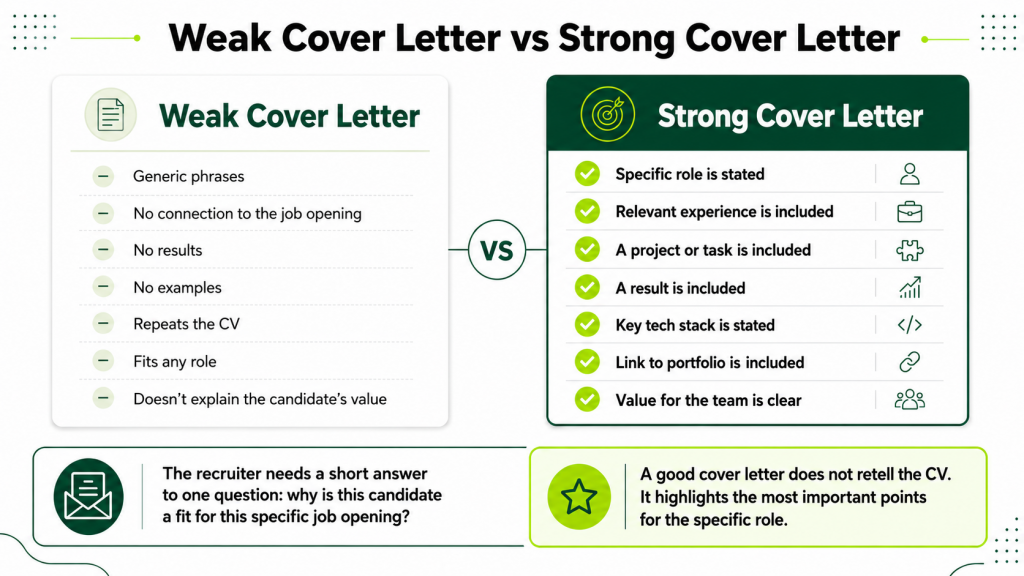
Weak vs Strong Cover Letter
Weak cover letter
Hello. I am interested in your vacancy. I have experience in IT, I learn quickly, I am responsible, communicative, and want to grow in your company. I would be happy to consider your offer.
Why it is weak
- no role;
- no specific experience;
- no tech stack;
- no result;
- no connection to the vacancy;
- the text could be sent to anyone.
Strong cover letter
Hello. I am applying for the Backend Developer position. For the past two years, I have worked with Python, PostgreSQL, and REST API, and contributed to developing a service for processing client requests. In my latest project, I optimized several slow queries and reduced the response time of a key endpoint from 1.8 seconds to 0.6 seconds. I would be happy to discuss how my experience could be useful to your backend team. I have attached my CV to the application.
Why it is strong
- the role is stated;
- the stack is clear;
- there is a task;
- there is a result;
- the candidate’s value is visible;
- the letter is short.
Ready-to-Use Cover Letter Examples for IT Specialists
Example for a Junior Frontend Developer
Hello. I am applying for the Junior Frontend Developer position. I work with HTML, CSS, JavaScript, and React, and I have built several educational projects with responsive layout, forms, and API integration. On GitHub, I pinned a project with search and data filtering, where I described the stack, setup, and my role. I would like to join a team where clean layout, readable code, and building interfaces for real users matter.
Example for a Frontend Developer
Hello. I am applying for the Frontend Developer position. I have experience building interfaces with React and TypeScript, connecting REST APIs, and working with components for a user account area. In my latest project, I contributed to redesigning a request form: we simplified the completion flow and reduced the number of user errors. I would be happy to discuss how my experience could be useful to your frontend team.
Example for a Backend Developer
Hello. I am applying for the Backend Developer position. I have experience building APIs, working with PostgreSQL, queues, and integrations with external services. In my latest project, I contributed to improving the order processing module: I rewrote part of the logic, reduced synchronization errors, and added logging for ambiguous scenarios. I would be happy to tell you more about the projects and technical decisions in an interview.
Example for a Fullstack Developer
Hello. I am applying for the Fullstack Developer position. I have worked with React, Node.js, PostgreSQL, and REST API, building functionality from interface to server-side logic. In one project, I implemented a request management module: frontend form, API, data storage, and error handling. Your vacancy is close to my experience because it requires understanding the product from both sides.
Example for a QA Engineer
Hello. I am applying for the QA Engineer position. I have worked with web applications, test documentation, bug reports, Postman, and SQL queries for data validation. In my latest project, I was responsible for regression testing of the user account area and checking integrations with a payment service. I can be useful to a team where it is important to quickly identify problematic scenarios and describe defects clearly for developers.
Example for an Automation QA Engineer
Hello. I am applying for the Automation QA Engineer position. I have worked with UI and API test automation, Playwright, JavaScript, and integrating checks into CI. In my latest project, I added automated tests for authorization and the key request submission flow so the team could check critical functionality faster before release. I would be happy to discuss which checks are currently important for your team.
Example for a Business Analyst
Hello. I am applying for the Business Analyst position. I have experience gathering requirements, describing business processes, preparing user stories, and aligning decisions between the client, development, and QA teams. In one project, I contributed to redesigning the request submission process: I described the current flow, collected pain points, and prepared requirements for the new version of the form. I would be happy to discuss how my experience could be useful to your product team.
Example for a System Analyst
Hello. I am applying for the System Analyst position. I have worked with API descriptions, integrations, data structures, and requirements for backend teams. In my latest project, I prepared a specification for data exchange between an internal system and an external service: I described scenarios, request formats, responses, and error handling. Your vacancy interests me because it involves work at the intersection of business and development.
Example for a Data Analyst
Hello. I am applying for the Data Analyst position. I have experience working with SQL, dashboards, and product metrics analysis. In one project, I analyzed a registration funnel and prepared insights about the steps where users most often interrupted the flow. The team used this data to improve the form and test hypotheses. I would be happy to tell you more about examples of my analysis.
Example for a Project Manager
Hello. I am applying for the Project Manager position. In IT projects, I managed development, design, and QA teams, working with backlog, timelines, risks, and client communication. In my latest project, the team released an MVP in three months: we fixed critical requirements in advance and reduced the number of disputed changes before release. I would be happy to tell you more about my approach to task management and team communication.
Example for a Product Manager
Hello. I am applying for the Product Manager position. I have worked with backlog, user flows, hypothesis testing, and new feature launches. In one project, the team redesigned onboarding: we studied new user behavior, changed the structure of the first screens, and prepared a new version for testing. Your vacancy interests me because it focuses on product metrics and user experience development.
Example for a DevOps Engineer
Hello. I am applying for the DevOps Engineer position. I have worked with Linux, Docker, CI/CD, monitoring, and cloud infrastructure. In my latest project, I configured pipelines for staging and production, added basic checks before deployment, and improved error visibility through monitoring. I would be happy to discuss which infrastructure tasks are currently a priority for your team.
Example for a UX/UI Designer
Hello. I am applying for the UX/UI Designer position. I have worked with web service interfaces, Figma prototypes, user flows, and preparing layouts for development. In one project, I redesigned a request form: I simplified the field structure, prepared error states, and gave the team a clear specification. I have attached my portfolio to the application.
How to End a Cover Letter
Strong final lines
The final line should invite dialogue.
Good options:
- I would be happy to discuss how my experience could be useful to your team.
- I can share more about the projects and technical decisions in an interview.
- I am attaching my CV and GitHub, and would be happy to answer any questions.
- I have added my portfolio to the application and would be happy to discuss the role’s tasks.
- I would be happy to have a short call and tell you more about my relevant experience.
Weak final lines
Avoid ending like this:
- I really hope to hear from you.
- Please consider my candidacy.
- Thank you in advance for your time.
- I am ready for any work.
- Please hire me.
The last one may sound honest, but recruitment is still not a casting call for a drama series.
Checklist Before Sending
Before sending your cover letter, check that:
- the specific vacancy is mentioned;
- the text is written for this role;
- there is a connection to the employer’s requirements;
- the letter does not repeat the whole CV;
- there are 1–2 relevant examples;
- the stack or tools important for the role are mentioned;
- there is a result, metric, or clear contribution;
- the text fits into 2–3 short paragraphs;
- there are no generic phrases;
- there are no invented achievements;
- there is a link to GitHub, portfolio, LinkedIn, or CV;
- the link leads to a polished profile or project;
- the tone sounds natural;
- the letter can be read in 30–40 seconds;
- the final line invites further conversation.
Mini Cover Letter Template
Use this structure as a base, but always adapt it to the vacancy.
Hello. I am applying for the [role title] position. I have experience with [relevant experience / stack / tools], and in recent projects I worked on [tasks similar to the vacancy]. In one project, I [specific contribution or result]. I see that your vacancy requires [key requirements], which matches my experience. I am attaching my CV / GitHub / portfolio and would be happy to discuss the role.
Filled-in example
Hello. I am applying for the Frontend Developer position. I have experience with React, TypeScript, and REST API, and in recent projects I worked on user account and admin panel interfaces. In one project, I redesigned a request form and simplified the completion flow for users. I see that your vacancy requires a product-oriented approach and experience with interfaces for B2B clients, which matches my background. I am attaching my CV and GitHub and would be happy to discuss the role.
FAQ: Common Questions About IT Cover Letters
Does an IT specialist need a cover letter in 2026?
Yes, if the vacancy matters to you, the role is competitive, or you need to explain the relevance of your experience. A cover letter is especially useful for junior specialists, candidates changing direction, specialists with unconventional backgrounds, and those applying for remote or international roles.
What should an IT specialist write in a cover letter?
Mention the role, 1–2 reasons why the vacancy interests you, relevant experience, key technologies or tools, a specific result, and a link to GitHub, portfolio, LinkedIn, or CV.
How long should the letter be?
The optimal length is 5–8 short sentences or 2–3 small paragraphs. For LinkedIn or Telegram, 3–5 sentences are enough.
Should a junior developer write a cover letter?
Yes. For a junior candidate, a cover letter is a chance to show projects, stack, accuracy, GitHub, and understanding of the vacancy. This is especially important when commercial experience is still limited.
What should I write if I have no commercial IT experience?
Write about educational projects, pet projects, internships, open source, hackathons, freelance tasks, test assignments, and tools you have already worked with.
Should I list my entire tech stack?
No. It is better to mention the technologies connected to the vacancy. The full stack belongs in the CV; the cover letter highlights the most relevant skills.
Can I use ChatGPT for a cover letter?
Yes. But the final text should be edited: add real details from your experience, remove generic phrases, and check that the letter matches the vacancy.
How is a cover letter different from a CV?
A CV shows your career path, skills, and projects. A cover letter explains why this particular experience fits a specific vacancy.
How should I end a cover letter?
Use a short final line such as:
I would be happy to discuss how my experience could be useful to your team.
Or:
I can share more about the projects and technical decisions in an interview.
Final Thoughts
An IT specialist’s cover letter in 2026 should be short, precise, and connected to a specific vacancy.
Its job is not to retell the CV, but to quickly show the employer:
- who you are;
- which role you are applying for;
- which tasks you have already handled;
- which technologies and tools are relevant to the vacancy;
- what contribution you can bring to the team;
- where they can verify your experience.
A developer should write about stack, projects, architecture, performance, and GitHub. A QA engineer should focus on types of testing, tools, test documentation, and clear bug reports. An analyst should write about requirements, processes, SQL, and communication between teams. A Project Manager or Product Manager should show timelines, team coordination, backlog, metrics, users, and feature launches. DevOps and SRE specialists should write about infrastructure, CI/CD, cloud, monitoring, and reliability.
A junior candidate can rely on educational projects, GitHub, practice, and a clear explanation of motivation. Middle and senior specialists should show independence, task scale, product impact, and mature decision-making.
The main rule is simple:
A good cover letter answers the question: why is this candidate the right fit for this team?
When the letter gives that answer quickly, specifically, and in a natural voice, it stops being a formality and becomes a practical tool for job search.