



How to Answer “Where Do You See Yourself in Five Years?” in a Job Interview
The question “Where do you see yourself in five years?” can sound as if the recruiter has suddenly decided to test your fortune-telling skills. Give it another minute, and a crystal ball, tarot cards, and a request to predict the exchange rate in 2031 might appear on the table.
In reality, the question is much simpler.
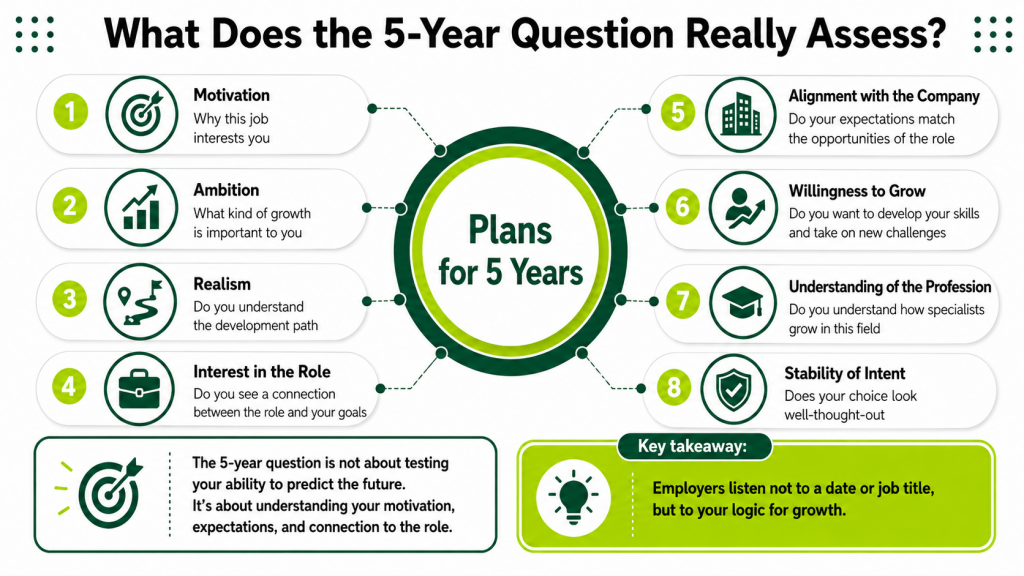
The employer usually does not want a precise forecast of your entire future. They want to understand a few practical things:
- whether you have career goals;
- whether you understand why this role interests you;
- whether you are ready to grow professionally;
- whether your expectations match what the company can offer;
- whether you see the job as a thoughtful career step, not just a random stop between “I need to work somewhere” and “let’s see what happens.”
The good news: nobody expects you to have a perfect five-year plan. You do not need to name your future job title, exact salary, laptop color, or the name of your future manager.
A strong interview answer should sound honest, calm, and realistic. It shows that you are not just looking for any job. You understand your professional direction and can connect the current vacancy with your future growth.
In this article, we will break down how to answer the question “Where do you see yourself in five years?”, what recruiters actually want to hear, which phrases to avoid, how to talk about career goals without sounding overdramatic, and what to say if you genuinely have no idea where you will be in five years.
That happens too. We are all human beings, not Excel spreadsheets with forecasts through 2031.
Why Employers Still Ask “Where Do You See Yourself in Five Years?”
This question can feel old-fashioned.
The world changes quickly. Professions change. Companies change. People change. Even job titles sometimes look as if they were assembled from random words by a corporate generator.
And yet, this question is still alive.
Why?
Because it helps employers quickly understand how a candidate thinks about work, growth, and their professional future.
The Recruiter Is Checking Your Motivation
The employer wants to understand why you applied for this specific role.
One candidate says:
“I’m interested in this role because I want to grow in this direction, work on more complex tasks, and deepen my expertise.”
Another candidate says:
“Well, I sent out a lot of applications, and you were the first to reply.”
Both answers may be honest. But the impression will be very different.
The question about five-year plans helps the recruiter understand whether the candidate is interested in the role itself, not just in closing the job-search problem as quickly as possible.
Of course, everyone needs a salary. Recruiters understand that too. They also have rent, groceries, bills, and subscriptions that somehow always charge at the worst possible moment.
But in an interview, it is important to show not only financial motivation, but also professional motivation.
The Employer Is Checking Whether Your Expectations Are Realistic
Sometimes a candidate applies for an entry-level position and says:
“In one year, I want to become the head of the department.”
In theory, ambition is good.
In practice, the recruiter may mentally open a calendar and try to figure out where, between the current role and department head, the candidate plans to fit experience, results, team responsibility, decision-making, and several years of actual work.
A strong answer shows that you understand:
- the level of the role;
- the possible career path;
- the pace of growth;
- the requirements for the next stage;
- the connection between skills and responsibility.
The employer wants to see that your long-term plans are not built on the fantasy of “I’ll join, work a little, and somehow suddenly become the person in charge.”
The Company Is Checking Whether Your Expectations Match the Role
Imagine you want to manage a team in a few years, but the vacancy is designed for deep expert work without a management track.
Or the opposite: the company is looking for someone who can gradually take on more responsibility, while you want a stable role with no expansion of tasks.
Neither option is bad on its own.
The problem starts when expectations do not match.
The question “Where do you see yourself in five years?” helps both sides understand whether the role, team, and company are a good fit.
It is much better to clarify this during the interview than three months after joining, when you have already learned the name of the office plant, got used to the company chat, and realized that the development path goes in a completely different direction.
What the Employer Actually Wants to Hear
The employer is not waiting for this answer:
“In five years, I see myself as a successful, wealthy, and happy person.”
It sounds nice. Almost like a birthday toast.
But in an interview, you need a more practical answer.
A Good Answer Shows Professional Interest
Your answer should explain that you are interested in growing in the chosen field.
You do not need to sound grand or dramatic:
“I have dreamed of doing this since childhood.”
If that is true, great. If not, there is no need to turn the interview into a school essay called “How I Discovered My Life Purpose.”
It is enough to show:
- what tasks interest you;
- what skills you want to strengthen;
- what direction you want to grow in;
- why this vacancy connects with your development.
A Good Answer Shows That You Understand the Role
One of the best ways to strengthen your answer is to connect your plans with the current role.
For example:
“I’m interested in growing in the kinds of tasks connected with this position: understanding processes more deeply, working on more complex cases, and gradually taking on more responsibility.”
This shows that you did not simply prepare a nice phrase from the internet. You understand where you are applying.
A Good Answer Sounds Realistic
A realistic answer does not mean being so modest that you sound like:
“I’ll just sit quietly and not bother anyone.”
A realistic answer means your plans sound achievable.
For example:
“In five years, I would like to be a strong specialist who confidently handles complex tasks, understands the business context, and can support the team through experience.”
That sounds calm, mature, and free from career fantasy castles in the air.
A Good Answer Shows Value for the Company
The employer listens to your answer and thinks not only about you.
They also think:
- what this person can contribute to the team;
- whether they will grow inside the role;
- whether they can be trusted with more complex tasks;
- how interested they are in the result;
- whether they will leave in two months because they “changed their mind.”
That is why a strong answer should include not only what you want, but also what value you will be able to bring.
The Main Mistake: Taking the Question Too Literally
Many candidates panic because they hear the question as:
“Name your exact job title, company, income, city, number of children, dog breed, and happiness level five years from now.”
But that is usually not what the recruiter is asking.
They are asking:
“How do you think about your professional development?”
That is a completely different question.
You Do Not Need to Predict the Future
In five years, the market may change. The company may change. Your specialization may change. Your personal circumstances may change. Even your attitude toward the profession may change.
That is normal.
A good answer can sound like this:
“I don’t have a rigid plan with one exact job title, but I do have a clear direction. I want to grow in this profession, strengthen my skills, work on more complex tasks, and gradually take on more responsibility.”
This is honest and professional at the same time.
You Do Not Need to Promise Eternal Loyalty to the Company
A weak idea would be to say:
“I will definitely work here forever.”
First, it sounds too theatrical.
Second, nobody knows what will happen in five years.
Third, the recruiter understands the reality of the labor market too.
It is better to say:
“It’s important for me to find a company where I can develop in the long term, grow through real tasks, and deliver visible results.”
That sounds stable without unnecessary vows on the corporate handbook.
You Do Not Need to Look Perfect
The perfect candidate who knows everything, is always motivated, never doubts themselves, and has been building a career strategy since the age of fourteen usually exists only in presentations.
In real life, people change plans, try new things, grow through mistakes, and sometimes have no idea why they have no energy left to answer emails by Friday.
The employer does not expect perfection.
They expect adequacy, honesty, and a clear connection with the role.
A Strong Formula for Answering the Five-Year Question
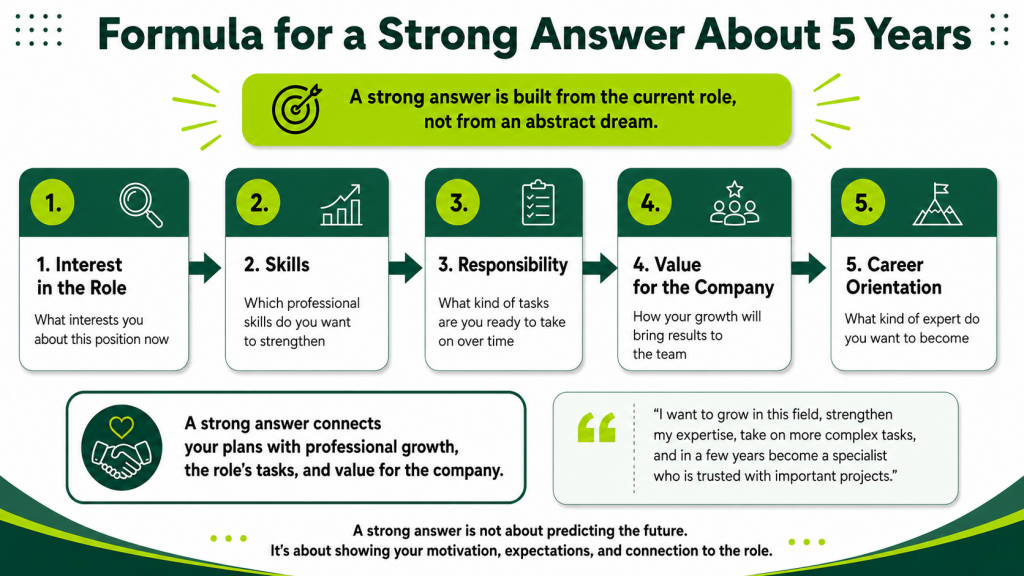
To avoid getting lost, use a simple formula:
Current interest → Skills to develop → Value for the company → Realistic career direction
Let’s break it down.
1. Current Interest
Start with what interests you right now.
For example:
“Right now, I’m interested in developing in this field and understanding the tasks that influence the team’s results more deeply.”
This immediately shows that your answer is connected to real work, not to an abstract dream.
2. Skills You Want to Develop
Next, name what you want to strengthen.
For example:
- professional skills;
- independence;
- work with more complex tasks;
- understanding of business processes;
- communication with the team;
- analytical thinking;
- project management;
- mentoring;
- expertise in your field.
You do not need to list everything at once.
Choose two or three points that fit the vacancy.
3. Value for the Company
Add the idea that your growth should be connected with results.
For example:
“It’s important to me that development is reflected not only in a job title, but also in the quality of my work: that I can take on more responsibility and bring more noticeable results to the team.”
That is a mature thought. Recruiters like mature thoughts. Not because they have a secret club for mature thoughts, but because it shows a professional attitude.
4. Realistic Career Direction
Finish with a realistic career direction.
For example:
“In a few years, I see myself as a specialist who can be trusted with complex tasks, understands the processes well, and helps the team move toward results.”
Final Version of the Answer
“Right now, I’m interested in developing in this field, strengthening my expertise, and working on more complex tasks. In five years, I see myself as a strong specialist who confidently manages their area of responsibility, understands the business context, and helps the team achieve results. It’s important to me to grow not only by job title, but also by the quality of my work, level of independence, and value for the company.”
A Universal Answer to “Where Do You See Yourself in Five Years?”
Sometimes you need an answer that works for almost any vacancy.
Not too bold. Not too modest. No unnecessary drama. No feeling that the candidate copied it from the first list they found online.
Here is a good version:
“In five years, I would like to be a strong specialist in my field, understand business needs more deeply, and take on more responsibility. It’s important to me to grow not only by job title, but also by the quality of my work: to handle more complex tasks, understand processes better, and bring visible results to the team. Right now, I see this vacancy as a logical step in that development.”
Why This Answer Works
- It shows professional growth.
- It connects your goals with the vacancy.
- It presents a realistic career plan.
- It avoids exaggerated promises.
- It does not say, “I just want more money.”
- It makes the candidate sound thoughtful.
A Shorter Version
“In five years, I see myself as a strong specialist who confidently works with complex tasks, takes on more responsibility, and brings visible results to the team. It’s important to me to develop in the profession step by step, and this vacancy looks like a logical step in that direction.”
This version works well if the interview is moving quickly and the recruiter asks for a brief answer.
A More Natural Version
“I’m not trying to predict every detail five years in advance, but I understand the direction. I want to become stronger in the profession, work on more complex tasks, and gradually expand my area of responsibility. For me, good growth means that, after a few years, you are trusted not only with standard tasks but also with more important decisions.”
This answer sounds human and natural.
How to Answer If You Do Not Have a Clear Career Plan
The most common anxiety candidates have is:
“What if I honestly don’t know where I see myself in five years?”
The answer: do not invent a fantasy plan just for the interview.
You do not need to say:
“In five years, I will be the head of international innovation development for strategic processes.”
Especially if you did not understand what you just said.
You can honestly admit that you do not have one exact job title in mind, but you do have a direction.
Good Answer
“I don’t have a rigid plan with one specific job title yet, but I do have a clear direction. I want to grow in this profession, strengthen practical skills, and gradually move toward more complex tasks. Right now, it’s important for me to join an environment where I can grow through real projects, responsibility, and regular feedback.”
Why This Works
- The candidate is honest.
- There is no feeling of confusion.
- There is professional interest.
- There is a desire to grow.
- There is an understanding that growth comes from work, not magic.
Another Version
“I don’t want to name a job title just to give a polished answer. For me, the direction matters more: becoming a more independent specialist, understanding processes better, and taking on tasks where my contribution has a visible impact on the result. In five years, I would like to see that I have grown in expertise and can be useful to the team on more complex projects.”
This answer is especially good if you dislike loud career statements.
How to Answer If You Have Limited Experience
If you do not have much experience, the five-year question can feel especially stressful.
It may seem as if you urgently need to show huge ambitions. But it is better not to play the role of someone who has already figured out their entire career while they are still at the beginning.
At an entry level, the employer usually does not expect a perfect plan.
They expect:
- interest in the profession;
- willingness to learn;
- realistic expectations;
- understanding of basic tasks;
- a desire to grow through practice.
Example Answer
“In five years, I would like to become a confident specialist who understands the field well, can handle tasks independently, and take on more responsibility. Right now, it’s important for me to build a strong practical foundation, learn through real projects, and gradually grow professionally. I understand that development starts with doing current tasks well.”
This answer sounds better than:
“In five years, I want to be a manager.”
Why?
Because it shows maturity. Even if you have limited experience, you understand that growth is built through practice.
Short Version
“I see myself as a specialist who has moved from basic tasks to more complex ones, understands processes well, and can work more independently. Right now, my main priority is to gain practical experience and grow in the profession step by step.”
How to Answer After Changing Careers
A career change is a separate story.
A person enters a new field and may worry that they look less confident compared with candidates who have direct experience.
The five-year question can actually work in your favor here.
The main idea: you are not simply “trying something new.” You are consciously building a new career direction.
Example Answer
“In five years, I see myself as a specialist who has confidently settled into the new field, gained practical experience, and can handle tasks independently. It’s important to me not just to change direction, but to build a sustainable career: develop skills, understand processes more deeply, and gradually take on more complex projects.”
Why This Answer Is Strong
- It shows awareness.
- It reduces the employer’s concern.
- It explains your motivation.
- It shows long-term interest.
- It does not sound like “I just got tired of my previous job.”
If They Ask Why You Are Confident About the Change
You can add:
“I’ve already had a chance to understand which tasks interest me in this direction, and I want to continue developing not just theoretically, but through practice, teamwork, and real results.”
This matters.
Employers are often afraid that a candidate who changed fields will quickly change their mind again. Your answer should show stability.
How to Answer as an Experienced Specialist
An experienced candidate has a different task.
You need to show not just a desire to grow, but a mature understanding of your next professional level.
Here, it is worth talking not only about skills, but also about influence on processes, quality of decisions, mentoring, complex projects, and team development.
Example Answer
“In five years, I would like to be an expert who not only performs their own tasks, but also influences the quality of processes: helps improve approaches, shares experience with colleagues, and participates in more complex projects. I’m interested in growth through responsibility, independence, and results, not only through a job title.”
Why This Answer Works
It includes:
- professional depth;
- value for the company;
- realistic growth;
- mature motivation;
- no unnecessary drama.
If You Want Management Growth
You can say:
“In the long term, I’m interested in growing toward greater responsibility, including management tasks if that is logical for the team and the company. Right now, it’s important for me to integrate well into the role, show results, and gradually expand my influence on processes and people.”
This sounds better than:
“In five years, I want to be the head of the department.”
Why?
Because you show that you are ready to grow through results, not through entitlement to a title.
How to Answer If You Do Not Want to Become a Manager
Many candidates think career growth must always mean a management position.
It does not.
Growth can be:
- expert growth;
- project-based growth;
- product-related growth;
- horizontal growth;
- growth through task complexity;
- growth through independence;
- growth through mentoring;
- growth through influence on decisions;
- growth through a wider area of responsibility.
And that is a completely normal career path.
Example Answer
“I don’t necessarily see development only through a management role. I’m more interested in growth through expertise: working on more complex tasks, understanding processes more deeply, making better decisions, and becoming the person the team can turn to with difficult questions. In five years, I would like to be exactly that kind of specialist.”
This answer is especially useful if you do not want to manage people, spend your life in endless meetings, and suddenly discover that your job now consists of a calendar, spreadsheets, and the phrase “let’s sync.”
Another Version
“For me, professional growth is not only about a new title. I want to develop through deeper expertise, independence, and quality of results. In a few years, I would like to work with higher-level tasks and be useful to the team through experience and a systematic approach.”
How to Answer If Stability Matters to You
The phrase “I want stability” is not bad by itself.
The problem is that in an interview it can sound passive:
“I just want a calmer place where they pay on time and nobody bothers me.”
Even if, after your previous experience, this is exactly how you feel inside, it is better to phrase the idea more professionally.
Stability can be shown through:
- long-term interest;
- a desire to grow in one field;
- willingness to understand processes more deeply;
- reliability;
- responsibility;
- a desire to be useful to the team.
Weak Version
“I just want a stable job.”
Strong Version
“It’s important to me to develop in a stable professional environment where I can go deeper into tasks, build long-term results, and gradually take on more responsibility. In five years, I would like to be a specialist who understands the company’s processes well and brings consistent value to the team.”
The meaning is almost the same.
The impression is completely different.
How to Answer If You Want to Earn More Money
Money is a normal part of career goals.
What does not work well is making money the only point of your answer.
If, when asked “Where do you see yourself in five years?”, you answer:
“With a salary three times higher.”
The recruiter may think:
“I understand. But in what role? For what value? What tasks? What contribution?”
It is better to connect financial growth with professional growth.
How to Say It Well
“I want to grow professionally, take on more complex tasks, and increase my value as a specialist. For me, it is logical that income should grow together with the level of responsibility and results, but the foundation for that is expertise, quality of work, and value for the company.”
This answer shows maturity.
You are not pretending that money does not matter, but you are also not turning the interview into a salary negotiation in the first minute.
How to Adapt Your Answer to a Specific Vacancy
One universal answer is useful.
But the best answer is always connected to the specific vacancy.
Before the interview, open the job description and highlight:
- key responsibilities;
- skills that are repeated several times;
- expected level of independence;
- team tasks;
- possible growth directions;
- the language the company uses to describe the ideal candidate.
Then connect that with your answer.
Step 1. Identify the Main Tasks of the Role
For example, the vacancy may emphasize:
- client communication;
- data analysis;
- building processes;
- team communication;
- project work;
- quality improvement;
- independent task ownership;
- product or service development.
That means you should mention these directions in your answer.
Step 2. Connect Your Plans With the Tasks
Do not speak too generally:
“I want to develop and grow.”
Be more specific:
“I’m interested in growing in the tasks connected with this role: understanding user needs more deeply, working with data, suggesting improvements, and seeing the results of my work.”
Step 3. Do Not Promise What the Vacancy Does Not Offer
If the vacancy is expert-focused and you talk only about managing a team, that may raise a question.
If the role requires stable process execution and you say you want to completely change direction in a year, that is also a warning sign.
Your answer should be ambitious, but compatible with the vacancy.
Examples of Answers for Different Situations
Below are ready-made versions you can adapt.
Do not copy them word for word like a Wi-Fi password. Take the structure and replace the details with your own.
Example 1. Universal Strong Answer
“In five years, I see myself as a strong specialist in my field who confidently works with more complex tasks and takes on more responsibility. It’s important to me to grow not only by job title, but also by level of expertise, quality of decisions, and value for the team. Right now, this vacancy looks like a logical step for me because it gives me the opportunity to develop skills that are important for my professional growth.”
Example 2. Answer Without a Clear Career Plan
“I don’t have a rigid plan with one specific job title, but I do have a clear direction. I want to grow in this profession, strengthen practical skills, and gradually move toward more complex tasks. In five years, I would like to see that I have become a more independent specialist and can bring visible results to the team.”
Example 3. Answer for a Candidate With Limited Experience
“In five years, I would like to be a specialist who works confidently in the profession, understands processes well, and can handle tasks independently. Right now, it’s important for me to build a strong foundation, learn through practice, and gradually take on more responsibility. I understand that growth starts with doing current tasks well.”
Example 4. Answer After a Career Change
“In five years, I see myself as a specialist who has confidently established themselves in the new field and can manage tasks independently. It’s important for me to build a sustainable career in this direction: develop skills, gain practical experience, and gradually work on more complex projects. I see this vacancy as an important step in that transition.”
Example 5. Answer for an Experienced Specialist
“In five years, I would like to be an expert who influences the quality of processes and helps the team work more effectively. I’m interested in complex tasks, improving approaches, sharing experience with colleagues, and having more independence. For me, growth is not only about a title, but also about the level of responsibility, trust, and results.”
Example 6. Answer With Management Ambitions
“In the long term, I’m interested in growing toward greater responsibility, possibly including management tasks. At the same time, I understand that this kind of growth should be connected with results, team trust, and understanding of processes. Right now, it’s important for me to perform well in the role, understand the tasks, and gradually expand my area of responsibility.”
Example 7. Answer Without a Desire to Become a Manager
“I don’t necessarily connect development only with a management role. I’m more interested in growing through expertise: working on more complex tasks, understanding processes more deeply, and becoming a specialist who can be trusted with important decisions. In five years, I would like to be that kind of person for the team.”
Example 8. Answer If Stability Matters to You
“It’s important to me to develop in a stable professional environment where I can go deep into tasks and build long-term results. In five years, I would like to be a specialist who understands the company’s processes well, works independently, and brings consistent value to the team.”
What Not to Say When Asked “Where Do You See Yourself in Five Years?”
Now let’s look at phrases that are better kept to yourself.
Some of them are honest. Some are even funny. But in an interview, they can damage the impression.
Mistake 1. “I Don’t Know, I Haven’t Thought About It”
This is too blunt.
It may create the impression that the candidate arrived by chance and does not connect the vacancy with their development at all.
Better:
“I don’t have a rigid plan around a specific job title, but I do have a direction: I want to grow in this profession, strengthen my skills, and work on more complex tasks.”
Mistake 2. “I Want Your Job”
Sometimes candidates say this with a smile. Sometimes they are trying to show ambition.
But it sounds risky.
The recruiter may smile back, while mentally placing a small red flag next to your name.
Better:
“In the long term, I’m interested in growing toward greater responsibility, if that is logical for the team and connected with my results.”
Mistake 3. “The Main Thing Is That the Salary Is Higher”
Money matters.
But if that is the only point of the answer, it sounds narrow.
Better:
“I want to grow professionally, take on more complex tasks, and increase my value as a specialist. For me, it is logical that income grows together with the level of responsibility and results.”
Mistake 4. “I Plan to Start My Own Business”
If you are applying to a company and immediately say that your goal is to leave and build your own business, the employer may assume this job is temporary for you.
Even if you do have that idea, it is better in an interview to talk about development within the current role.
Better:
“I’m interested in growing in the profession, understanding processes better, and taking on more responsibility. Right now, I’m focused on working in a team and developing within the role.”
Mistake 5. “I Hope I Won’t Be Working by Then”
As a joke, maybe.
As an interview answer, dangerous.
The recruiter may laugh, but the conclusion will probably not help you.
Save that phrase for a Friday evening conversation with friends.
Mistake 6. “We’ll See How It Goes”
This phrase sounds as if you are open to any path and do not really understand why you want this job.
Better:
“I understand that plans can change, but right now my direction is to grow in this profession, strengthen my skills, and gradually move toward more complex tasks.”
Mistake 7. “I Just Want a Calm Job”
Even if, after your previous workplace, you truly want quiet, stability, and no one messaging you at 11:40 p.m. with the word “urgent,” it is better to say it differently in an interview.
Better:
“I value a stable environment where I can do high-quality work, develop professionally, and bring long-term value to the team.”
Weak Answer vs Strong Answer
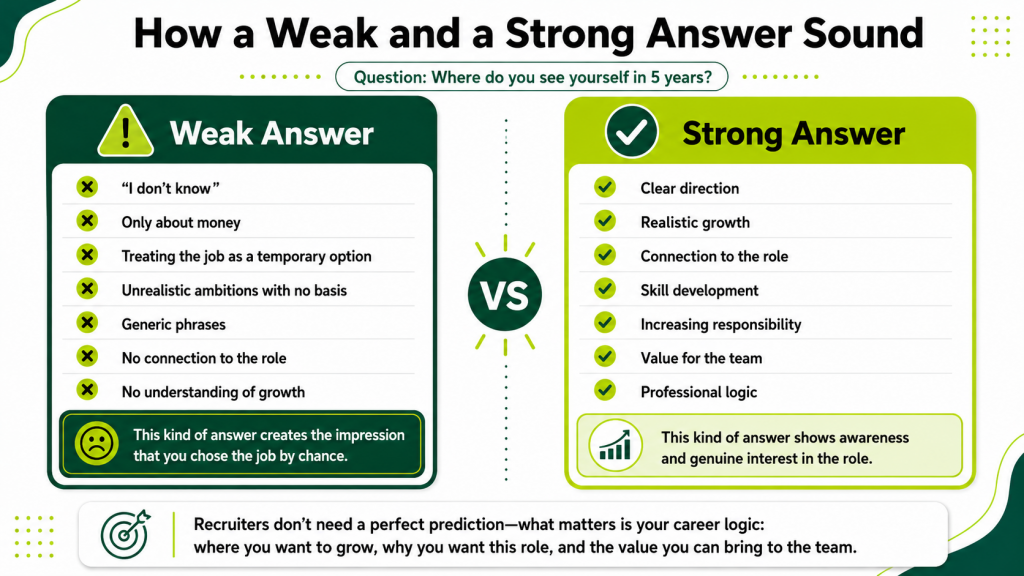
Weak Answer
“I don’t know, it’s hard to say. I guess I want to develop, maybe become a manager or move somewhere else. The main thing is to have a decent salary and stability.”
What Is Wrong With It
- There is no connection with the vacancy.
- There is too much uncertainty.
- Career goals sound random.
- Money appears to be the main motivation.
- There is no understanding of professional growth.
Strong Answer
“I don’t have one fixed job title planned for five years from now, but I do have a clear direction. I want to grow in this profession, strengthen my expertise, work on more complex tasks, and gradually take on more responsibility. It’s important to me that growth is connected with real results and value for the team. This vacancy looks like a logical step in that development.”
What Works Well
- The answer is honest.
- There is a clear direction.
- There is professional growth.
- There is a connection with the vacancy.
- There is value for the company.
- There is no unnecessary drama.
How Not to Sound Too Ambitious
Ambition is good.
But in an interview, it is important to show it carefully.
The problem starts when a candidate speaks as if the current vacancy is too small for them, the company is temporary, and the team is simply supposed to hold the door while they walk toward their great future.
Too Sharp
“In five years, I want to be a manager, lead a large department, and make strategic decisions.”
This may be a normal goal, but without context it sounds as if the person has already mentally skipped over the current role.
Better
“In the long term, I’m interested in greater responsibility, possibly including management tasks. But I understand that you get there through results, understanding processes, and earning the team’s trust. Right now, it’s important for me to perform well in the current role and gradually expand my area of responsibility.”
This answer shows ambition without making the employer nervous.
The Rule of Healthy Ambition
Talk not only about what you want to receive, but also about how you plan to get there.
Weak:
“I want to grow quickly.”
Better:
“I want to grow through strong results, skill development, and readiness to take on more complex tasks.”
How Not to Sound Too Passive
There is another extreme: answering as if you do not want anything at all.
For example:
“Well, I don’t really plan my career. The main thing is to do my job.”
At first glance, this may sound fine.
But the employer may hear:
“I’m not very interested in developing.”
If you are not chasing titles, talk about growth through work quality.
Better Answer
“I’m not setting a goal to grow only for the sake of a new title. It’s important for me to develop through the quality of my work, independence, and more complex tasks. In five years, I would like to be a specialist who is trusted with important issues and understands their area of responsibility well.”
This is not passivity.
It is a mature expert position.
How to Answer in an Online Video Interview
In an online interview, your answer about five-year plans should be especially focused.
Why?
Because in a video call, long answers feel even longer. If a candidate speaks for three minutes, freezes, adjusts their headphones, looks away, and adds “well, something like that,” it becomes harder for the recruiter to stay focused.
Ideal Length
Keep your answer within 40–60 seconds.
That is enough to show:
- where you want to develop;
- which skills you want to strengthen;
- how this connects with the vacancy;
- what value you want to bring.
Mini-Structure for an Online Interview
“Briefly, I see my development in this profession. I want to strengthen my expertise, work on more complex tasks, and gradually take on more responsibility. In five years, I would like to be a specialist who understands processes well, works independently, and brings visible results to the team. This role interests me specifically as a step in that direction.”
This answer is easy to say out loud.
It is not overloaded, and it sounds natural.
How to Prepare Your Answer in Advance
Preparing for the five-year question does not mean memorizing a text like a poem.
If you sound rehearsed, the recruiter will notice. It creates the school-board effect: the words are correct, but the person behind them feels far away.
It is better to prepare meaning blocks.
Step 1. Answer the Question: Why Do I Want This Vacancy?
Write down two or three reasons:
- the tasks interest you;
- you want to develop specific skills;
- you like the work format;
- you want to grow in this field;
- you see a connection with your previous experience;
- you want to move to the next level.
Step 2. Choose a Growth Direction
It does not have to be a job title.
You can choose:
- strong expertise;
- independence;
- complex projects;
- work on a larger scale;
- mentoring;
- process management;
- team management;
- development inside the same field.
Step 3. Connect Growth With Value
Add this thought:
“It’s important to me that my growth is connected with the team’s results.”
This makes your answer stronger.
Step 4. Shorten It to Five or Six Sentences
Do not turn the answer into an autobiography.
A good answer is:
- short;
- specific;
- calm;
- connected with the vacancy;
- free from loud promises.
Step 5. Say It Out Loud
This matters more than it seems.
A text that looks good in your notes may sound strange out loud. Especially phrases like:
“I strive for synergy of competencies within strategic development.”
If you said it and felt tired yourself, rewrite it.
Ready-to-Use Answer Builder
Use this template and add your own details.
“Right now, I’m interested in developing in [direction / field / type of tasks]. Over the next few years, I want to strengthen [skills / expertise / independence] and work on more complex tasks. In five years, I see myself as a specialist who [realistic direction: leads projects, takes on more responsibility, supports the team, improves processes]. It’s important to me that my growth is connected not only with a title, but also with the quality of my work, results, and value for the company.”
Filled-In Example
“Right now, I’m interested in developing in this professional field and understanding business tasks more deeply. Over the next few years, I want to strengthen my expertise, become more independent, and work on more complex tasks. In five years, I see myself as a specialist who can be trusted with important projects and who helps the team achieve results. It’s important to me that my growth is connected not only with a job title, but also with the quality of my work, results, and value for the company.”
Phrases You Can Use in Your Answer
If it is difficult to formulate your answer from scratch, take one or several of these phrases.
About Development
- “It’s important to me to grow in the profession step by step.”
- “I want to strengthen my expertise in this field.”
- “I’m interested in working on more complex tasks.”
- “I want to grow through practice, responsibility, and results.”
- “For me, development is not only about a title, but also about the quality of work.”
About Value for the Company
- “It’s important to me to bring visible results to the team.”
- “I want to understand processes better and influence the quality of decisions.”
- “I’m interested in developing in a way that is useful to the company.”
- “I would like to become a specialist who can be trusted with complex tasks.”
About Career Goals
- “I have a clear direction for development.”
- “I’m not fixed on one specific job title, but I understand which skills I want to develop.”
- “In the long term, I’m interested in a wider area of responsibility.”
- “I want to move toward the next professional level.”
About Stability
- “A long-term professional environment matters to me.”
- “I want to go deeper into tasks and build sustainable results.”
- “I’m interested in a growth path within one direction.”
- “I want to develop in a company where there are real tasks and clear responsibility.”
Mini-Checklist for a Strong Answer
Before the interview, check your answer.
Your answer is good if:
- you can explain why this vacancy interests you;
- the answer includes professional growth;
- you name skills or tasks you want to develop;
- your plans sound realistic;
- you do not talk only about salary;
- you do not make the vacancy sound temporary;
- you do not promise overly fast growth;
- you connect your plans with value for the team;
- the answer takes about one minute;
- you can say it naturally.
If at least half of these points are present, that is already good.
If all of them are present, you can go to the interview with the feeling that the five-year question will not bite.
Common Candidate Mistakes
Mistake: Answering Too Abstractly
“I want to develop, grow, and be successful.”
It sounds nice, but too general.
Add specifics:
“I want to grow in this profession, work on more complex tasks, strengthen my expertise, and take on more responsibility.”
Mistake: Talking Only About a Job Title
“I want to become a manager.”
It is better to explain what kind of growth stands behind the title:
“I’m interested in growing toward greater responsibility, managing tasks, and participating in process development.”
Mistake: Making the Vacancy Sound Temporary
“For now, I want to work here, and then I’ll see.”
Better:
“Right now, it’s important for me to find a role where I can develop step by step and build long-term professional results.”
Mistake: Copying a Template Answer
Recruiters have heard hundreds of identical phrases.
If your answer sounds like this:
“I see myself as a successful professional in a dynamically developing company…”
There is a risk that, mentally, the recruiter has already gone to make coffee.
Speak more simply. More naturally. More specifically.
Mistake: Turning the Answer Into a Long Monologue
Five years is a long period.
But your answer should not be long.
You do not need to tell your entire career philosophy from your first year of university to retirement.
The ideal length is five to seven sentences.
How to Answer If the Recruiter Asks: “What Position Are You Interested In?”
Sometimes after a general answer, the recruiter asks for more detail.
For example:
“What position would you like to hold in five years?”
You can answer carefully.
If You Know the Position
“In the long term, I’m interested in a position with a wider area of responsibility, possibly at the level of senior specialist or team lead, if that matches my results and the opportunities within the company.”
If You Do Not Know the Position
“I don’t want to focus too much on a specific job title yet. For me, the level of tasks matters more: more independence, more complex projects, influence on results, and the opportunity to share experience with colleagues.”
This answer shows maturity.
Not all career goals have to be named as a job title.
How to Answer If You Had a Career Break
If you are asked about five-year plans after a career break, the recruiter may be checking not only your goals, but also the stability of your motivation.
It is important to show that you are returning consciously.
Example Answer
“After a career break, it is especially important for me to return to a professional environment and develop step by step. In five years, I see myself as a specialist who works confidently in their field, has restored and strengthened practical skills, takes on more complex tasks, and brings stable results to the team. Right now, I’m focused on entering the role, showing the quality of my work, and gradually expanding my responsibility.”
This answer reduces part of the employer’s concern and shows that a pause does not mean a lack of plans.
How to Answer If You Have Changed Jobs Often
If your CV includes several short periods of employment, the five-year question may be a way to check your long-term motivation.
Here, it is important to show that you are looking for a more intentional stage.
Example Answer
“Right now, it’s important for me to choose a role where I can develop more consistently and go deeper into tasks. In five years, I would like to be a specialist who understands processes well, works with more complex tasks, and brings sustainable results. I want my next stage to be connected not just with another line on my CV, but with real professional growth.”
The phrase “another line on my CV” sounds natural and honest.
At the same time, it does not sound like an excuse.
How to Answer If You Are Moving From Another Company Into a Similar Role
Here, it is important to show not “I did the same thing and want to keep doing it,” but development.
Example Answer
“I have already worked with similar tasks, and now I’m interested in moving to the next level: understanding processes more deeply, working with more complex cases, and making a greater contribution to the team’s results. In five years, I see myself as a specialist who not only confidently manages their area of responsibility, but also helps improve approaches within the team.”
This answer shows that you are not standing still.
How to Answer If the Vacancy Is Below Your Previous Level
Sometimes a candidate applies for a role that is simpler than their previous one: after a career break, relocation, a market change, or personal circumstances.
The recruiter may worry that you will get bored quickly.
Your answer should show awareness.
Example Answer
“I understand the level of this role and I’m considering it consciously. Right now, it’s important for me to join the team, show results, and develop in a clear professional environment. In five years, I see myself as a specialist who uses previous experience, understands the company’s processes well, and gradually takes on more responsibility where it is useful to the team.”
How to Answer If You Want to Shift Direction Within the Same Profession
For example, you stay in your field but want a different type of task.
Example Answer
“In five years, I would like to develop confidently in this direction and be a specialist who can independently manage tasks, make better decisions, and see the impact of their work on the overall result. Right now, it’s important for me to move toward this type of task, gain practical experience, and gradually strengthen my expertise.”
This answer shows that the transition is not random.
How to Sound Natural, Not Like a Candidate From a Textbook
An interview is a conversation, not an exam in corporate wording.
So do not overload your answer with words like:
- “synergy”;
- “transformation”;
- “multidisciplinary growth”;
- “strategic positioning of myself as a professional unit.”
If that is how you speak in everyday life, fine, no questions.
But if not, keep it simpler.
Too Artificial
“In five years, I see myself as a highly effective professional implementing complex career strategies within a dynamically developing organizational environment.”
More Natural
“In five years, I would like to be a strong specialist who is trusted with complex tasks. It’s important to me to grow in the profession, understand processes better, and bring visible results to the team.”
The second version sounds better.
And, importantly, you can say it without feeling like you are reading a printer manual.
How to Understand That Your Answer Sounds Weak
Check yourself.
Your answer needs improvement if, after hearing it, the recruiter may think:
- the candidate does not understand why they want this vacancy;
- the candidate is looking for any job;
- the candidate will leave quickly;
- the candidate wants growth the company cannot offer;
- the candidate talks only about money;
- the candidate cannot formulate goals;
- the candidate has unrealistic expectations;
- the candidate does not connect their plans with results.
Quick Test
Read your answer and ask yourself:
“If I were the employer, would I understand why this person is interested in this specific role?”
If the answer is no, add a connection with the vacancy.
Answers for 20 Seconds, 40 Seconds, and 60 Seconds
Sometimes it is useful to have several versions.
20-Second Answer
“In five years, I see myself as a strong specialist who works with more complex tasks, takes on more responsibility, and brings visible results to the team. It’s important to me to develop in the profession step by step, and this vacancy looks like a logical step.”
40-Second Answer
“I don’t have a rigid plan around one specific job title, but I do have a clear direction. I want to grow in this profession, strengthen my expertise, and gradually move toward more complex tasks. In five years, I see myself as a specialist who can be trusted with important projects and who understands processes well. It’s important to me that growth is connected not only with the title of the position, but also with real value for the team.”
60-Second Answer
“To be honest, I’m not planning every detail five years ahead, but I understand the direction for myself. I’m interested in growing in this profession, strengthening practical skills, understanding business tasks better, and gradually taking on more responsibility. In five years, I would like to be a specialist who is trusted with complex tasks, works independently, and helps the team achieve results. For me, growth is not only a new job title, but also the quality of decisions, level of responsibility, and contribution to the overall result. This vacancy interests me because it is connected with the tasks and skills I want to continue developing.”
How to Answer If the Question Feels Strange
Sometimes a candidate thinks internally:
“Five years? I don’t know what will happen in five months.”
That is a normal thought.
Especially when the market is changing, companies are restructuring, and professions require constant learning.
But in an interview, it is better not to argue with the question.
Do not say:
“It is impossible to plan five years ahead now.”
There is some truth in that.
But it is better to answer more softly:
“I understand that a lot can change in five years, so I wouldn’t fixate on one exact job title. But my direction is to grow in this profession, strengthen my skills, and take on more complex tasks. In a few years, I would like to be a specialist who brings more value to the team through experience and independence.”
This way, you acknowledge reality without avoiding the answer.
How to Connect Your Answer With Career Goals
Career goals in an interview should not look like a wish list.
Weak Career Goals
- I want a higher salary.
- I want a good job title.
- I want remote work.
- I want less stress.
- I want a normal manager.
All of this is understandable.
But for an interview, these wishes need to be translated into professional language.
Instead of “I Want a Higher Salary”
Say:
“I want to grow in terms of responsibility and professional value.”
Instead of “I Want a Good Job Title”
Say:
“I want to move toward higher-level tasks.”
Instead of “I Want Remote Work”
Say:
“A work format where I can be productive and consistently show results is important to me.”
Instead of “I Want Less Chaos”
Say:
“I value an environment where processes allow people to do high-quality work and develop.”
Instead of “I Want a Normal Manager”
Say:
“Clear feedback and the opportunity to grow through real tasks are important to me.”
How to Answer If the Company Is Small
In a small company, career growth may be less formal.
There may be no grades, large departments, or vertical ladder with ten steps.
So it is better to talk about growth through tasks and responsibility.
Example Answer
“I understand that in a small team, growth is often connected not only with a job title, but also with an expanded area of responsibility. In five years, I would like to be a specialist who understands processes well, can take on more complex tasks, and helps the team move faster and with better quality.”
How to Answer If the Company Is Large
In a large company, you can talk about development within the structure, but carefully.
Example Answer
“I’m interested in developing within this field, gradually strengthening my expertise, and moving toward higher-level tasks. In five years, I would like to be a specialist who understands the company’s processes well, can work with more complex projects, and brings results not only in my own area, but also through collaboration with other teams.”
How to Answer If You Want International Experience
If the vacancy involves an international environment or English communication, you can mention this as part of your development.
Example Answer
“In five years, I would like to be a specialist who confidently works not only with standard tasks, but also with more complex projects, including collaboration with different teams and markets. I’m interested in developing professional skills, communication, and the ability to work in a broader context.”
Do not say:
“I want to get out of here.”
In an interview, it is better to talk about professional development, not geographical escape.
How to Answer If You Are Afraid of Sounding Generic
The main way to avoid sounding generic is to add one specific detail.
For example:
- what tasks interest you;
- what skill you want to strengthen;
- what type of growth feels right to you;
- why the vacancy fits;
- what value you want to bring.
Generic
“I want to develop and bring value to the company.”
Better
“I want to grow in tasks where it is not enough to simply follow instructions, but where you need to understand the goal, suggest solutions, and be responsible for the result.”
This already sounds more alive.
Even Better
“I’m interested in growing in tasks where I need to combine analytics, communication, and practical results. In five years, I would like to be a specialist who can manage such tasks independently and help the team make stronger decisions.”
Mistake → Better
Mistake
“I don’t know where I’ll be in five years.”
Better
“I’m not fixed on one specific job title, but I understand the direction: I want to grow in the profession, strengthen my skills, and work on more complex tasks.”
Mistake
“I want to be the boss.”
Better
“In the long term, I’m interested in greater responsibility, possibly including management tasks, if that is connected with results and the team’s needs.”
Mistake
“I want to earn more.”
Better
“I want to increase my professional value through expertise, responsibility, and results. Financial growth is logically connected with that development for me.”
Mistake
“I just want stability.”
Better
“I value a stable environment where I can go deep into tasks, develop professionally, and bring long-term value to the team.”
Mistake
“We’ll see how it goes.”
Better
“I understand that plans can become clearer over time, but right now my direction is to grow in this profession and gradually move toward more complex tasks.”
FAQ: Common Questions About Five-Year Plans
Why Do Employers Ask “Where Do You See Yourself in Five Years?”
They ask to understand your career goals, motivation, expectations from work, and how those expectations connect with the vacancy.
The employer wants to see how consciously you choose the role and how you imagine professional growth.
What Should I Say If I Do Not Know Where I Will Be in Five Years?
You can honestly say that you do not have a rigid plan around one job title, but you do have a direction for development: strengthening skills, taking on more complex tasks, becoming more independent, and growing in responsibility.
Can I Say That I Want to Become a Manager?
Yes, if it sounds realistic.
It is better to speak not only about the title, but also about growth in responsibility, management tasks, results, and readiness to develop to that level.
Should I Mention Salary?
You can mention financial growth, but do not make it the main point of the answer.
It is better to connect income with professional value, level of responsibility, and results.
What Is Considered a Bad Answer?
A weak answer sounds random, harsh, or too abstract.
For example:
- “I don’t know.”
- “The main thing is money.”
- “I want to start my own business.”
- “I want your manager’s job.”
- “We’ll see how it goes.”
How Long Should the Answer Be?
Ideally, 40–60 seconds.
That is enough to show your development direction, connection with the vacancy, and professional motivation.
Can I Prepare the Answer in Advance?
Yes.
It is better to prepare not a memorized text, but a structure:
- development direction;
- skills;
- value for the company;
- realistic career direction.
Final Checklist Before the Interview
Before the interview, answer these questions:
- Why am I interested in this vacancy?
- What skills do I want to develop?
- Which tasks genuinely interest me?
- What kind of growth matters to me: expert, management, project-based, or horizontal?
- How can my growth be useful to the company?
- What can I say in 40–60 seconds?
- Does my answer avoid phrases like “I don’t know,” “the main thing is money,” and “we’ll see”?
- Does my answer sound natural, not like a template from the internet?
- Can I say it calmly out loud?
- Is there a connection between the current role and my future goals?
Short Cheat Sheet
A strong answer to “Where do you see yourself in five years?” should include five elements.
1. Development Direction
Where you want to grow professionally.
2. Skills
What you want to strengthen.
3. Responsibility
What tasks you want to take on over time.
4. Value for the Company
How your growth will help the team.
5. Realism
Why this path looks achievable.
Ready Formula
“I want to grow in this profession, strengthen my expertise, work on more complex tasks, and gradually take on more responsibility. In five years, I see myself as a specialist who brings visible results to the team and grows not only by job title, but also by level of professional value.”
Final Thoughts
The question “Where do you see yourself in five years?” does not require an exact prediction of the future.
In an interview, the point is not to guess your future job title.
The point is to show that you think about your development consciously.
A strong answer does not have to be perfect.
It should be:
- honest;
- calm;
- realistic;
- connected with the vacancy;
- clear for the recruiter;
- useful for the employer;
- natural for you.
You do not need to promise the impossible, pretend to be a career strategist with a plan through retirement, or say phrases that make even you feel uncomfortable.
It is enough to show one simple idea:
you understand why this role interests you, you want to grow in the profession, you are ready to take on more responsibility, and you see your growth through real tasks, skills, and results.
That kind of answer sounds confident.
No drama, no five-year fortune-telling, and no corporate magic.