



Why You Can Feel Like a Junior in a New Country Even If You Have 10 Years of Experience
Ten years in the workforce usually give a person a certain luxury. You know which problems can be solved in two calls, and which will take three months, ending in an inevitable fire. You can tell the difference between “urgent” and “someone is simply anxious,” understand when a manager genuinely wants your opinion and when they have already made the decision and are waiting for you to arrive at it gracefully. You do not confuse frantic activity with actual results, you know what the phrase “fast-growing company” is worth, and you can read a job listing as if it were not text, but an interrogation transcript.
And then you find yourself in a new country.
Suddenly, someone who led a team, launched products, filled difficult roles, built sales funnels, managed clients, or created campaigns with real budgets starts to feel as though they only graduated from university yesterday. They reread a job description three times. Spend a long time wondering whether it is appropriate to message the recruiter. Ask acquaintances what the phrase “we need a self-sufficient specialist” actually means. Cannot understand why, in an interview, their ten years of experience sounded less convincing than the experience of a local candidate who spent three years at a company they have never even heard of.
At that point, it is very tempting to draw one of two conclusions. The first is: “Maybe I overestimated myself.” The second is: “Maybe this market is strange and has no idea what it is doing.” Both conclusions are convenient because they are short. And both are often wrong.
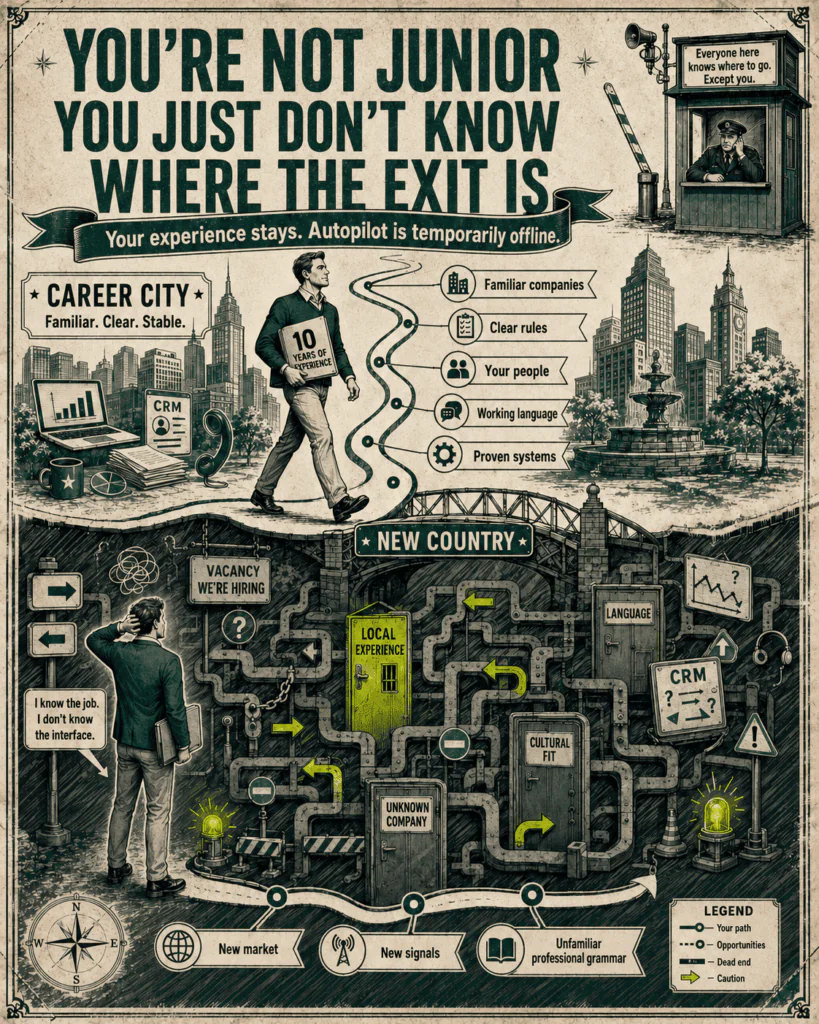
The truth is different: you have not become a junior in your profession. You have become a junior in a new professional environment.
That is an unpleasant way to put it. It sounds almost like a demotion, only without a new nameplate on the door or an honest conversation. But it is more accurate than the story about “lost confidence.” You may still have strong professional skills, fast thinking, management experience, good judgment, technical knowledge, a trained eye, and the habit of seeing things through. None of that evaporates when you cross a border. Your suitcase may arrive later, but experience does not need to clear customs.
The problem is that experience does not exist in a vacuum. It is always tied to the environment where you learned to use it. To a market where company names mean something. To a language in which you know how to sound confident. To a hiring system where you know what questions to ask, what numbers to show, and which words are best avoided in the presence of an HR professional. Cultural codes, professional reputation, familiar ways of making agreements, referrals, the accepted level of directness in communication, document requirements, local services, application rules, CV formats, expectations of managers — all of this works like an invisible operating system.
In your old country, you knew the interface. In the new one, you see the same buttons, but they are labelled in another language, some have moved into a neighbouring menu, and one of them somehow triggers the fire alarm.
That is why a strong professional can sit in front of a laptop and feel like someone who has suddenly forgotten how work works.
Experience Is Not Tenure. It Is a Set of Shortcuts
When people say, “I have ten years of experience,” they usually mean time. Ten calendars, ten seasons of quarterly reports, ten years of morning messages where someone inevitably writes, “Good morning, I have an urgent question.” But the job market does not measure the number of working Mondays you have lived through.
The market is trying to understand something else: how quickly you will be able to deliver results here.
Experience is valuable not because you have been busy for a long time. It is valuable because, over time, you have developed automatic solutions. You know where to look for a problem. You understand who to message. You can see which conflict can wait and which one will turn into a small corporate Chernobyl by tomorrow. You can read between the lines in client emails, spot risk in numbers, hear in a candidate’s voice that they will accept the offer and then disappear into the mist along with their phone number.
But most of those automatic decisions developed inside a specific environment.
A marketer who has spent ten years working in one market knows local triggers, audience habits, common objections, and cultural taboos. They can feel which advertising message will sound alive and which will make people look as though they are thinking, “Who wrote this, and why did nobody stop them?” In a new country, the language may be familiar, but the cultural associations are different. The words are the same; the meaning is not. A joke that once delivered great reach can now look like an attempt by someone from a corporate training session to become “one of the young people.”
An experienced salesperson can read a client within the first few minutes of a conversation. But only while the client speaks in a familiar way. In one culture, quickly suggesting that you get to the point is seen as respect for someone else’s time. In another, it looks like suspicious haste. In one country, “I’ll think about it” means “come back next week.” In another, it means “please do not message me again; I have already mentally placed your number in the ‘never’ folder.”
A recruiter may be excellent at filling vacancies as long as they understand where to find candidates, which companies are good talent pools, what salary expectations are realistic, who is genuinely ready to change jobs, and who only updated their profile after a particularly strange meeting. In a new country, the familiar market map disappears. Company names mean nothing. Professional communities are unfamiliar. Local job platforms can look like a website somebody built in 2011 and has carefully avoided touching ever since, just in case the working registration button gets scared.
Developers, designers, analysts, writers, product managers, support specialists — all of them run into the same unpleasant reality. The profession may be digital, the work may be remote, the laptop may be exactly the same, but the environment still changes. And with it, the value of familiar decisions changes too.
Your experience has not been erased. It has simply stopped being automatic in some ways.
And when that automaticity disappears, an experienced professional feels like a beginner. Because this is exactly what starting work in an unfamiliar system looks like: you know that you can think, but every action demands too much conscious effort.

A New Country Tests More Than Your Profession. It Tests Your Ability to Find Your Way Around
In a familiar environment, you do not notice how many decisions you make on autopilot.
You know how contracts are arranged. You understand which terms are considered normal. In two minutes, you can tell whether a vacancy is a real job or an attempt to find someone who will simultaneously run social media, sell, write copy, manage advertising, smile at clients, and probably fix the printer in whatever free time remains.
You know where to look for salary ranges. Who to ask about a company. What level of English is actually hidden behind the phrase “would be an advantage.” What “flexible schedule” means. At some companies, it means you can start at nine or ten. At others, it means you can reply to messages from a supermarket at eleven at night because “we are one team.”
When you arrive in a new country, all of that everyday professional literacy disappears. You do not know where formalities end and risk begins. You do not understand when you should negotiate and when it will look strange. You struggle to distinguish a normal probation period from a situation where they plan to keep you in limbo for three months and then announce that “the company has decided to move in a different direction after all.”
You start to feel as though you are constantly one step behind.
You do not know how people are expected to write their first message to an employer. You are not sure whether your CV format is suitable. You do not understand why there was no reply after a good interview. You do not know whether you can ask directly about pay, taxes, contract type, number of vacation days, equipment, schedule, or overtime compensation. Formally, you are an adult with a profession. In practice, you feel like an intern on an office tour who has been given a badge but forgotten to ask where the bathroom is.
And that is not a weakness of character. It is the cost of not having a local map.
Every labour market is more than a collection of vacancies. It is a system of unwritten rules. It has its own accepted language, its own “respected” companies, its own ways of validating experience, its own warning signs, and its own hiring rituals. In some places, employers want to see a neat, dry CV with no personal story. Elsewhere, they value a detailed account of projects. In some markets, a candidate with ten years of experience is viewed cautiously if they cannot show a portfolio. In others, the portfolio is secondary, while a local recommendation becomes the main proof.
The problem is that these rules are rarely posted on the homepage of a job site. Nobody gives them to you together with a residence permit, a bank card, or your first internet bill. They are passed on through conversations, observation, mistakes, other people’s stories, and awkward interviews.
In other words, through the very method that annoys experienced people most: practice in which, once again, you do not know everything in advance.
Your Brain Has Not Declined. It Is Just Overloaded With Unfamiliar Details
The most insulting part of relocation is that you can objectively remain a strong professional while subjectively feeling much slower, less capable, and less confident.
You take longer to formulate your thoughts. You answer questions more slowly. After a normal call, you feel as exhausted as you would after a major meeting involving three conflicts and one person who, for some reason, decided to share an 87-slide presentation. You may know the language well, but you constantly check yourself: Did that come out right? Was I too direct? Too dry? Did my tone offend someone? Did the other person understand that I meant something completely different?
At that moment, your working memory is occupied by more than the task itself.
At the same time, it is translating words, reading intonation, selecting safe phrasing, tracking cultural signals, trying to understand a joke, checking whether your reaction is appropriate, and reminding you that after the call you still need to deal with documents, the bank, rent, health insurance, deliveries, and that mysterious letter from a local authority which looks like a wedding invitation but probably contains a tax notice.
Research on migration and adaptation links acculturative stress with increased psychological strain and work-related stress. This does not mean that every move automatically turns a person into a patient. It means something more boring and unpleasant: adaptation requires resources, and resources are not unlimited.
The second problem is language. Even when you speak confidently, working in a second language often requires more effort than it appears to from the outside. Research on bilingualism shows that language is connected not only to “being able to find the right words,” but also to planning, note-taking, calculations, and the internal organisation of tasks. In other words, you may not simply speak more slowly. You may take longer to build a thought that you would assemble almost effortlessly in your native language.
And this is where a very dangerous mistake appears.
A person starts interpreting temporary overload as proof of professional inadequacy. They think: “I used to make decisions quickly, and now I freeze.” Or: “I used to lead negotiations confidently, and now I sounded like someone asking for permission to take a napkin.” Or: “Maybe I was never that strong a professional. Maybe everything was simply too familiar at home.”
No. At home, things really were familiar.
A familiar environment saves an enormous amount of mental energy. It removes hundreds of small decisions from your shoulders. You do not analyse how to order coffee, greet a colleague, message a recruiter, understand your manager’s facial expression, explain why you are running late, or react to silence in a chat. You simply live and work.
In a new country, every small detail requires your brain to start up separately. It is like using a computer where 48 tabs are open, a video call is running, a video is being rendered, and, for some reason, the system update has also started. Technically, the machine still works. In practice, the fan is already negotiating with God.
That is why the feeling of “I have become a junior” often comes not from a shortage of professional skills, but from a temporary shortage of available attention.

An Employer Does Not See Your Journey. They See Risk
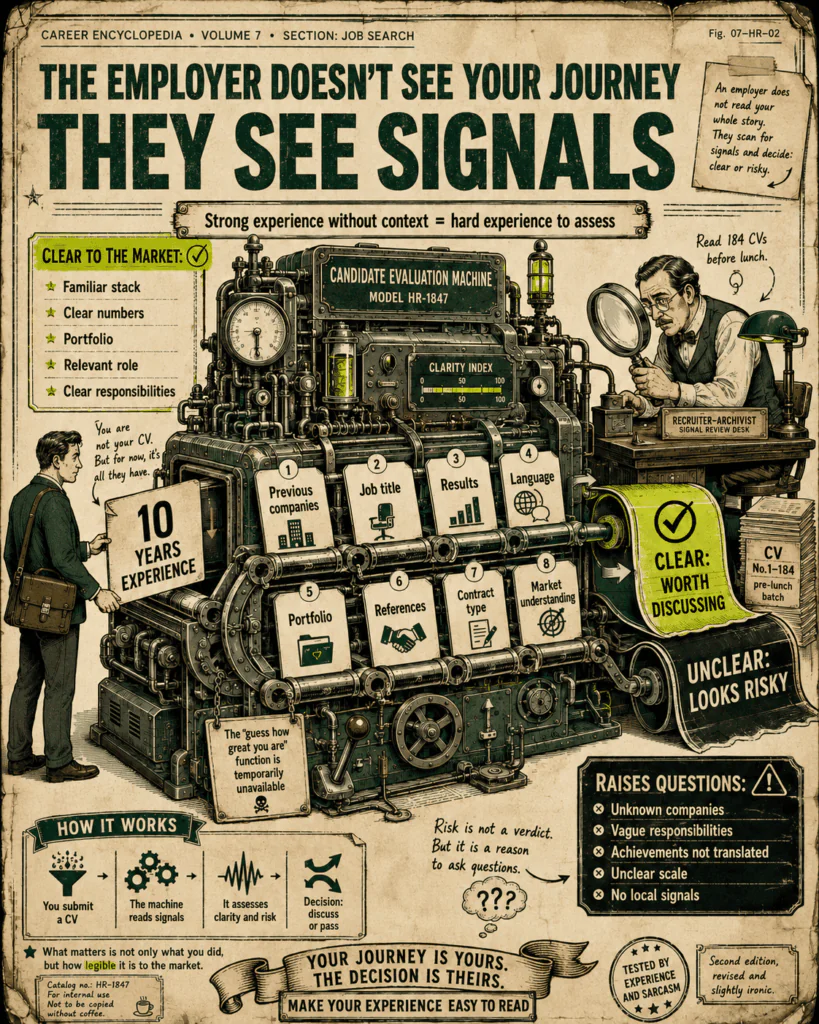
Now for the unpleasant part, which people usually try to soften with beautiful phrases about “unique experience.” An employer in a new country may genuinely see you as a candidate with a higher level of uncertainty.
Not because they are necessarily a bad person. Not because all recruiters sit in a dark room inventing ways to make immigrants’ lives harder. Most hiring is simply less elegant than that. A recruiter has too many vacancies, too little time, several dozen CVs, and a manager messaging, “Could we have this done yesterday?”
They are looking for clear signals.
A recognisable company in your work history. A recognisable title. A recognisable stack. A recognisable language. Recognisable references. A clear salary level. A clear employment arrangement. Clear results. A clear reason for relocation. A clear answer to the question: “How are you going to work with our clients, team, time zone, processes, and paperwork?”
When some of those signals are missing, experience becomes harder to assess. And anything that is hard to assess is usually treated as risk in hiring. Sometimes fairly, sometimes lazily, sometimes with open bias. But the mechanism remains the same.
Your previous companies may have been well known at home and completely invisible here. For you, they were major brands, complex systems, strong teams, and important career steps. For a new employer, they are names that cannot be checked quickly. They do not know the scale of the business, the maturity of its processes, the standards expected of employees, the quality of leadership, or the real weight of your role.
Your title may sound familiar but mean something different. A “manager” in one company is someone who makes decisions and leads a function. In another, it is an employee who was given a phone, a spreadsheet, and the promise of career growth after the end of the world. “Head of” may mean the manager of a twenty-person department, or the only person who knows how to use Excel. Without context, a title does not do much work.
Your results may be strong but untranslated. “Increased sales by 40%” sounds good until the questions appear: from what baseline, over what period, by what method, in what industry, in what economy, with what budget, and with what team? At home, you may not have needed to explain this in detail because the market already understood the scale. In a new market, you will need to explain it.
Your references may be excellent but locally useless. A former manager may be ready to confirm that you saved projects, retained clients, and were the only person who knew where the latest version of the presentation was stored. But the new employer does not know that manager, does not speak the same language, or does not understand how valuable their assessment really is.
Finally, some professions require formal recognition of education, licences, qualifications, and professional status. International organisations and labour-market research keep returning to the same issue: foreign diplomas and skills often translate poorly into jobs that match a person’s actual level when recognition procedures are difficult, expensive, or slow. The OECD directly links timely recognition of qualifications with migrants gaining faster access to work that matches their skills.
This is especially visible in regulated professions. But even in digital fields, where nobody asks a designer for a certificate confirming their right to open Figma, a similar logic applies. Only instead of a diploma, employers assess your portfolio, language, local experience, ability to work in a particular market, and how clearly you can explain your professional story.
Your ten years have not disappeared. They simply stopped being accepted by default.
“But I Work Online” Is the Most Expensive Myth of Digital Careers
People working in digital, IT, marketing, design, content, support, sales, and online education have a separate illusion. It sounds reasonable: “My work is digital. That means it barely depends on the country.”
There is some truth in that. But only half of it.
Yes, a digital specialist can work from a laptop in different cities. Yes, code, a design file, an ad account, a piece of writing, a knowledge base, or an analytics system do not require physical presence in an office with grey carpet and a water cooler that always runs out the moment you decide to make tea.
But working online does not make every market the same.
Remote work still depends on how you explain tasks, which time zone you are available in, which payment systems you can use, what type of contract you are willing to sign, whether you understand data and confidentiality requirements, whether you can join calls, whether you are familiar with local business culture, and whether you can maintain trust without being physically present.
The more senior the role, the less an employer is interested in technical ability alone.
A junior developer may be given a clear task: here is the repository, here is the ticket, here is the deadline, here is the person who will review it. A senior developer often needs to do more than write code. They need to debate priorities, spot architectural risks, explain decisions, align with product teams, avoid turning a technical discussion into a religious war, and understand where the team is breaking down not because of technology, but because nobody has agreed on the terminology.
The same thing happens in marketing. A specialist may be excellent at setting up campaigns, but senior-level work assumes an understanding of the business, the audience, the competitive landscape, brand tone, and the political and social sensitivity of messaging. In a new country, your professional tool remains the same, but the context in which you use it changes.
Sales are even tougher. You can know CRM systems inside out, understand negotiation structures, manage a pipeline, and close deals. But if you do not feel the local communication distance, do not understand which arguments inspire trust, how decision-making cycles work, and who in a company actually influences the choice of supplier, you become a strong professional without a map of the terrain.
Remote work does not cancel local reality. It simply lets you run into it while sitting at home in slippers.
Professional Culture Is a Language Rarely Taught in Courses
When people talk about relocation, they often think about language in the literal sense: learning words, improving grammar, stopping themselves from saying “I am agree,” learning to distinguish formal address from friendly conversation. All of that matters. But professional culture is much broader than vocabulary.
It is a set of rules that nobody puts in a job description.
For example, how people are expected to express disagreement. In some places, a strong employee says directly: “This decision will not work because…” Elsewhere, that phrase automatically turns you into someone who is “difficult to work with.” There, you need to begin by naming the shared goal, acknowledging the other person’s logic, asking several questions, offering an alternative, and only then carefully leading colleagues to the idea that the original plan was built from a mix of optimism and bad maths.
In some places, initiative means showing up with a ready-made solution. In others, it means asking permission first. Somewhere, a manager expects you to identify a problem yourself. Somewhere else, they see that as an attempt to shift responsibility onto them. In some places, you can message your manager in the evening. In others, a message after working hours feels almost like entering their apartment through the balcony.
There are countries and companies where a candidate is expected to sell themselves confidently. There, the modest answer “I was just doing my job” is read as a lack of achievement. In another environment, overly active self-promotion can look like an attempt to take centre stage before you have even been given a ticket.
That is why a professional can feel awkward even with good language skills. They know the words, but they do not yet know the social grammar.
This is especially painful for people who used to be confident negotiators, managers, consultants, or experts. At home, they could afford to be natural. To joke, disagree, make decisions quickly, and avoid explaining every step. People knew them. The context worked in their favour.
In a new environment, naturalness temporarily becomes a luxury. At first, you have to be careful. And it is very easy to confuse caution with a loss of professional strength.
But they are different things.
You have not become less competent. You simply do not yet know where this culture draws the line between confidence and rudeness, independence and overstepping, friendliness and pushiness, ambition and desperation.
It is irritating. Because adults do not enjoy relearning things that once seemed obvious. Especially when, before relocating, they were the people explaining to others how work was done.
What You May Lose Is Not Experience, but Status
There is another layer that people rarely talk about directly because it is too personal and too unpleasant.
Relocation can take away not only familiar processes, but familiar status.
At home, you may have been the person people messaged for advice. The person invited into difficult projects. The specialist whose name was known in the industry. The manager who could stop a pointless meeting with one question. The colleague people came to when they needed to quickly understand what was happening and why everything had broken again.
In a new country, you may become the person who is always asking questions. Where to look for work. How to arrange documents. How to open a bank account. How taxation works. How to respond to a vacancy. What salary level to name. What this clause in the contract means. Where to find a doctor. Why you have once again received a letter that looks as though it was written by people who hate both verbs and readers.
This is not just an everyday inconvenience. It is a blow to your familiar professional identity.
A person may know they are an experienced specialist and still not feel like one. Because experience is not only knowledge. It is also the sense that you have influence. You understand the system, know how to act in it, and know that your words carry weight. When the system is new, your influence drops at first. And the brain draws a simple, blunt conclusion: “If I have no influence, I must be weaker.”
Psychologically, it is like playing chess well your whole life and then being placed at a board where the pieces move according to different rules. Your intelligence is still there. Your strategic thinking is still there. But you will still lose your first games to someone who sees combinations less clearly, but knows why the rook suddenly moves diagonally here.
And yes, it is infuriating.
Especially for people who built their careers through competence. Through the ability to figure things out. Through personal responsibility. Through the inner thought: “I will handle it because I usually understand how things work.”
In a new country, you may not understand for a while. And this is not some romantic stage of personal growth. It is simply a period in which your navigation system is being rebuilt while your self-esteem tries not to fall apart with it.
Sometimes the Market Really Does Look Down on You
It is important not to reduce everything to internal feelings. Sometimes the problem is not anxiety, adaptation, or poor self-presentation.
Sometimes the market really does treat an immigrant professional as a riskier, less understandable, or less valuable candidate.
This can show up in strange interview questions. Distrust of experience from another country. Requests to “prove yourself first in a simpler role.” Salary offers noticeably below market level. Endless test assignments where you are invited to prove that you exist for free. Phrases like “we need someone who really understands the local specifics,” even when the work consists of analysing spreadsheets, writing code, or setting up advertising campaigns.
Some employers genuinely want local experience because it reduces their adaptation costs. Some do not want to spend time on someone who needs the market explained to them. Some fear a language barrier. Some simply choose candidates who resemble the people they have hired before. And some, honestly, love the phrase “cultural fit” right up until it lets them avoid explaining why they chose someone else.
Research on cultural intelligence shows that the ability to navigate different cultural environments is linked to job performance and adaptation. But that does not mean the responsibility for adaptation always falls on the candidate alone. An organisation can either make it easier for someone to enter a new environment or make that entry feel like completing a quest where the instructions are written in invisible ink.
So do not turn every rejection into proof of your own uselessness. But do not explain absolutely everything with discrimination, the market, or “the wrong people” either. A career in a new country requires adult diagnosis.
Where do you genuinely lack a local signal? Where do you need to package your experience differently? Where do you not know the rules? Where is the market objectively closed? Where is the vacancy simply bad? Where is a company looking for a senior specialist on the budget of someone willing to work for gratitude and access to a coffee machine?
The sooner you learn to separate these causes, the less energy you will spend on useless shame.
The Most Common Mistake Is Trying to Prove That You Are Not a Junior
When someone feels professionally downgraded, they often become defensive.
They make their CV longer. They add everything: every course, every responsibility, every project, every internal award, every conference where they once stood near a well-known speaker. As a result, the document turns into an archaeological layer where a recruiter has to excavate your strengths from dozens of tasks such as “managed the meeting calendar.”
Or they start speaking too generally in interviews: “I have extensive experience,” “I have worked in different industries,” “I adapt quickly,” “I am a people person.” It sounds as though you have decided to replace evidence with a collection of words that have survived every career crisis but never became convincing.
Sometimes the opposite happens. A candidate tries to sound so confident that they begin to resemble someone who came to the interview to audit the company. They interrupt, dismiss local processes, explain how “things were better where I worked,” and insist that their previous market was more difficult, so they will master everything here in a week. The employer does not think, “What a strong professional.” They think, “I wonder how many days will pass before the first conflict.”
There is a third mistake too: trying to perform total localness.
A person changes everything in their CV, hides their previous experience, tries to speak as though they have worked in this market all their life, avoids mentioning relocation, and pretends to understand every rule perfectly. It is a risky strategy. At some point, it becomes clear that you do not know something obvious to locals, and then the distrust becomes stronger than it would have been after a normal, honest explanation.
You do not need to prove that you are a local professional.
You need to show that you are an experienced professional who understands the difference between your previous environment and the new one, and who knows how to close that gap quickly.
That is much stronger.
Not “I already know everything.” But “I know exactly what I need to learn, and I know how to turn an unfamiliar environment into a clear working system.”
The Right Question Is Not “How Do I Start Over?” but “What Exactly Needs Translating?”
When people relocate, they often feel as though they need to rebuild their careers from scratch. That is an exaggeration born of panic.
You are not starting from scratch. You have not forgotten your profession. You have not lost your ability to learn. You have not stopped seeing mistakes, handling money, talking to people, writing code, analysing markets, managing projects, or creating products. But your experience needs translation.
Not language translation in the sense of replacing Russian words with English ones. Professional translation.
You need to translate role titles into functions the market understands. Translate results into numbers and context. Translate former companies into a description of their scale. Translate skills into tasks that employers here consider important. Translate your career story into an answer to the question: “Why is your previous experience useful to us?”
Let us say you were an HR Manager. Your old CV may say: “Full-cycle recruitment, employee onboarding, corporate culture development.” That is normal in a market where such wording is understood automatically. In a new environment, it is more useful to show the scale and mechanics: which roles you filled, how many vacancies you managed per month, how you worked with hiring managers, which channels you used, which metrics you improved, how you built onboarding, which HR systems you know, and which formats you worked in — office-based, hybrid, remote, international teams.
If you are a designer, it is not enough to write, “Created visual materials for brands.” Show which business problem the design solved. Where the work was used. What changed after launch. How you worked with constraints, feedback, deadlines, and the team. A new market has no obligation to guess that you are talented. In fact, it has no obligation to anyone. It is an unpleasant feature of the market, but at least it is honest.
If you are a sales manager, do not speak only about “managing clients.” Show the sales cycle, segments, average deal size, client types, share of repeat business, your role in negotiations, and the tools you used. State what transfers into the new environment: the ability to run discovery, identify needs, handle objections, build a pipeline, prepare proposals, and support clients after the deal.
If you are a content specialist, do not limit yourself to “wrote articles and posts.” Explain which audiences you worked with, which tasks your writing solved, how you measured results, and how you collaborated with SEO specialists, designers, editors, marketers, and subject-matter experts. A good text without context is just a text. A good text that solves a clear task is already a professional asset.
Your experience needs translation not because your previous path was not good enough. It needs translation because another market cannot read it without explanation.
Local Experience Is Not a Magic Pass. It Is a Set of Verifiable Signals
The phrase “local experience required” sounds as though an employer is demanding that you complete a secret initiation ritual: spend three years drinking coffee with the right people and learn to pronounce the name of every district in the city without mistakes.
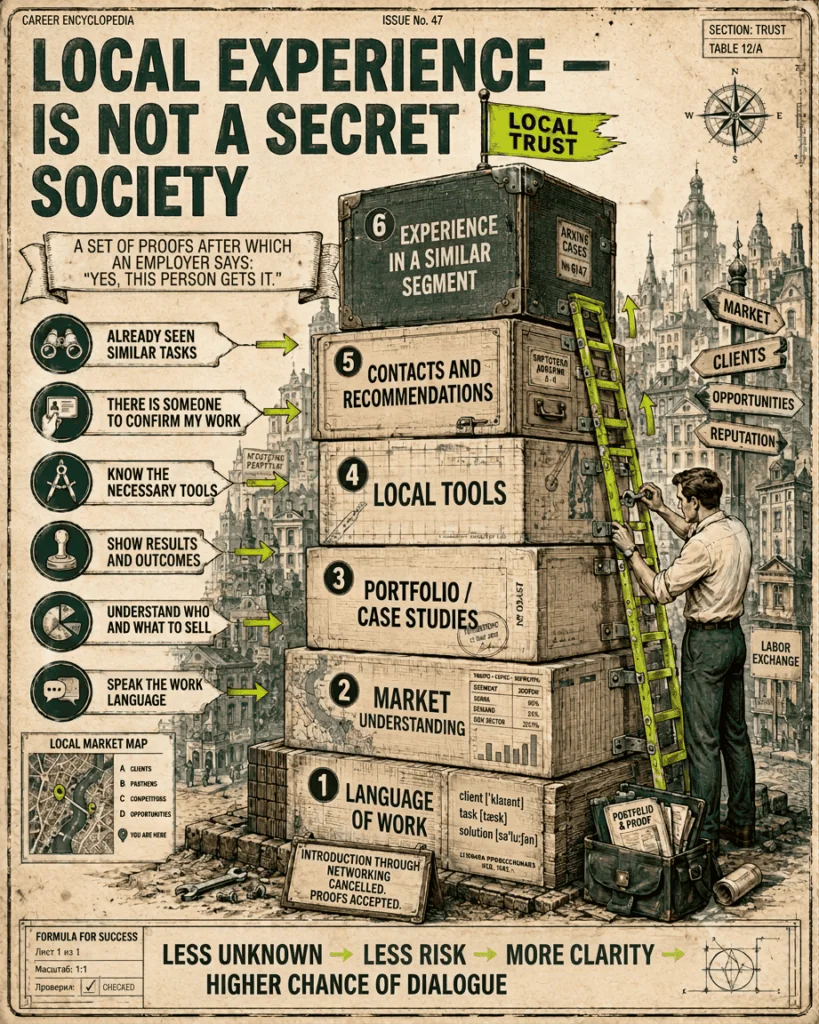
Sometimes that is exactly what it looks like. But more often, “local experience” is not one huge secret skill. It is a set of signals that reduce uncertainty.
You understand how the market works. You have a portfolio showing work with a similar audience. You know local tools. You can name realistic timelines. You can explain how you will be employed. You can get through an interview without ten minutes of internal panic when you are asked something unexpected. You have at least a few professional contacts who can confirm that you do not disappear after the first difficult task.
These signals can be collected faster than they seem. But you cannot obtain them by sitting in waiting mode and repeating to yourself: “They should appreciate me properly.”
The market almost never evaluates anyone according to their true worth. It evaluates people according to the evidence available.
That is why, in the first months, it is useful to treat job searching as research rather than an endless referendum on your own value. You need to understand which roles are genuinely open to specialists with your profile. Which requirements repeat. Which local tools appear in vacancies. How expectations are phrased. Which companies are prepared to hire people with international experience. Where flawless language is needed and where working proficiency is enough. What strong profiles look like for people already working in similar roles.
This is not a humiliating return to the first step. It is map-making.
A strong professional differs from a weak one not because they never end up in an unfamiliar system. A strong professional understands more quickly how that system works.
Sometimes You Will Have to Take a Lower-Level Role. But It Is Important to Know Exactly What You Are Paying For
There are situations where a transitional role genuinely makes sense. For example, when you are changing not only countries, but also your working language, industry, company type, contract format, or level of responsibility. You used to manage an offline team and now want to move into international digital work. You worked in local business and now want to enter B2B SaaS. You sold in one market and now want to work with a different audience. You have a lot of experience, but it does not match what the new market is currently buying.
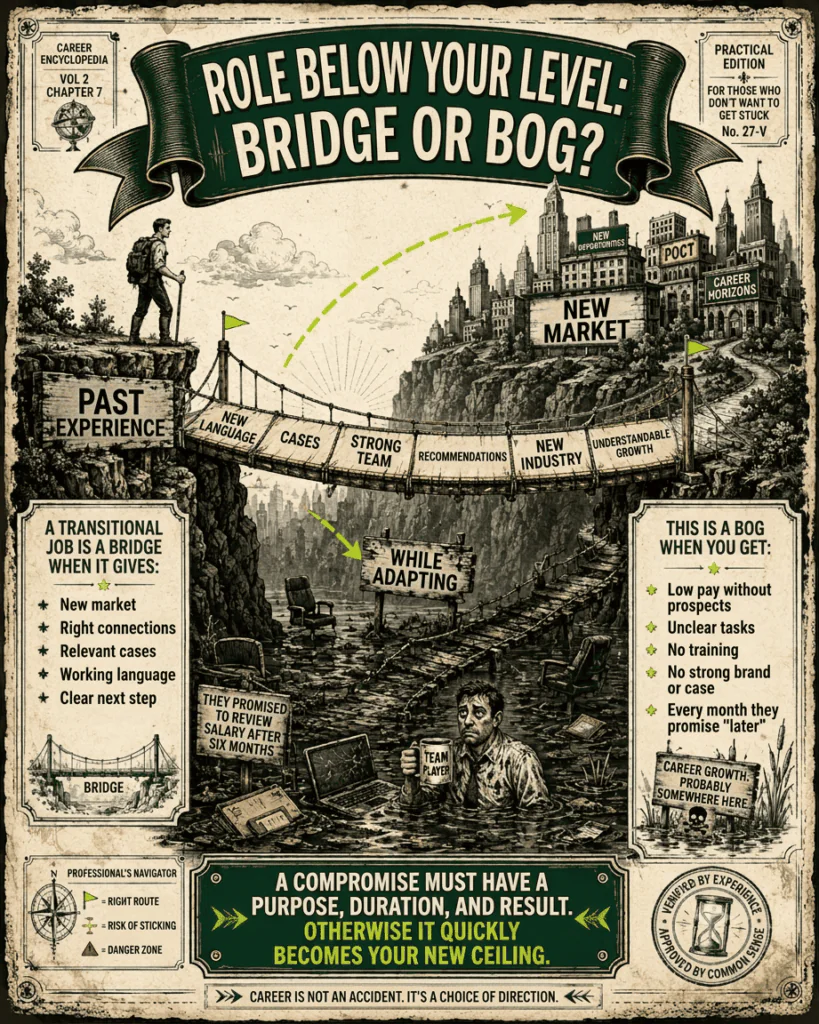
Then a lower-level role may be an investment rather than a defeat.
But only on one condition: you understand what you are buying with that role.
Not “I agree to anything because I am scared.” But “I am consciously taking a position that gives me the local signals I need: language, portfolio, references, an understanding of processes, experience in the right segment, access to a professional network.”
These are different things.
A bad transitional job is one where you give away experience, time, and energy but receive nothing except a line in a local employment contract. There is no learning, no clear product, no strong team, no new expertise, no growth, no opportunity to show results. There is only the hope that the company’s location will somehow turn you into a more valuable candidate. Usually, it does not.
A good transitional job is one after which, a year later, you can say: “Now I do not just have a local line on my CV. I have proof that I know how to work in this environment.”
The main thing is not to confuse a temporary compromise with a new professional norm. People sometimes accept roles below their level for so long that they begin to believe their actual ceiling is now there. That is a dangerous point. The market is very willing to get used to paying someone less when that person keeps explaining it by saying, “Well, I am still adapting.”
Adaptation needs a timeline, a goal, and a clear result. Otherwise, it turns into a convenient name for being stuck.
Your Task Is Not to Juniorise Yourself, Only the Local Interface
This may be the most useful thought in the whole story.
You do not need to become a junior professional again. You do not need to start at the level of someone who has just seen a CRM for the first time, does not understand the difference between a lead and a client, confuses KPI with the name of a new cryptocurrency, and thinks “teamwork” is when everyone looks at the same chat at once.
You only need to become a junior temporarily in one thing: understanding the new environment.
That means recognising that you may not yet know the local market, the language of professional communication, the hiring system, document requirements, cultural nuances, and the rules of the career game. That does not cancel your expertise in the profession itself.
This approach changes your behaviour.
Instead of trying to look all-knowing, you begin asking precise questions. Instead of being ashamed of what you do not know, you close those gaps quickly. Instead of endlessly comparing “how it was at home” with “how strange it is here,” you study what actually works. Instead of complaining, “They do not value me,” you begin gathering evidence that the new market understands.
This is not always pleasant. Sometimes you will have to admit that some old habits do not transfer. Sometimes that your title at home was higher than your actual level of responsibility. Sometimes that you are stronger at your profession than at self-presentation, and now it has become visible. Sometimes that you really do need to bring the language to a level where you can disagree, joke, clarify, and defend your position, rather than simply agree politely on calls.
But that is working information, not a verdict.
The most harmful position is to think that people must either immediately return your former status or that you have been completely reset. Between those extremes, there is an adult reality: you bring a strong core of experience while building a new layer of professional literacy.
Do Not Confuse Modesty With Invisibility
In a new country, many professionals begin speaking about themselves more quietly. Out of caution, linguistic uncertainty, fear of seeming arrogant, or the feeling that previous achievements “do not count.”
That is understandable. But the job market is bad at noticing what you have decided to hide.
Your CV should not look like an apology for existing. Your profile should not consist of generic responsibilities. At an interview, you should not answer as though you are afraid of accidentally taking up too much air in the room.
Modesty is useful in private life. In hiring, it often looks like a lack of substance.
An employer needs to see not only what you can do, but how you think. How you make decisions. How you explain complex things. How you work in uncertainty. How you respond when a familiar process breaks down. And people with ten years of experience usually have many such stories. They simply stop noticing them because they consider them normal.
For a new market, these stories may be the strongest proof of maturity.
Not “I handle stress well,” but “A launch failed because of X, I did Y, aligned Z, and as a result the team kept the deadline / client / budget / working product.” Not “I work well with people,” but “I managed a conflict between departments, found a shared goal, changed the process, and reduced the number of errors.” Not “I learn quickly,” but “I mastered a new tool / market / product and, within several months, used it to achieve a specific result.”
In a new environment, you will have to explain the obvious more often. It is tiring. But that explanation turns past experience into evidence a new employer can buy.
The Most Unpleasant Part: Your Former Confidence Will Return Before You Feel It
People often wait for an internal signal. Once I get used to things, improve my language, find a social circle, sort out the documents, stop getting nervous in interviews — then I will start acting confidently again.
Usually, it happens the other way around.
First, you act with incomplete confidence. You go to interviews where you do not know all the rules. You apply for roles where you feel underqualified. You write to people you do not know. You try to explain your experience, make mistakes in your wording, notice what did not work, adjust how you present yourself, and try again.
Only then does the feeling appear: “Ah. I think I understand what I am doing again.”
Confidence rarely arrives as permission to begin. More often, it appears as a side effect of dozens of actions you took before you felt ready.
This is not an inspirational postcard. It is mechanics.
You cannot wait for the new environment to become familiar. It will become familiar after you begin living in it professionally rather than only watching from the outside.
Yes, there will be rejections. Yes, there will be interviews after which you catch yourself thinking that you could have answered better. Yes, there will be vacancies where your experience is seen as “too international,” “not local enough,” “too strong,” “not relevant enough,” or where nobody even opens your message. The labour market sometimes knows how to reject people as though it does not fully understand why itself. It is an old tradition.
But every such interaction gives you data. And data is more useful than sitting for weeks with the feeling that you have become professionally smaller.
You Are Not Starting Over. You Are Going Through an Unpleasant Conversion
In a new country, you can feel like a junior even with ten years of experience because seniority is not only the ability to do the work. It is also the ability to do it within a specific system: to understand the market, language, people, rules, expectations, risks, and the way people here are expected to prove their value.
Your professional level does not live in your passport, a company name, or the word “Senior” in an old profile. But the market is not obliged to recognise it instantly simply because you know your worth.
You will have to translate your experience. Gather new signals. Learn the local grammar. Separate real gaps from temporary overload. Do not let bad employers sell you the story that you are “too inexperienced” when they simply want a strong specialist at the price of someone on probation.
And perhaps most importantly: do not try to prove that you are not a junior at everything.
You are not a junior in your profession.
You are a junior in the interface of a new environment.
It is inconvenient. Sometimes humiliating. Often expensive in time, money, and self-respect. But the interface can be learned. And those ten years of experience remain with you the whole time — simply waiting for you to learn how to show them in a way that finally makes the new market understand that it is not looking at a beginner, but at someone who has already survived enough workplace disasters to know where to find the fire extinguisher.