



Are You Looking for a Job—or Just Refreshing Job Boards?
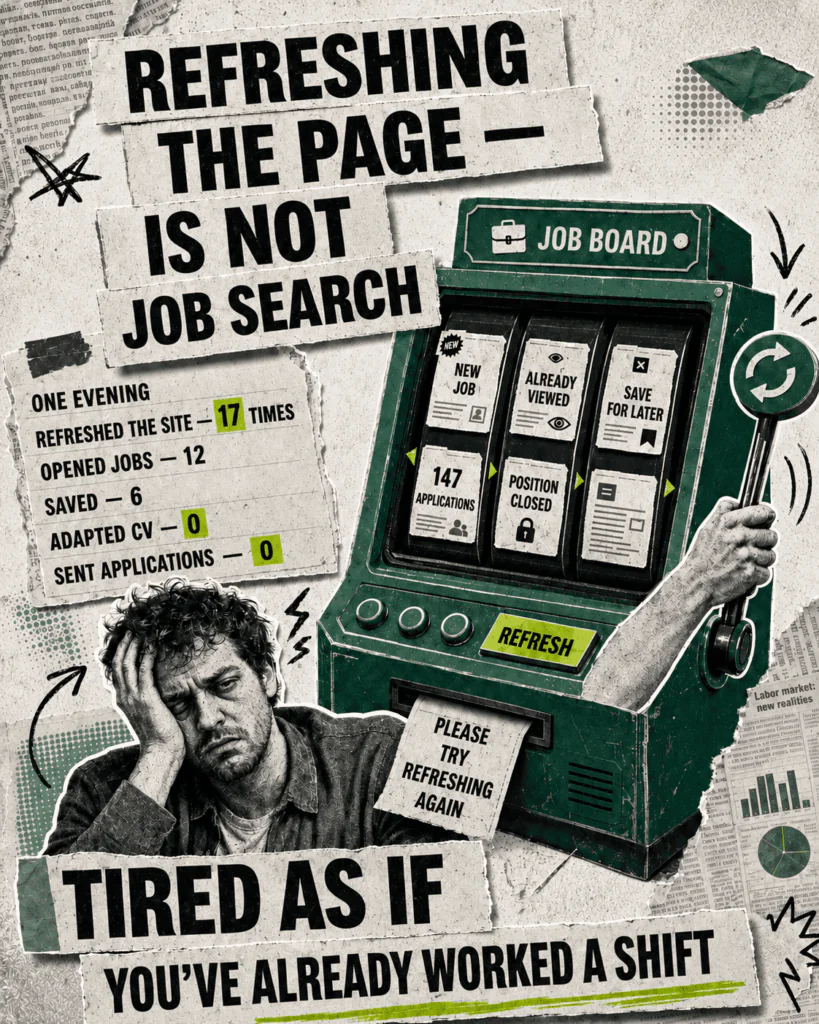
You are not always looking for a job. Sometimes you are simply refreshing job boards like someone who no longer believes in miracles but still keeps pulling on the handle of a closed store. Maybe it will open today. Maybe someone will finally respond. Maybe the world that ignored you yesterday will suddenly decide it cannot manage without you.
The bad news is that the world does not work like that. The worse news is that job boards are very good at pretending it does.
Something is always happening there. New listings appear, headlines change, and “urgent” or “immediate start” roles light up the screen. New companies talk about fast-paced environments, close-knit teams, and competitive pay, even though those phrases sometimes conceal one exhausted manager, two employees on the verge of quitting, and a spreadsheet nobody has opened since February.
It all resembles a buffet where half the food is plastic, a quarter has been sitting there since yesterday, and everything that is actually edible disappears before you have even found a plate.
A person sits down to look for work. At least, that is what they call it.
They open one website, then a second and a third. They save listings, read requirements, frown, compare salaries, and occasionally submit a CV. More often, they promise themselves they will do it in the evening, when they have enough energy to “put everything together properly.”
By evening, they have just enough energy to open the listings again.
After a week, it feels as though an enormous amount of work has been done. After a month, it seems the market is dead. After two, it feels as though nobody wants you. After three, you start wanting to take another course, rewrite your profile summary, post a quote about leaving your comfort zone, and quietly collapse face-first onto the pavement of your career.
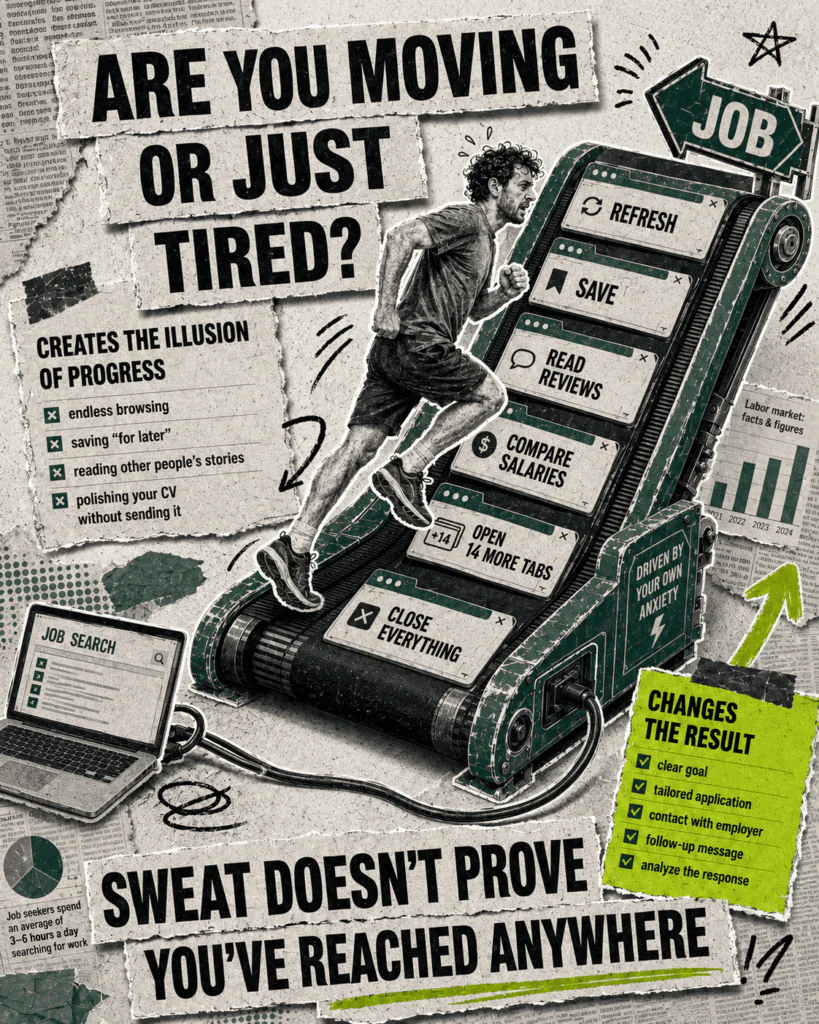
The problem is that all of this can look like a job search, consume hours, and leave you as exhausted as a full working day. Yet it may have about as much to do with actually finding a job as watching cooking videos has to do with making dinner.
When the Job Search Becomes an Anxiety Ritual
Most people are not only looking for work. They are looking for relief.
They need to reduce their anxiety, at least temporarily, through an action that resembles forward movement. Opening a job board is easy. Tailoring your CV to a particular position is harder. Building a case study, messaging the head of a department, or admitting that the problem is not a lack of confidence but a missing skill is hardly a celebration for the nervous system.
So people choose an action that provides immediate relief while carrying almost no risk. They scroll, save, return, and refresh the page again. They can remain busy without exposing their actual value to any real test.
Nobody has rejected you because nobody has seen you yet. Nobody has questioned your level because you have not entered a space where anyone can evaluate it.
The psychology behind this circus is fairly ordinary. Endless scrolling, occasional interesting discoveries, and the anxious anticipation of a new opportunity create a variable reward mechanism. Every so often, among dozens of pointless listings, a role really does appear to be suitable, and the brain receives a small flash of hope.
Then the listing disappears, turns out to be outdated, requires seven years of experience with a technology that has existed for four, or offers a salary capable of competing only with your utility bills. But the brain has already learned the lesson: refresh the page one more time.
Gradually, job boards stop being tools and become slot machines. Instead of coins, you feed them your time, attention, and whatever remains of your self-esteem.
Every “maybe something new has appeared” feels like a small leap towards rescue. A leap, not a rescue. The difference is roughly the same as the difference between repairing a leaking pipe and sticking a bandage over it.
The Platform Needs Your Visit. You Need an Offer.
Job boards are designed to make you return. They may help people find work, but their own success is measured not by the number of happy hires but by traffic, activity, and user retention.
You and the platform simply have different performance metrics. For you, success means receiving an offer. For the platform, success happened the moment you opened the app again in the morning, at lunchtime, and before bed.
So do not assume that three hours of honest suffering in the listings feed must bring you closer to employment. A platform is under no obligation to solve your life in gratitude for the time you have spent there. It is merely confirming that you will probably return tomorrow.
This is not a conspiracy or an act of deliberate cruelty. It is how a product designed to retain attention works. That does not make you feel any better when the evening is over, your eyes are tired, and the only measurable outcome is twenty-seven saved vacancies and a desire never to hear the phrase “fast-growing team” again.
It is easy to mistake observing the market for participating in it. You see hundreds of jobs, learn the names of companies, begin to distinguish between different shades of corporate dishonesty, and can almost recite the requirements for project managers from memory. Yet not a single company knows you exist.
The Market Isn’t Dead. It Has Just Become Less Patient.
The market for digital professions has not disappeared. Fields related to data, financial technology, artificial intelligence, software development, and digital services continue to grow particularly quickly. Online platforms connect hundreds of millions of workers and clients with global demand.
The problem is that the cost of entry is increasing alongside the market. Employers are becoming less interested in your desire to try something new and more interested in a clear set of skills that can be matched to actual tasks.
According to the World Economic Forum, 39% of core professional skills will change by 2030, while a significant proportion of workers will need training, retraining, or updated competencies. This is neither a tragedy nor the end of human civilisation. It is simply the entry fee for a market that changes faster than attractive certificates can become outdated.
Digital infrastructure has expanded access to work, but it has also expanded the pool of competitors. In the past, you might have been a strong specialist among a particular client’s contacts, people in your city, or candidates who happened to see an advert in a local group. Now you enter the same funnel as people from different countries, time zones, and price brackets.
The internet has achieved something remarkable: submitting an application has become easier, while becoming necessary has become harder.
A low barrier to applying creates a huge volume of candidates. According to Greenhouse, recruiters received an average of 588 applications per role in the third quarter of 2024, 26% more than a year earlier. In that environment, an employer cannot carefully read the story of every capable person and recognise their hidden potential.
They need to remove the noise quickly and find a handful of candidates who look like a sensible bet. Not the best people on the planet, not the most motivated, and not necessarily even the most experienced. Simply the ones whose value is easier to understand and raises fewer questions.
There’s Job Searching, and Then There’s Consuming Job Listings
People who describe themselves as “actively looking” can be roughly divided into two groups.
One group is genuinely moving towards an agreement with an employer. The other consumes job listings and collects the feeling of being involved in the process.
The person in the first group understands that hiring is an employer’s attempt to reduce risk in exchange for money. They choose a direction, assess demand, gather evidence, enter the market, and analyse the response.
The person in the second group continues offering employers diligence, decency, and a rich inner world, as though the company were a lonely adult who had spent years dreaming of meeting this exact person. Somewhere in the background, music should begin to play, the recruiter should drop their coffee cup, and realise that the search is finally over.
The company was not dreaming about you.
Companies rarely dream about candidates at all. They calculate, even when the vacancy is written in a warm, personal tone, the website features photographs of smiling employees, and the culture page explains that everyone is part of a family.
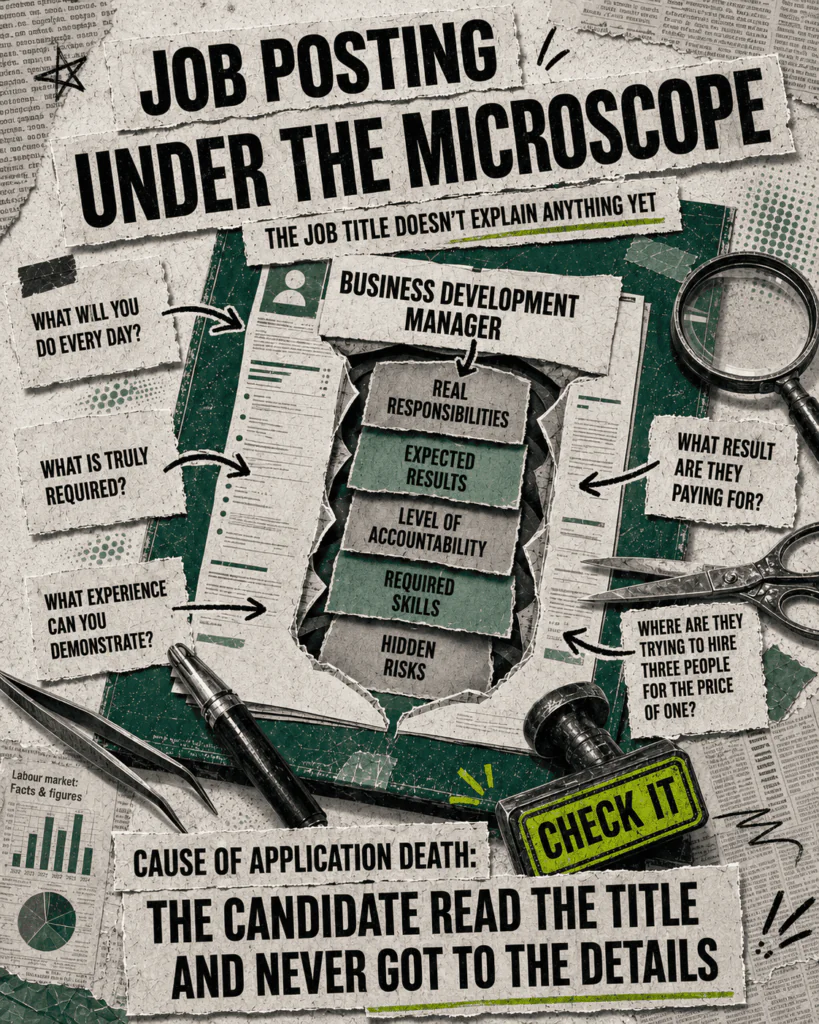
The employer estimates how long it will take you to settle into the role, how quickly you will begin creating value, how much supervision you will need, and how expensive your mistakes might be. They look at whether your experience matches the actual tasks, whether your claimed skills can be verified, and whether you understand where you have applied.
In 2026, all of this is assessed faster and more ruthlessly. Companies are introducing artificial intelligence into recruitment, automating repetitive stages, and increasingly using skills-based hiring. This does not mean that a robot is sitting behind every job listing, destroying your CV with mechanical laughter.
It means the funnel has become faster, louder, and less patient. A polished but generic image of a “responsible and quick-learning professional” loses to a specific match between a task and a proven skill.
A One-Size-Fits-All CV Is a White Flag
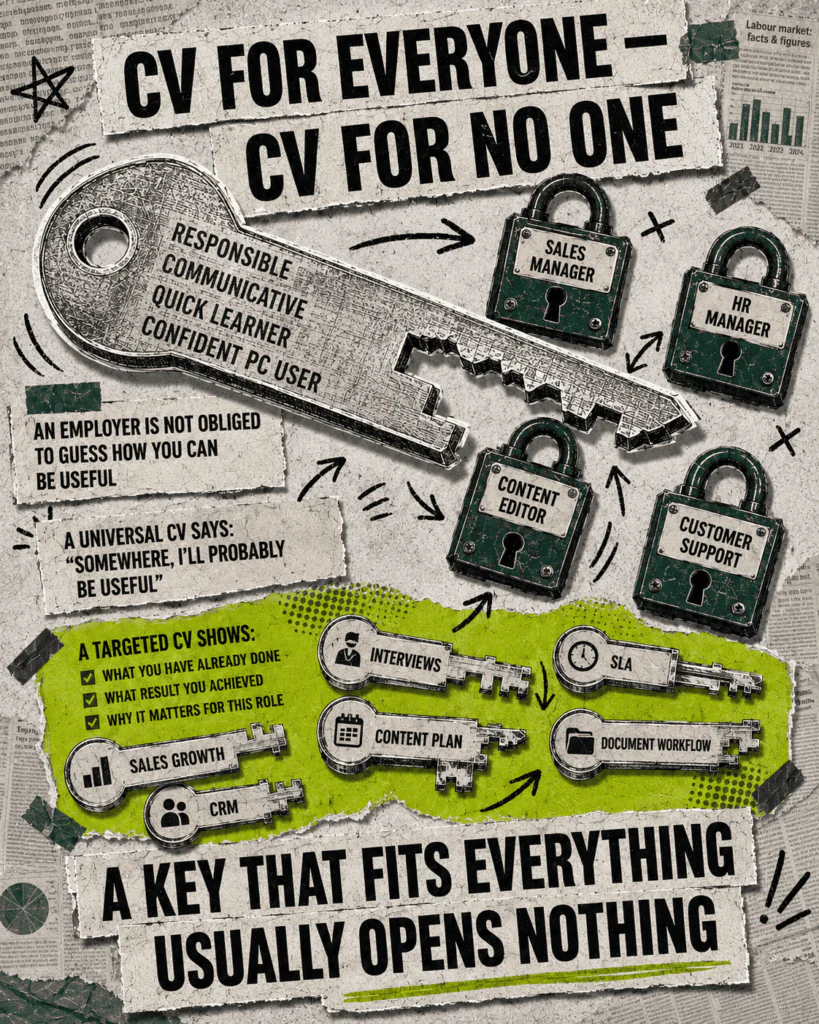
When you send the same CV to roles in content marketing, editing, project coordination, account management, and executive assistance, it does not necessarily demonstrate flexibility. Sometimes it shows only one thing: you have not decided which problem you solve better than other people.
An employer is under no obligation to conduct an archaeological excavation and dig your professional meaning out of nine previous jobs, twelve courses, and an “About Me” section written as though you survived a shipwreck in an ocean of soft skills.
When the relevant value is not visible within the first few seconds, the document is sent to join hundreds of similar biographies. Not because you are a poor professional, but because your CV takes too long to understand.
When applications arrive in large numbers, an employer is not looking for reasons to choose you. They are primarily looking for reasons to reduce the options quickly.
Sending the same generic CV everywhere resembles trying to win a chess tournament by throwing the pieces at the referee. The gesture is noticeable and there is certainly energy behind it, but the results tend to be modest.
Candidates are not the only overwhelmed party. According to Greenhouse, many job seekers encounter employers disappearing after interviews, while a significant proportion of applicants admit to sending out applications in bulk.
This creates a closed loop. Candidates spray CVs in every direction because almost nobody responds. Employers stop responding because they are drowning in irrelevant applications. In the end, both sides think the other is full of idiots, and each is right in its own way.
In a system like this, the person who needs the job most does not win. The person who is easiest to understand does.
Employers Don’t Need Your Biography. They Need Less Risk.
People often interpret this as personal cruelty from the market. “But I’m a good professional,” they say. Perhaps you are. Now you need to demonstrate it in a way that does not require the employer to take your word for it.
“I learn quickly” sounds pleasant, but where can anyone see evidence of it? “I’m motivated” is also nice, but which specific company risk does your motivation reduce? “I’m ready to work” is another favourite argument.
Being ready to work is not a competitive advantage. It is a minimum hygiene standard of adult life, roughly equivalent to having soap in the bathroom. It is good that it is there, but it may be too early for a standing ovation.
To receive invitations, you have to stop describing yourself only as a person and start presenting yourself as a solution. That sounds cynical because hiring is a fairly cynical process.
A company is not searching for a soulmate. It is purchasing relief from a problem.
It needs someone who will earn money, save time, reduce mistakes, establish order, or complete a task that the team has lacked the time, brainpower, or patience to handle.
Your CV should answer not only “Who are you?” but also “Why will things improve once you arrive?” It needs to answer quickly, while the recruiter is entering the fourth hour of sorting through applications and dreaming either of coffee or of a replacement nervous system.
Translate Your Experience from the Language of Biography into the Language of Value
Most candidates can only describe themselves in the language of biography. They write where they worked, what they were responsible for, which projects they joined, and which courses they completed.
That is the language of a report on years already lived. Employers are interested in results, scale, repeatability, and relevance to their own tasks.
“Managed the company’s social media” tells the reader only that the person had access to the accounts. It is much more useful to explain what changed after they arrived: whether organic reach increased, the cost per lead fell, or a coherent content system appeared.
“Communicated with clients” sounds like a description of being alive during working hours.
It would be far clearer to show whether the person reduced first-response time, improved retention, recovered at-risk accounts, or lowered the number of repeat enquiries.
“Participated in projects” says nothing about the person’s role either. They might have launched the project, rebuilt it, rescued it before the deadline, or remained silently present in the group chat. To a recruiter, those are four entirely different stories.
Failing to translate your experience into the language of value does not make you a bad professional. It simply makes you difficult to sell.
The market dislikes difficult sales, especially when other people have already done the uncomfortable work and explained which result they can reproduce.
The More Competitive the Market, the Narrower Your Positioning Should Be
Many candidates are afraid to narrow their positioning. They think that saying “I’m an editor for B2B SaaS companies” will permanently close the doors to every other industry and force them to spend the rest of their working life editing articles about enterprise integrations.
So they end up with descriptions such as “a versatile digital professional with experience in content, communications, strategy, analytics, and operations management.” It sounds impressive, almost like an intergalactic all-purpose machine.
In practice, this wording asks the recruiter to decide why they need you. The recruiter does not want to make that decision for you because other candidates have already selected a specific angle of value themselves.
Clarity does not mean you can do only one thing. It means that in a particular conversation, you show the part of your experience that matters to the person in front of you.
Broad experience can become an advantage once your primary purpose is clear. Until then, it often resembles an unlabelled tool warehouse: everything is technically inside, but nobody understands who should enter or what they are supposed to find.
The more competitive the market, the more valuable clarity becomes. This is particularly important in digital professions because the search territory is enormous and the formal barrier to submitting an application is low.
Digital platforms have opened access to global demand, which is genuinely good news. At the same time, they have given employers access to global supply. You are now one of many people in a shared funnel, and the funnel is highly democratic—which is precisely why it is so merciless.
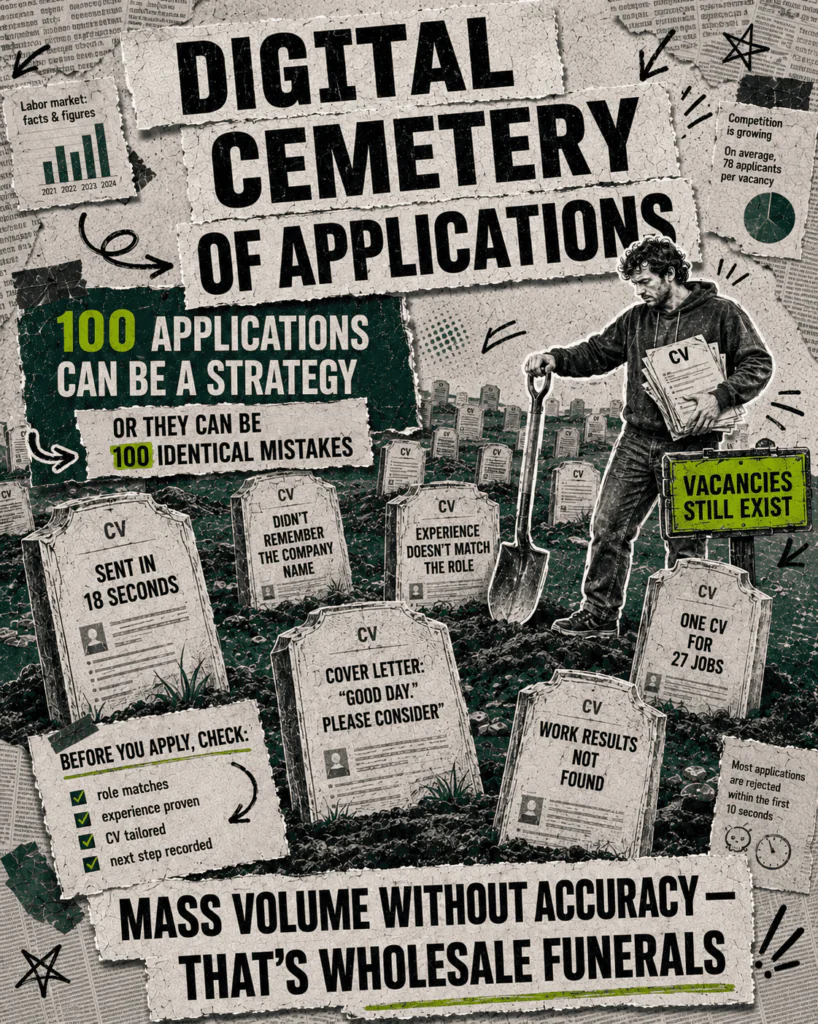
Why a Hundred Applications Can Get You Nothing
The logic of a high-volume job search appears flawless: the more applications you send, the greater your chances of finding work. At the level of school mathematics, this seems perfectly reasonable.
At the level of real recruitment, details begin to emerge.
A hundred weak, irrelevant, identical applications do not always create a hundred opportunities. Sometimes they create a hundred repetitions of the same mistake, except that nobody takes the time to put most of the rejections into words.
Someone spends months focusing on quantity and receives nothing. They begin to believe that the market hates them, when the market is simply responding badly to noise.
When every candidate is making noise, it becomes especially important not to become yet another source of it. That does not mean spending three days writing every cover letter and attaching the company’s full family tree from the date its legal entity was registered.
Your application simply needs to make it immediately clear why you have applied for this particular role, which part of your experience matches the task, and where the evidence can be found. Sometimes a few precise lines and a properly assembled CV are enough.
The quality of an application is not measured by its length. It is measured by the number of questions it answers for the employer.
A Good Job Search Looks Boring
This may be the most disappointing part of the entire story. A real job search rarely resembles an adventure, a personal transformation, or an inspiring television series about overcoming adversity.
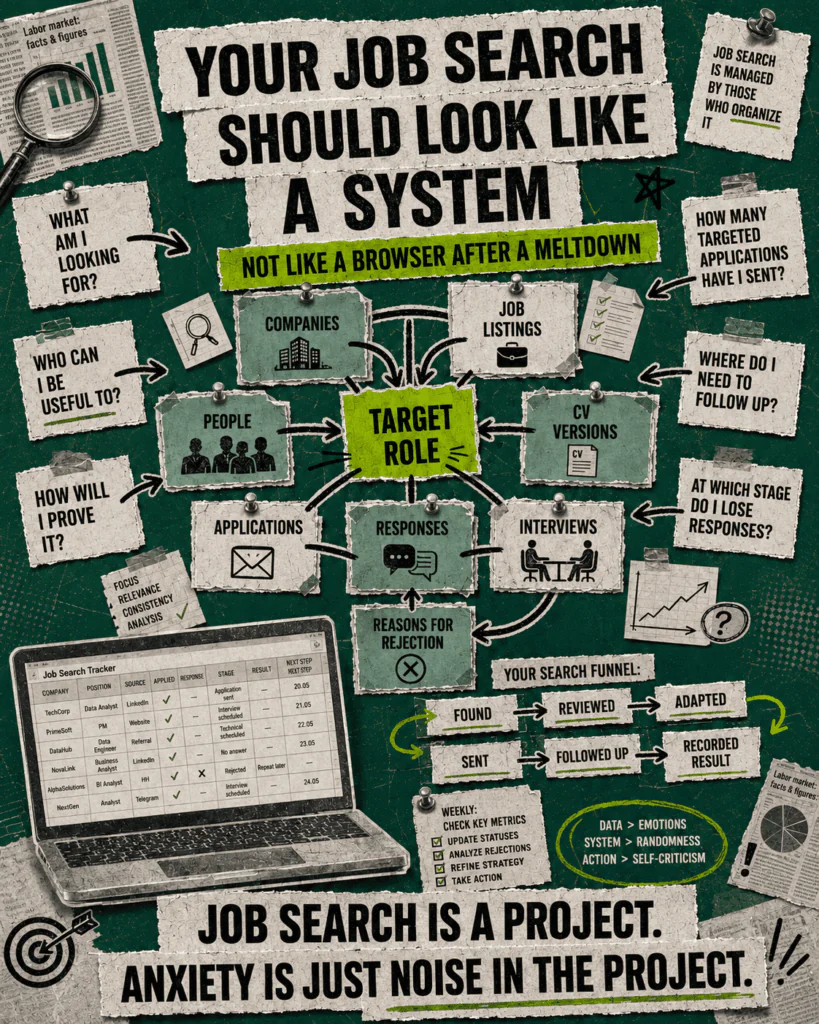
It is closer to a sales funnel in which the product is your demonstrable professional result.
First, you choose one or two realistic directions. Then you examine which tasks and requirements repeatedly appear in job listings and compare them with your current experience.
After that, you assemble a CV, profile, case studies, and a short message to the employer around the chosen goal. Then the test begins: you enter the market, record the response, and search for the bottleneck.
When your CV is barely opened, the problem lies in the initial signal. When it is opened but you receive no invitations, you need to examine the relevance and presentation of your experience. When you are getting interviews but no offers, the cause is probably no longer your profile headline.
When the only offers you receive are underpaid or entirely unrelated to your chosen direction, the market is communicating something important as well. Perhaps that is how it currently interprets your available evidence, even though you would prefer a different reading.
A good job search repairs a specific stage. A poor one responds to every problem by deciding to “completely reinvent the career,” buying another course, and spending the evening choosing a new profile photo.
Boredom is a sign of maturity here. When the search constantly resembles an emotional drama, there is usually no system anywhere in sight.
What Should Anyone Be Paying You For?
A real job search begins with an unpleasant question: what should anyone pay you for once your need for money and exhaustion with your current life are removed from the conversation?
The question is not mocking you. It is simply removing an irrelevant layer.
The employer does not care that your mortgage, burnout, former manager, and inner phoenix have finally become unbearable to one another. They are not paying for the drama of the previous chapter. They are paying for the usefulness of the next one.
That is why you need a commercially readable version of yourself. Not merely “I can write copy,” but an understanding of what you can accomplish through writing.
You may be able to generate leads, improve conversion, explain a complex product, build an expert reputation, guide users towards an action, or reduce the number of repetitive questions handled by customer support. Perhaps you know how to retain attention, move people towards registration, untangle a chaotic knowledge base, or write emails that make life easier for the sales team.
The same applies to project management. “I know how to manage projects” is too broad and therefore almost useless. It is much clearer to explain which projects you managed, with what kind of team, in which environment, within which timeframe, and what happened when everything stopped going according to plan.
As long as you describe yourself too generally, you are mainly useful for receiving supportive comments from friends. In recruitment, you remain a blurred image in which anything can be imagined and therefore nothing can be chosen with confidence.
Learning Instead of Entering the Market
Another condition affecting digital job searches is the cult of preparation. People spend weeks polishing their profiles, months studying, building portfolios, and waiting for the moment when they will finally stop feeling embarrassed by their work.
Then the stage arrives when they are no longer embarrassed. They are frightened. The real market does not care whether you have reached emotional maturity. It simply checks whether you match the task.
Learning is necessary. The market genuinely is changing, and without updating your skills, progress will become increasingly difficult. The problem begins when learning never reaches a market test.
That kind of learning becomes professional tourism. You walk attractively around the profession, take photographs beside industry terminology, buy certificate-shaped souvenirs, but never actually enter the country.
A course does not make you a professional. Even a very good course does not make you a professional automatically.
It can provide structure, tools, practice, professional vocabulary, and a framework for thinking. What makes you a professional is a series of situations in which you apply all of that to someone else’s problem and produce a result.
Preferably, the result should be something you can show, describe, or at least explain clearly. Until then, what you have is educational baggage. It may prove useful, but on its own it sells less effectively than the landing page promised next to the countdown timer and the “secure your place” button.
Evidence Starts Working Before the First Conversation
The market values evidence more than inspiration. This is particularly visible in remote work, where people are often assessed long before the first call.
Anything that can confirm your competence works on your behalf around the clock. A portfolio, public case studies, a well-structured profile, professional analyses, examples of completed tasks, and a clear set of tools all reduce uncertainty.
Even the structure of your first message says a great deal about you. It allows people to guess whether they will later need to extract meaning from you with pliers on every project, or whether you can independently organise your thoughts into a usable working format.
People underestimate the power of public evidence because they assume the market should figure everything out for itself. Sometimes it does—for example, when you arrive through a strong recommendation.
In every other situation, the market does not guess. It filters.
When you make it easy to understand who you are and why you are needed, you are already completing part of the employer’s work. The market appreciates that, even while maintaining the expression of a government employee late on a Friday afternoon.
Applications Are Only One Channel
When your entire search consists exclusively of applications, you voluntarily enter the most crowded, noisy, and impersonal section of the market. That does not mean applications are useless. They are necessary, but they do not have to be your only route to an employer.
Beyond published vacancies, there are referrals, professional communities, direct outreach, public content, former colleagues, and clients. There are department heads, editors, team leads, founders of small companies, and people who have not yet published a vacancy but already know they need a specialist.
When you have no other channels, you are constantly swimming in the coldest part of the water. There, you are compared with hundreds of people through a few screens of text, with almost no context.
Many people want to believe that someone will eventually notice them because it is only fair. Unfortunately, the market does not resemble a literary competition in which a strict but honest judge is guaranteed to read far enough to discover your radiant soul.
It is closer to a large, exhausted room full of people trying to solve a problem quickly.
When that problem can be solved by a specialist who has already appeared on someone’s radar, arrived through a recommendation, or explained their value in advance, the probability changes significantly.
Direct contact is not arrogance. It is part of the work.
Arrogance begins when you write, “Hello, I would like to work for your company. Please review my CV,” and attach a document without offering a single explanation of why you contacted that particular company.
Effective outreach looks different. You understand what the company does, which task you could handle, and what evidence supports your confidence. Then you briefly explain who you are, why you are writing now, and where examples of your work can be found.
This requires no poetry, humiliation, or tourist backpack overloaded with emojis and two paragraphs of gratitude. It requires meaning and respect for another person’s time.
Not the Perfect Candidate, but a Risk the Employer Can Understand
Some job seekers try to appear perfect. They smooth out their profiles as though preparing for an audience with the royal family: everything neat, safe, distinctive in no way, and free of sharp edges.
Then they wonder why nobody remembers them. There is little reason to be surprised: they removed every specific detail to avoid accidentally raising a question, and along with the questions, they removed the interest.
An employer does not need a perfect person. They need a risk they can understand.
They know that perfect candidates do not exist, but they want to see in advance what they are dealing with. A clearly stated specialisation, strong area, limitations, and genuine depth create the impression of a mature professional.
The image of “I can do everything, I’m interested in everything, I adapt quickly, and I work well under pressure and in a multitasking environment” creates a different impression. It usually suggests that the person has learned to answer attractively but has not yet learned to choose.
Hiring will always involve risk. Your task is not to appeal to everyone. It is to make the risk sufficiently understandable.
The employer should be able to think: “I can see this person’s limitations, understand their strength, and imagine where they will produce results.” That thought is more useful than a vague impression of a pleasant, motivated, and exceptionally versatile candidate.
Market Silence Is Not a Verdict—but It Isn’t Random Either
Job seekers often confuse the market’s reaction with an assessment of their value as human beings. Silence after an application quickly becomes a diagnosis: there must be something wrong with me.
Sometimes you are more or less fine, while the packaging is not working. Sometimes the packaging is strong, but the market is overloaded. You may have chosen unsuitable roles, overestimated how transferable your experience is, or set a price that your current evidence does not yet support.
Sometimes the problem lies in communication. Sometimes you genuinely were one of hundreds of applications that nobody physically managed to reach.
It is unpleasant, but a company’s silence is not a final judgement of your worth as a person. An overloaded system does not remain silent only in front of weak candidates. Sometimes it is simply drowning.
Romanticising this idea is also dangerous. You can spend years comforting yourself with the belief that the market is broken, employers are blind, algorithms are stupid, and you are permanently unlucky.
Sometimes all of that is true. Sometimes that version of events simply allows you to avoid changing your strategy.
When several months pass with almost no views, responses, or interviews, the problem no longer lies only with the market. Your search system has been designed to protect your self-esteem, not to lead to employment. That means the system will have to be dismantled.
Where the Job Search Usually Breaks Down
The first failure is usually the goal. Someone searches too broadly, applies for roles that differ significantly in purpose, and never appears to be a precise match anywhere.
The second failure is a weak signal of value. The candidate says a great deal about themselves but proves almost nothing. The document contains duties, personal qualities, and ambitions, yet it is difficult to identify a result that could be transferred to a new company.
The third failure is dependence on platforms. The person waits for the market to arrive through an interface that serves hundreds of other anxious, exhausted, and hopeful people in exactly the same way.
These problems are rarely solved by spending another evening in the vacancies feed. A vague goal has to be narrowed, weak evidence has to be gathered, and reliance on a single channel has to be replaced by a broader network of contacts.
The most uncomfortable truth is that some people refresh job boards precisely because they are afraid of conducting a real search. A real search produces measurable answers, while the feed offers endless postponement.
Inside it, you can avoid choosing a direction, admitting to a skills gap, or noticing that five months have passed without a single high-quality direct approach.
The platform will not display a notification saying: “Dear user, you are no longer searching for work. You are consuming hope in an aesthetically pleasing manner.”
Which is a shame. It would be a useful notification.
While You Search for a Job, Scammers Are Searching for You
The more people want remote work, the more attractive the market becomes to those who plan to exploit rather than employ them. The FTC, Europol, INTERPOL, and technology companies regularly issue warnings about fake vacancies, fraudulent interviews, and schemes designed to extract money or personal documents.
Offers are particularly dangerous when the “employer” asks you to pay for placement, verification, training, or equipment from a particular partner. The same applies to requests to move someone else’s money through your account, open a mysterious work wallet, or install suspicious software supposedly needed for an interview.
This is not a complex corporate procedure or a special feature of international recruitment. It is the moment when common sense should enter the room, take your laptop away, and send you to drink a glass of water.
A real employer pays you. They do not ask you to prove your loyalty by transferring money to a stranger first.
The longer the search continues, the easier it becomes to believe an offer that looks too good to be true. Exhaustion weakens critical judgement, while the promise of a quick escape from uncertainty becomes more persuasive than usual.
That is why verifying a company should be part of the system rather than a symptom of pessimism. Desperation does not turn a suspicious vacancy into a real one.
What You Should Actually Be Counting
A real job search is fairly practical. You choose a position, examine which requirements appear repeatedly, and compare them with your experience.
Skills gaps are better treated as useful information rather than personal catastrophe. Some can be addressed quickly. Others require practical experience you genuinely do not yet have. Certain roles are realistic targets now, while others will require further growth, regardless of how much you like the job title.
You then gather evidence and adapt your CV and profile around a specific angle of value. After that, you move into applications, direct messages, communities, referrals, and contact with people who might recognise you as a solution.
The main change happens when you stop counting viewed vacancies and begin counting meaningful interactions with the market.
How many relevant applications have you submitted? How many people have you contacted personally? How many case studies have been added to your portfolio? At which stage does the response disappear? What changes after you revise the CV or the message?
That is when something resembling control over the situation begins to appear.
Without measurement, a job search becomes a religious practice. You perform rituals, hope for a reward, and have no idea which pricing plan determines when it will be delivered.
Sometimes the Market Is Right, Even If It Says So Rudely
In digital professions, a career often looks better from the outside than it does from within. The profile is polished, the tools are listed, and the projects sit neatly in rows—everything appears respectable.
A closer inspection may reveal that some skills are dead weight. Certain tasks were performed only occasionally, others under intensive supervision, and some so long ago that the only remaining connection to the modern market is their name.
That is why honest self-diagnosis is more useful than inspirational posts. When the market does not respond, it is not necessarily mistaken.
Sometimes it is simply showing you—rudely, without music or emotional support—the gap between your internal assessment of yourself and the value that can be read from the outside.
That hurts, but it is useful. Once people notice the gap, they stop spending months merely refreshing websites and begin building capital.
New case studies, tools, contacts, and more precise specialisations appear. Sometimes you have to temporarily lower your ambition regarding the job title in order to increase the density of your evidence.
That is not defeat. Defeat is spending six months in the listings feed, describing yourself as someone who is actively looking, while refusing to admit that the only truly active participant throughout that time was the finger scrolling down the page.
You’re Already Exhausted, Even Though the Search Hasn’t Really Begun
The darkly comic part of the situation is that many people become deeply exhausted by a job search they have not really started.
They are tired of reading, comparing, saving, and worrying. They imagine rejections in advance, agonise over every unclear phrase, and experience a small blow each time nobody responds.
Their mind is already paying the full price. The market has still not received a proper proposition from them.
That is the particularly painful part.
When this thought feels uncomfortable, it may have struck not your pride but the mechanism itself. The mechanism is quite simple: observing the market has been presented as participating in it.
An application does not automatically become a job search when it is random and irrelevant. Refreshing the feed changes nothing when no action follows it.
Another course does not move you closer to work unless it addresses a specific gap.
A polished profile is useless when nobody can understand your value from it.
Even the phrase “open to opportunities” works poorly when nobody knows which opportunities you are open to.
Job Listings Are Raw Material, Not Painkillers
The search begins when you take responsibility for clarity. For the chosen goal, the presentation, the evidence, and entering the market.
Taking a chance on you should feel reasonably easy. Hiring is always a risk, and your task is not to appeal to every employer. You need to make the risk understandable enough for a particular person to decide: “This candidate is worth trying.”
When the alternative is opening the job board again and hoping that the perfect role will eventually leap out and persuade you to accept it, the news is not encouraging.
Nobody is searching for you with a magical beam. You are being compared, filtered, tested for clarity, and evaluated through signals.
When you do not control how those signals appear, the market has to fill in the gaps. The market has little imagination and usually does not use it in your favour.
So the question remains fairly simple. Are you looking for a job, or are you refreshing job boards to avoid being alone with the truth that jobs are found not with your eyes, but with a system?
There is nothing unusual about the second option either. Many people do it. Platforms encourage it, anxiety enjoys it, and the brain is happy to purchase the illusion of movement.
The price is paid in months of your life, lost focus, and declining self-esteem. What remains is the heavy feeling that you are constantly doing something while arriving nowhere.
You can—and should—look at vacancies. You simply need to treat them as raw material for decisions rather than pain relief, an evening ritual, or a substitute for action.
When you read a vacancy, change nothing, and simply open the next one, you are no longer a hunter. You are a visitor.
And visitors are the people the job market remembers least.