


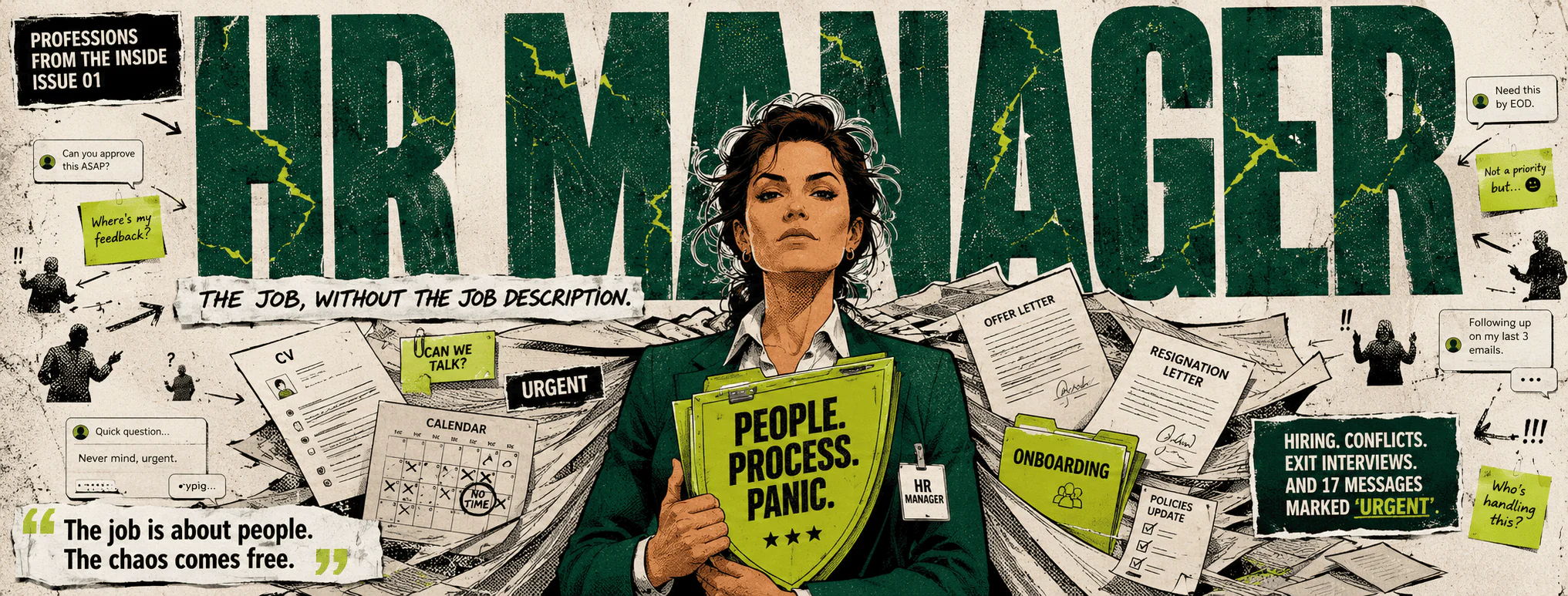
One Day in the Life of an HR Manager: What the Job Description Doesn’t Show
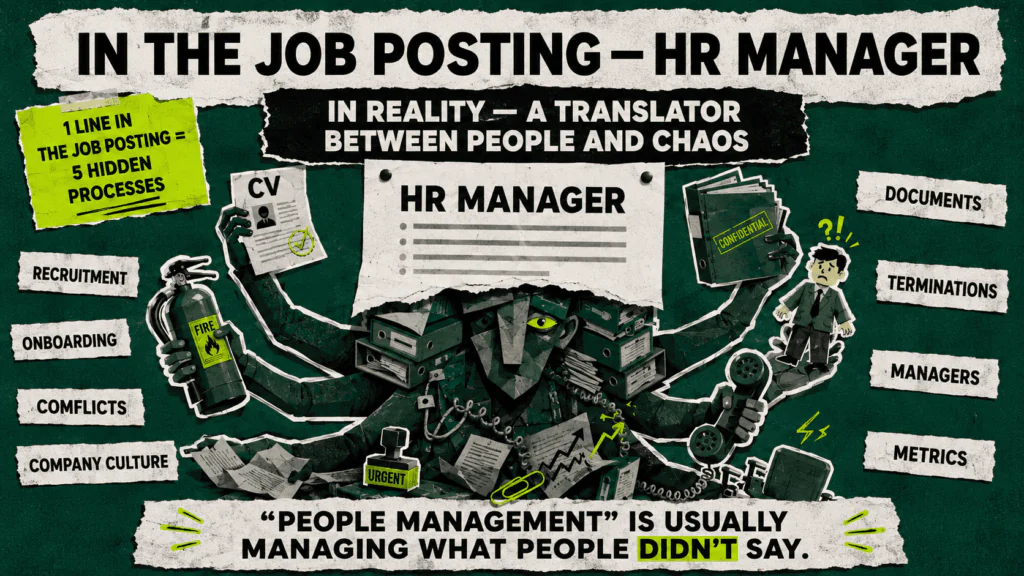
An HR Manager job posting usually looks like a respectable document. Everything is neatly laid out: recruiting, employee onboarding, developing company culture, supporting HR processes, taking part in performance reviews, supporting the team, partnering with managers. Sometimes they add “work in a fast-paced environment” so applicants understand in advance: what awaits them is not really a job, but an attempt to keep eight cups of coffee balanced in their hands while someone opens the door with an elbow and asks why the team still has no Senior Backend Developer with C1 English, fintech experience, intern-level salary expectations, and the ability to start tomorrow.
On paper, an HR Manager is someone who helps a business find people, helps people find their place, and helps teams avoid breaking into nervous little fragments. In reality, an HR Manager often resembles an air traffic controller at an airport where the planes have no labels, the pilots are arguing with the weather, passengers are demanding compensation for delays, and leadership is convinced that one person in front of a screen should be perfectly capable of “keeping it all sort of under control.”
That is what the job description doesn’t show.
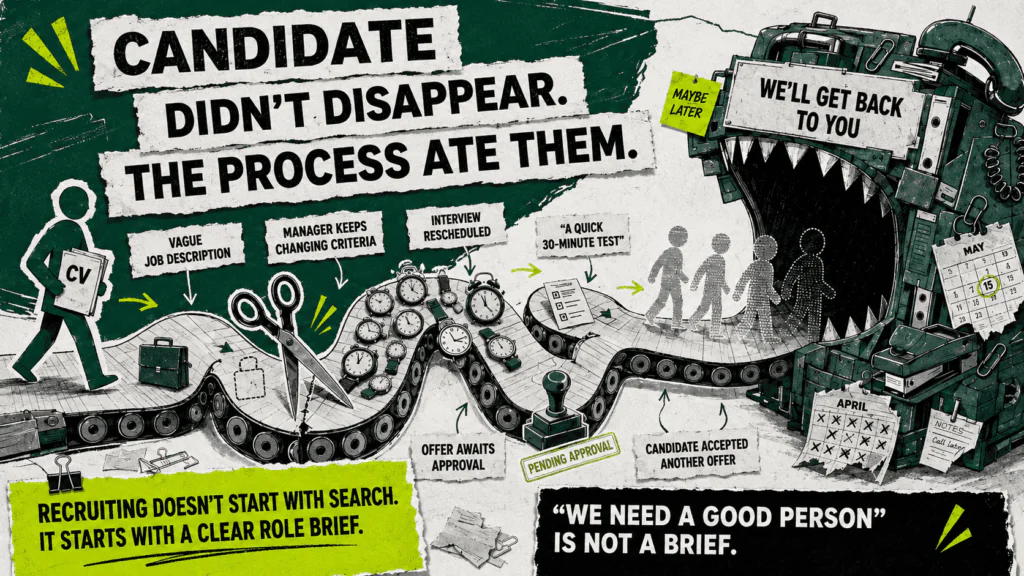
It doesn’t show that recruiting is far from always about finding a candidate. Sometimes it is about finding someone willing to talk to the company after three LinkedIn messages, one call, two rescheduled interviews, and the sudden disappearance of the manager who was supposed to conduct the final meeting but stepped out “for twenty minutes” and returned three working days later with the idea of completely changing the requirements for the role.
It doesn’t show that onboarding is not a polished welcome pack, a branded mug, and a photo of the new employee in the company chat. Onboarding is an attempt to make sure the newcomer understands who to message, where the documents are stored, why they do not have access to half the systems, who makes decisions, what is considered normal, and what people here mean when they say, “We just move fast around here.” Sometimes a new hire is introduced to the role as though they were dropped by parachute into a forest at night, handed a flashlight with no batteries, and told, “You’ll figure it out. Everyone here is pretty independent.”
It doesn’t show that working with people rarely looks like the version of working with people you see in presentations. In presentations, people smile, listen to one another, express their needs calmly, and come to one-to-ones prepared. In real life, one employee messages HR at 11:48 p.m. saying, “Could we talk?”, another disappears after receiving an offer, a third wants to “discuss their career path” but is actually preparing to leave, a fourth insists they are being undervalued despite ignoring messages in the work chat for three weeks, and a fifth simply came in to complain about a colleague who types too loudly.
And all of that can happen before lunch.
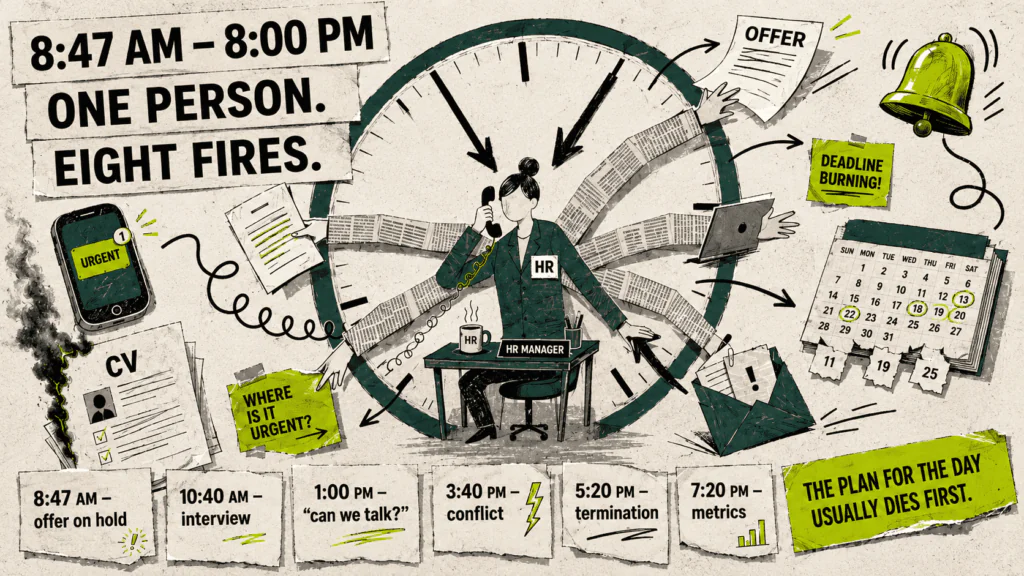
08:47 AM. The workday hasn’t started yet, and you already owe someone something
For a normal person, the day begins with coffee, the commute, a few minutes of silence before the screen, and an attempt to remember why work was invented in the first place. For an HR Manager, the day often starts with notifications.
The first message usually looks harmless: “Good morning, have you got a minute?” It is a trap. It almost never means the person genuinely has a minute. It means that, very soon, you are about to learn something that was considered stable yesterday.
For example, the head of sales has suddenly decided that they need another manager. Not in a month. Not after the budget is approved. Not after someone figures out what this person will actually be doing. They need one urgently. Preferably yesterday.
Then a message arrives from the candidate you sent an offer to yesterday. They thank you for the opportunity, write that “everything sounds great,” and then add that they would like to come back to the question in two weeks because they are considering several other options at the same time. A cold empty space appears in your calendar. The manager has already told the team that the new employee is starting on Monday. A Monday that now exists only in their own internal world.
Then payroll writes. They need a list of employees who were hired, rehired, left, returned, changed roles, documents, addresses, surnames, schedules, terms, contracts, and, most likely, star signs. Urgently. By ten.
At the same time, someone from marketing reminds you that the job ad copy needs to be approved today. The one where the responsibilities already include “recruiting,” “onboarding,” “development,” “performance reviews,” “retention,” “internal communications,” “event planning,” “documentation,” “strategic involvement,” “employer branding,” and, apparently, responsibility for solar storms as well, because the team has seemed unusually irritated lately.
The posting is written as though the company is not looking for an HR Manager but for a neat human version of a multifunctional office machine.
And that is the moment you realise: the day has begun.
09:15 AM. Recruitment: a romantic name for a process where everyone disappears
From the outside, recruitment looks almost elegant. An HR Manager studies the market, talks to candidates, conducts interviews, finds the right people. On corporate websites, all of this is usually accompanied by a photo of someone in a blazer looking at a laptop and smiling as though they have just found the ideal candidate in seven minutes.
Inside the company, recruitment usually begins when someone sends you a hiring request.
The request says, “We need a strong specialist.” Great. “Strong” is always such a clear word. Especially when no one can explain exactly what that strength is supposed to look like. Maybe the candidate should be able to hit the quarterly target with one hand, lead negotiations with the other, open the CRM with a foot, and use their head to think about retention, NPS, and the new client presentation at the same time.
You ask for clarification on the responsibilities. The manager replies, “Well, all the usual stuff.” That is the second trap phrase after “Have you got a minute?” Because “the usual stuff” means something completely different to everyone.
For one manager, “the usual stuff” means handling five clients and preparing a weekly report. For another, it means owning the strategy for an entire function, building a team, closing deals, dealing with difficult clients, training new hires, and occasionally rescuing a project that has been lying face-down in the general chat for two weeks.
You try to find out which skills are mandatory. They tell you, “They need experience.” How many years? “Enough to understand.” Understand what exactly? “Our specific environment.” What is specific about your environment? At this point, people usually begin replying a little more slowly, because the phrase “specific environment” is often used when a company has no clear answer about who it is looking for, but has a very clear feeling that all the previous candidates were somehow “not quite right.”
And now you are no longer just an HR Manager. You are a translator from management-speak into human language. You need to take phrases like “we need someone with drive,” “I want someone who will really be on fire,” “they should be independent,” and “ideally, they should have an entrepreneurial mindset” and turn them into understandable copy. And you need to do it in a way that does not sound like an announcement looking for someone ready to work at a company where, in the morning, nobody knows what they will be doing after lunch.
Sometimes the requirements look perfectly reasonable. That is when you almost relax. Then the manager adds, “It would also be great if they could work with European clients, understand analytics, put together presentations, manage social media, help with hiring, and know their way around AI tools.” You stay silent for a few seconds because you are trying to figure out whether they are still looking for a specialist or whether the company has decided to find itself a second nervous system.
Recruitment does not begin with posting a vacancy. It begins with pulling the real need out of the manager’s head and making sure it does not disappear again behind the phrase, “We just need a normal person.”
It is not the most visible part of the job. It is almost never written in the posting. There, it is usually called something modest like “gathering role requirements.”
A very delicate name for a process in which you sometimes have to get an adult manager to answer one question: “What exactly will this person be doing in their first three months?”
10:40 AM. Interviews: the place where everyone tries to look better than they are
An interview is not a conversation. It is a diplomatic meeting between people who both understand that the other side wants to make a good impression.
The candidate is trying to appear composed, motivated, professional, stable, loyal, and sufficiently reasonable to be allowed access to the company calendar. The company is trying to appear organised, transparent, modern, honest, and like the kind of place where no one sends messages marked “very urgent” on a Saturday evening.
Everyone pretends that what is happening is perfectly natural.
In this scene, the HR Manager has to be an interviewer, psychologist, analyst, translator, observer, and the person who remembers that the next interview starts in twenty minutes.
The candidate says they left their previous job because there was no room for growth. That may be true. It may mean they were promised a promotion for three years and then watched a colleague who joined later get promoted because they were good at making presentations in Canva. It may mean the candidate did not receive the kind of development they expected. It may mean they were simply tired of a manager who treated the phrase “feedback” as a form of intimidation.
Your job is not to guess the truth from a facial expression. That is impossible. Your job is to hear the structure of the story.
How does the person talk about their previous employer? How do they describe their mistakes? How do they respond to uncomfortable questions? Do they speak only about how everyone around them was strange, toxic, incompetent, and generally unworthy of their presence? Or can they recognise where they themselves failed, did not communicate clearly, or noticed a problem too late?
That does not mean the candidate should sit there and explain how they once ruined a project, then lost access to a spreadsheet, and afterwards accidentally sent an email to the wrong client. A reasonable candidate is not required to turn an interview into a confession. But someone who cannot see anything in their career other than other people’s fault rarely becomes easier to work with after they join.
Sometimes a candidate seems ideal. They speak confidently, answer in a structured way, give examples, ask good questions. After the interview, the manager writes, “I really liked them, but they seem a little too confident.” A week later, another candidate comes in. They are more modest, more cautious, slightly nervous. The manager writes, “They lacked confidence.”
At that point, the HR Manager begins to feel like someone who has to find an apple that is both green and red, and preferably not round, because the last round apple somehow “didn’t work for us.”
A job description usually says, “Conduct interviews.” In reality, that means sitting between the candidate’s interests, the manager’s expectations, the budget, the market, the actual scope of work, and the collective fantasy that the perfect person exists and simply has not read your message yet.
11:50 AM. Managers do not hire employees. They hire their own idea of an employee
There is one uncomfortable thing many HR Managers understand fairly quickly: roles are rarely difficult to fill just because there are no candidates in the market.
Sometimes the problem is that the manager has not decided who they actually want to see on the team.
They may say they need someone independent, then get irritated when the candidate makes a decision without approval. They may ask for an employee with initiative, then consider only those suggestions that happen to match their own ideas to be initiative. They may say they want someone who “can challenge things with arguments,” but after the candidate’s first attempt to question the logic behind a decision, say, “Well, the personality seems a bit difficult.”
The HR Manager has to see this before the candidate starts.
Because a bad hire rarely looks like a disaster on day one. On the first day, everything looks respectable. The new employee receives a laptop, access to systems, a brief welcome from the manager, a few links to documents, and the feeling that everything is about to become clearer.
Two weeks later, it turns out the manager expected something different. A month later, the employee realises that the actual job does not match what was discussed during the interview. Two months later, both sides begin using the same phrase: “We probably just were not a fit.”
It is a very convenient phrase. It sounds gentle, almost intelligent. As though two people met at a literary evening, exchanged glances, and realised that one likes Chekhov while the other prefers living in a state of endless changes to requirements.
In practice, “we were not a fit” often means that no one clearly defined expectations in time.
In stories like this, the HR Manager ends up between two people who imagined the same job in completely different ways. One thought they would be developing a function. The other thought they would be plugging operational gaps. One wanted freedom. The other wanted control. One expected feedback. The other believed that silence was a sign of trust.
And somewhere between them lies your job description, where all of this was called “exciting tasks in a fast-growing company.”
01:00 PM. Lunch. In theory
An HR Manager has lunch. It exists as a concept. Roughly like ideal onboarding, a transparent grading system, and the phrase, “We just want to talk.”
Sometimes you do manage to eat. Usually, that is when an employee messages you: “I have a question about my leave.” A question about leave is almost never only about leave.
It can include conflict with a manager, accumulated exhaustion, anxiety about money, the desire to leave, resentment towards colleagues, rumours about layoffs, or a general feeling that the company is heading somewhere and the person does not know whether they should run with it or in the opposite direction.
An HR Manager often becomes the first person people come to not because they can solve the problem, but because they are easier to approach.
That is valuable and difficult at the same time.
People rarely come with a ready-made way to explain what is happening. They do not say, “My work boundaries have collapsed, and I do not understand how to discuss this safely with my manager.” They say, “I just can’t do this anymore.”
They do not say, “I feel that my achievements are being systematically devalued, and it is affecting my motivation.” They say, “Everything is just driving me crazy.”
They do not say, “I want to revisit my role because it has changed over the past year, while the pay and expectations have stayed the same.” They say, “Could we talk like human beings?”
And you talk.
Not as a psychotherapist. An HR Manager should not pretend to be a psychotherapist. Not as the employee’s lawyer against the company. Not as the company’s representative against the employee. Ideally, you help the person name the problem, understand their options, and avoid making a decision in the heat of the moment when they simply want to slam the laptop shut.
But sometimes there are not many options.
Sometimes the person really is burned out. Sometimes the manager really does behave as though the team is an extension of their calendar. Sometimes the company genuinely does not have the money to revise the terms. Sometimes the employee objectively is not coping. Sometimes nobody is at fault; the organisation simply grew faster than its processes, and now everyone is running through the corridors with the faces of people who have just been told that the fire alarm is part of the company culture.
The job description calls this “employee support.” It sounds beautiful. Almost like a pillow.
In reality, it is work in a space where many people arrive only after their patience has run out and they still have not found the words.
02:15 PM. Onboarding: when someone has been hired, but does not quite exist yet
Every company loves to say that onboarding matters. That is true. Then a new employee starts on Monday, their manager is away on a business trip, their access has not been set up yet, the laptop is with the IT specialist who has called in sick, and the welcome meeting is moved to Thursday because “well, they can read the materials for now.”
The materials, of course, exist. Somewhere. In a folder. Most likely with a name like “New_Onboarding_Final_v2_definitely_final.” Inside, there is a document from two years ago, a presentation featuring employees who left long ago, and a link to a video that no longer opens.
At that point, the HR Manager has to make sure that the new person does not feel like an accidental guest in someone else’s office.
It is harder than it sounds.
The first days at work strongly influence how someone sees the company later on. Not because everyone is fragile and waiting for confetti at the entrance. The first days simply show very quickly how attention works here.
If people forgot about your arrival, if no one can explain who your manager is, if you have asked for access to the system three times already, if you were added to a chat but no one told you why it exists, if your first day at work passed in waiting, you draw conclusions.
They are not always accurate. But they are perfectly logical.
Sometimes the HR Manager becomes the person manually compensating for the absence of processes. They remind IT about the laptop, the manager about the plan for the first week, payroll about the documents, the team about introducing the new hire, and the new hire themselves that what is happening does not necessarily reflect the normal way things work.
Because companies love calling chaos “flexibility.” Sometimes it really is flexibility. Sometimes it is simply chaos that learned to use respectable words.
Good onboarding does not need to be expensive. It does not require branded boxes, twenty videos, or a mandatory photo in front of a branded wall. It requires clarity, availability, and basic human attention.
Who you are. What is expected of you. Who can answer your questions. What a good result looks like after a week, a month, three months. Where your area of responsibility ends. What to do when something is unclear.
That is all.
And yet that is often the scarcest thing in a company.
03:40 PM. Conflict. A word everyone knows, but nobody wants to say out loud
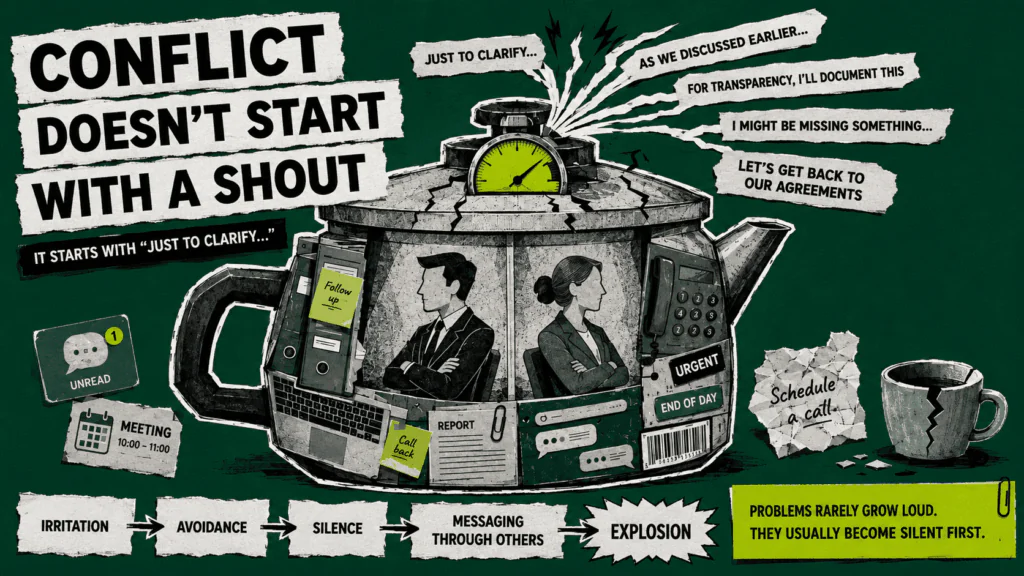
Conflict rarely arrives elegantly. It does not walk into the meeting room and say, “Good afternoon, I am conflict, and I would like to discuss the terms of my presence.”
Usually, it comes in the form of several small details.
Someone stops saying hello. Someone stops inviting a colleague to meetings. Someone begins replying in one-word answers. Messages appear in work chats that begin neutrally and end as though there is a small landmine hidden between the lines.
“Colleagues, let me clarify this one more time.”
“As we already discussed.”
“For the sake of transparency, I am putting this in writing.”
“Perhaps I am missing something.”
“Let’s return to the original agreement.”
These phrases are not frightening by themselves. But an HR Manager quickly learns to hear when they stop sounding like ordinary work communication and start sounding like an early warning before a cold war.
People rarely conflict because of just one email, one deadline, or one comment. Usually, it is an accumulation. One person believes the other is constantly shifting tasks onto them. The second is convinced the first controls their every move. One manager thinks the employee is too sensitive. The employee thinks the manager speaks to them like a failed experiment.
After a while, they are no longer arguing about the task. They are arguing about who, in this story, is normal.
In situations like this, the HR Manager often finds themselves in the position of a person called to the scene of an accident after the cars have already crashed, the drivers have argued, the witnesses have left, and someone has managed to write about it in the general chat.
HR’s job is not to make everyone friends. Not everyone needs to be friends. And corporate friendship is a wonderful thing until the first distribution of bonuses, leave dates, or areas of responsibility.
The task is to bring the conversation back to facts.
What happened. What was said. What was expected. What was violated. What the person wants to change. What can realistically be changed. Where a work conflict ends and personal dislike begins, the kind that cannot be fixed with one forty-minute call.
Sometimes the conflict is resolved. Sometimes people begin working more carefully because they finally hear one another. Sometimes one employee moves to another team. Sometimes someone leaves. Sometimes the company pretends that everything is over because the people involved have stopped messaging each other directly and now use the manager as a living message delivery system.
In the job description, this is called “maintaining a healthy team atmosphere.”
A very optimistic name for work in which you occasionally watch adults with good job titles and expensive laptops fail to agree on who was supposed to create a task in the tracker.
04:30 PM. HR paperwork: where the romance of HR dies from paperwork
There are parts of HR that look boring right up until something is processed incorrectly.
Documents, contracts, leave, changes to terms, dismissals, internal orders, personal data, approvals, access, employee statuses: none of this usually inspires excitement. Nobody comes to a meeting and says, “Today I feel especially inspired by the properly documented change of role.”
But these are the things that keep a company functioning.
When everything is calm, documents seem like bureaucracy. When there is a dispute, a dismissal, an audit, a claim, a compensation conflict, or a question about who promised what to an employee, documents suddenly become the thing separating the company from a long, expensive conversation with unpleasant consequences.
An HR Manager often lives in a strange world where colleagues can ignore an email asking them to confirm employee changes for weeks, then write, “Why is this not ready yet? It is very urgent.”
Because “urgent” in a corporate environment often does not mean “this situation only appeared just now.” It means, “I remembered it at the exact moment when the consequences got close enough to hit me in the face.”
Someone may send you a resignation letter at the last minute. Ask you to process a transfer quickly. Tell you that an employee is changing roles next week. Remind you that a contract expires tomorrow. Say that a person is leaving “probably today,” even though the person themselves has not told anyone officially.
And once again, you become the person who has to turn the collective organisational fog into a clear sequence of actions.
The HR side of the job does not bring many emotional rewards. Nobody applauds you for checking a document in time. Nobody writes a thank-you post about leave being processed correctly. But one mistake here can become extremely visible.
It is like electricity in an office. As long as it is there, nobody thinks about it. When it is gone, everyone suddenly becomes an infrastructure expert.
05:20 PM. Dismissal: the conversation nobody wants to have, but everyone wants handled perfectly
Dismissal is one of the emotionally hardest parts of an HR Manager’s job. Even when the person has wanted to leave for a long time. Even when the decision was expected. Even when both sides are so tired of each other that the corporate email thread between them resembles an exchange of diplomatic notes between two countries.
Because a dismissal is almost never only about dismissal.
For the employee, it can mean losing stability, routine, status, a team, income, a sense of control. For the manager, it is the risk of being left without a person at the most inconvenient moment. For the company, it is another open role, redistributed work, explanations to the team, and a possible drop in trust. For HR, it is a conversation in which you have to preserve respect for the person without turning the situation into a theatre where everyone speaks in hints.
Sometimes the employee comes to you on their own. They say they have decided to leave. In an ideal world, you calmly discuss the reasons, timing, handover, final paperwork, and feedback. In the real world, the person may be sitting across from you and feeling relief, resentment, anxiety, anger, and guilt at the same time. Even if they wrote the resignation letter themselves.
Sometimes the company initiates the dismissal. Then the HR Manager becomes part of a process that can rarely be called pleasant. Especially when the decision is connected not to the person’s behaviour, but to layoffs, restructuring, the loss of a project, or business mistakes the employee did not create.
There are companies that handle dismissals with respect. They speak directly. They explain what is happening. They do not make a person learn about their fate from suddenly disappearing access to their calendar. They do not call layoffs “human resource optimisation” as though they were talking about boxes in a warehouse.
There are companies where dismissal looks like a bad production. The manager asks HR to “somehow have a gentle conversation.” They do not come to the meeting themselves. The wording is vague. Responsibility is blurred. The person understands that the decision has already been made, but is expected to offer a version of events that is convenient for the company.
And this is where an HR Manager has to be not convenient, but professional.
Do not promise what will not happen. Do not give false hope. Do not hide behind bureaucratic language. Do not turn a person into a problem that needs to be quickly removed from the system.
Even the most difficult dismissals can be handled with dignity. Not gently. Not pleasantly. With dignity.
Those are different things.
06:30 PM. Company culture: the person trying to explain why people no longer want to go to quiz night
Job descriptions love talking about developing company culture. It sounds modern, warm, and is almost always accompanied by photographs from a celebration where employees stand with glasses, smile, and look as though nobody discussed in private chats afterwards why the mandatory team-building event was scheduled for Saturday.
Company culture is not merchandise. Not events. Not group photos. Not a company chat full of birthday messages. Not a monthly newsletter where the CEO says the company is a family, while a week later employees learn that the family education budget has been frozen.
Culture is what people do when there is no official presentation.
How a manager reacts to a mistake. How a team speaks about colleagues who are not in the room. Whether you can ask a question without feeling like an idiot. Whether you can admit that you are struggling. Whether you can refuse an extra task. What happens to a person who says an uncomfortable truth. How the company behaves when promises become expensive.
An HR Manager can come up with ten initiatives, launch twenty surveys, organise an internal club, add meetings to the calendar, prepare guides, collect feedback, create polished communication. But if managers systematically ignore people, devalue their contribution, change agreements without explanation, and believe respect means an employee does not complain, no company culture will save the situation.
It will simply become a beautifully designed piece of scenery.
People very quickly feel the difference between “we care about the team” and “we want the team to ask fewer questions.”
That is why an HR Manager sometimes ends up in the uncomfortable role of explaining one simple thing to the business: company culture does not appear on a Friday evening after pizza and a quiz. It is built from hundreds of small decisions made on Monday morning, when nobody is thinking about culture.
When a manager answers a message. When they admit a mistake. When they do not shift responsibility. When they do not promise a promotion if they are unsure. When they explain why a decision was made this way. When they do not act as though the team should be grateful for the opportunity to work late into the night.
It sounds obvious. That is why many companies prefer ordering stickers.
07:20 PM. Metrics: the numbers trying to explain why people leave
At some point, the HR Manager opens a spreadsheet.
It may be beautiful. With colours, charts, funnels, trends, percentages, statuses, filters. It may be frightening. With red cells staring at you like medical test results after a sleepless week.
The spreadsheet contains time-to-hire, offer acceptance rate, turnover, retention, probation pass rate, engagement, absenteeism, eNPS, cost per hire, and a few more abbreviations that sound like medication for corporate anxiety.
Metrics are necessary. Without them, HR quickly turns into the department everyone sees as pleasant but optional. Until you can show where candidates are dropping out, why turnover is increasing, which teams lose people more often, why new hires do not pass probation, how long it takes to close roles, the business will see HR as a service that “does something with people.”
But numbers never tell the whole story.
Turnover has increased. Why? Because the market became more active? Because a competitor raised salaries? Because one particular team has a difficult manager? Because people are tired? Because the company grew and the roles did not keep up? Because the company hired too quickly last quarter, and now it turns out that expectations were put together out of thin air and an old presentation?
One number can be the result of ten different causes.
An HR Manager is constantly balancing between two dangers. The first is drowning in numbers and forgetting that behind every line is a person who decided to leave not because they were “one unit of attrition,” but because they ran out of energy, trust, money, or patience.
The second is giving up on numbers and living in a world of vague impressions. That is where the phrase, “I think everything is fine,” appears very quickly. It is usually said at the exact moment when four people leave one team in a month, but nobody wants to ruin the mood in the meeting.
A good HR Manager does not choose between people and numbers. They use numbers to notice in time where people are beginning to struggle.
Sometimes it works. Sometimes the spreadsheet shows the problem only after the strongest employees have updated their CVs.
08:00 PM. Why a job description will never tell you the whole truth
Because a job description is not a diary.
It will not say, “You will regularly have to explain to managers that candidates are not required to read minds.” It will not say, “Sometimes you will talk to someone who is crying, and ten minutes later to someone else who urgently demands that you find a marketing professional at CMO level for a junior budget.” It will not clarify, “You will need to look composed on days when an offer falls through, a strong employee leaves, a new hire does not show up, and a manager asks you to ‘just quickly review another hundred CVs.’”
It will not write, “You will know slightly more than you would like to know and say slightly less than people expect from you.” It will not say, “You will watch good people leave because nobody listened to them in time.” It will not warn you, “Sometimes you will defend the company in front of an employee and, an hour later, defend the employee in front of the company, while both sides suspect that you are not sufficiently on their side.”
Not because every company deliberately lies. Although some are genuinely good at turning beautiful wording into a dense smokescreen.
It is simply because no job description can fit the real work of an HR Manager into ten bullet points.
If it were written honestly, it would sound something like this:
“We are looking for someone who can remain steady in conditions of constantly changing inputs, listen to people when they are struggling, speak to managers when it is uncomfortable, look for candidates where they barely exist, keep processes from falling apart, remember documents, budgets, deadlines, emotions, risks, and other people’s agreements. Ideally, this person should also retain a straight face, a sense of humour, and the ability not to reply ‘Interesting’ every time someone says, ‘Everything is on fire around here.’”
That job posting might receive fewer applications.
But the people who applied would understand this: HR is not only about people.
It is about the system people live and work in, make mistakes in, grow tired in, grow in, argue in, leave, return, receive offers, reject offers, ask for a promotion, refuse to go to the company event, fail to understand why they have been invited to a meeting at 6:30 p.m., and occasionally write:
“Could we talk?”
And the HR Manager replies:
“Yes, of course.”
Because that is usually where it all begins.