
What Achievements Should an HR Manager Include in a CV?
There is a professional irony in HR: an HR manager can explain perfectly to a candidate how to show results in a CV, and then write their own CV as if they simply lived in the office, managed spreadsheets, joined calls with hiring managers, and occasionally heroically searched for people on LinkedIn.
What achievements should an HR manager include in a CV? This is an important question because, in this profession, results are often hidden behind processes. Recruitment, onboarding, training, HR analytics, retention, communication with managers, HR administration, internal projects — all of this can easily turn into a dry list of responsibilities.
An employer reads that kind of CV and sees: “Conducted interviews. Managed onboarding. Worked with employees.” Technically, all of that may be true. But it sounds as if the candidate was simply present while HR-related events were happening.
A strong HR manager CV shows something else: what changed because of your work.
- Vacancies started closing faster.
- Hiring managers began formulating requests more clearly.
- New employees went through onboarding more smoothly.
- The team gained a transparent feedback system.
- HR processes stopped depending on one person’s memory and three heroic spreadsheets.
- Data on hiring, turnover, and onboarding became clear to the business.
- Employees started getting answers, instructions, and support without going through the quest called “find the one person who knows.”
These are exactly the kinds of results worth bringing into your CV.
This article will help you understand which HR manager achievements look strong in a CV, how to tell an achievement from a responsibility, which metrics to use, how to write about results without inventing numbers, and how to package your experience so an employer sees you as a specialist who influences processes, the team, and the business.
Quick Answer: What Achievements Should an HR Manager Include in a CV?
An HR manager should include achievements related to recruitment, onboarding, employee retention, HR processes, training, HR analytics, automation, HR administration, employer branding, and collaboration with managers.
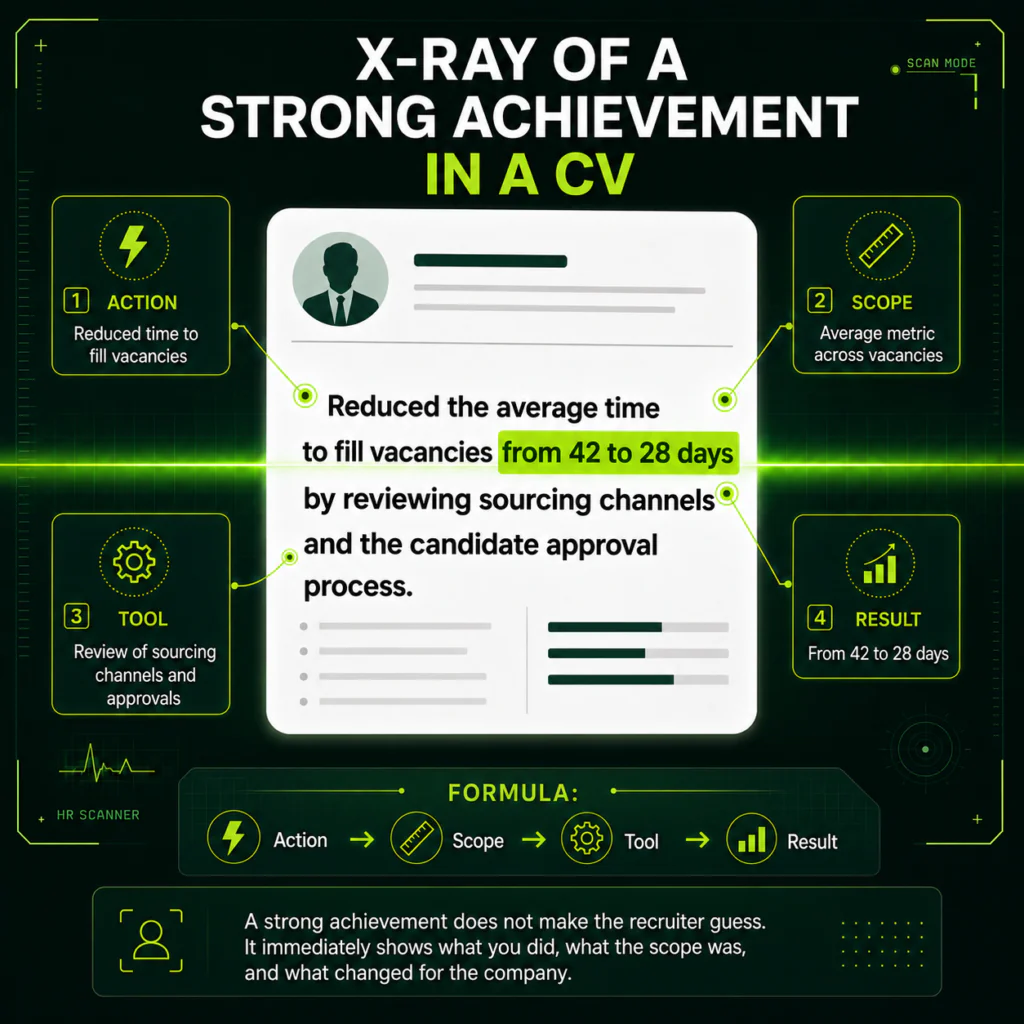
A strong achievement answers four questions:
- What did you do?
- At what scale?
- Which method or tool did you use?
- What changed as a result?
Weak Example
Handled recruitment.
Strong Example
Managed full-cycle recruitment, from clarifying hiring needs with managers to candidate start dates, reducing the average time-to-fill from 42 to 28 days.
The difference is simple. In the first case, the person describes a function. In the second, they show the process, scale, and result.
An HR manager achievement in a CV is a specific professional result that improved hiring, onboarding, retention, processes, communication, or team performance.
Why Achievements Matter More Than Responsibilities
A Responsibility Shows the Area of Work
Responsibilities answer the question: “What was included in your role?”
For example:
- recruitment;
- conducting interviews;
- onboarding new employees;
- managing HR documents;
- participating in HR projects;
- communicating with managers;
- organizing training;
- working with internal processes.
This information is useful, but it is not enough. Almost every HR specialist will have similar responsibilities in their CV. If ten candidates write “recruitment,” an employer still cannot understand who closed difficult roles, who can manage a hiring funnel, who built a process from scratch, and who simply posted vacancies and waited for applications like a fisherman by a quiet lake.
An Achievement Shows the Result
An achievement answers the question: “What became better because of your work?”
For example:
- time-to-fill decreased;
- offer acceptance rate increased;
- resignations during the probation period decreased;
- a clear onboarding program was created;
- hiring managers started providing feedback faster;
- HR documents were moved into one structured system;
- regular HR reporting was introduced;
- employees received a transparent process for contacting HR;
- the company began to understand the reasons behind turnover more clearly.
When an employer sees points like these, they are no longer reading a list of tasks. They are seeing a professional contribution.
HR CVs Are Read Especially Carefully
There is one more important detail. HR manager CVs are often reviewed by people who work in hiring, team management, employee development, or operations themselves. In other words, the audience understands how HR works from the inside.
If a CV is full of generic phrases, it shows.
Phrases like:
- “responsible specialist”;
- “communicative HR professional”;
- “able to multitask”;
- “stress-resistant professional”;
- “handled all HR processes” —
sound familiar, but they prove almost nothing.
It is better to show specifics:
Supported company growth from 35 to 80 employees: filled vacancies, built onboarding, prepared materials for managers, and tracked probation period progress.
Here, there is scale, movement, and a clear area of influence.
How an Achievement Differs from a Responsibility
The Simple Formula
A responsibility is what you were responsible for.
An achievement is what changed because of your actions.
You can test any CV bullet with one short question:
“And what happened as a result?”
If this question naturally comes up after reading the bullet, you are probably looking at a responsibility.
Example
Conducted interviews.
And what happened as a result?
You can strengthen it:
Conducted structured interviews using a unified candidate evaluation scorecard, which accelerated candidate alignment with hiring managers and reduced the number of repeat interviews.
Now the phrase shows a result.
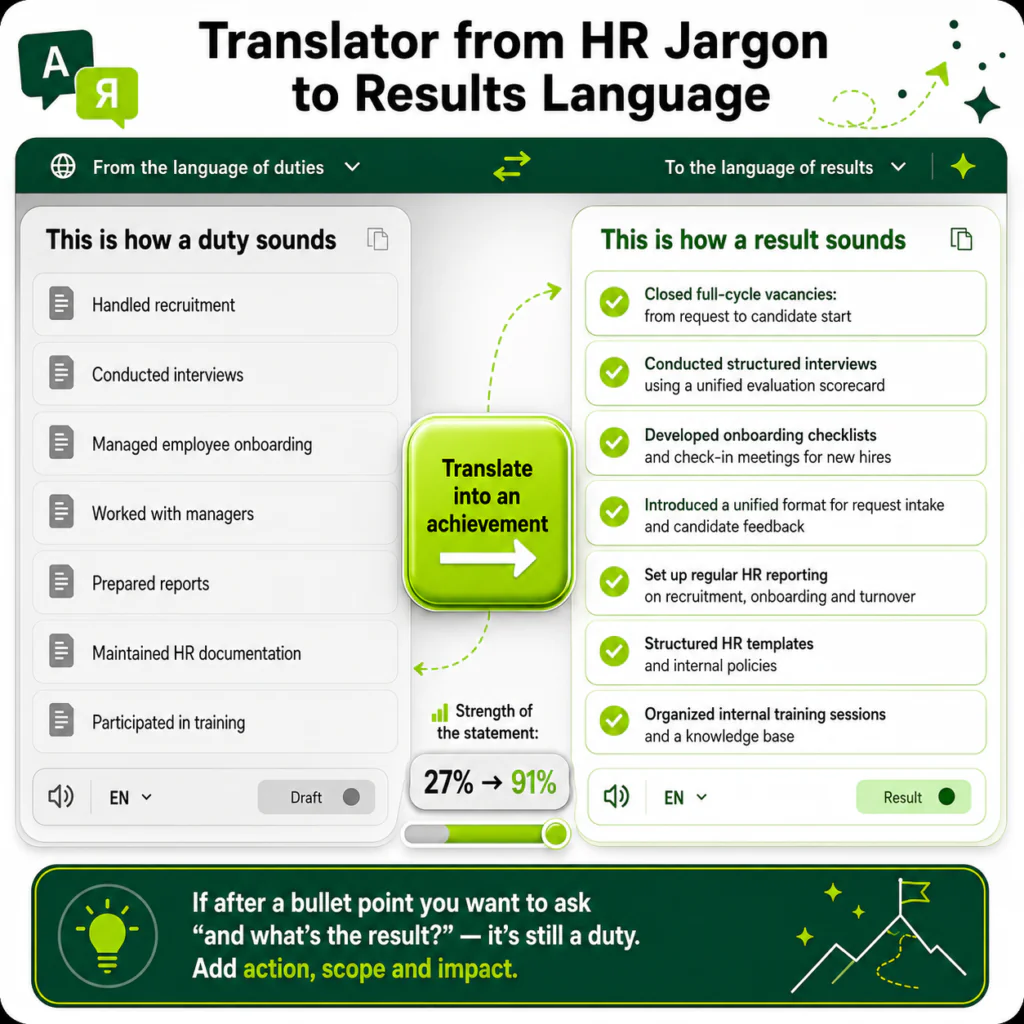
Responsibility vs Achievement
| Responsibility | Achievement |
| Posted job vacancies | Updated job posting templates and improved the quality of applications through clearer descriptions of tasks and requirements |
| Conducted interviews | Introduced structured interviews and unified candidate evaluation criteria |
| Managed onboarding | Developed onboarding checklists and follow-up meetings for new employees |
| Worked with managers | Set up a process for clarifying hiring requests and aligning candidates with hiring managers |
| Managed HR documents | Structured HR templates and updated internal policies |
| Participated in training | Organized an internal training program for new employees and managers |
| Prepared reports | Set up regular HR reporting on recruitment, onboarding, and turnover |
| Worked on turnover | Launched exit interviews and analysis of resignation reasons |
The Main Sign of a Strong Achievement
A strong achievement can be shown to a manager without extra explanation.
For example:
Reduced the average time-to-fill from 45 to 30 days.
Everything is clear.
The task mattered. There was a metric. It improved.
Another example:
Prepared a welcome pack, checklists, and a system of follow-up meetings for new employees.
This is also clear. Even without exact numbers, it is obvious that the person created a working tool, not just “managed onboarding.”
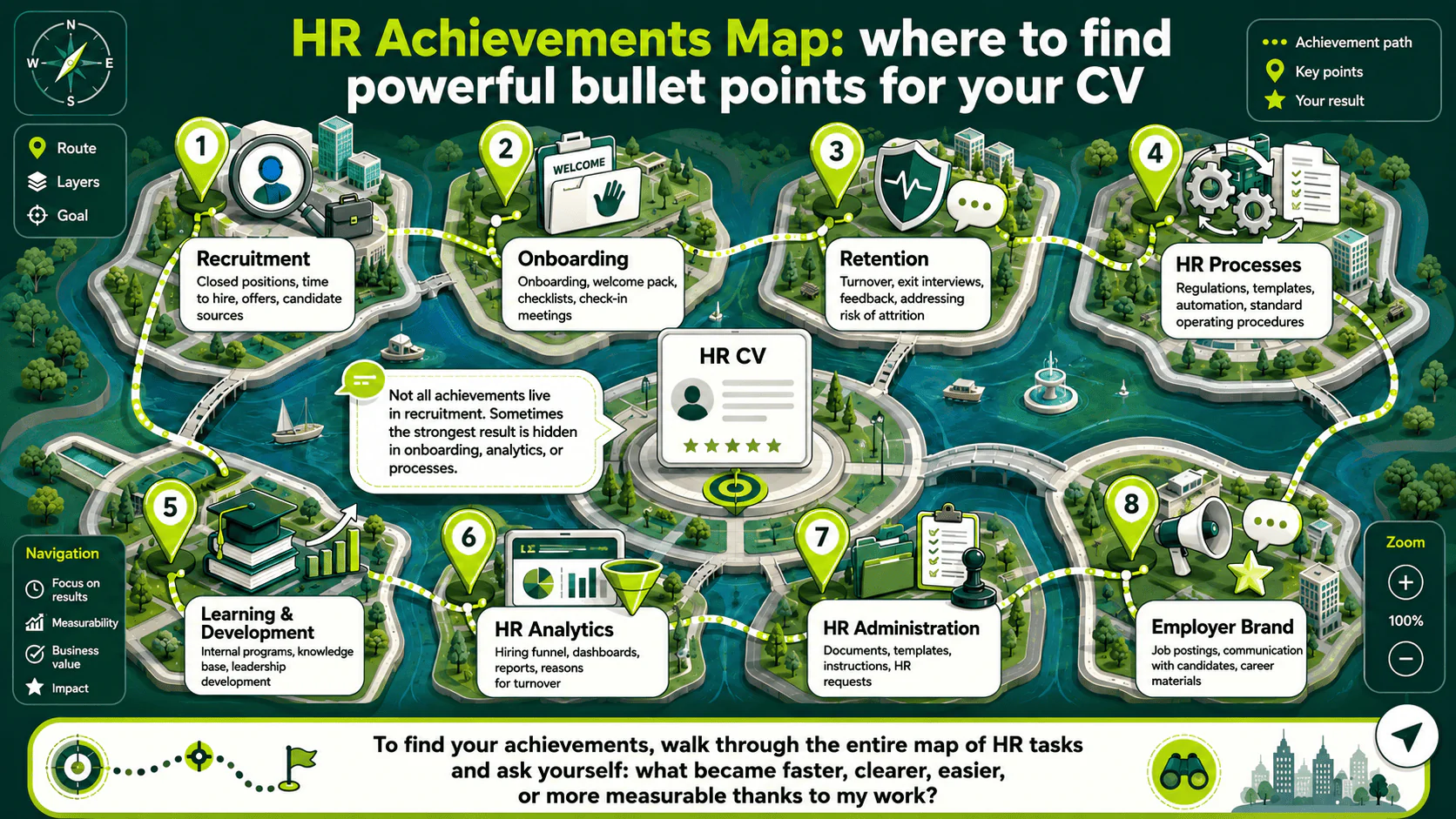
What Counts as an HR Manager Achievement?
Results in Recruitment
Recruitment is one of the easiest areas for achievements because it is often possible to find numbers and facts.
You can write about:
- number of closed vacancies;
- complexity of roles;
- time-to-fill;
- quality of candidates;
- offer acceptance rate;
- improvements in the hiring funnel;
- work with candidate sourcing channels;
- reduction in candidate refusals;
- improved cooperation with hiring managers;
- creation of a candidate database;
- high-volume hiring;
- sourcing rare specialists.
Examples of Recruitment Achievements
- Filled 40+ vacancies in one year, including mid-level and managerial positions.
- Reduced the average time-to-fill from 42 to 28 days by revising sourcing channels and the candidate approval process.
- Set up a hiring funnel to track applications, interviews, offers, refusals, and candidate start dates.
- Increased the offer acceptance rate after improving candidate communication and clarifying expectations more accurately.
- Introduced a unified hiring request intake format with managers, reducing the number of unsuitable candidates at the early stages.
- Built a candidate database for repeat hiring and faster sourcing for standard roles.
- Optimized job descriptions by making tasks and requirements more specific.
- Managed full-cycle recruitment: from hiring request to candidate start date and onboarding support.
Important nuance: if you mention the number of filled vacancies, specify the period. “Filled 35 vacancies” sounds weaker than “Filled 35 vacancies in one year.” The period gives scale.
Improving Employee Onboarding
Onboarding is often underestimated in CVs. Many people simply write:
Managed onboarding for new employees.
But onboarding is not just a welcome email and a cup of coffee, although coffee is also human.
A good onboarding process affects how quickly an employee understands their role, joins the team, passes probation, and stays with the company.
You can write achievements about:
- developing an onboarding program;
- creating a welcome pack;
- preparing checklists for new hires;
- organizing follow-up meetings;
- meetings with managers;
- probation period support;
- reducing early resignations;
- accelerating time-to-productivity;
- improving communication between the new employee, HR, and the manager.
Examples
- Developed an onboarding program for new employees with checklists, welcome materials, and follow-up meetings.
- Introduced regular 1:1 meetings during the probation period to track risks and collect feedback.
- Prepared onboarding guidelines for managers supporting new employees.
- Reduced resignations in the first months of employment through regular support for new hires.
- Updated the onboarding process for employees in different departments so that it reflected the tasks of each role.
- Created a unified onboarding journey: first day, first week, first month, and probation period completion.
- Set up feedback collection from new employees after their first month of work.
- Prepared a welcome pack that reduced repeated questions from new hires.
Reducing Turnover and Improving Retention
Turnover is a painful topic for any business. When employees leave, the company loses time, money, knowledge, and team energy. An HR manager who can not only hire people but also understand why they leave looks much stronger.
In a CV, you can write about:
- analysis of resignation reasons;
- exit interviews;
- regular feedback collection;
- work with managers;
- improvement of onboarding conditions;
- development of internal communications;
- implementation of 1:1 meetings;
- retention initiatives;
- improving employee experience;
- work with engagement.
Examples
- Launched exit interviews and regular analysis of resignation reasons.
- Prepared recommendations for managers on reducing employee attrition risks.
- Introduced regular feedback collection within the team.
- Systematized resignation reasons and presented improvement proposals to leadership.
- Participated in developing retention measures for key positions.
- Set up probation period checkpoints to identify attrition risks early.
- Helped managers structure communication with employees after internal changes.
- Prepared turnover analytics and identified recurring reasons for employee departures.
If exact percentages cannot be disclosed, use wording that does not reveal confidential data:
Reduced resignations during the probation period after introducing regular follow-up meetings and feedback analysis.
This phrase sounds honest and professional.
Automating HR Processes
Automation is a strong CV section, especially if processes used to depend on manual work, scattered chats, and files named something like “Final_Table_Definitely_Last_New2.”
You can write achievements about:
- implementing an ATS;
- participating in HRIS implementation;
- setting up templates;
- automating reporting;
- moving documents into a digital format;
- creating a candidate database;
- systematizing HR data;
- simplifying approval processes;
- reducing manual work;
- setting up an HR dashboard.
Examples
- Participated in ATS implementation and trained the team to use the system.
- Moved part of HR operations into a digital format: hiring requests, candidate statuses, feedback templates.
- Set up a unified candidate database and stage-based candidate statuses.
- Reduced manual tasks by automating regular reporting.
- Prepared templates for job postings, candidate emails, interviews, and feedback.
- Structured HR document storage and internal policies.
- Created an onboarding tracking table with stages, owners, and meeting dates.
- Set up an HR dashboard for recruitment, onboarding, and turnover.
The key is to show not just that you “worked in a system,” but what exactly you improved.
Weak
Worked with an ATS.
Stronger
Set up candidate statuses in the ATS and introduced a unified vacancy management process, making the hiring funnel more transparent for HR and managers.
Developing the Employer Brand
Employer branding is not only about beautiful posts with smiling colleagues and the phrase “we are a dream team.” It is about how candidates and employees perceive the company.
You can include achievements if you participated in:
- writing job descriptions;
- career pages;
- candidate communication;
- candidate events;
- internal materials;
- company content;
- working with reviews;
- improving candidate experience;
- market communication;
- creating materials about company culture and the team.
Examples
- Updated job posting templates and made role descriptions clearer for candidates.
- Prepared HR materials to support employer brand development.
- Participated in creating content about the team, processes, and growth opportunities.
- Improved candidate communication during selection and offer stages.
- Set up a unified tone and format for candidate replies, including rejections and interview invitations.
- Prepared materials for the career page: team description, processes, and hiring stages.
- Collected candidate feedback on the hiring process and proposed improvements.
- Improved candidate experience through more transparent communication at recruitment stages.
Training and Employee Development
Training is a strong achievement area if you organized programs, supported managers, collected materials, launched internal sessions, or participated in employee development.
You can write about:
- training programs;
- soft skills training;
- onboarding training;
- manager training;
- competency matrices;
- career tracks;
- knowledge bases;
- internal meetings;
- training needs assessment;
- individual development plans.
Examples
- Organized an internal training program for new employees.
- Prepared a database of training materials for current employees and new hires.
- Participated in developing a competency matrix for the team.
- Helped managers structure employee development plans.
- Launched regular training sessions on communication, feedback, and client work.
- Collected training needs by department and prepared a plan for internal events.
- Organized training for new managers on conducting 1:1 meetings and onboarding employees.
- Prepared guidelines and materials for knowledge transfer within the team.
HR Administration
HR administration often looks too dry in a CV. But this area also contains achievements, especially if you brought order, updated templates, reduced errors, improved document storage, or supported the company during growth.
You can write about:
- structuring documents;
- updating templates;
- reducing errors;
- maintaining employee files;
- preparing orders and contracts;
- supporting hiring, transfers, and terminations;
- HR policies;
- cooperation with accounting and managers;
- preparing reports;
- simplifying internal procedures.
Examples
- Structured HR documents and updated contract, application, and internal policy templates.
- Set up a unified HR document storage process.
- Supported hiring, transfers, and terminations in line with internal procedures.
- Updated HR templates and employee guidelines.
- Prepared clear HR process memos for managers.
- Reduced repeated questions about HR procedures by updating internal materials.
- Participated in an HR document audit and prepared corrections.
- Organized a convenient process for data transfer between HR, accounting, and managers.
HR Analytics and Reporting
HR analytics is one of the strongest ways to show professional maturity. Even if you did not build complex models, starting to track key indicators regularly is already a result.
You can write about:
- recruitment reporting;
- turnover;
- onboarding;
- hiring funnel;
- candidate sources;
- time-to-fill;
- offer acceptance rate;
- probation period success;
- eNPS;
- retention rate;
- HR dashboard;
- regular leadership reports.
Examples
- Set up monthly HR reporting on recruitment, onboarding, and turnover.
- Created a dashboard for key HR metrics.
- Analyzed candidate sources and shifted focus toward more effective channels.
- Identified weak stages in the hiring funnel and proposed process changes.
- Prepared leadership reports on team status and hiring dynamics.
- Introduced regular analysis of probation period progress.
- Set up tracking of candidate refusal reasons and rejection reasons from managers.
- Used recruitment data to adjust job postings and requirements.
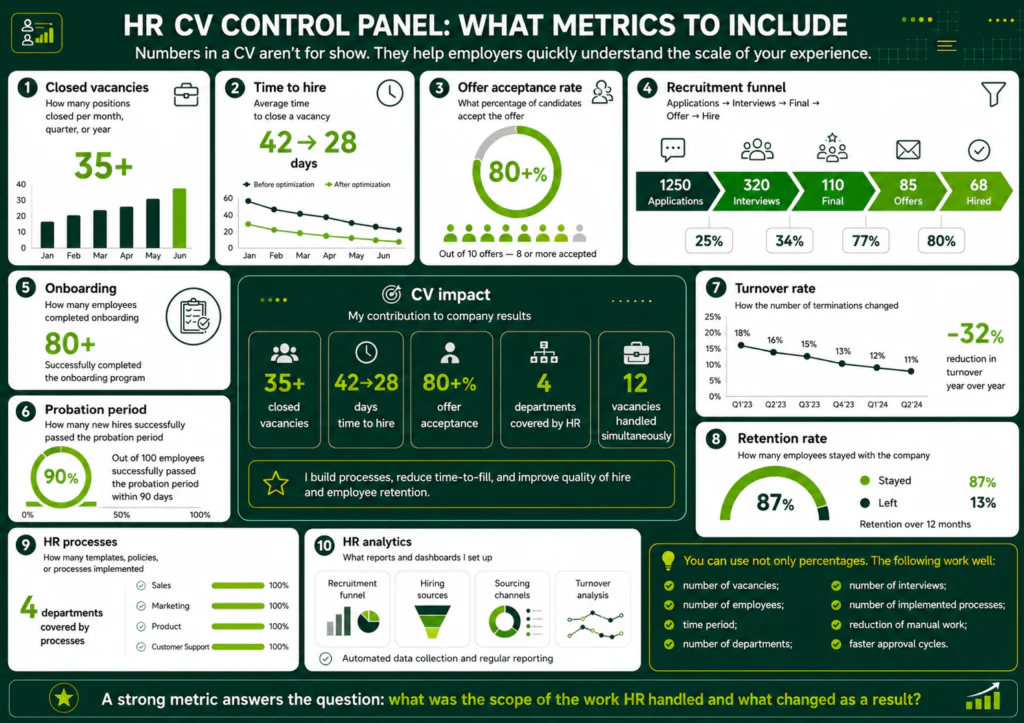
Which Metrics to Use in an HR CV
Recruitment Metrics
If your work included recruitment, start with these indicators:
- number of filled vacancies;
- number of vacancies handled at the same time;
- average time-to-fill;
- time-to-fill for difficult positions;
- offer acceptance rate;
- number of interviews conducted;
- application-to-interview conversion;
- interview-to-offer conversion;
- number of candidate start dates;
- number of refusals at the final stage;
- effectiveness of candidate sources;
- cost-per-hire, if you worked with it;
- share of hires through direct sourcing;
- share of hires through referrals;
- number of talent pools created.
Example
Managed up to 12 vacancies simultaneously, handled full-cycle recruitment, and tracked conversion across hiring funnel stages.
Onboarding Metrics
For onboarding, you can use:
- number of employees who completed onboarding;
- time-to-productivity;
- probation period pass rate;
- number of follow-up meetings;
- onboarding satisfaction level;
- reduction in resignations during the first months;
- number of prepared materials;
- number of departments covered by the onboarding program.
Example
Developed an onboarding program for 5 departments, including checklists, welcome materials, and follow-up meetings during the first month.
Retention Metrics
Here, you can use:
- employee turnover;
- retention rate;
- number of exit interviews;
- recurring resignation reasons;
- dynamics of resignations during the probation period;
- number of employees in your area of responsibility;
- engagement survey results;
- eNPS;
- number of employee experience improvement initiatives.
Example
Launched exit interviews and regular analysis of resignation reasons, then prepared recommendations for managers on reducing employee attrition risks.
HR Process Metrics
For HR processes, you can mention:
- number of implemented processes;
- number of updated policies;
- number of templates;
- reduction in manual work;
- approval speed;
- number of automated operations;
- number of employees covered by the process;
- number of departments where a new workflow was introduced.
Example
Standardized the recruitment process: prepared templates for hiring requests, interviews, feedback, and reporting for managers.
Training Metrics
For training and development, you can use:
- number of training sessions held;
- number of participants;
- number of training materials;
- number of managers trained;
- training usefulness score;
- number of programs developed;
- number of internal experts;
- department coverage.
Example
Organized a series of internal training sessions for employees and managers, and prepared materials for further use in the knowledge base.
HR Administration Metrics
You can use:
- number of employees supported;
- number of hires, transfers, and terminations processed;
- number of updated templates;
- request processing speed;
- reduction in errors;
- number of prepared instructions;
- volume of document flow;
- number of policies.
Example
Managed HR administration for a team of 120+ employees, updated document templates and internal instructions.
The Formula for a Strong CV Achievement
Basic Formula
Action → scale → tool → result
Example
Implemented an onboarding system for new employees across 4 departments, prepared checklists and follow-up meetings, and reduced the number of repeated questions during the first month of work.
Let’s break it down:
- action: implemented an onboarding system;
- scale: for new employees across 4 departments;
- tool: checklists and follow-up meetings;
- result: fewer repeated questions.
Formula for Recruitment
Filled / set up / improved → which roles → over what period → what changed
Example
Filled 35+ vacancies in one year, including mid-level positions, and reduced the average time-to-fill by revising sourcing channels.
Another Example
Set up regular hiring funnel analytics, making it easier to identify stages where candidates were being lost.
Formula for Onboarding
Developed / updated / implemented → for whom → what it included → what effect it had
Example
Developed an onboarding program for new employees: welcome materials, checklists, meetings with managers, and HR follow-up checkpoints.
Formula for HR Processes
Structured / automated / standardized → which process → how → what became easier
Example
Standardized the candidate approval process by introducing a unified feedback template and response deadlines for hiring managers.
Formula for Analytics
Set up / implemented / prepared → which data → for whom → how it was used
Example
Set up monthly recruitment and onboarding reporting for managers to track time-to-fill, candidate start dates, and probation period progress.
Formula for Employer Branding
Prepared / updated / launched → which material or process → for which audience → what improved
Example
Updated job posting templates and candidate communication, making role descriptions more accurate and easier for applicants to understand.
How to Find Your Achievements If All You Can Think Is “I Just Worked”
Step 1. Write Down All Tasks Without Filtering
Take a sheet of paper, a document, or a spreadsheet and write down everything you did.
For example:
- filled vacancies;
- conducted interviews;
- communicated with managers;
- managed onboarding;
- updated documents;
- prepared reports;
- handled employee questions;
- collected feedback;
- helped with training;
- worked with an HR system;
- prepared job postings;
- maintained a candidate database;
- participated in internal projects.
At this stage, do not evaluate the wording. Simply unload your experience from your head.
Step 2. Ask “What Changed?” Next to Each Task
For example:
Task: managed onboarding.
What changed?
- checklists appeared;
- new employees started understanding the work process faster;
- managers received a clear plan;
- HR began seeing risks during the probation period;
- there were fewer chaotic questions.
This can already become an achievement:
Developed onboarding checklists and follow-up meetings for new employees so managers and HR could track probation period progress.
Step 3. Find the Scale
Scale makes an achievement convincing.
Look for:
- number of employees;
- number of vacancies;
- number of departments;
- period;
- number of interviews;
- number of documents;
- number of managers;
- number of projects;
- number of training sessions;
- team size;
- team growth;
- number of cities or locations;
- number of processes.
Examples of Scale
- team of 80+ employees;
- 35 vacancies in one year;
- 6 departments;
- 4 managers;
- 120 interviews per quarter;
- 20+ document templates;
- onboarding for employees in three functions;
- team growth from 30 to 70 people.
Step 4. Find a Measurable Change
Percentages are not always necessary. “Measurable” does not only mean “from 42 to 28 days.”
You can use:
- faster;
- less manual work;
- clearer process;
- fewer repeated questions;
- unified workflow;
- regular reporting;
- transparent funnel;
- checkpoints;
- knowledge base;
- standardized templates;
- reduced errors;
- improved approval process.
The main thing is to be specific.
Weak
Improved HR processes.
Stronger
Standardized the recruitment process: introduced a hiring request template, an interview scorecard, and a unified feedback format from managers.
Step 5. Check the Achievement for Honesty
An HR CV should be strong, but honest. If you do not have numbers, do not invent them. A recruiter may ask:
- where the number came from;
- how it was calculated;
- what period it covered;
- what exactly you did;
- who else was involved;
- what your area of responsibility was.
If you can answer, great. If the number appeared “for beauty,” it can damage the impression.
Examples of HR Manager Achievements for a CV
Achievements in Recruitment
- Filled 45 vacancies in one year, including mid-level and senior roles.
- Reduced the average time-to-fill from 42 to 28 days.
- Managed full-cycle recruitment: hiring request intake, sourcing, interviews, communication with managers, offer, and candidate start date.
- Set up regular hiring funnel analytics.
- Optimized the candidate approval process with managers.
- Increased the offer acceptance rate through more accurate discussion of candidate expectations.
- Built a candidate database for repeat hiring.
- Improved job descriptions by making requirements and tasks clearer.
- Introduced a unified hiring request intake template for hiring managers.
- Reduced the number of unsuitable candidates at early stages by clarifying the vacancy profile.
- Worked with several recruitment channels and analyzed their effectiveness.
- Filled high-volume roles within tight deadlines.
- Managed candidate communication at all hiring stages.
- Prepared email templates for invitations, rejections, and offers.
- Participated in hiring planning together with managers.
- Set up vacancy status reporting for management.
- Conducted initial interviews and structured feedback for managers.
- Reduced final-stage refusals through more accurate alignment of terms.
- Accelerated sourcing for recurring roles through the candidate database.
- Helped managers define role requirements more precisely.
Achievements in Employee Onboarding
- Developed an onboarding program for new employees.
- Prepared a welcome pack, checklists, and first-day materials.
- Introduced regular HR meetings with new hires during the probation period.
- Prepared guidelines for managers on supporting new employees.
- Created an onboarding plan for the first day, first week, and first month.
- Set up feedback collection after the first month of work.
- Reduced repeated questions from new employees through a materials database.
- Updated the onboarding process for several departments.
- Implemented onboarding checkpoints to assess attrition risks.
- Helped managers structure new employee introduction to tasks.
- Supported onboarding after active team growth.
- Prepared probation period review meeting templates.
- Organized a system for introducing new employees to the team and internal processes.
- Introduced a clear process for access, documents, and work instructions.
- Combined onboarding materials into one knowledge base.
- Created an onboarding map for employees in different functions.
- Improved the first working day process.
- Set up cooperation between HR, the manager, and the office team during new employee start dates.
- Prepared a memo for new employees on internal rules.
- Supported probation period progress and collected feedback from managers.
Achievements in Retention and Turnover Management
- Launched exit interviews and regular analytics on resignation reasons.
- Prepared turnover reports for leadership.
- Identified recurring employee departure reasons and proposed changes.
- Introduced regular employee feedback collection.
- Participated in developing retention measures for key specialists.
- Set up attrition risk tracking during the probation period.
- Helped managers implement regular 1:1 meetings.
- Systematized employee feedback on working conditions and communication.
- Prepared internal process improvement proposals based on feedback.
- Tracked resignation dynamics by department and reason.
- Supported teams during periods of change and reduced tension through clear communication.
- Introduced regular HR meetings with employees on onboarding and development topics.
- Participated in updating internal communication rules.
- Helped managers identify burnout and overload risks in teams.
- Prepared analytics on candidate refusal reasons and employee resignation reasons.
- Set up a feedback process after probation period completion.
- Introduced a clear process for employees to contact HR.
- Prepared recommendations for managers on working with feedback.
- Supported internal employee moves between roles.
- Participated in building a talent pool.
Achievements in HR Processes
- Described and standardized key HR processes.
- Implemented unified templates for job postings, interviews, and feedback.
- Moved part of HR operations into a digital format.
- Set up a system for storing HR documents and internal policies.
- Created a template base for hiring, onboarding, and internal communications.
- Audited HR processes and proposed changes to accelerate work.
- Implemented a unified candidate approval workflow with managers.
- Updated the new employee registration process.
- Reduced manual tasks by automating regular reporting.
- Prepared instructions for key HR procedures.
- Set up a transparent hiring request process.
- Systematized employee HR requests.
- Created checklists for standard HR tasks.
- Participated in HRIS or ATS implementation.
- Trained the team to work with a new HR system.
- Set up deadline tracking across recruitment and onboarding stages.
- Updated internal HR process policies.
- Reduced process dependency on verbal agreements.
- Prepared an HR process map for managers.
- Created a unified reporting format for HR tasks.
Achievements in Training and Development
- Organized an internal training program for employees.
- Built a database of training materials for new and existing employees.
- Prepared a competency matrix for the team.
- Helped managers structure employee development plans.
- Launched regular soft skills training sessions.
- Organized training for new managers on onboarding and feedback.
- Collected training needs by department.
- Prepared an employee development plan based on manager feedback.
- Participated in creating career tracks.
- Organized internal knowledge-sharing meetings.
- Prepared instructions and materials for knowledge transfer.
- Set up training participation tracking.
- Collected feedback on training programs.
- Introduced regular knowledge base updates.
- Participated in preparing a competency assessment system.
- Helped managers conduct development meetings with employees.
- Prepared materials for onboarding training.
- Supported employee training after process changes.
- Organized internal events to develop team cooperation.
- Prepared individual development plan templates.
Achievements in HR Analytics
- Set up monthly HR reporting on recruitment, onboarding, and turnover.
- Created a dashboard for key HR metrics.
- Analyzed the effectiveness of recruitment sources.
- Tracked time-to-fill and reasons for delays.
- Identified weak stages in the hiring funnel.
- Prepared leadership reports on team status.
- Introduced regular analysis of resignation reasons.
- Set up tracking of candidate refusal reasons.
- Systematized data on probation period progress.
- Prepared analytics on HR team workload.
- Tracked hiring dynamics by department.
- Set up regular feedback collection from new employees.
- Used data to adjust the recruitment strategy.
- Prepared employee training reports.
- Analyzed turnover by team and reason.
- Created a unified HR report format for managers.
- Set up vacancy status tracking.
- Prepared analytics on application quality.
- Tracked candidate conversion between stages.
- Participated in hiring planning based on data.
Achievements in HR Administration
- Structured HR documents and internal policies.
- Updated templates for contracts, applications, and orders.
- Set up a unified HR document storage process.
- Supported hiring, transfers, and terminations.
- Prepared HR procedure instructions for employees.
- Participated in an HR document audit.
- Reduced repeated questions about HR procedures through clear materials.
- Set up cooperation between HR, accounting, and managers on HR administration topics.
- Systematized employee files.
- Updated internal HR communication templates.
- Prepared employee memos on vacation, sick leave, and internal procedures.
- Introduced deadline tracking for HR documents.
- Supported HR administration during team growth.
- Prepared a database of standard documents.
- Updated internal instructions for managers.
- Participated in moving HR processes into a digital format.
- Set up a convenient HR request submission process.
- Maintained up-to-date HR information.
- Supported employee documentation for different employment formats.
- Prepared documents for internal changes in team structure.
How to Write Achievements If You Do Not Have Exact Numbers
Use Scale Instead of Result Numbers
If you cannot write “reduced time-to-fill from 42 to 28 days,” show the scale of your work.
Examples
- Supported recruitment for a team of 80+ employees.
- Managed up to 10 vacancies simultaneously.
- Set up onboarding for employees across 4 departments.
- Prepared 20+ templates for HR processes.
- Updated HR materials for the entire team.
- Organized training for managers across several functions.
Scale helps the employer understand the level of your tasks.
Use a Time Period
A time period also strengthens the wording.
Examples
- Updated job posting templates and candidate communication process over 6 months.
- Filled several key positions for the team within one quarter.
- Supported team growth and onboarding of new employees throughout the year.
- Prepared a training materials database for onboarding in 3 months.
Use Process Changes
Not every achievement is expressed in percentages. Sometimes the result is order where there used to be chaos with a light trace of “who edited this spreadsheet last?”
Examples
- Standardized the recruitment process.
- Introduced unified candidate evaluation criteria.
- Set up onboarding checkpoints.
- Created a knowledge base for new employees.
- Updated HR document templates.
- Systematized employee feedback.
- Set up regular reporting for managers.
Use Careful Wording
If numbers are approximate or confidential, write carefully.
Useful wording:
- helped reduce;
- participated in reducing;
- contributed to accelerating;
- increased process transparency;
- simplified approvals;
- reduced manual work;
- made the process more predictable;
- structured;
- systematized;
- introduced a unified workflow.
Example
Participated in reducing time-to-fill by revising sourcing channels and working regularly with hiring managers.
This is more honest than taking full credit for a result if it was a team effort.
How Junior HR Specialists Can Write Achievements
Junior Specialists Have Achievements Too
Many entry-level specialists think: “What achievements do I have? I just helped, wrote to candidates, scheduled interviews, and updated spreadsheets.”
But a CV is not only about big projects. An achievement can be small if it shows accuracy, contribution, and growth.
A junior HR specialist can write about:
- number of processed applications;
- helping fill vacancies;
- organizing interviews;
- maintaining a candidate database;
- preparing job postings;
- candidate communication;
- updating spreadsheets and reports;
- participating in onboarding;
- preparing materials;
- completing HR tasks without errors or delays.
Examples
- Processed candidate applications and kept the recruitment database up to date.
- Coordinated interviews between candidates and managers.
- Prepared candidate message templates for different recruitment stages.
- Helped manage the hiring funnel and update candidate statuses.
- Participated in onboarding new employees: prepared materials, meetings, and instructions.
- Kept the candidate database up to date.
- Supported the HR team with vacancy reporting.
- Managed candidate communication until the start date.
- Prepared draft job postings based on manager briefs.
- Participated in preparing welcome materials for new employees.
How Junior Specialists Can Avoid Empty Phrases
Weak
Helped the HR manager.
Stronger
Coordinated interviews, managed candidate statuses, and helped keep the hiring funnel up to date.
Weak
Completed assigned tasks.
Stronger
Prepared candidate message templates, updated the recruitment database, and helped organize meetings with managers.
A junior HR CV does not need to show legendary victories. It should show professional accuracy, process understanding, and readiness to grow.
How to Describe HR Achievements Without a Management Title
Achievements Do Not Require the Title “Manager”
You do not need to be an HRD to write strong achievements. A specialist without a leadership role can influence processes, candidates, onboarding, documents, analytics, and communication.
You can show:
- personal contribution;
- independent tasks;
- participation in projects;
- improvements within your area of responsibility;
- support for managers;
- work with data;
- process quality;
- creation of materials;
- support for the team.
Examples
- Independently managed full-cycle recruitment for line and office roles.
- Prepared feedback templates for managers.
- Set up candidate status tracking in the shared database.
- Participated in updating the onboarding program.
- Prepared materials for new employees.
- Systematized HR documents in my area of responsibility.
- Analyzed candidate refusal reasons and shared data with the manager.
- Helped build communication between HR and hiring managers.
How to Show Your Contribution in a Team Project
If the project was a team effort, do not write as if you single-handedly built an HR empire, implemented a system, trained every manager, and still had time to water the office ficus.
Use honest verbs:
- participated;
- was responsible for;
- coordinated;
- supported;
- prepared;
- managed;
- collected;
- analyzed;
- implemented within my area;
- helped set up.
Example
Participated in ATS implementation: was responsible for transferring the candidate database, setting up statuses, and training the HR team to use the system.
This bullet looks honest and convincing.
How to Adapt Achievements to a Specific Vacancy
Read the Vacancy Like a Map of Expectations
A vacancy almost always tells you which achievements should be moved higher in the CV.
If the job posting focuses on recruitment, your hiring results should come first:
- closed vacancies;
- time-to-fill;
- sourcing channels;
- funnel;
- offers;
- collaboration with managers.
If the focus is on HR processes, bring forward:
- automation;
- policies;
- templates;
- HRIS;
- reporting;
- standardization.
If the company is looking for someone to develop the team, focus on:
- onboarding;
- retention;
- training;
- engagement;
- feedback;
- working with managers.
Choose the 4–6 Most Relevant Achievements
You do not need to put every professional victory from the past few years into your CV. A CV is not a museum of HR glory.
It is better to choose what fits the role.
For example, the vacancy requires:
- recruitment;
- onboarding;
- HR analytics;
- working with managers.
Then your experience section should include:
- Filled 35+ vacancies in one year.
- Set up the hiring funnel and candidate status reporting.
- Developed an onboarding program with checklists and follow-up meetings.
- Introduced a regular format for hiring request intake and manager feedback.
- Prepared monthly HR reporting on recruitment and onboarding.
Use Keywords Naturally
For ATS and initial screening, clear keywords from the vacancy are useful:
- recruitment;
- employee onboarding;
- onboarding;
- HR analytics;
- HR metrics;
- ATS;
- HRIS;
- HR administration;
- employee experience;
- employee retention;
- turnover;
- training;
- HR processes;
- performance review;
- internal communications;
- employer brand.
But keywords should be integrated into normal sentences.
Poor
HR analytics, HR metrics, ATS, onboarding, retention, eNPS, HRIS, employee experience.
This looks like a suitcase where everything was packed “just in case.”
Better
Set up HR analytics for recruitment, onboarding, and turnover, and prepared regular reports for managers.
Weak and Strong Achievement Wording
Recruitment
Weak
Handled recruitment.
Strong
Managed full-cycle recruitment: from clarifying hiring needs with managers to offer and candidate start date.
Even Stronger, If You Have Numbers
Filled 40+ vacancies in one year and reduced the average time-to-fill by revising sourcing channels and the candidate approval process.
Interviews
Weak
Conducted interviews.
Strong
Conducted structured interviews using a unified candidate evaluation scorecard and prepared feedback for managers.
Onboarding
Weak
Managed employee onboarding.
Strong
Developed onboarding checklists and a system of follow-up meetings for new employees during their first month.
Documents
Weak
Managed HR documents.
Strong
Structured HR documents and updated templates for contracts, applications, and internal policies.
HR Analytics
Weak
Prepared reports.
Strong
Set up monthly HR reporting on recruitment, onboarding, and turnover for managers.
Working With Managers
Weak
Interacted with managers.
Strong
Introduced a unified format for hiring request intake and candidate feedback, accelerating alignment during recruitment stages.
Training
Weak
Organized training.
Strong
Collected training needs by department and prepared an internal session program for employees and managers.
HR Processes
Weak
Improved HR processes.
Strong
Described key HR processes and prepared templates and checklists for recruitment, onboarding, and HR requests.
Which Verbs to Use in HR Achievements
Action Verbs
Use verbs that show contribution:
- implemented;
- developed;
- launched;
- set up;
- structured;
- systematized;
- optimized;
- reduced;
- increased;
- improved;
- prepared;
- organized;
- created;
- updated;
- automated;
- analyzed;
- identified;
- proposed;
- supported;
- coordinated.
Verbs for Team Projects
If the result was shared:
- participated in implementation;
- was responsible for preparation;
- coordinated the process;
- supported the launch;
- managed my part of the project;
- collected data;
- prepared materials;
- helped managers;
- supported the process;
- ensured communication.
Verbs That Sound Weaker
Use these carefully:
- handled;
- helped;
- participated;
- performed;
- was responsible for;
- oversaw;
- carried out.
These words are not bad by themselves, but they often sound vague. Add specifics to them.
Weak
Participated in onboarding.
Stronger
Participated in onboarding new employees: prepared welcome materials, coordinated meetings, and collected feedback after the first month.
Common Mistakes in Describing HR Manager Achievements
Mistake 1. Writing Only Responsibilities
If the entire experience section looks like this:
- recruitment;
- onboarding;
- document management;
- conducting interviews;
- working with employees,
the employer sees a list of functions but not the level of your work.
Add the result:
- how many;
- how fast;
- for whom;
- what changed;
- which process appeared;
- which metric improved;
- which tool was implemented.
Mistake 2. Using Phrases That Are Too Generic
Phrases like “improved HR process efficiency” sound nice but empty if there are no details next to them.
Better
Standardized the recruitment process: introduced a hiring request template, an interview scorecard, and a feedback format for managers.
Mistake 3. Using Unverified Numbers
Numbers strengthen a CV when they are real.
If a number may raise questions, prepare an explanation:
- what period it covers;
- what exactly was counted;
- what the starting point was;
- where the data came from;
- what your role was;
- who else participated.
If you do not have data, use scale and specific process changes.
Mistake 4. Overloading the CV With HR Terms
HRIS, ATS, eNPS, retention, onboarding, employee experience — these are normal words in the HR environment. But when there are too many of them, the text turns into terminology salad.
Write simply:
Set up the onboarding process for new employees: checklists, welcome materials, follow-up meetings, and feedback collection.
Mistake 5. Mixing Personal Qualities With Achievements
Personal qualities matter, but the achievements section is not the best place for them.
Weak
Responsible, communicative, good with people.
Stronger
Set up regular communication with managers on vacancy statuses and feedback deadlines.
The quality becomes visible through action.
Mistake 6. Writing One Achievement Across Half a Page
A CV should be quick to read. An achievement is best written in one line or one short bullet.
Too Long
As part of my work, I handled many different tasks related to recruitment, conducted interviews, communicated with managers, helped candidates, answered questions, monitored employee start dates, and tried to make the process more convenient.
Stronger
Managed full-cycle recruitment: from hiring request intake to candidate start date, supporting communication with managers and candidates at all stages.
Mistake 7. Copying Templates Without Connecting Them to Your Experience
Ready-made examples are useful, but they need to be adapted. If you write “reduced time-to-fill from 45 to 30 days,” and during the interview it turns out nobody tracked time-to-fill, trust drops faster than interest in a vacancy with the salary listed as “based on interview results.”
Use only wording you can explain.
How to Format Achievements in an HR Manager CV
Where to Place Achievements
The best place is the Work Experience section.
Under each company, you can include:
- A short description of your area of responsibility.
- 4–6 achievements.
- Tools, if they are important for the vacancy.
Example Structure
HR Manager, Company X
Employment period
Area of responsibility: full-cycle recruitment, onboarding, HR processes, collaboration with managers, HR reporting.
Achievements:
- Filled 40+ vacancies in one year, including mid-level positions.
- Set up the hiring funnel and regular reporting on vacancy statuses.
- Developed an onboarding program with checklists and follow-up meetings.
- Introduced a unified format for hiring request intake and feedback from managers.
- Prepared a template base for job postings, interviews, and candidate communication.
How Many Achievements to Include
Optimal numbers:
- 3–5 bullets for one role;
- 5–7 bullets for key experience;
- 2–3 bullets for less relevant work.
If there are too many achievements, the CV becomes heavy. Choose the strongest and most relevant ones.
How Long Each Bullet Should Be
A good bullet usually takes one line or two short lines.
Format
Action verb + object + scale + result.
Example
Set up monthly HR reporting on recruitment, onboarding, and turnover for managers.
How to Present Achievements at the Top of the CV
You can add a short Key Achievements section after the professional summary.
Example
Key Achievements
- Filled 45 vacancies in one year, including mid-level and managerial roles.
- Reduced the average time-to-fill from 42 to 28 days.
- Developed an onboarding program for new employees.
- Set up HR reporting on recruitment, onboarding, and turnover.
- Participated in ATS implementation and team training.
This section is especially useful if you have extensive experience and need to show your strengths quickly.
How to Write Achievements for ATS
What Matters for ATS
ATS tools and initial recruiter screening prefer clarity.
Your CV should contain clear terms:
- HR Manager;
- recruitment;
- talent acquisition;
- employee onboarding;
- onboarding;
- HR processes;
- HR analytics;
- HR administration;
- ATS;
- HRIS;
- employee experience;
- employee turnover;
- employee retention;
- employee training;
- employer brand;
- internal communications.
The key is to insert them naturally.
Example of ATS-Friendly Wording
Set up HR analytics for recruitment, employee onboarding, and turnover, and prepared regular reports for managers.
This includes keywords, but the sentence still sounds normal.
What to Avoid
- overly creative section titles;
- infographics instead of text;
- tables that systems may read poorly;
- images with text instead of standard bullets;
- rare abbreviations without explanation;
- decorative wording.
For a website, blog, or portfolio, you can be more creative. For a CV, clarity is better. ATS will not appreciate your subtle visual humor, even if it is excellent.
Ready-Made Blocks for Different Types of HR Experience
If Recruitment Is Your Strength
Professional focus: full-cycle recruitment, hiring funnel management, communication with managers, improving candidate experience.
Achievements:
- Managed full-cycle recruitment: from hiring request intake to candidate start date.
- Reduced average time-to-fill by revising sourcing channels and working regularly with managers.
- Set up analytics across hiring funnel stages.
- Improved the quality of job descriptions and candidate communication.
- Built a candidate database for repeat hiring.
If HR Processes Are Your Strength
Professional focus: standardization, automation, internal policies, HR operations.
Achievements:
- Described and standardized key HR processes.
- Prepared templates for recruitment, onboarding, feedback, and HR requests.
- Moved part of HR operations into a digital format.
- Set up a unified HR document storage process.
- Reduced manual work through regular templates and reporting.
If Onboarding Is Your Strength
Professional focus: onboarding, new employee support, working with managers, probation period progress.
Achievements:
- Developed an onboarding program for new employees.
- Prepared a welcome pack, checklists, and follow-up meetings.
- Introduced regular feedback collection during the probation period.
- Prepared manager guidelines for employee onboarding.
- Updated the onboarding process for several departments.
If HR Analytics Is Your Strength
Professional focus: HR metrics, reporting, hiring funnel, turnover, data for decision-making.
Achievements:
- Set up monthly HR reporting on recruitment, onboarding, and turnover.
- Created a dashboard for key HR metrics.
- Analyzed candidate sources and sourcing channel effectiveness.
- Identified weak stages in the hiring funnel.
- Prepared reports for managers on the status of HR processes.
If You Are a Generalist HR
Professional focus: full-cycle HR tasks, recruitment, onboarding, processes, communication with managers and employees.
Achievements:
- Supported full-cycle HR processes for a team of 80+ employees.
- Filled vacancies, managed onboarding, and maintained regular communication with managers.
- Developed materials for onboarding and internal HR procedures.
- Set up reporting on recruitment, onboarding, and turnover.
- Participated in improving internal communications and employee experience.
How to Write Achievements After a Career Break
Show That Your Experience Is Still Relevant
If you had a break, your previous achievements still matter. The key is to show that your experience applies now.
You can focus on:
- systematic HR skills;
- recruitment results;
- process work;
- communication with managers;
- analytics;
- onboarding;
- business understanding;
- learning new tools during the break.
Example
Before my career break, I managed full-cycle recruitment, filled mid-level roles, set up onboarding, and prepared HR reporting. During the break, I updated my knowledge of ATS tools, HR analytics, and modern recruitment formats.
Do Not Turn Your CV Into an Explanation Letter
In a CV, it is enough to briefly show experience and achievements. Details about the break are better left for the interview if the question comes up.
Stronger Wording
I have experience in recruitment, onboarding, and HR analytics. In my last role, I filled 35+ vacancies in one year, developed onboarding checklists, and set up regular recruitment status reporting.
How to Connect HR Achievements With Business Results
Employers Do Not Think Only in HR Terms
A manager wants to understand how HR affects the business.
An HR achievement can be connected to:
- hiring speed;
- team quality;
- lower people-related losses;
- process predictability;
- saving managers’ time;
- reducing chaos;
- data transparency;
- faster start for new employees;
- lower risks;
- better communication.
Examples of Connecting HR Results With Business Meaning
HR Result
Reduced time-to-fill.
Business Meaning
The team receives people faster and covers workload sooner.
HR Result
Implemented onboarding.
Business Meaning
New employees begin working on tasks faster.
HR Result
Set up turnover analytics.
Business Meaning
Leadership sees why employees leave and can make decisions.
HR Result
Standardized the recruitment process.
Business Meaning
Fewer candidates are lost and less time is spent on approvals.
HR Result
Prepared templates and instructions.
Business Meaning
Processes depend less on one person.
Mini Templates for CV Achievements
Universal Templates
Use these formulas and insert your own data.
- Filled [number] vacancies over [period], including [type of roles].
- Reduced the average time-to-fill from [before] to [after].
- Set up a hiring funnel and regular reporting on [metrics].
- Developed an onboarding program for [audience] with [tools].
- Introduced follow-up meetings during the probation period for [audience].
- Built a candidate database for [type of roles].
- Updated job posting templates and candidate communication.
- Standardized the hiring request intake process with managers.
- Prepared an HR dashboard for [metrics].
- Launched exit interviews and analysis of resignation reasons.
- Systematized HR documents and internal policies.
- Participated in ATS/HRIS implementation and was responsible for [area of responsibility].
- Organized internal training for [audience].
- Prepared a competency matrix for [team/department].
- Set up feedback collection from new employees.
- Supported team growth from [number] to [number] employees.
- Updated the onboarding process for [number] departments.
- Prepared manager guidelines for [process].
- Reduced manual work in HR processes through [tool].
- Improved recruitment transparency through [reporting/statuses/regular meetings].
Templates Without Exact Numbers
- Structured the recruitment process and made vacancy statuses transparent for managers.
- Prepared unified templates for job postings, interviews, and feedback.
- Updated the onboarding program and added checkpoints during the first month.
- Set up regular reporting on HR processes.
- Systematized employee and candidate feedback.
- Prepared materials for internal training.
- Simplified the HR request process for employees.
- Created a knowledge base on HR procedures.
- Helped managers define candidate requirements more accurately.
- Improved candidate communication during recruitment stages.
How to Check a Finished Achievement
Checklist
Before adding an achievement to your CV, check whether:
- there is an action;
- the result is clear;
- the scale is shown;
- there is a number or measurable change;
- the wording is connected to the vacancy;
- the bullet can be explained in an interview;
- the phrase sounds professional;
- there are no exaggerations;
- there is no corporate jargon;
- there are no empty personal qualities instead of results;
- the achievement takes one or two lines;
- your personal contribution is visible;
- it is clear what became better.
Quick Test
Read the bullet and ask yourself:
- Will the employer understand how I was useful?
- Can I support this phrase with an example?
- Does it include a result, not just an action?
- Does this bullet fit the vacancy?
- Can I calmly talk about this in an interview?
If yes, the achievement can stay.
Example of a Ready CV Section
HR Manager
Area of responsibility: full-cycle recruitment, onboarding new employees, HR processes, collaboration with managers, reporting.
Achievements:
- Filled 40+ vacancies in one year, including mid-level and managerial roles.
- Reduced the average time-to-fill from 42 to 28 days by revising sourcing channels and the candidate approval process.
- Developed an onboarding program for new employees: welcome materials, checklists, and follow-up meetings.
- Set up monthly HR reporting on recruitment, onboarding, and turnover.
- Introduced a unified format for hiring request intake and manager feedback.
- Prepared a template base for job postings, interviews, candidate emails, and internal HR procedures.
HR Specialist
Area of responsibility: recruitment, candidate communication, interview coordination, onboarding support, HR documents.
Achievements:
- Coordinated interviews between candidates and managers and kept vacancy statuses up to date.
- Prepared candidate message templates for different recruitment stages.
- Helped manage the hiring funnel and update the candidate database.
- Participated in onboarding new employees: prepared welcome materials and instructions.
- Systematized HR documents and internal templates within my area of responsibility.
HR Generalist
Area of responsibility: full-cycle HR tasks, recruitment, onboarding, HR administration, internal communications, HR analytics.
Achievements:
- Supported HR processes for a team of 100+ employees.
- Managed full-cycle recruitment and communicated with managers at all hiring stages.
- Updated the onboarding process and prepared checklists for new employees.
- Set up regular employee feedback collection.
- Structured HR documents and internal HR policies.
- Prepared reporting on recruitment, onboarding, and turnover.
FQA
What Achievements Should an HR Manager Include in a CV?
Include achievements that show results in recruitment, onboarding, employee retention, HR processes, training, HR analytics, HR administration, and employer branding. A strong bullet shows action, scale, and change.
What Counts as an HR Manager Achievement?
An achievement is a professional result that improved a process or metric. For example: vacancies were filled faster, turnover decreased, an onboarding program was created, managers started receiving regular reporting, or HR documents became structured.
Which Metrics Should Be Added to an HR CV?
Useful metrics include: number of filled vacancies, time-to-fill, offer acceptance rate, number of interviews conducted, turnover, retention rate, eNPS, number of employees in your area of responsibility, onboarding period, number of implemented processes, and HR document volume.
How Can an HR Manager Write Achievements Without Numbers?
Use scale, period, and a specific change. For example: “Developed an onboarding program for new employees,” “Standardized the recruitment process,” “Prepared templates for job postings, interviews, and feedback,” “Set up regular HR reporting for managers.”
What Should Be Written Instead of Responsibilities in an HR CV?
Instead of “conducted interviews,” write “conducted structured interviews using a unified candidate evaluation scorecard.” Instead of “managed onboarding,” write “developed onboarding checklists and follow-up meetings for new employees.” Instead of “prepared reports,” write “set up monthly HR reporting on recruitment, onboarding, and turnover.”
Can You Include Achievements Without Leadership Experience?
Yes. Achievements can be related to processes, candidates, documents, onboarding, analytics, communication, and improvements in daily HR work. A leadership title is not required for a strong CV.
What Achievements Should a Recruiter Include?
A recruiter should mention the number of filled vacancies, complexity of roles, average time-to-fill, offer acceptance rate, work with sourcing channels, hiring funnel improvements, candidate communication, and collaboration with hiring managers.
How Do You Know If an Achievement Fits a CV?
An achievement fits if it includes action, result, scale, and relevance to the vacancy. You should also be ready to explain it in an interview: what you did, how you measured the result, what role you played, and what changed.
Final Checklist for HR Manager Achievements
Before sending your CV, check that:
- The CV includes achievements, not only responsibilities.
- Each key bullet clearly shows what you did.
- There is scale: number of vacancies, employees, departments, processes, or a time period.
- The numbers are real and can be explained.
- Achievements are connected to the vacancy.
- The first bullets in the experience section are the strongest.
- There are results in recruitment, onboarding, processes, or analytics.
- The wording is short and specific.
- There are no generic phrases like “responsible” or “stress-resistant” instead of results.
- Clear keywords are used: recruitment, onboarding, HR processes, HR analytics, ATS, HR administration.
- The text is easy to read.
- Every bullet can be discussed in an interview without an awkward pause and a look at the ceiling.
Conclusion
HR manager achievements in a CV should show more than a list of work tasks. They should show your professional value. An employer wants to see which processes you improved, which vacancies you filled, how you helped new employees onboard, how you worked with turnover, what data you collected, and what you did for the team.
A strong achievement follows a clear logic: what you did, at what scale, how you did it, and what changed.
You can use numbers if they are real. You can write without numbers if you show scale, process, and result. The main thing is to move away from dry responsibilities and show a specific contribution.
An HR CV becomes stronger when it shows a specialist who can do more than “handle recruitment” and “work with employees.” It shows someone who brings order, improves processes, speaks to managers in the language of business needs, and helps the company grow through people.