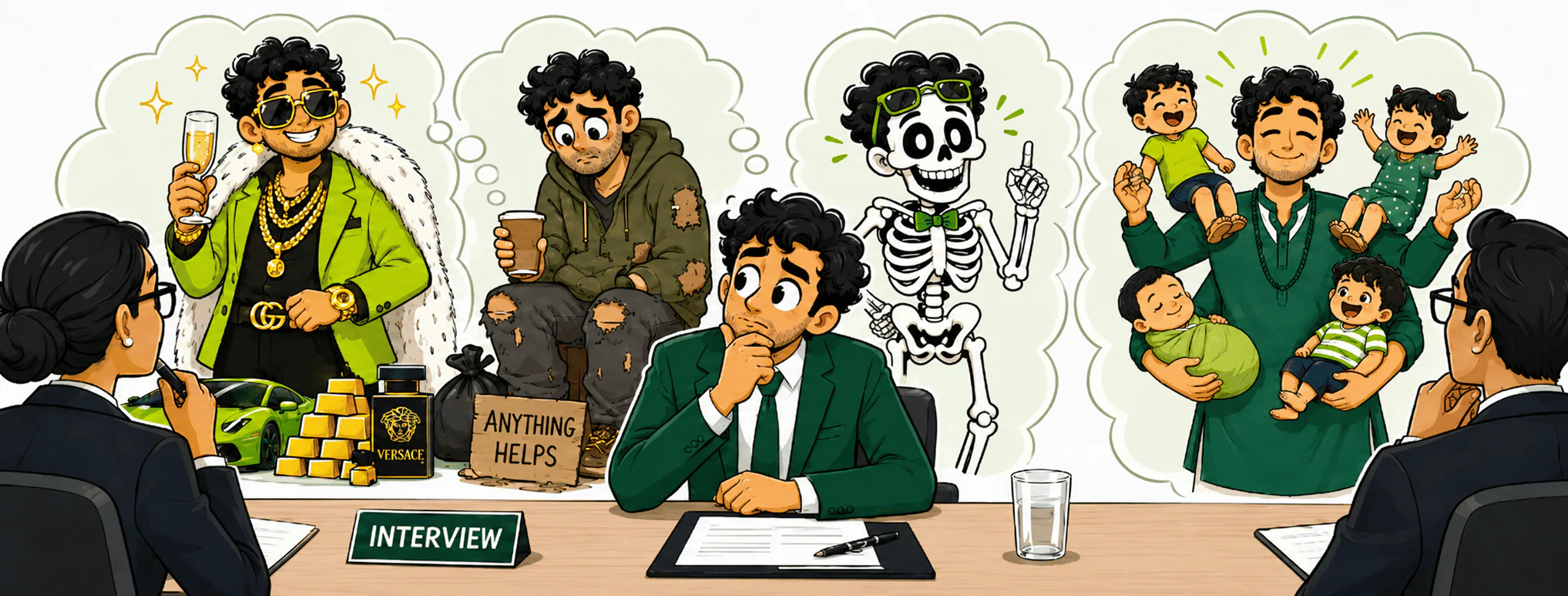


How to Update Your CV and Pass the Recruiter’s Screening
Your resume is not old, it is just “from another era”
An old resume is like your favorite jacket from university. Technically, it still holds up: the zipper works, the pockets are there. But if you show up to an interview in it in 2026, it may create the impression: “Nice person, but slightly stuck in 2018.”
The 2026 job market has become faster, stricter, and more technology-driven. Employers receive more applications, recruiters use ATS more often, candidates are massively writing resumes with AI, and job openings are becoming more specific. Simply listing your past responsibilities is no longer enough. A modern resume in 2026 has to answer three questions quickly:
Who are you?
What can you do?
What value have you already brought to a business?
In the past, you could create a resume once and then carefully update only the date of your most recent job for the next five years. Today, that approach works about as well as using “123456” as your password: convenient, maybe, but really not recommended.
In this article, we will break down how to update a resume, how to refresh an old resume without panicking, how to create an ATS resume, how to pass ATS screening, how to use ChatGPT for your resume, and how not to turn your CV into a soulless text that sounds like it was written by a microwave with career ambitions.
Why an old resume no longer works in 2026
An old resume is usually not bad. It simply answers questions the market is barely asking anymore.
Previously, an employer wanted to see where you worked, for how many years, and what responsibilities you had. Today, that is not enough. In 2026, a recruiter looks not only at work experience, but also at relevance, achievements, skills, resume format, resume keywords, portfolio, LinkedIn, GitHub, Behance, case studies, and the candidate’s ability to explain their value in simple words.
If your resume says:
“Performed tasks for the marketing department”
that tells almost nothing. What tasks? For what product? With what result? What changed after your work? Did the world become a better place? Did sales grow? Did the team stop crying on Mondays?
In a modern 2026 resume, the wording should be closer to this:
“Launched an email funnel for a B2B product and increased lead-to-demo call conversion by 18% in 3 months.”
The difference is huge. In the first case, the person “did something.” In the second, it is clear that they solved a problem, understood the context, and achieved a result.
There is another reason why an old resume performs poorly: it is often written “for everyone.” And a resume for everyone is a resume for no one. If you send the same CV to openings for project manager, product manager, marketing manager, and “well, maybe they’ll take me in HR,” the recruiter can feel it. Quickly.
In 2026, it is important to tailor your resume to the job opening. You do not need to rewrite everything from scratch every time, but you do need to adjust the emphasis. For one role, analytics may matter more. For another, team management. For a third, client experience. For a fourth, knowledge of specific tools.
The labor market has become more skills-centered. Reports about the future of work for 2025–2030 emphasize that employers are paying more attention to skill transformation, AI literacy, adaptability, and the ability to learn, not just to the job title in someone’s employment record.
And this is where the main problem with an old resume begins: it often describes the past, but does not show why you are suitable for a future job.
What has changed in the labor market: AI, ATS, and competition
In 2026, job searching has started to resemble a sports competition where some participants arrive with a coach, some with AI, some with a beautifully designed portfolio, and someone is still sending a file named Resume_final_really_final_new2.doc.
The main changes can be divided into three big groups: AI, ATS, and competition.
AI has become normal, but not a magic wand
AI tools, ChatGPT, and other assistants are already widely used for creating resumes, cover letters, interview preparation, and job description analysis. That is normal. More than that, completely ignoring AI is strange, especially if you work in IT, marketing, design, HR, support, or management.
But there is a nuance. Employers are increasingly seeing identical AI-generated resumes. They sound polished, but empty:
“I am a highly motivated, results-oriented professional with strong communication skills and a desire for growth.”
Congratulations, you have just described about half of LinkedIn.
A resume created with AI can be useful if AI helps you structure your thoughts, improve wording, and identify weak spots. But if ChatGPT writes everything for you without facts, numbers, and your real experience, you end up with a template. And templates do a poor job of selling a candidate.
Recent discussions among employers show that companies are becoming more concerned about candidates embellishing their experience with AI, so the value of specificity, proof, and honest case studies is increasing.
ATS has become a filter you need to pass through
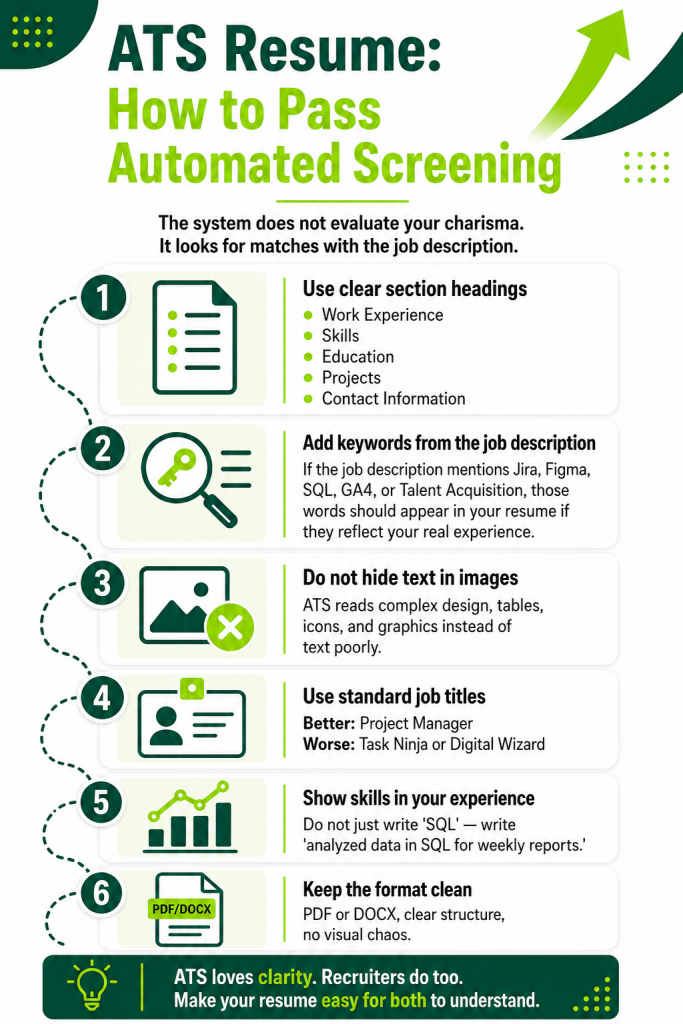
ATS is an automatic resume screening system. In simple terms, it helps companies sort applications, search for keywords, match resumes with job openings, and make recruiters’ lives easier.
An ATS resume is not some secret magical document. It is a resume that the system can read properly. No tables with seven columns, no images instead of text, no design experiments after which even a human cannot immediately figure out where the experience section is and where the phone number is.
A resume for ATS should be structured, clear, and text-based. It should include resume keywords that match the job opening: names of tools, skills, methodologies, platforms, languages, and areas of work.
But here is an important point: you do not need to trick ATS. Do not insert a hidden white-font list of every technology from Python to “I know how to turn on a printer.” That is not a strategy. That is the career version of cheating on a test.
How do you pass ATS resume screening? You need to do three things:
- Use a clear structure.
- Include relevant keywords.
- Show experience that matches the vacancy.
Competition has become broader
This is especially noticeable in the CIS region. Job seekers from Kazakhstan, Uzbekistan, Moldova, Georgia, Armenia, Ukraine, Azerbaijan, Kyrgyzstan, and other countries are increasingly competing not only locally, but also for international, remote, and hybrid roles.
Remote work and hybrid work have expanded the market. That is a plus: you can work for a company from another country. But it is also a minus: candidates from dozens of other cities and markets are applying for the same vacancy alongside you.
At the same time, the global market is also changing: companies are reconsidering remote and hybrid formats, some employers are bringing back office requirements, while others keep flexibility only for certain roles and levels.
That is why a modern 2026 resume should not simply say, “I am looking for a job.” It should say: “I understand the market, I can work in modern conditions, and I can be useful in this specific role.”
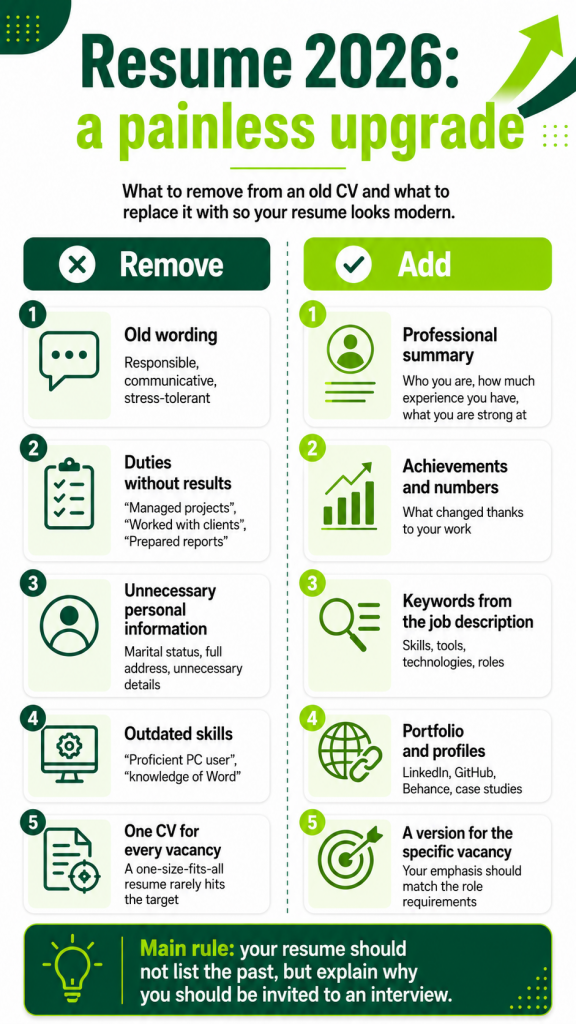
What to remove from an old resume
Updating a resume often starts not with adding things, but with cleaning things up. Like at home: sometimes, to make the place look better, you do not need to buy a new vase, you just need to finally throw away the phone box from 2014.
Here is what you should remove from an old resume.
1. An objective like “I want to grow”
The phrase:
“Objective: to get an interesting job in a stable company where I can grow”
sounds nice, but it provides almost no value. The employer already understands that you want a job, not that you collect vacancies as a hobby.
Instead, it is better to write a professional summary: a short career profile of 3–5 lines. For example:
Project Manager with 5+ years of experience in IT and digital projects. Managed teams of up to 12 people and launched products for markets in Kazakhstan and Europe. Strengths: timeline management, client communication, Agile/Scrum, budgeting, and risk management.
This immediately gives context: who you are, how much experience you have, where you are strong, and what value you can bring.
2. Experience that is too old
If you are applying for a middle or senior position, you do not need to describe your part-time promoter job from 2013 in detail if it is unrelated to your current role.
The exception is when that experience explains an important skill: sales, communication, people management, or customer service.
Experience older than 10 years can be shortened. Keep the company name, job title, years, and 1–2 lines if it matters. The main focus should be on the last 5–7 years.
3. Responsibilities without results
An old resume often looks like a job description:
● reporting;
● working with clients;
● participating in projects;
● creating content;
● processing requests;
● interacting with the team.
The problem is that almost anyone can write this. In 2026, you need to show results.
Before:
“Worked with customer requests.”
After:
“Processed 60–80 requests per day, maintained CSAT at 92%, and helped reduce average response time from 4 hours to 1.5 hours.”
Before:
“Managed social media.”
After:
“Developed a content plan for Instagram and LinkedIn, increasing organic reach by 46% in 4 months.”
4. Outdated skills
The skill “confident PC user” in 2026 sounds as if you are saying “I know how to use a door handle.” If you work in an office, digital, or IT environment, this is already a basic expectation.
It is also better to remove overly general skills:
● communication skills;
● stress resistance;
● responsibility;
● punctuality;
● fast learner.
Not because they are bad. They just do not prove anything on their own.
Instead of “stress resistance,” write:
“Worked with 30+ active clients at the same time while maintaining SLA for response times and deadlines.”
Instead of “communication skills,” write:
“Held weekly syncs with development, design, and marketing teams and aligned priorities among 5 stakeholders.”
5. A photo that does not help
For most digital roles, a photo is not required. If you do add a photo, it should be neutral and professional. A photo from a party, from your car, from the beach, or with a mysterious person cropped out on the left is better saved for other platforms.
For ATS, it is better not to overload the resume with visuals at all. The system may not read everything, and the recruiter cares more about the content.
6. Overly creative design
This is an especially painful topic for designers. Yes, a beautiful CV is pleasant to look at. But if the resume is impossible to read quickly, it loses.
Creativity belongs in the portfolio. A resume is for quickly understanding experience. Behance, Dribbble, a personal website, or a PDF case study will taste better than a resume where the text wraps in a circle around your photo.
7. Unnecessary personal information
You do not need to include marital status, number of children, exact address, passport details, zodiac sign, or favorite tea variety. Even if the tea is excellent.
For a modern CV, it is enough to include:
● first and last name;
● city/country;
● email;
● phone or messenger;
● LinkedIn;
● portfolio/GitHub/Behance/website;
● work format: remote, hybrid, relocation, if relevant.
What sections to add to a modern resume
For a 2026 resume to look modern, it needs a clear structure. It does not have to be long. What matters is that a recruiter can understand your professional story in 20–30 seconds.
1. Professional summary
This is a short block at the beginning of the resume. Its task is to quickly explain who you are and why the recruiter should keep reading.
A good summary answers these questions:
● what your role is;
● how much experience you have;
● what industries you have worked in;
● what your strengths are;
● what result you can bring.
Example for a marketer:
Digital Marketing Specialist with 4+ years of experience in performance and content marketing. Worked with SaaS, e-commerce, and educational projects in CIS and European markets. Able to launch advertising campaigns, analyze funnels, reduce CPL, and turn chaos into clear reports without spreadsheet magic.
Example for HR:
HR Generalist with 5 years of experience in IT and service companies. Filled roles in development, support, marketing, and sales; built onboarding, performance review, and internal communication processes. Key strength: finding people who do not just match the hard skills, but also survive their first meeting with the team.
2. Key skills
The “Skills” section is not there for beauty. It is there for ATS and for quick scanning by the recruiter. It should include hard skills and soft skills, but not formatted like a random salad.
It is better to divide skills into groups:
Hard skills:
SQL, Google Analytics 4, Figma, Jira, Notion, HubSpot, Python, Excel, Power BI, Meta Ads, SEO, UX Research, Customer Support, Talent Acquisition.
Soft skills:
communication, expectation management, prioritization, meeting facilitation, conflict handling, decision-making, feedback.
But soft skills are better confirmed through experience. Anyone can write “leadership.” But “coordinated a team of 8 people and reduced project launch time by 3 weeks” is already proof.
3. Achievements
You can include an achievements section separately or build achievements into your work experience. For middle and senior candidates, a separate “Key Achievements” block often works well.
Examples:
● Increased user retention by 12% by improving the onboarding scenario.
● Reduced time-to-hire from 42 to 27 days for IT roles.
● Launched a design system that sped up layout preparation by 30%.
● Reduced repeat support requests by 18% after updating the knowledge base.
● Implemented a KPI dashboard for the sales department, reducing manual reporting by 6 hours per week.
Resume achievement examples should be specific. Numbers are great. But if you do not have numbers, you can show scale:
● what teams you worked with;
● how many clients you served;
● what processes you improved;
● what products you launched;
● what problems you solved.
4. Tools
In 2026, tools matter, especially for IT, design, marketing, HR, support, and management.
Examples:
For IT: Python, JavaScript, TypeScript, React, Node.js, Docker, Kubernetes, AWS, PostgreSQL, Git, CI/CD.
For design: Figma, Adobe Photoshop, Illustrator, After Effects, Webflow, Framer, Miro, FigJam, UX research tools.
For marketing: Google Analytics 4, Google Ads, Meta Ads, TikTok Ads, Ahrefs, Semrush, HubSpot, Mailchimp, Looker Studio.
For HR: LinkedIn Recruiter, Boolean search, ATS, BambooHR, Greenhouse, Lever, Notion, Miro, HR analytics.
For support: Zendesk, Intercom, Freshdesk, Help Scout, Jira Service Management, CRM, knowledge base tools.
5. Portfolio and case studies
A portfolio is no longer only for designers. In 2026, almost everyone needs case studies.
A marketer can show:
● advertising campaigns;
● SEO growth;
● email sequences;
● content strategies;
● funnel analytics.
HR can show:
● onboarding structure;
● career tracks;
● scorecard template;
● recruitment process;
● employer branding project.
A manager can show:
● roadmap;
● product launch;
● process optimization;
● project plan;
● team results.
Support can show:
● knowledge base;
● scripts;
● SLA improvement;
● reduction in repeat requests;
● customer journey.
An IT specialist can show GitHub, pet projects, open-source contributions, technical articles, and architecture decisions.
6. AI skills
AI literacy is becoming an advantage in many professions. But writing “I know ChatGPT” is no longer enough. It is better to show exactly how you use AI tools.
Examples:
● use ChatGPT for drafts of email campaigns and A/B hypotheses;
● apply AI tools for initial analysis of customer feedback;
● automated routine reports using no-code and AI;
● use AI to generate test scenarios;
● sped up UX hypothesis preparation through AI-assisted research;
● created an internal prompt library for the support team.
The main thing is not to pretend you are an AI guru if you once asked ChatGPT to write a birthday message for a colleague. Recruiters are people too, but not that trusting.
How to adapt your resume to a specific vacancy
A resume tailored to a vacancy is one of the main principles of job searching in 2026. This does not mean you need to write a new CV from scratch every time. It means you need to change the emphasis.
Imagine your resume is a wardrobe. You do not wear the same outfit to a business meeting, a picnic, and a friend’s wedding. Even though the person inside is the same. A resume works the same way.
Step 1. Analyze the vacancy
Before applying, carefully read the job description and highlight:
● job title;
● key responsibilities;
● required hard skills;
● desirable skills;
● tools;
● work format;
● industry;
● expected results.
For example, a Project Manager vacancy says:
● IT project management;
● Agile/Scrum;
● client communication;
● timeline and budget control;
● Jira/Confluence;
● Spanish B2;
● SaaS experience.
This means these words should appear in your resume if they match your real experience. Not “somewhere at the bottom in small print,” but in your summary, skills, and experience.
Step 2. Adjust the summary
Before:
Project Manager with experience managing projects in different fields.
After:
Project Manager with 4+ years of experience in IT and SaaS projects. Managed development, design, and QA teams, worked with Scrum/Kanban, and communicated with clients in Spanish. Key strength: keeping deadlines, budgets, and people in a state of “we’ve got this,” not “we’re on fire.”
Step 3. Reorder your skills
If the vacancy is about email marketing, do not put SMM as your first skill. If the vacancy is about UX research, do not start with “logos and branding.” If the vacancy is about backend, do not make HTML/CSS your main focus, even if you know them.
A recruiter scans quickly. ATS also looks for matches. So the most relevant resume keywords should be closer to the beginning.
Step 4. Rewrite your experience according to the vacancy’s tasks
This does not mean lying. It means showing the right side of your experience.
For example, you have customer support experience and are applying for a Customer Success Manager role.
Old description:
Answered customers in chat and solved problems.
Adapted description:
Worked with B2B clients after purchase: helped with product setup, identified reasons for support requests, and shared insights with the product team.
Contributed to reducing churn by improving the knowledge base and following up regularly with clients.
The experience is the same, but the focus is different.
Step 5. Add the language of the vacancy
If the vacancy says “performance marketing,” use that exact term, not only “targeted advertising.” If it says “talent acquisition,” add it alongside “recruitment.” If it says “stakeholder management,” do not replace everything with “communication with colleagues.”
ATS resumes like matches. Recruiters do too.
But do not copy the job description in whole chunks. It looks strange. Imagine a person on a date repeating your dating app profile word for word. Technically, it matches, but you want to leave.
How to describe skills and achievements correctly
One of the most common questions is: how do you describe work experience in a resume so that it sounds convincing?
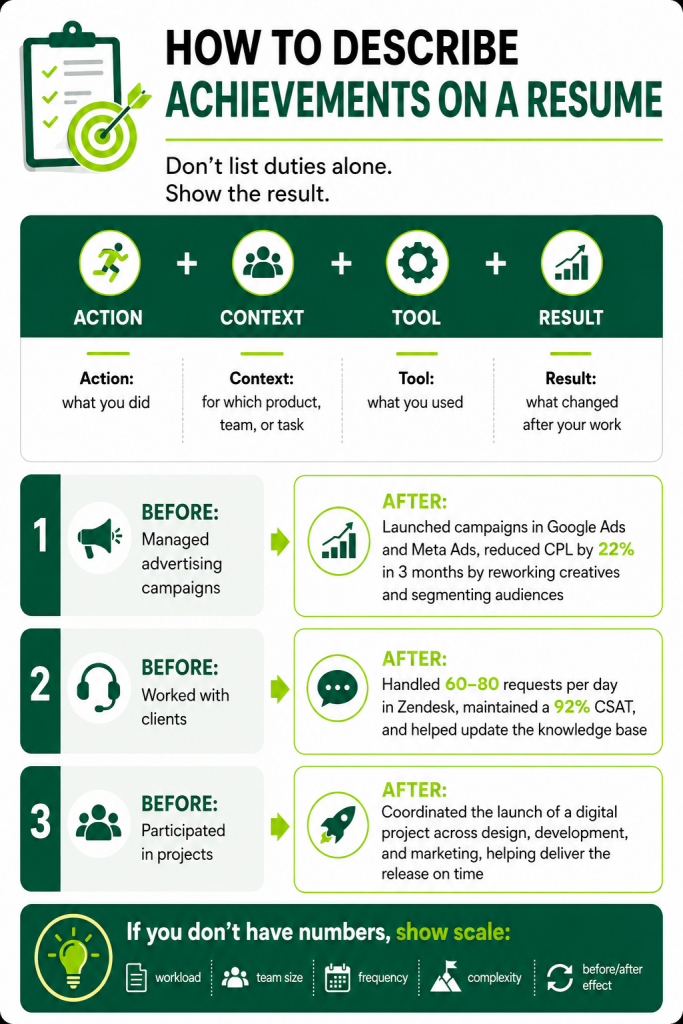
The answer: through actions, context, and results.
A good formula:
What you did + for whom/what + how you did it + what result you achieved.
For example:
Optimized onboarding for new users in a mobile app by adding in-app tips and an email sequence, which increased activation by 14% in 2 months.
This includes action, context, method, and result.
How to describe resume achievements when you do not have numbers
Not everyone has access to KPIs. Sometimes the company did not share numbers, sometimes the project was internal, and sometimes you simply did not track analytics. This is not the end of the world. A recruiter does not expect every candidate to arrive with an accounting report and a brass band.
If you do not have exact numbers, use:
● scale;
● frequency;
● volume;
● complexity;
● process change;
● impact on the team;
● before/after.
Examples without exact numbers:
Rebuilt the handoff process between sales and support, helping the team process requests faster and lose less context.
Created a library of UI components for recurring screens, reducing the amount of manual work for designers and developers.
Updated the structure of the customer knowledge base, after which the support team answered fewer repetitive questions manually.
Yes, numbers are better. But specific details without numbers are still stronger than “responsible and communicative.”
Examples of strong achievements for different roles
IT developer:
Rewrote part of the legacy codebase in TypeScript, reduced the number of bugs in the payment module, and simplified maintenance for the team.
Optimized SQL queries, reducing report loading time from 12 to 3 seconds.
Set up a CI/CD pipeline, reduced manual deployment steps, and sped up release delivery.
UX/UI designer:
Conducted a UX audit of the onboarding flow and proposed changes to screen structure, helping increase registration completion by 11%.
Created a design system in Figma for a product with 40+ screens, speeding up the preparation of new layouts for the team.
Prepared an interactive prototype to test a hypothesis before development, helping avoid unnecessary implementation costs.
Marketer:
Launched performance campaigns in Google Ads and Meta Ads, reducing CPL by 22% in 3 months.
Updated the SEO structure of the blog, increasing organic traffic by 35% in six months.
Set up email segmentation, increasing open rate from 21% to 34%.
HR:
Filled 18 IT vacancies in one quarter, including backend, frontend, QA, and product roles.
Implemented an onboarding process for new employees, reducing repetitive questions during the first 2 weeks of work.
Updated the interview scorecard, helping managers compare candidates faster using unified criteria.
Customer Support:
Processed up to 80 requests per day in Zendesk while maintaining CSAT above 90%.
Created response templates for frequent questions, reducing average first response time.
Passed recurring user issues to the product team and contributed to improving the FAQ and interface.
Manager:
Coordinated the launch of a new product across development, design, and marketing teams, releasing it on time.
Set up weekly KPI reporting, reducing chaos in project statuses and the number of urgent “what is going on?” messages.
Implemented a task prioritization process, helping the team focus on projects with the highest business impact.
Hard skills and soft skills in a resume: how not to ruin the skills section
Hard skills are specific professional skills: tools, technologies, methods, languages, analytics, platforms.
Soft skills are interaction skills: communication, organization, leadership, critical thinking, adaptability.
A common mistake among candidates is mixing everything into one list:
Figma, responsibility, SQL, communication skills, Jira, stress resistance, Photoshop, leadership.
It looks like the shopping list of a very tired person.
Better:
Hard skills: Figma, UX research, wireframes, prototypes, design systems, usability testing, Jira, Miro.
Soft skills: discussion facilitation, reasoning behind decisions, working with feedback, task prioritization.
But even better is to confirm soft skills through experience:
Facilitated design reviews with product, development, and marketing teams, helping align decisions without endless “let’s think about it some more.”
How to update your resume
Different fields have different expectations. A universal resume is possible, but the emphasis should differ.
Resume for IT
For an IT role, the recruiter and hiring manager want to quickly see:
● technology stack;
● commercial experience;
● projects;
● role in the team;
● complexity of tasks;
● GitHub or portfolio;
● contribution to results;
● English, if the role is international.
Do not simply write:
“Developed web applications.”
Better:
“Developed the frontend for a B2B SaaS platform using React and TypeScript, worked with REST API, participated in code reviews and interface performance optimization.”
For backend:
“Developed APIs in Node.js, worked with PostgreSQL and Redis, optimized request processing for the payment module.”
For QA:
“Wrote test cases, performed manual and regression testing, automated smoke tests in Playwright, and helped reduce the number of critical bugs before release.”
An IT resume should be specific. Mention technologies not only in the skills section, but also in your experience. ATS and recruiters need to understand where and how you used them.
Resume for design
A designer needs to show not only taste, but also thinking. Beautiful layouts are good. But businesses care about the problems you solve.
A designer’s resume should include:
● specialization: UX/UI, product design, graphic design, motion, brand design;
● tools;
● industries;
● types of projects;
● portfolio;
● case studies;
● product impact;
● collaboration with the team.
Weak wording:
“Created designs for websites and applications.”
Better:
“Designed interfaces for a fintech app: user flows, wireframes, UI layouts, and interactive prototypes in Figma. Worked with a product manager and developers, prepared specifications for handoff to development.”
If you have Behance, Dribbble, a personal website, or a PDF portfolio, add the link at the top of your resume. Do not make the recruiter search for your work like treasure on a pirate map.
Resume for marketing
Marketing in 2026 has become even more measurable. Employers want to see not just “creativity,” but the connection between actions and results.
In a marketer’s resume, the following are important:
● channels: SEO, PPC, SMM, email, content, influencer, PR;
● tools;
● budgets, if you can disclose them;
● metrics: CPL, CAC, ROAS, CTR, CR, retention, LTV;
● industries;
● case studies;
● analytics;
● AI tools.
Weak wording:
“Worked on brand promotion.”
Better:
“Launched a content strategy for B2B SaaS: prepared an SEO cluster, updated the blog structure, and increased organic traffic by 35% in 6 months.”
For performance:
“Managed an advertising budget of up to $15,000/month, launched campaigns in Google Ads and Meta Ads, and reduced CPL by 22% through creative updates and audience segmentation.”
Marketing without numbers is like soup without salt. You can eat it, but why suffer?
Resume for HR
HR resumes often suffer from overly general phrases:
“Handled recruitment, adaptation, and HR processes.”
But HR is not just “I love people.” It is processes, metrics, communication, business tasks, and sometimes the ability not to cry after the fifth approval of a vacancy.
In an HR resume, it is worth showing:
● what vacancies you filled;
● what levels: junior, middle, senior, lead;
● what areas: IT, marketing, sales, support;
● time-to-hire;
● sourcing channels;
● ATS;
● onboarding;
● performance review;
● HR analytics;
● employer branding;
● internal communications.
Example:
“Filled IT and digital roles for a product company: frontend, backend, QA, designer, marketer. Used LinkedIn, Boolean search, Telegram channels, and a referral program. Reduced time-to-hire from 45 to 31 days by updating the funnel and communication templates.”
If you are an HR Generalist:
“Managed the full cycle of HR processes: recruitment, onboarding, adaptation, 1:1s, performance reviews, and exit interviews. Updated the onboarding plan for new employees and helped managers integrate people into work faster.”
Resume for support
Customer Support, Technical Support, Customer Success: this is not “just answering chats.” Good support affects retention, product, reputation, and money.
In a support resume, it is important to show:
● channels: chat, email, phone, social media;
● tools: Zendesk, Intercom, Freshdesk, Jira;
● volume of requests;
● SLA;
● CSAT/NPS;
● work with the knowledge base;
● escalations;
● collaboration with product/dev teams;
● languages.
Weak wording:
“Consulted clients.”
Better:
“Processed 60–80 requests per day via Zendesk and email, maintained CSAT at 92%, created response templates, and updated the knowledge base to reduce repeat requests.”
For technical support:
“Diagnosed users’ technical issues, collected logs, reported bugs in Jira, and worked with QA and the development team until incidents were resolved.”
Resume for management
A management resume should show not only that you “managed,” but what exactly you managed.
It is important to include:
● team size;
● type of projects;
● budget;
● deadlines;
● methodologies;
● KPIs;
● results;
● stakeholders;
● tools;
● crises you managed to solve.
Weak wording:
“Managed projects and a team.”
Better:
“Managed a cross-functional team of 10 people, coordinated the launch of a mobile application, and controlled the roadmap, deadlines, and risks. The project was released on schedule with no critical blockers.”
For a Product Manager:
“Conducted discovery, analyzed user feedback, formed the backlog, prioritized tasks using impact/effort, launched A/B tests, and tracked activation metrics.”
How to use AI for your resume without making it generic
A resume created with AI is an excellent tool if you use it as an assistant, not as the author of your professional biography.
ChatGPT can help you:
● improve resume structure;
● turn responsibilities into achievements;
● adapt your resume to a vacancy;
● find resume keywords;
● shorten long text;
● prepare a summary;
● check logic;
● write a cover letter;
● prepare for an interview.
But ChatGPT does not know your real experience unless you give it that information. It can beautifully write:
“Increased team efficiency by 40%.”
And then during the interview, you will be asked: “How exactly?”
That is where the career horror movie begins, without popcorn.
How to use ChatGPT for a resume correctly
Give AI the facts:
● your job title;
● industry;
● tasks;
● tools;
● projects;
● results;
● metrics;
● the vacancy you are adapting for;
● resume language;
● desired style.
Example of a good prompt:
“Help me improve the experience description for my resume. I worked as a customer support specialist at a SaaS company. I answered customers in Zendesk, handled 50–70 requests per day, maintained CSAT at 91%, created response templates, and passed bugs to Jira. I want to apply for a Customer Success Specialist role. Rewrite the experience so that it sounds more relevant, but without inventing facts.”
That is a good prompt. It keeps AI grounded in reality.
How to improve a resume with AI: a working process
- Copy the job description.
- Copy your current resume.
- Ask AI to find mismatches.
- Ask it to suggest keywords.
- Ask it to improve the summary.
- Ask it to rewrite experience through achievements.
- Check every phrase.
- Remove everything that does not sound like you.
- Add specifics.
- Read it out loud.
If, after reading it out loud, you sound like “a dynamic professional with a proven track record of synergistic impact on business outcomes,” rewrite immediately. People do not talk like that. Not even in interviews. Not even after the third coffee.
AI resume mistakes
The main AI resume mistakes are:
1. Text that is too generic
AI loves words like “efficient,” “results-driven,” “cross-functional,” and “dynamic.” Sometimes they are useful. But if every sentence sounds like a corporate poster, that is bad.
2. Invented achievements
Do not add numbers that never existed. A recruiter may ask for details. A hiring manager definitely will.
3. The same style across all candidates
When hundreds of people use similar prompts, the texts become similar. Add your own case studies, context, and natural wording.
4. Mismatch with reality
If your resume says “Advanced SQL,” but in the interview you confuse JOIN with the name of a gym, it will be awkward.
5. Loss of personality
A resume should be professional, but not sterile. Especially in fields where communication matters.
How to make AI-generated text sound human
After generation, ask yourself:
● Did I really work like this?
● Can I explain every point?
● Is there specificity here?
● Is this clear to a recruiter?
● Does this sound like me?
● Are there real tools and results in the text?
● Are there any overly loud words?
A good AI resume is not a resume written by AI. It is your resume, improved with AI.
Resume update checklist before sending
Before sending your CV, go through this list. It is simple, but it saves you from many mistakes.
Structure
● Your name, contacts, city/country are included.
● LinkedIn, GitHub, Behance, portfolio, or website are included if relevant.
● There is a professional summary of 3–5 lines.
● Work experience is listed from newest to oldest.
● Recent roles are described in more detail, older ones more briefly.
● There is a skills section.
● Tools are included.
● Education and courses are included if important.
● There is no unnecessary personal information.
ATS
● The resume is saved as PDF or DOCX, depending on the employer’s requested format.
● There are no complex tables, images instead of text, or strange columns.
● Section headings are clear: “Work Experience,” “Skills,” “Education.”
● Keywords from the vacancy are used.
● Job titles are understandable.
● Tools are written in standard form: Google Analytics 4, Figma, Jira, React, SQL.
● There is no hidden text or keyword stuffing to trick the system.
Content
● Responsibilities are rewritten through actions and results.
● There are resume achievement examples with numbers or clear scale.
● There are no generic phrases without proof.
● It is clear what tasks you solved.
● It is clear what tools you worked with.
● It is clear what value you brought.
● The resume is adapted to a specific vacancy.
Language
● No bureaucratic wording.
● No mistakes or typos.
● The text sounds natural.
● No overly long paragraphs.
● No phrases like “stress-resistant team player with high motivation” unless they are proven by something.
● If the resume is in English, the language has been checked separately.
Final check before sending
Open the vacancy and your resume side by side. Ask yourself:
● Is it clear within 30 seconds why I am a fit?
● Does the resume include the key requirements from the vacancy?
● Are my achievements visible?
● Does the CV look outdated?
● Is it too long?
● Can I explain every point in an interview?
If the answer to all questions is “yes,” you can send it. If somewhere the answer is “well, almost,” it is better to fix it. The 2026 market loves prepared candidates. Let’s leave spontaneity for choosing dessert.
Common resume mistakes in 2026
Mistake 1. One resume for all vacancies
This is the most common mistake. A candidate sends the same file to dozens of vacancies and then wonders why there are so few responses.
Solution: create a base resume and 2–3 versions for different directions. For example:
● Product Manager;
● Project Manager;
● Customer Success Manager.
And adapt the summary, skills, and first experience points for each vacancy.
Mistake 2. Too much text
A resume is not an autobiography. You do not need to describe every workday since 2012. The recruiter needs to quickly understand relevance.
Optimal length:
● junior: 1 page;
● middle: 1–2 pages;
● senior/lead/manager: 2 pages;
● executive: sometimes more, but still structured.
If your resume is 5 pages long, it really needs to be justified. And no, “I worked a lot” is not always a justification.
Mistake 3. No achievements
If a resume contains only responsibilities, the candidate looks replaceable. Achievements show the difference between “did tasks” and “got things done.”
Bad:
“Managed advertising campaigns.”
Good:
“Managed advertising campaigns in Google Ads and Meta Ads, reducing CPL by 18% through creative updates and segmentation.”
Mistake 4. Too much design
A beautiful resume can help, but only if it is readable. If ATS cannot recognize the text, a beautiful layout becomes a problem.
It is better to choose a simple resume template:
● one or two columns maximum;
● clear headings;
● readable font;
● enough white space;
● no overload of icons.
Mistake 5. Unclear job title
Sometimes candidates write overly creative titles:
● Digital Ninja;
● Growth Wizard;
● People Happiness Fairy;
● Customer Hero;
● Marketing Rockstar.
It sounds fun, but ATS and recruiters may not understand what it means. It is better to use a standard job title and leave creativity for the description of your approach.
Mistake 6. Irrelevant courses
Courses are good, but you do not need to list everything. If you took an SMM course in 2017 and are now applying for a Senior Product Manager role, that course is unlikely to matter.
Keep only what strengthens your profile:
● relevant professional courses;
● certifications;
● languages;
● technical programs;
● training related to the vacancy.
Mistake 7. Weak LinkedIn
If your resume includes LinkedIn, it should be alive. You do not have to post wise thoughts every day against a background of a laptop and coffee. But the profile should match your resume.
Check:
● current job title;
● normal summary;
● experience matches the CV;
● skills are listed;
● there is a photo;
● the profile is not empty;
● region and work format are specified.
For an international job search, LinkedIn is often no less important than the resume.
Mistake 8. Portfolio without explanations
A portfolio should be understandable. If a recruiter opens Behance or a website and sees only beautiful images without context, it is harder to assess your contribution.
Add the following to case studies:
● task;
● your role;
● process;
● tools;
● result;
● what changed after the project.
This is especially important for design, marketing, product, content, HR branding, and management.
Mistake 9. Unchecked English
For international vacancies, an English resume should be accurate. Do not use a literal translation from Russian. The phrase “I was making control of tasks” sounds alarming.
Better:
Managed task tracking and team communication in Jira and Slack.
Check your English CV separately. And do not exaggerate your language level. If you write C1 but in the interview can confidently say only “London is the capital…,” it will be difficult.
Mistake 10. The resume does not answer the question “why you?”
The main mistake is that the resume does not sell the candidate. It has facts, but no clear value.
A good resume answers:
● why you fit the role;
● what experience you already have;
● what tasks you solved;
● what results you delivered;
● what tools you worked with;
● why you should be invited to an interview.
A resume does not have to be perfect. It needs to be clear, honest, specific, and relevant.
Practical example: how to update an old resume
Suppose an old resume says:
Project Manager
Responsibilities: project management, client communication, task assignment, deadline control, working with the team, preparing reports.
This description is not terrible. But it is too general.
Updated for the 2026 labor market:
Project Manager with 4+ years of experience in digital and IT projects. Coordinated development, design, marketing, and QA teams of up to 12 people. Managed projects from brief to launch, controlled deadlines, budget, risks, and client communication. Worked in Jira, Confluence, Notion, and Slack.
Achievements:
— Launched 6 client projects on time, including a SaaS platform and an e-commerce product.
— Implemented a weekly status report, reducing the number of urgent clarification requests from clients.
— Rebuilt the task assignment process, helping the team estimate deadlines faster and reduce rework.
Now there is more visible: context, tools, scale, result.
Another example for a marketer.
Old:
Marketer
Handled advertising, social media, email campaigns, analytics.
Updated:
Digital Marketing Specialist with 3+ years of experience in e-commerce and online education. Launched performance campaigns in Google Ads and Meta Ads, managed email marketing, and analyzed the funnel in GA4 and Looker Studio.
Achievements:
— Reduced CPL by 20% in 3 months through creative updates and audience segmentation.
— Set up an email sequence for new leads, increasing purchase conversion by 9%.
— Prepared a monthly marketing dashboard for the team and leadership.
Now this is not just “handled advertising.” This is a specialist who understands business results.
How to make a resume lively but professional
A friendly tone in a resume is acceptable, but use it carefully. A resume is not stand-up comedy, although sometimes you really want it to be.
You can write in a lively way:
I help teams launch projects without chaos, endless calls, and mysterious tasks marked “needed yesterday.”
But you should not write:
I am a project manager who will save your company from the apocalypse if you give me access to Jira and coffee.
Although, admittedly, it sounds tempting.
The best style for a 2026 resume is clear, confident, and specific. No pathos, no bureaucratic wording, no attempt to seem like a “market superstar.” Recruiters are tired of superhumans. They need understandable specialists who know how to do the work.
What you can add to stand out
A short professional phrase:
I build clear processes between the product, the team, and the client.
A note about your work style:
I work well in fast-moving teams where independence, transparent communication, and responsibility for results matter.
Market context:
Worked with teams and clients from Kazakhstan, Moldova, Georgia, and the EU.
Work format:
Open to remote/hybrid work, international teams, and B2B SaaS projects.
These details make a CV feel more alive and help the recruiter understand where you will fit naturally.
Mini-template for a modern 2026 resume
Below is a structure you can use as a foundation.
First Name Last Name
Role: Product Manager / UX Designer / Digital Marketer / HR Generalist / Customer Support Specialist
Location: city, country
Format: remote / hybrid / relocation
Contacts: email, phone, Telegram
Profiles: LinkedIn, GitHub, Behance, portfolio
Professional summary
3–5 lines: who you are, how much experience you have, what fields you have worked in, what your strengths are, what result you bring.
Key skills
Hard skills: tools, technologies, methodologies.
Soft skills: communication, prioritization, expectation management, facilitation, feedback.
Work experience
Company — Job Title
Month year — month year
Brief context about the company or product.
● Action + context + result.
● Action + tool + result.
● Achievement with a number or scale.
● Collaboration with teams/clients.
● Contribution to a process, product, or metrics.
Projects / portfolio
● Project name.
● Your role.
● Task.
● Tools.
● Result.
● Link, if available.
Education
University, specialization, years.
Relevant courses and certifications.
Languages
Russian, English, Romanian, Kazakh, Uzbek, Georgian, Armenian, Azerbaijani — indicate real levels.
Additional information
You can include:
● volunteer projects;
● mentoring;
● publications;
● talks;
● open-source;
● professional communities.
Only if it strengthens your candidacy.
Final check: what a modern 2026 resume should be like
A modern 2026 resume is not just a beautiful document. It is your career landing page. Only instead of a “Buy” button, it should create the thought: “Invite to interview.”
It should be:
Relevant.
Tailored to a specific vacancy, not “somewhere.”
Readable.
Without visual chaos or text you want to print out and burn.
ATS-friendly.
With a clear structure, keywords, and normal formatting.
Specific.
With results, tools, tasks, and scale.
Honest.
Without invented KPIs, fake seniority, or “confident Python” after two YouTube videos.
Human.
So behind the text, there is a person, not a corporate robot.
Conclusion: your resume should work for you while you drink coffee
In short, here is how to update your resume for the 2026 job market:
remove the unnecessary, add specificity, adapt it to the vacancy, use keywords, show achievements, prepare an ATS resume, update LinkedIn and your portfolio, use AI tools wisely, but do not give away your personality to them.
A resume is not just a list of workplaces. It is your professional story told in a way that helps the recruiter quickly understand: “Yes, this person is worth talking to.”
And the good news is: you do not need to be the perfect candidate. You need to be a clear candidate. In 2026, that is already a major competitive advantage.
A bad resume makes the recruiter guess.
An average resume lists responsibilities.
A strong resume shows value.
And a very strong resume makes the reader want to write:
“Hello! When would be a convenient time for a call?”