



How to Discuss Salary Without Feeling Awkward
Talking about money in a job interview often triggers a tiny alarm bell in a candidate’s head: “If I name a number now, I’ll ruin everything.”
In reality, salary is simply one part of the working conditions, just like responsibilities, schedule, employment format, team setup, and scope of ownership. The employer is discussing the value the business will get. The candidate is discussing the terms under which they are ready to deliver that value.
In this article, we’ll break down how to discuss salary without feeling awkward, how to talk about compensation in an interview, how to state your salary expectations, how to ask about the salary range, how to negotiate after receiving an offer, and how to avoid underselling yourself during a job search.
No dramatic pauses. No “well, I’m not really sure.” No feeling that you showed up to ask a strict relative for pocket money.
Why Salary Conversations Feel Tense
Money in hiring is a strange topic.
Everyone understands that people look for work because they need income, growth, stability, and decent working conditions. Everyone understands that a company hires a specialist within a specific budget. But as soon as the question “What are your salary expectations?” comes up, many candidates start acting as if they have been caught doing something suspicious.
Where the awkwardness comes from
Most of the time, the real problem is not the negotiation itself. It is the mindset behind it.
A candidate starts thinking:
- “What if I name a number higher than they are willing to pay?”
- “What if they decide I only care about money?”
- “What if I ask for too little and ruin my own offer?”
- “What if the recruiter asks a follow-up question and I freeze?”
- “What if they choose someone cheaper?”
As a result, the person starts speaking vaguely:
- “Well, I’m open to discussion…”
- “The most important thing for me is interesting work…”
- “Why don’t you make an offer and I’ll think about it…”
- “I’m not very familiar with the market right now…”
These phrases may feel safe inside the candidate’s head. To an employer, they often sound like the candidate does not have a clear position.
Why It Is Normal to Discuss Salary
A job is an agreement between two sides.
The company wants to solve a business problem: hire someone who can do the work, deliver results, strengthen the team, reduce risks, improve processes, sell, write, manage, analyze, support customers, or launch projects.
The candidate wants to understand:
- how much they will earn;
- which currency the compensation is calculated in;
- whether the amount in the vacancy is gross or net;
- whether there are bonuses or commissions;
- how salary reviews work;
- which responsibilities are included in the role;
- what workload is expected;
- which conditions apply after the probation period.
This is a business conversation. There is nothing rude about it.
Awkwardness appears when a candidate tries to look convenient instead of being clear.
Money is connected to responsibilities
Salary is not discussed separately from the role.
The amount depends on:
- level of responsibility;
- complexity of tasks;
- independence;
- impact on results;
- candidate’s experience;
- rarity of skills;
- employment format;
- urgency of the hire;
- company budget;
- labor market conditions.
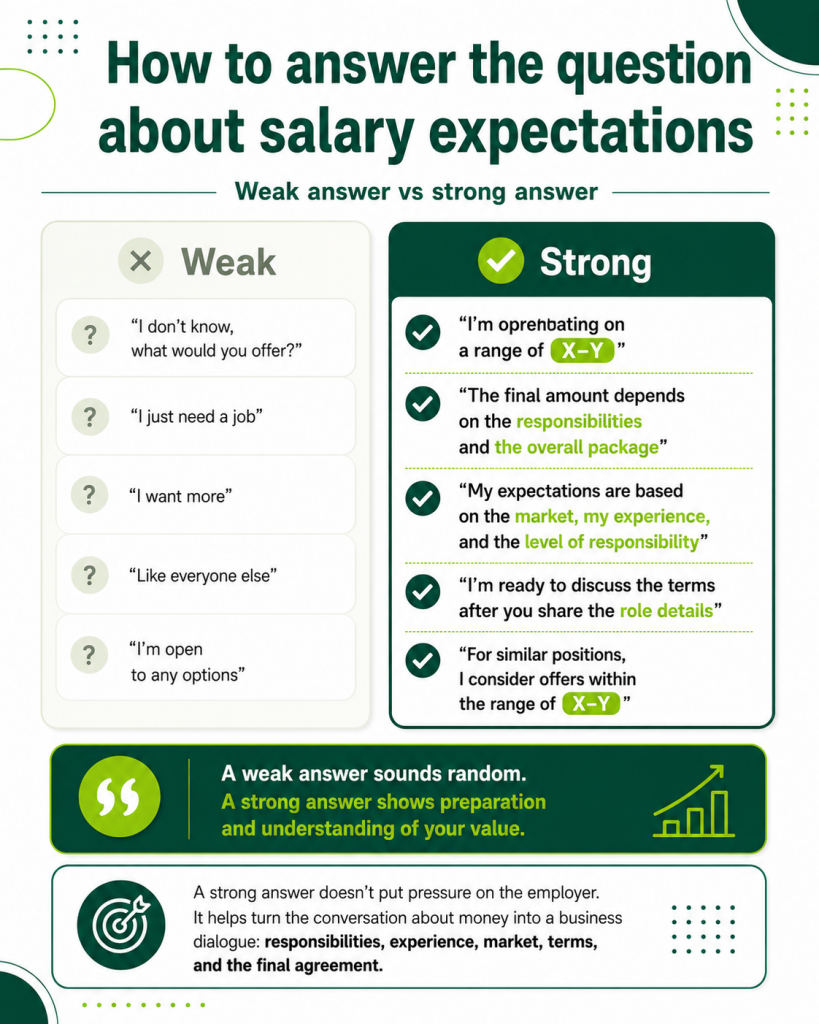
That is why a strong position does not sound like, “I want more.”
It sounds like this:
“Based on the responsibilities, my experience, and the level of ownership required, my target range is X–Y.”
This answer does not pressure the employer. It shows that the candidate understands their market value and can discuss terms professionally.
When to Bring Up Salary
One of the main questions is: when should you ask about salary during the interview process?
The answer depends on the stage, but the general principle is simple: clarify the basic range early, and discuss details closer to the offer.
During the first contact
If a recruiter messages you about a role and the salary is not listed, you can ask about the compensation range right away.
This does not sound rude. It saves time for both sides.
Example:
Thank you for sharing the role details. Could you please let me know what compensation range is planned for this position? I’d like to make sure our expectations are aligned upfront.
This wording is short, polite, and mature. You are not demanding, arguing, or apologizing. You are clarifying an important condition.
During the first interview
If salary was not discussed in messages, you can bring it up during the HR interview.
It is usually better to do this closer to the end of the conversation, after you have already discussed your experience, the role, and the work format.
Example:
We’ve discussed the responsibilities and expectations for the role. Could you please share the compensation range planned for this position?
This sounds natural because you connect compensation to what you have already learned about the role.
Before a long interview process
If the company invites you to several interview stages, a test assignment, a meeting with the hiring manager, and a final interview, it is better to clarify the salary range in advance.
Otherwise, you may spend a week or two in the process and only find out at the end that the offer is far below your minimum.
Phrase:
Before the next stage, I’d like to clarify the compensation range. It’s important for me to understand whether our expectations are aligned.
This is especially important if:
- the vacancy does not include a salary range;
- the hiring process is long;
- there is a test assignment;
- the role requires several meetings;
- you are considering multiple opportunities;
- you already have a minimum acceptable amount.
After receiving an offer
After the offer, the candidate has a stronger position for negotiation. The company has already selected you as a suitable specialist, the team has invested time in interviews, and the hiring manager has confirmed interest.
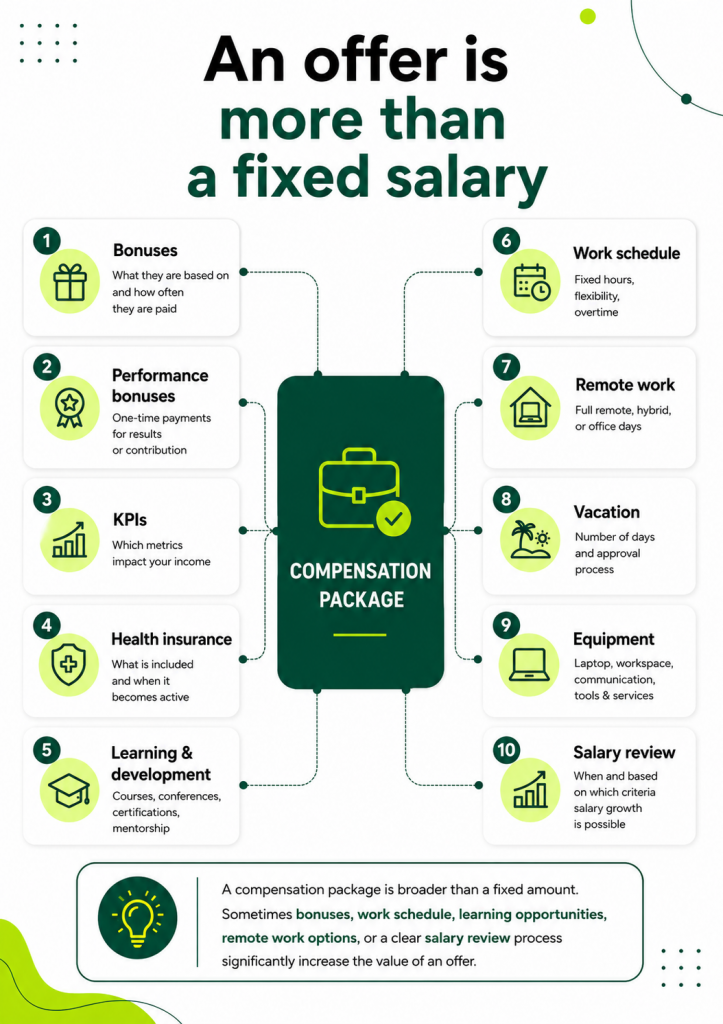
At this stage, you can discuss not only the fixed salary, but the entire compensation package:
- bonuses;
- commissions;
- KPIs;
- schedule;
- remote work;
- vacation;
- health insurance;
- learning budget;
- equipment;
- salary review;
- conditions after the probation period.
Example:
Thank you for the offer. I’m interested in the role and would like to discuss compensation. Based on the responsibilities and my experience, my target is X.
When you should not delay the conversation
Some candidates wait until the very end because they are afraid of damaging the impression.
That is risky.
If salary is critical for you, it is worth clarifying the range before going deep into the process. Otherwise, you can end up emotionally invested in the role, go through several stages, meet the team, mentally rearrange the furniture in your new office, and then receive an offer below your expectations.
A salary range is not a whim. It is a compatibility filter.
How to Define Your Salary Range
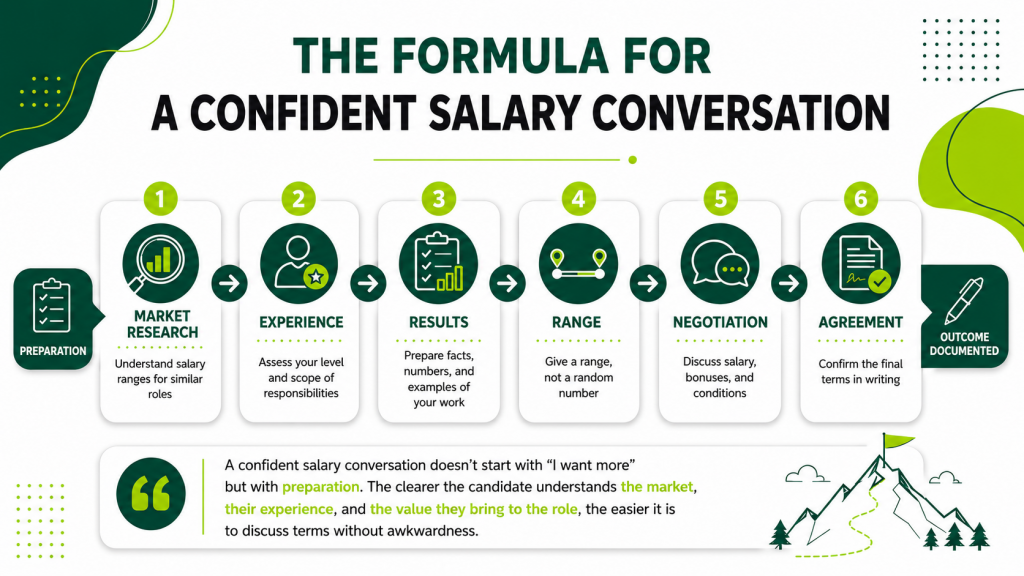
Before discussing salary with HR or an employer, you need to prepare your range. Not one random number you heard from a friend, but a practical working range.
What a candidate’s salary range means
A candidate’s range is the compensation range within which they are ready to consider offers.
It usually has three levels.
Minimum acceptable amount
Below this number, the offer does not work for you.
Comfortable amount
This is the level at which you would be ready to accept an offer if the responsibilities and conditions are reasonable.
Target amount
This is the upper reference point that reflects your experience, strong results, and a good match with the role.
Example:
- minimum acceptable: 1,800;
- comfortable: 2,200;
- target range: 2,500–2,700.
In an interview, you usually do not name your minimum. You name a range closer to the comfortable and target levels.
Where to research the market
To understand fair compensation for your role, use several sources:
- job postings with visible salary ranges;
- offers from similar companies;
- salary reports;
- professional communities;
- career consultations;
- conversations with peers;
- your own offers from recent months;
- recruiter reactions to your range.
It is important to compare not just job titles, but responsibilities.
The same title in different companies can mean very different levels of ownership. In one company, a specialist may simply handle current tasks. In another, they may lead a function, communicate with clients, manage contractors, and put out fires that somehow always start on Friday evening.
What to consider when calculating your range
When preparing your salary expectations, take into account:
- experience;
- level of independence;
- task complexity;
- results;
- work format;
- currency;
- taxes;
- employment type;
- schedule;
- bonuses;
- payment stability;
- probation period;
- salary review;
- workload;
- urgency of the hire.
If a company offers remote work, a flexible schedule, and strong learning opportunities, one package may look attractive. If the role requires overtime, high responsibility, and constant availability, the compensation should reflect that.
Gross, net, and other traps
One common mistake is failing to clarify what amount is being discussed.
Gross means the amount before taxes and deductions.
Net means the amount the person actually receives after deductions.
When discussing salary, always clarify:
- whether the amount is gross or net;
- which currency the payment will be made in;
- how the cooperation is structured;
- who pays taxes;
- whether there is a fixed component;
- whether there are bonuses;
- what bonuses depend on;
- when payments are made.
Phrase:
Am I correct that this amount is net? I’d like to clarify the format so I can compare offers accurately.
This is a normal question. It does not damage the impression, and it protects you from an unpleasant surprise.
How to Ask About the Salary Range
Many candidates are afraid of the first question. They worry it will sound too direct.
In reality, you can ask briefly and neutrally.
The main principle
There is no need to build a long introduction before the topic.
Weak version:
I’m sorry, maybe it’s too early to ask, and I understand that money isn’t the most important thing, but still, if possible, I’d like to know maybe approximately what the salary level might be…
This wording makes the topic awkward before the employer has even reacted.
Better:
Could you please share the salary range planned for this position?
Short. Polite. Professional.
Phrases for messages
If the vacancy came through a message:
Thank you for the role description. Could you please share the compensation range planned for this position?
If the recruiter suggests a call:
I’d be happy to discuss the vacancy. To align expectations in advance, could you please let me know the salary range planned for the role?
If the role looks interesting but salary is missing:
The responsibilities look relevant to my experience. Could you give me an idea of the compensation range?
If you do not want to spend time on unsuitable conditions:
Before the next step, I’d like to clarify the income range so we can understand whether our expectations match.
Phrases for a call
On a call, you can say:
I’d like to clarify the financial side. What range is planned for this position?
Or:
We’ve discussed the responsibilities, thank you. Could you please share the compensation level the company is considering for this role?
Or:
To evaluate the opportunity properly, I’d like to understand the salary range.
If the recruiter avoids the answer
Sometimes a recruiter says:
Salary is discussed individually.
You can clarify:
I understand. Is there a general range within which the company is considering candidates?
If the answer is still vague:
In that case, I’ll share my expectations from my side: for similar roles, I’m considering a range of X–Y, depending on the responsibilities and the overall package.
This brings the conversation back to specifics.
If salary depends on the candidate’s level
The recruiter may say:
Our range depends on experience.
Your answer:
Of course. Could you share the general range for the role? That would help me understand how closely our expectations align.
If the range is broad, ask:
Which factors influence whether a candidate lands in the upper part of the range?
This is a strong question. It shows that you think in terms of value, responsibilities, and impact.
How to Answer “What Are Your Salary Expectations?”
This question often feels sudden, even though it comes up in almost every hiring process.
The best way not to freeze is to prepare your answer in advance.
Do not name a random number
Weak answer:
Well, probably somewhere from 1,000 to 5,000.
The range is too wide. The employer cannot understand the candidate’s real target.
Another weak version:
Whatever you can offer.
This hands over the initiative and increases the risk of receiving the bottom end of the budget.
One more answer that is better to avoid:
I currently make X, so I’d like at least a little more.
Your current salary does not always reflect your market value. A person may have gone a long time without a salary review, worked in a company with low budgets, or performed tasks above their formal level.
Name a range instead
Example:
I’m targeting a range of X–Y, depending on the responsibilities, work format, and overall package.
This is a strong answer because it:
- gives the employer a clear reference point;
- leaves room for discussion;
- connects compensation to responsibilities;
- sounds confident;
- does not close the negotiation with one fixed number.
If you know the market
Phrase:
I’ve researched offers for similar roles and I’m targeting a range of X–Y. The final number depends on the scope of responsibility, team setup, and compensation structure.
If you are changing jobs
Phrase:
For my next role, I’m considering offers in the range of X–Y. It’s important to me that the compensation matches the responsibilities and level of ownership.
If you are changing fields
When moving into a new field, it is important to frame your answer carefully.
Phrase:
I understand that part of my experience will transfer directly, and part will need to be built in the new role. At this stage, my target range is X–Y, depending on the responsibilities, training, and expectations for the first few months.
This shows that you are realistic without undervaluing yourself.
If you are unsure about the market
You can answer like this:
I’m currently checking the market for similar positions. Based on my preliminary understanding, my target range is X–Y. I’d also like to understand what range you have planned for this role.
This is better than avoiding the answer completely.
If HR asks for one exact number
Sometimes the recruiter says:
Please name a specific amount.
You can answer:
Based on the current responsibilities and my experience, a comfortable number for me would be X. At the same time, I’m open to discussing the overall package if there are bonuses, a review cycle, or additional benefits.
This gives a number without closing the conversation.
How to Justify the Salary You Want
Strong salary negotiation is built on arguments, not emotions.
“I want more” sounds weaker than “my experience matches the responsibilities of the role, and the market range I see is X–Y.”
Arguments that work
Employers understand arguments connected to value for the team and the business.
You can refer to:
- similar experience;
- results in previous roles;
- independence;
- speed of adaptation;
- rare skills;
- market knowledge;
- experience with similar products;
- process management;
- ability to reduce risks;
- client-facing work;
- impact on metrics;
- project launch experience;
- mentoring;
- process optimization.
Example of good reasoning
Instead of:
I want X because I have rent, expenses, and life is expensive in general.
Better:
My target is X. In my previous role, I handled a similar scope of work, owned the result for the function, and independently managed the full work cycle. I see that this role involves a comparable level of responsibility.
Personal expenses are understandable on a human level, but they rarely work as a strong negotiation argument. The company is interested in the connection between the amount and the candidate’s value.
Prepare 3–5 achievements
Before the interview, write down specific results.
For example:
- reduced request processing time;
- increased conversion;
- reduced the number of errors;
- launched a new process;
- improved communication quality with clients;
- closed a complex project;
- introduced a reporting system;
- trained new employees;
- accelerated material preparation;
- stabilized team operations.
It is better if at least some results can be shown with numbers.
Format:
Situation → what you did → what changed
Example:
The team did not have a unified process for handling requests. I built a knowledge base of common cases, updated response templates, and introduced a clear escalation path. Average response time decreased, and the number of repeat requests went down.
Even if you do not have perfect numbers, you can describe the result through specific changes.
Consider the level of the role
For a junior-level candidate, arguments may include:
- I learn quickly;
- I have already worked with similar tasks;
- I have a portfolio;
- I understand basic processes;
- I am ready to take feedback;
- I can own a clear section of work.
For a middle-level candidate:
- I can work independently;
- I am responsible for results;
- I understand priorities;
- I can propose solutions;
- I collaborate with different teams;
- I know typical risks.
For a senior-level candidate:
- I lead complex work;
- I influence processes;
- I make decisions;
- I work with uncertainty;
- I strengthen the team;
- I take ownership of results.
The higher the level, the more strongly compensation is tied to independence, impact, and responsibility.
How to Talk About Salary in an Interview
An interview is not a test of modesty. It is a meeting where both sides figure out whether they are a good match.
What a confident position sounds like
Confidence is not rigidity.
A confident candidate does not pressure, negotiate for sport, or try to “beat” the recruiter. They speak clearly.
Example:
My target range is X–Y. I’m ready to discuss the final number once I have a more precise understanding of the responsibilities and the overall package.
This phrase includes everything:
- a range;
- flexibility;
- connection to responsibilities;
- readiness for dialogue.
How not to sound rude
Rudeness does not come from asking about money. It comes from the way the question is phrased.
Too blunt:
So how much do you pay?
Better:
Could you please share the compensation range planned for this role?
Too blunt:
I won’t work for that amount.
Better:
Thank you, I understand the offer. My target is higher, so I’d like to clarify whether there is room to review the amount.
Too blunt:
Competitors pay more.
Better:
Based on similar roles in the market, I’m seeing a range closer to X–Y.
How to stop apologizing
Apologies weaken your position.
Instead of:
I understand this might be a lot, but I’d like to…
Say:
Based on my experience and the responsibilities, my target is X.
Instead of:
Sorry for asking about salary…
Say:
I’d like to clarify the financial conditions of the role.
Instead of:
I feel awkward saying this, but…
Say:
It’s important for me to align expectations on compensation.
Money is part of the vacancy. You can discuss it without apologizing.
How to Negotiate Salary After an Offer
The offer stage is the best moment to discuss the details of the package.
At this point, it is important not to accept immediately if the amount is below your expectations, and not to respond emotionally if the offer looks weak.
What to do after receiving an offer
- Thank the employer.
- Read the terms carefully.
- Clarify the compensation structure.
- Compare it with your range.
- Prepare your arguments.
- Discuss the amount or package.
- Confirm agreements in writing.
Example response to an offer
Thank you for the offer. I’m interested in the role, and the responsibilities look relevant to my experience. I’ve reviewed the terms carefully and would like to discuss compensation. Based on the level of responsibility, my target is X.
This sounds professional and does not turn the conversation into a conflict.
How to ask for a higher offer
Phrase:
I’d like to discuss a fixed salary closer to X. My experience matches the responsibilities of the role, and I believe I can get up to speed quickly.
Or:
Could we consider compensation at the level of X? That would make the offer fully aligned with my expectations.
Or:
I’m interested in the offer. The only point I’d like to discuss is the fixed salary. Is there room to review the amount?
If the company has a limited budget
Sometimes the employer honestly says they cannot go higher.
In that case, you can discuss other conditions:
- bonus;
- commission;
- salary review after three months;
- review after the probation period;
- additional vacation days;
- learning budget;
- paid courses;
- flexible schedule;
- remote work;
- equipment compensation;
- phone or internet allowance;
- relocation support;
- extended health insurance.
Phrase:
If the fixed salary is limited, could we discuss a bonus, a review after the probation period, or additional conditions?
When to stop negotiating
Negotiation should not become an endless tug-of-war.
If the company has given a final answer, make a decision:
- does the salary work for you;
- do the other conditions compensate for the difference;
- is there growth potential;
- is the review process clear;
- are you ready to work under these terms.
If the offer is below your minimum, it is better to decline respectfully than start the job already irritated on day one.
What to Do If the Offer Is Below Your Expectations
A low offer is unpleasant, but it is not always the end of the conversation.
The main thing is not to react with, “Well, that tells me everything.” Sometimes a company can review the amount, adjust the package, or offer a clear review plan.
Step 1. Thank them and clarify
Phrase:
Thank you for the offer. My target is higher, so I’d like to clarify whether there is room to review the amount.
Step 2. Name your target
Phrase:
My comfortable range is X–Y. Based on the responsibilities of the role, I’d like to discuss a level closer to X.
Step 3. Ask about the factors
Phrase:
Which factors influence the compensation level within this role?
This helps you understand where the limitation comes from:
- position budget;
- candidate level;
- internal grade system;
- probation period;
- missing approval;
- bonus structure.
Step 4. Discuss a review
Phrase:
Could we agree on a compensation review in 3–6 months based on specific results?
It is important not just to hear “we’ll revisit it later,” but to understand:
- when the topic will be revisited;
- based on which criteria;
- who makes the decision;
- what needs to be achieved;
- whether it will be confirmed in writing.
Step 5. Make a decision
If the company offers less than expected, evaluate the full package:
- are the responsibilities interesting;
- is there growth potential;
- is the team strong;
- is the review process clear;
- how important is income right now;
- what alternatives do you have;
- does the workload match the amount.
Sometimes it makes sense to accept an offer below your target for the sake of experience or a move into a stronger company. But it should be a conscious decision, not the result of confusion.
What Else Is Included in a Compensation Package Besides Salary
Many candidates look only at the fixed amount. That is understandable: rent and groceries are not usually paid with “growth opportunities.” But when comparing offers, it is important to evaluate the full package.
Fixed salary
This is the base salary you receive regularly.
Clarify:
- whether the amount is gross or net;
- currency;
- payment dates;
- employment format;
- whether anything changes after probation;
- whether the amount is fixed in the contract.
Bonuses and commissions
A bonus can be a good addition if the rules are clear.
Clarify:
- what the bonus is paid for;
- how KPIs are measured;
- who approves the payment;
- how often it is paid;
- whether bonuses have actually been paid historically;
- whether the bonus can be cancelled.
Phrase:
Could you please explain how the bonus component works: which metrics affect the payout and how often it is paid?
Salary review
This is one of the most important points.
Clarify:
- when a review is possible;
- whether it is tied to probation;
- whether there is a regular performance review cycle;
- who makes the decision;
- which criteria are considered.
Phrase:
How does compensation review work in the company? Is there a planned cycle or a review after probation?
Schedule and work format
Flexible hours, remote work, or a hybrid format can significantly affect the overall value of the offer.
Clarify:
- whether you need to be in the office;
- how many days per week;
- whether there are fixed working hours;
- how the company handles overtime;
- whether extra hours are paid;
- whether there are on-call duties;
- whether you need to be available outside working hours.
Learning and development
Sometimes the company covers:
- courses;
- conferences;
- professional certifications;
- language learning;
- mentoring;
- internal programs.
If this matters for your career, include it when evaluating the offer.
Equipment and work expenses
Clarify:
- whether a laptop is provided;
- whether phone expenses are compensated;
- whether internet is covered;
- whether there is a home office budget;
- who pays for required tools and services.
Vacation and sick leave
Do not forget to ask:
- how many vacation days there are;
- how sick leave is handled;
- whether there are additional days off;
- how the company treats vacation in the first few months;
- whether unpaid leave is possible.
Health insurance
If health insurance is included, clarify:
- when coverage starts;
- what the package includes;
- whether family members are covered;
- whether dental care is included;
- which clinics are available;
- whether there are limits.
How to compare offers
Create a table.
| Parameter | Offer 1 | Offer 2 |
| Fixed salary | ||
| Gross/net | ||
| Currency | ||
| Bonuses | ||
| Salary review | ||
| Schedule | ||
| Remote work | ||
| Vacation | ||
| Learning | ||
| Insurance | ||
| Risks | ||
| Overall impression |
Yes, “overall impression” matters too. Sometimes an offer looks beautiful on paper, but after speaking with the team, you want to wrap yourself in a blanket and disappear from every messenger app. That is also a signal.
Common Mistakes in Salary Discussions
Mistakes do not happen because a candidate is a bad negotiator. More often, the candidate simply did not prepare.
Mistake 1. Not knowing the market
Weak version:
I don’t know what people are paid now. You can make an offer.
Better version:
I’ve researched offers for similar roles and I’m targeting a range of X–Y.
Mistake 2. Naming a range that is too wide
Weak version:
From 1,000 to 3,000.
The employer will almost always hear the lower number.
Better version:
My target is X–Y, depending on the responsibilities and overall package.
The range should be realistic. The gap between the lower and upper end should not sound like a month-long weather forecast.
Mistake 3. Apologizing
Weak version:
I understand this amount may seem high…
Better version:
Based on my experience and the level of responsibility, my target is X.
Mistake 4. Talking only about personal expenses
Weak version:
I need this amount because my expenses have increased.
Better version:
My target is connected to the level of responsibility, my experience, and the market range for similar roles.
Mistake 5. Accepting immediately
If the offer is below your expectations, you do not have to answer instantly.
You can say:
Thank you for the offer. I’ll review the terms carefully and get back to you.
This gives you time to think, compare, and prepare for negotiation.
Mistake 6. Not clarifying gross and net
Weak version:
The amount works for me.
Better version:
Could you please clarify whether the amount is gross or net?
Mistake 7. Forgetting about bonuses
If the company mentions a bonus, understand the rules.
Weak version:
Great, there are bonuses.
Better version:
How is the bonus component calculated, and what conditions need to be met for the payout?
Mistake 8. Not confirming agreements in writing
If you agreed on a review, bonus, or different amount, ask for it to be confirmed in the offer or email.
Phrase:
Could we confirm these terms in the written offer so we have the same understanding of the agreement?
Memory in hiring is flexible. Today everyone remembers everything. A month later, the conversation becomes “I think we discussed something slightly different.” Better not to test it.
Ready-to-Use Phrases for Different Situations
You can save this section separately. It will come in handy before an interview, a recruiter conversation, or an offer discussion.
If salary is not listed in the vacancy
Could you please share the compensation range planned for this position?
I’d like to align expectations on the conditions in advance. Could you give me an idea of the salary range?
The responsibilities look interesting. I’d like to clarify the financial range for the role.
If the recruiter asks about expectations too early
I’ll be able to name a more precise range once I understand the responsibilities better, but at this stage my target is X–Y.
For similar roles, I’m considering offers in the range of X–Y, depending on responsibility and the overall package.
I’m targeting X–Y. I’d also like to understand what range you have planned.
If you need to name your desired salary
My target is X–Y, and the final amount depends on the responsibilities, work format, and compensation structure.
For roles with this level of responsibility, I’m considering a range of X–Y.
A comfortable level for me would be X. At the same time, I’m open to discussing the full package.
If the company asks you to lower your expectations
I’m open to discussing the terms, but I’d like to understand what changes the compensation level and what review options are available.
My minimum threshold is X. Below that amount, it would be difficult for me to consider the offer.
If the fixed salary is limited, could we discuss the bonus component or a review after the probation period?
If the offer is below your expectations
Thank you for the offer. I’m interested in the role, but in terms of compensation I’d like to discuss a level closer to X.
I’ve reviewed the terms carefully. My target is higher, so I’d like to clarify whether there is room to review the fixed salary.
Based on the responsibilities and my experience, a comfortable level for me would be X. Could we consider that option?
If the company is not ready to increase the amount
Could you please let me know when a compensation review would be possible?
Which results would I need to show for us to return to this discussion in 3–6 months?
Can we confirm the review conditions after the probation period?
If you want to decline a low salary
Thank you for the offer and for the team’s time. I’m interested in the role, but the current compensation level is below my minimum threshold. For that reason, I won’t be able to accept the offer at this stage.
Thank you for the offer. After reviewing the conditions, I understand that we are not aligned on the financial side. I’d be happy to reconnect if the budget for the role changes.
If they ask about your current salary
You do not have to disclose your current salary if you do not want to.
Phrase:
I’d prefer to focus on the target range for the new role. At the moment, I’m considering offers in the range of X–Y.
Or:
My current salary does not fully reflect the level of responsibility I’m considering now. For the new position, my target is X–Y.
If you need to discuss salary in writing
Thank you for the information. Before the next stage, I’d like to clarify the compensation range for the role. My current target is X–Y, depending on the responsibilities and package.
The vacancy looks relevant. Could you please share the salary range planned for the position?
To evaluate the offer properly, I’d like to clarify the financial conditions: fixed salary, bonuses, and payment format.
Sample Dialogues
Sometimes ready-made phrases make sense on their own, but it is hard to imagine how the conversation might continue. Let’s look at a few scenarios.
Scenario 1. The recruiter messages first
Recruiter:
Hi! We have an open role that I think may be interesting for you.
Candidate:
Hi. Thank you, I’d be happy to take a closer look. Could you please share the compensation range planned for this position?
Recruiter:
Salary is discussed after the interview.
Candidate:
I understand. To align expectations upfront, I’ll share my range from my side: for similar roles, I’m considering X–Y, depending on responsibilities and the overall package. How closely does that match the budget for the position?
The candidate does not argue or demand. They help the recruiter quickly understand whether there is a match.
Scenario 2. HR asks about expectations during the first interview
HR:
What are your salary expectations?
Candidate:
I’m targeting a range of X–Y. The final amount depends on the responsibilities, level of ownership, work format, and overall package. What range do you have planned?
HR:
We are not sharing the exact range at this stage.
Candidate:
I understand. In that case, it would still be helpful to understand the general range so we don’t spend time on a process where the conditions are not aligned from the start.
The candidate remains polite while bringing the conversation back to the point.
Scenario 3. The offer is below expectations
Employer:
We are ready to offer X.
Candidate:
Thank you for the offer. I’m interested in the role, and the responsibilities look relevant to my experience. In terms of compensation, my target is closer to Y. Is there room to review the fixed salary?
Employer:
The budget is limited at the moment.
Candidate:
I understand. Could we discuss a review after the probation period based on specific results? I’d also like to understand whether there is a bonus component or other conditions that could strengthen the package.
This is a normal business conversation. Nobody falls off their chair, the recruiter does not call security, and LinkedIn does not block your profile.
Scenario 4. The company asks for your minimum
HR:
What is the lowest amount you would consider?
Candidate:
My minimum threshold is X. The comfortable range for making a decision is X–Y, depending on the package and conditions.
This answer is honest, but it does not give away your entire negotiation position.
How to Talk About Salary If You Are Afraid of Rejection
Fear of rejection is a normal reaction. But it is important to understand: if a company rejects you only because you asked about money in a professional way, that is also useful information.
What can actually happen
After you ask about salary, several things are possible:
- the company shares the range;
- the recruiter asks for your expectations;
- you learn that the budget is lower;
- the conversation continues;
- the company takes a pause;
- you realize the role is not a fit.
None of these outcomes is a disaster.
The real disaster is going through five interview stages, completing a test assignment, spending evenings on the process, putting other opportunities aside, and only learning at the end that the salary is below what you currently earn.
How to reduce internal tension
Before the conversation, remind yourself:
- I am discussing working conditions;
- salary is connected to responsibilities;
- asking about money does not make me an inconvenient candidate;
- the employer also has a budget;
- our goal is to understand whether there is a match;
- it is better to learn about a salary mismatch earlier;
- my value does not disappear because of one offer.
Mini reminder before the interview
Say this out loud:
I am not asking for a gift. I am discussing the terms of cooperation.
It sounds simple, but it works. The conversation becomes easier when you stop treating salary as a personal request.
How to Avoid Underselling Yourself in an Interview
There are several ways to undersell yourself.
Sometimes a candidate names a low number because they are afraid of losing the employer’s interest. Sometimes they forget to clarify bonuses. Sometimes they accept an offer below market because they are tired of job hunting.
Do not name your minimum first
If your minimum threshold is X, do not lead with that number.
It is better to name a higher range:
My target is Y–Z, depending on the responsibilities and package.
Your minimum amount is for your internal decision-making, not for your first sentence.
Do not compare only with your current salary
If you have worked in one company for a long time, your current income may lag behind the market.
Use these reference points instead:
- responsibilities of the new role;
- market ranges;
- level of ownership;
- demand for your skills;
- employment format;
- your results.
Do not agree under pressure
If they say:
We need your answer today.
You can reply:
Thank you. It’s important for me to review the conditions carefully. I’ll get back to you tomorrow by the end of the day.
If a company cannot give you even a short pause, that is worth thinking about.
Do not forget about the probation period
Sometimes a company says:
The salary will be lower during probation, and then we’ll review it.
Clarify:
- how much lower it will be;
- how long the probation period lasts;
- what the amount will be afterward;
- what needs to be achieved;
- who makes the decision;
- whether it will be included in the offer.
Phrase:
Could we confirm the salary after the probation period and the criteria for moving to it?
Do not accept vague promises
Phrases like “we grow quickly,” “we’ll see in a couple of months,” and “anything is possible here” may sound nice, but they do not replace an agreement.
Better to ask:
How exactly does salary review work, and when can we return to this discussion?
How to Discuss Salary When Changing Jobs
When changing jobs, it is important not to automatically carry your old salary into the new conversation.
A new role may have a different scope, workload, and expectations.
If you are moving into a more complex role
Phrase:
The new role has a broader scope of responsibility, so my compensation target is X–Y.
You can add:
In my previous position, I already handled some similar responsibilities, so I understand the scope and expectations.
If you are moving into a different field
Phrase:
I understand there will be an adaptation period in the new field. At the same time, I have transferable experience in similar tasks, so I’m considering a range of X–Y.
If you are returning after a career break
Phrase:
I’m currently targeting the market range for similar roles, which is X–Y. I’m ready to discuss the final amount after understanding the responsibilities and expectations for the first few months.
If you are moving to a remote format
Clarify:
- currency;
- taxes;
- schedule;
- time zone;
- contract format;
- equipment;
- vacation;
- sick leave;
- salary review;
- payment stability.
Phrase:
Could you please explain how payments work for the remote format: currency, gross or net, taxes, and bonus component?
How to Discuss Salary with an International Company
If you are speaking with a foreign employer or a company with an international team, there are additional details to clarify.
What to ask about
Make sure you clarify:
- payment currency;
- gross or net amount;
- contract type;
- taxes;
- working schedule;
- time zone;
- vacation;
- sick leave;
- bonuses;
- salary review;
- probation period;
- equipment;
- expense compensation;
- possible bank fees.
How to state your expectations
Phrase in English:
My compensation expectation is in the range of X–Y, depending on the scope of responsibilities, contract type, and overall package.
If the conversation is in another language, you can keep the same logic:
My target is X–Y per month, depending on the contract format, taxes, and overall package.
Do not compare amounts only
The same amount can lead to different take-home income depending on taxes, fees, and contract structure.
If the company names a gross amount, calculate the net amount. If they offer a contractor agreement, clarify which costs fall on you.
Mistake → Better Version
Situation: you need to ask about salary
Mistake:
How much do you pay?
Better:
Could you please share the salary range planned for this position?
Situation: HR asks about your expectations
Mistake:
I don’t really know. Offer me something.
Better:
I’m targeting a range of X–Y, depending on the responsibilities, level of ownership, and overall package.
Situation: the offer is below expectations
Mistake:
That’s too low.
Better:
Thank you for the offer. I’m interested in the role, but my compensation target is higher. Could we discuss a level closer to X?
Situation: the company is not ready to increase the amount
Mistake:
Fine, then whatever.
Better:
Could we discuss a review after the probation period and confirm the criteria?
Situation: you need to decline
Mistake:
This doesn’t work for me.
Better:
Thank you for the offer. After reviewing the conditions, I understand that the current compensation level is below my minimum threshold. I won’t be able to accept the offer at this stage.
Checklist Before a Salary Conversation
Use this checklist before an interview or offer discussion.
Market preparation
- I have reviewed salary ranges for similar vacancies.
- I understand which responsibilities are included in the role.
- I have compared offers across several companies.
- I have considered the work format and level of responsibility.
- I understand which currency I want to discuss compensation in.
My salary range
- I know my minimum acceptable amount.
- I know my comfortable range.
- I know my target amount.
- I am ready to name a range, not a random number.
- I understand the difference between gross and net.
Arguments
- I have 3–5 strong results prepared.
- I can connect my experience to the responsibilities of the vacancy.
- I understand the value I bring to the team.
- I can explain my salary expectations without apologizing.
- I am not building my argument only around personal expenses.
Questions for the employer
- What is the salary range for the role?
- Is the amount gross or net?
- Are there bonuses?
- How do KPIs work?
- When is a salary review possible?
- What happens after the probation period?
- Are learning, insurance, equipment, and vacation included?
- Which agreements will be confirmed in writing?
Offer decision
- I have compared the offer with my minimum threshold.
- I have evaluated the full compensation package.
- I have clarified unclear conditions.
- I have asked for a review if the amount is below my expectations.
- I have not accepted automatically out of fear of losing the offer.
FAQ: Common Questions About Salary in Interviews
How should I ask about salary in an interview?
Ask a short, businesslike question:
Could you please share the salary range planned for this position?
This format sounds professional and helps both sides align expectations quickly.
When should salary be discussed?
You can clarify the range during the first contact with the recruiter. Detailed negotiation is usually easier after the offer, when the company has already confirmed interest in you as a candidate.
What should I say when asked about salary expectations?
Name a range:
I’m targeting X–Y, and the final amount depends on the responsibilities, level of ownership, work format, and overall package.
Can I negotiate salary after receiving an offer?
Yes, if the offer has not been presented as final. After an offer, the candidate usually has a stronger negotiation position because the company has already chosen them as a suitable specialist.
What should I do if the offer is lower than expected?
Ask whether there is room to review the fixed salary, bonuses, or terms. You can also ask when the company would be ready to return to the compensation discussion.
Phrase:
My target is higher, so I’d like to clarify whether we can discuss the fixed salary, a bonus, or a review after the probation period.
Do I have to disclose my current salary?
Not necessarily. It is better to talk about your target range and the market value of the new role.
Phrase:
I’d prefer to focus on expectations for the new role. At the moment, I’m considering offers in the range of X–Y.
How can I avoid sounding rude when talking about money?
Speak briefly, confidently, and without apologizing. Salary is part of the working conditions, just like responsibilities, schedule, team, and employment format.
How do I define my salary range?
Research job postings, salary reports, similar offers, role requirements, and your own experience. Define your minimum amount, comfortable range, and target level.
How do I ask for a higher offer?
Phrase:
Thank you for the offer. I’m interested in the role. In terms of compensation, my target is closer to X. Could we consider reviewing the fixed salary?
How do I decline a low salary?
Phrase:
Thank you for the offer and for the team’s time. After reviewing the conditions, I understand that the current compensation level is below my minimum threshold. I won’t be able to accept the offer at this stage.
Final Takeaway
You can discuss salary without awkwardness when you treat the conversation as part of a professional decision.
You are not asking for a favor. You are not starting an argument. You do not have to accept the first offer just because the company has shown interest.
A strong conversation about money is built on three things.
Preparation
You know the market, your range, your minimum threshold, and your arguments.
Clarity
You speak briefly, specifically, and without apologizing.
Connection to responsibilities
You explain your salary expectations through experience, responsibility, results, and the overall package.
The main idea is simple: salary is not an awkward topic. It is one of the terms of cooperation.
The sooner you start discussing it professionally, the fewer random offers, disappointments, and internal monologues you will have in the style of: “I should have named a different number.”