



Why Employers Want Senior-Level Results on a Junior-Level Budget
There is a special genre of Ukrainian job posting. You open the description, read the requirements, and try to imagine the candidate these people are looking for. This is clearly not a human being. This is a cybernetic organism grown in a secret laboratory somewhere outside Kyiv.
It builds processes independently, works well amid uncertainty, takes ownership of results, analyses data, communicates with clients, manages contractors, and mentors junior colleagues. It proposes solutions, does not wait to be assigned tasks, and sees the business as a whole. English is preferred. Experience with AI, CRM systems, Google Analytics, Figma, Jira, Excel, budgeting, content, and, apparently, nuclear reactor engineering would be an advantage.
Then you reach the salary and realise the laboratory was shut down due to unpaid bills.
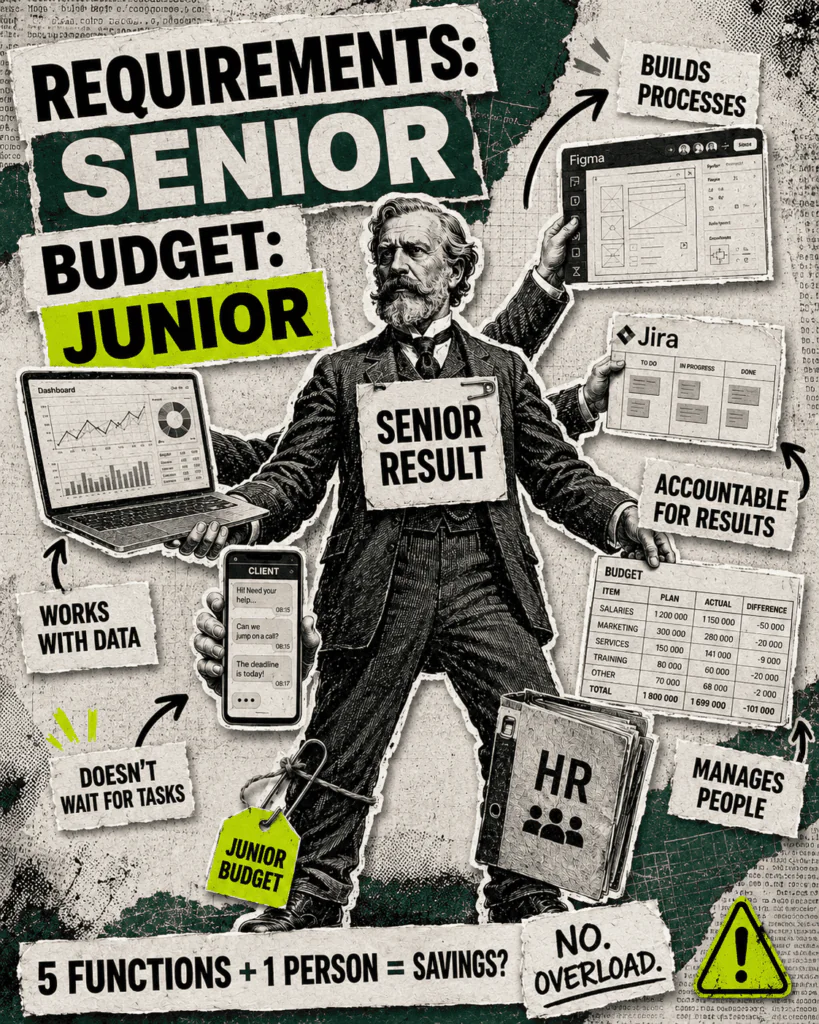
Today, let us skip the romantic stories about a “young, dynamic team” and the “opportunity to grow with the company.” Employers really do regularly expect senior-level results for the kind of money the market would normally offer a junior or a relatively inexperienced middle-level specialist. You see it in marketing, HR, sales, design, IT, finance, customer service, operations, and virtually every profession where the result cannot be placed on a supermarket scale and weighed at the checkout.
And the company is not always deliberately trying to deceive you. Sometimes the situation is far more interesting: it genuinely believes its offer is perfectly reasonable. That is when things become truly frightening.
Employers Often Do Not Need a Senior. They Need a Problem-Free Life
Let us start with the uncomfortable part. When a manager says, “We need a strong specialist,” they do not necessarily have the senior career level in mind. Managers rarely wake up thinking, “What grade of specialist should I purchase today?” Their reality usually looks rather different.
Sales have dropped. Advertising is behaving strangely. Customers are complaining. Employees are leaving. Projects are missing deadlines. The owner has asked for the third time why all the numbers are red. A contractor promised to send a report last Wednesday and, judging by their messenger activity, is currently either in deep meditation or living in another country under a new identity.
The manager needs someone whose arrival will make all of this stop being their problem. That is the real vacancy. Not “Marketing Specialist,” “HR Manager,” or “Project Manager.” The real job title sounds more like: “Please take this sack of burning cats away and bring it back in three months as a functioning system.”
An experienced specialist can usually handle a task like that. They can quickly assess the situation, separate symptoms from causes, understand what can be repaired, what must be rebuilt, and what should be carefully carried to the corporate graveyard and never opened again.
In other words, the company really does need senior-level results. The problem is that the vacancy budget was often calculated by completely different people, using completely different logic.
Finance looked at the payroll budget. The owner remembered what they paid someone two years ago. HR opened a few competitors’ job postings. The head of the department said, “We don’t need anyone ridiculously expensive.” And so a magnificent creature is born: the requirements were written by someone whose department is on fire, the salary was approved by someone staring at a cost spreadsheet, and for some reason the candidate is expected to reconcile the two.
Budgets and Expectations Often Have Never Even Met
In an ideal world, the task comes first. Then the company works out what level of specialist is capable of solving it. After that, it studies the market rate for such a person and makes an adult decision.
Can it afford a senior? Hire a senior. Cannot afford one? Reduce the scope of responsibility, hire someone less experienced, and give them a manager, training, or clearer processes. Beautiful. You almost want to put on some gentle music and watch the unicorns prepare the quarterly budget.
In real companies, the process often works differently. A budget for the employee already exists. Let us say it is a particular amount in Ukrainian hryvnias. It was not created because someone carefully researched the market and the cost of the necessary expertise. Sometimes it simply means, “This is what we can afford.” Sometimes it means, “The previous person earned roughly this much.” Sometimes it means, “The owner will not approve anything higher.” And sometimes an especially scientific method is used: the manager names a figure while staring thoughtfully at the ceiling.
Meanwhile, the responsibilities continue evolving on their own. The company grows, the number of processes increases, and mistakes become more expensive. The manager gets tired of controlling everything personally. Customers demand better service. Competitors move faster. New tools, channels, and requirements appear.
Expectations rise. The budget stays where it is.
You end up with the career equivalent of an old refrigerator: more and more food is being stuffed inside, the door barely closes, but no one intends to buy a new one. You just need to push harder with your knee.
That is how the vacancy begins to swell. A content manager used to publish materials on the website. Now they must create a content plan, write copy, handle SEO, analyse traffic, assign tasks to a designer, manage social media, and suggest growth ideas. The job title has stayed the same. So has the salary.
The employer then genuinely wonders why “all the candidates seem rather weak.” Because you are selling economy-class tickets and greeting people at the boarding gate with the question, “Does anyone here know how to fly the plane?”

Where the Belief That Strong Specialists Should Be Cheap Comes From
There is one important thing many candidates underestimate: a business owner is under no obligation to understand the labour market particularly well. Yes, it sounds strange. Someone can run a company, sign contracts, conduct difficult negotiations, and still have only a vague idea of what a good HR specialist, financial analyst, or UX designer costs.
Especially if the company has never needed such a person before.
Imagine the owner of a small business who has spent ten years developing sales. They understand product costs, margins, and sales department structures perfectly. Then the company grows and needs a strong HR specialist.
How much does a strong HR specialist cost? The owner may be working with a figure from 2021, a story told by another entrepreneur, and a vacancy they happened to see on Telegram three months ago. A formidable analytical foundation. Practically Bloomberg.
There is another reason. The work of an experienced specialist often looks suspiciously simple.
A good project manager holds a short meeting, asks a few questions, and changes the priorities. From the outside, it looks as though they spent twenty minutes talking and moved some cards around in Jira. A good HR specialist notices that employee turnover is caused not by “the wrong candidates” but by the manager of one particular department. They conduct interviews, compare the data, and tell the owner. A good marketer switches off some advertising campaigns, changes the funnel, and rejects the director’s favourite idea. A good analyst looks at a spreadsheet and identifies a flaw in the calculation logic within a couple of hours.
The employer sees a couple of hours. The specialist is selling the years that taught them where to look during those couple of hours.
And this is where the classic mistake happens: the company evaluates the amount of visible activity rather than the value of the correct decision. “What is so difficult about it?” Nothing at all. That must be why you have been looking for someone for three months.
Seniors Are Not Expensive Because They Age Elegantly Beside a Laptop
Some managers have a rather interesting understanding of experience. A person works for five years, receives the fashionable word senior, and then starts demanding more money purely because of their chronological age.
Of course, weak experienced specialists exist. The number of years spent in a profession does not automatically turn anyone into an expert. You can repeat the same single year of professional experience ten times. Some people do it with such discipline that you almost want to present them with a certificate.
A good senior costs more for a different reason: they reduce the number of expensive mistakes.
A junior often sees the task. A senior sees the consequences of the task. A junior is asked to launch a new acquisition channel and starts researching tools. A senior first asks who will process the additional flow of leads and whether the sales department can handle it.
A junior hears, “We need to hire twenty people,” and starts looking for twenty people. A senior asks why ten people are leaving the company every month. A junior designs a new interface according to the specification. A senior notices that the specification solves a problem users do not actually have.
That is what companies pay for. Not the number of buttons pressed, the age of the person’s LinkedIn profile, or the haunted expression of someone who has survived three rebrands.
An experienced specialist shortens the distance between a problem and a sensible solution. Sometimes they stop the work altogether before the company spends a month and an entire budget on obvious nonsense. The trouble is that this effect is difficult to see in advance, while the salary is very easy to see. It sits in the budget as one large number.
That is why some employers consider the following arrangement perfectly logical: let us find a young, energetic, highly intelligent person who already thinks like a senior, works like a senior, and takes responsibility like a senior, but for some reason has not yet worked out how much a senior costs.
The perfect candidate. Professionally capable and financially disoriented.
This Is How the Cult of “Fire in Their Eyes” Begins
You have almost certainly heard the phrases. We need someone with fire in their eyes. We need energy. We need someone who wants to develop. Motivation is important to us.
There is nothing inherently wrong with these words. Working with someone who is interested in absolutely nothing is difficult. When a candidate looks during the interview as though they were brought there against their will and their family is being held hostage, it is fair to have questions about their enthusiasm.
The problem begins when “motivation” becomes a convenient substitute for money.
The company looks for a candidate who will compensate for the professional gap by working excessive hours, studying independently at night, and taking on responsibilities far beyond the role.
The manager says, “We are prepared to give someone a chance.” Sometimes the translation is: “We have found the responsibilities of an expensive specialist and are willing to let you perform them cheaply.”
This is particularly easy to sell to young candidates. They are promised unique experience, direct access to senior leadership, extensive responsibility, influence over the product, and rapid growth. All of those things genuinely can support development. Difficult tasks can accelerate professional growth, and working alongside a strong manager can sometimes teach you more than a course whose homepage features a confident-looking person in a blazer.
But development requires the right environment.
When a junior receives a difficult task, support, permission to ask questions, and regular feedback, they grow. When a junior receives a burning department, access to the corporate chat, and a request to “show initiative,” they extinguish the fire with their own face.
That is experience too. Just a rather specialised variety.
Companies Want One-Person Armies Because They Calculate the Cost of People, Not Functions
Look at job postings from small and medium-sized businesses. They are often searching not for a person to perform a specific role, but for a portable collection of corporate services.
A marketer handles advertising, social media, analytics, and partnerships. HR recruits, manages onboarding and documentation, organises company events, and takes care of internal communications. An office manager gradually becomes a procurement specialist, administrator, executive assistant, and the person who knows why the third printer has once again decided to end its relationship with Windows.
A project manager leads the team, communicates with clients, sells additional services, and controls project finances. A content manager writes, edits, and publishes materials, designs simple banners, handles SEO, and analyses performance. If they can also edit video, the company begins looking at them with the tenderness of a business owner who has found free parking in central Kyiv.
Why does this happen? Because companies often calculate the cost of an employee but fail to calculate the cost of the functions.
Suppose the business needs content. A separate editor, SEO specialist, and social media manager cost money. That means several people, several salaries, and several terrifying lines in a spreadsheet. Let us combine them.
At the Excel level, it looks magnificent. Three roles have become one. Savings. Financial magic.
The problem starts after the person is hired. One human being cannot physically perform every function with equal depth. They choose whatever is urgent, then whatever is loudest. After that, the manager arrives and asks about the strategic tasks. The strategic tasks are lying in the corner. They have already been given names.
The company says the specialist “cannot handle it.” Of course they cannot. You hired one person to do the work of a small team and are surprised they have not reproduced by budding.

Sometimes the Vacancy Is to Blame Because It Was Assembled Like a Pizza
There is another source of senior-level requirements paired with junior-level budgets: the job description itself.
It is sometimes created by a remarkable group of people. HR asks the manager to write the requirements. The manager submits everything they can remember. HR studies competitors’ vacancies. The owner adds a couple of wishes. Someone says everyone needs AI now. Another person remembers English. Someone else recently saw the impressive phrase stakeholder management on LinkedIn.
Everything is mixed together. A text emerges.
The candidate reads it and assumes the company is building the next Google. The company sells furniture.
The “Nice to Have” section is particularly interesting. The heading itself sounds gentle, almost friendly. Team management experience would be an advantage. So would knowledge of financial planning, Upper-Intermediate English, international project experience, and the ability to conduct research.
Twenty lines later, it becomes clear that the real advantage would be a previous life lasting approximately forty-seven years.
The company may genuinely not require every skill on the list. The candidate does not know that. They see the profile of an extraordinarily strong professional and compare it with the stated salary.
The mismatch in expectations appears before the first interview. Strong specialists move on. Beginners apply. The manager conducts several interviews and tells HR, “The candidates seem rather weak.”
This is one of my favourite corporate storylines. The company puts up a sign saying “Canteen,” sets canteen prices, and then becomes upset when Michelin still has not sent an inspector.
Some Employers Know Exactly What They Are Doing
Now let us take off the child-safe gloves. Some companies have not misunderstood anything.
They know the market value of the specialist, understand the level of responsibility, and can clearly see the difference between a junior and a senior. They simply do not want to pay.
Businesses exist to make money. Reducing expenses is entirely normal. An employer is not obliged to transfer an additional thousand dollars to you purely out of admiration for your beautiful set of competencies.
The problem begins when cost-cutting is disguised as a career opportunity for you.
The company deliberately searches for someone below market rate and uses a perfectly understandable method. It widens the candidate funnel, searches for a long time, gives people difficult test assignments, takes advantage of their desire to find work, and talks about a future salary review.
Someday. After probation. After the KPIs are achieved. When the company reaches a certain level. When the difficult period ends. When Mercury approves the budget.
A promise of salary growth means nothing on its own. A date, conditions, and a clear metric mean something. “After three months, we will review your compensation from X to Y if A, B, and C are achieved” is an agreement. “Show us what you can do and then we’ll talk” is a sound. A pleasant, warm sound that costs the employer absolutely nothing.
Why Juniors Accept Senior-Level Responsibility
Because they need a job. There is your complex psychological analysis.
People like discussing the labour market as though candidates were completely free participants in the negotiation. They study offers, compare conditions, and confidently choose a career path.
Sometimes that is exactly what happens. And sometimes a person has rent to pay. They have a family. Their emergency fund would cover roughly one and a half takeaway meals. They have been job hunting for four months, submitted twenty-seven applications, received eight silences, three automated rejections, and a recruiter wrote “I’ll get back to you tomorrow” sometime last month.
In that situation, a vacancy with low pay and enormous requirements looks different. It looks like income.
Employers sense the state of the market. A candidate-driven market allows specialists to negotiate. An employer-driven market allows companies to talk about “the opportunity to prove yourself.”
Junior specialists are particularly vulnerable. They have not yet developed an internal understanding of what is normal. They do not know how many responsibilities one person can realistically handle, where a broad role ends and professional cannibalism begins, or how to calculate the value of responsibility.
They are told, “Everyone here is multifunctional.” Fine. “We’re a start-up, so everyone does a little more.” Reasonable. “You will be responsible for the entire marketing function.” This is where it may be worth slowing down.
A junior can mistake enormous responsibility for trust. They think: if the company is willing to place me in charge of an entire function, perhaps I really am already strong enough.
Sometimes the company simply could not find anyone else. Those are different things. Very different.
Why Even Seniors Accept These Offers
Now for the most uncomfortable truth for experienced specialists. Seniors do sometimes accept junior-level salaries. Employers remember that.
A person has been looking for work for a long time. They have moved to another city or country. They are changing fields. Returning after a career break. They have lost their previous role. They want to leave a toxic company so badly that they would happily work as a volcano keeper, provided the volcano promises not to message them after 7:00 PM.
Sometimes a senior simply undervalues themselves. This is particularly common among specialists who have spent many years in one company. They know every internal process down to the last file, but have little understanding of the external market.
They open job postings, see enormous lists of requirements, and conclude that they have fallen behind. They lower their expectations, attend an interview, and accept an offer. A week later, they discover that the “complex analytics system” is a Google Sheet with five tabs, while the “international division” consists of one client from Poland.
Congratulations. You are a senior again. Only the salary has already been signed.
There is another category of experienced specialist. They deliberately accept below-market compensation, expecting to prove their value quickly and renegotiate. Sometimes it works.
Sometimes, six months later, the manager puts on a very serious expression and explains that the company is going through a difficult period.
The senior looks at the processes they rebuilt, the team they trained, and the improved results. The company looks at the contract. Everyone sees something different.
“We Need Someone Independent” Can Mean Two Completely Different Things
Independence is an excellent quality. An experienced specialist genuinely does not need a manager appearing in the chat every forty minutes to ask, “Any progress?”
However, during an interview, it is worth listening carefully to what the company means by “independence.”
In a healthy team, an independent employee receives a goal, context, authority, and access to the necessary information. They choose how to achieve the result and discuss difficult issues with the manager when required.
In an unhealthy team, independence means the absence of a system. There is no documentation. The processes exist inside the head of an employee named Oleh. Oleh is on holiday. You need to request access from Anastasiia. Anastasiia has resigned. No one can clearly explain why the previous specialist left. The manager says they “couldn’t keep up with the pace.”
You are given a laptop, wished good luck, and asked two weeks later where the results are.
This is precisely where the company wants a senior. A junior will ask too many inconvenient questions. Where are the instructions? Who is responsible for approval? How are decisions made? Which metrics matter most?
A senior has a chance of excavating the corporate archaeological layers and building something that works. That is exactly why the company wants one. For some reason, it does not want to pay for the ability to pull a company out of an organisational pit without assistance.
After all, they are independent.
Ukrainian Companies Particularly Love the Word “Versatility”
Ukrainian businesses have an understandable habit of operating in a constant state of rapid adjustment. Teams change, business lines open and close, some processes move elsewhere, and employees work from different cities and countries. The company has one reality today, and a few months later the entire plan has to be rebuilt.
Versatile people really are valuable in that environment. A specialist capable of stepping beyond a narrow job description can save the company an enormous amount of time.
Versatility has a price, however. For some reason, this detail is regularly forgotten.
The company says, “We need someone who can pick up different tasks.” Wonderful. In that case, you are purchasing flexibility, and flexibility is a professional skill.
The person must quickly understand new contexts, work with different departments, switch between different types of tasks, and maintain quality while doing so. That is more difficult than performing one clearly defined function.
Some employers reason in the opposite direction. If the employee has no single narrow area, the work must be relatively simple. A little HR today. A little paperwork tomorrow. Help the director on Wednesday. Run an onboarding session on Thursday. Prepare a report on Friday.
The word “little” has astonishing power. Place it in front of any task, and the task practically stops taking time. Do a little social media management, communicate with clients a little, monitor contractors a little, and manage the budget a little.
By the end of the week, the employee is lying face-down on the desk a little.
How to Recognise Senior-Level Work Inside a Junior Vacancy
Do not focus on the job title. Job titles lost their ability to communicate the truth a long time ago.
At one company, a Marketing Manager controls strategy and the budget. At another, they select images for Instagram. At a third, they handle everything the owner did not have time to do.
Look at the level of decisions.
If you are expected to carry out specific tasks within an established system, the role is usually at junior or middle level, depending on complexity. If you are expected to decide independently which tasks should be performed in the first place, the level of responsibility is already higher.
When a person must build processes from scratch, make decisions with incomplete information, influence financial results, coordinate other employees, and take responsibility for an entire function, the company is buying experience. Even if the vacancy is called “Assistant.”
The phrase “Junior Head” is particularly entertaining. Yes, this form of corporate creativity also exists. Entry-level position, young specialist, ownership of a business function, and responsibility for KPIs. The next logical step is probably an internship as CEO with the possibility of receiving a reference.
Pay particular attention to the words “build from scratch.” Building from scratch means no functioning system exists. You will need to investigate the situation, propose a structure, persuade your colleagues, implement processes, and survive the resistance of people who have become emotionally attached to the old disorder.
That is expensive work. If a company wants it for the lowest possible salary, it either does not understand the level of the task or is deliberately cutting costs. Both options require questions.
An Interview Quickly Reveals Whether the Company Wants Talent or a Discount Miracle
Ask what result the company expects the person to deliver after three months. The result, not a list of tasks.
Sometimes this is where an exciting improvisational theatre performance begins. “Well, it is important that the person gets involved.” Fine. “That they take ownership of the function.” Understood. “That we start seeing the first results.” Which results? “Well, good ones.”
You are looking at a vacancy with metaphysical KPIs.
The more senior the specialist, the more specific the conversation about results should be. The company wants to increase the number of qualified leads, reduce time to hire, build a reporting system, launch a product, restructure a department, or reduce errors. Those are things you can discuss.
When an employer wants senior-level results on a junior-level budget, it often tries to keep expectations as broad as possible. Specificity creates uncomfortable questions.
If I am responsible for increasing sales, what authority will I have? If I am building HR processes, can I influence department heads? If I am responsible for marketing, what is my budget? If I must reduce project delivery times, can I change how the team works?
And sometimes a beautiful detail emerges: the responsibility belongs to you, while authority will be discussed later.
The corporate version of an attraction where you are strapped to a rocket while someone else keeps the controls.
“We Do Not Micromanage” Sometimes Means There Is No Management Either
Companies have learned to use the right words. Flexibility, freedom, autonomy, minimal bureaucracy, fast decisions. It sounds wonderful.
But the absence of bureaucracy and the absence of management are two different things.
In a strong company, the process may be simple. Everyone understands the goal, their role, and the decision-making procedure. There is little documentation because unnecessary documents genuinely are unnecessary.
In a weak company, there is also little documentation. Zero.
Everyone makes agreements however they can. Decisions change after messages from the owner. Priorities exist until the next meeting. An employee who was told yesterday that a task was urgent is asked today why they wasted time on it.
A junior quickly becomes lost. A middle-level specialist starts getting nervous. A senior may be able to build a system. That is why the company needs a senior.
Yet the owner sometimes sees it differently: “Everything is simple here. We’re a small business.” A small business can have extremely complex processes. The number of employees tells you nothing about the amount of disorder.
Sometimes ten people can create an organisational reality so impressive that a corporation with five thousand employees would quietly remove its hat in respect.
Company size is not an argument for low pay. The phrase “we have a small team” describes the structure. It does not magically reduce the complexity of your work.

Employers Compare Salaries with Tasks When They Should Compare Them with Responsibility
Suppose two specialists work with the same spreadsheet. The first enters data according to instructions. The second uses that data to decide where the company will allocate its budget.
The tool is the same. The value of the work is different.
Two HR specialists conduct interviews. One works from a completed job profile and passes the information to a recruiter. The other independently determines the requirements, advises the hiring manager, and takes responsibility for the quality of the hire.
Two marketers open the same advertising platform. One launches campaigns that have already been prepared. The other allocates the budget and is responsible for return on investment.
Companies often say, “But the tasks are similar.” Of course they are. A surgeon and a medical student may also hold the same scalpel. There is only a minor difference in the rest of the evening’s programme.
The value of a specialist is not determined by the number of actions they perform. It depends largely on the level of their decisions and the cost of an error.
If an employee’s mistake can be corrected in an hour, that is one level of responsibility. If a poor decision burns through the monthly budget, ruins the hire of a key employee, or causes the loss of a major client, that is a different kind of work.
When an employer wants to hand you expensive decisions but pay only for the number of “simple tasks,” you get senior-level results on a junior-level budget.
That is why candidates should pay particular attention to the phrase “responsible for.” Responsible for a function, the result, meeting the target, or quality. Wonderful. Now another question arises: what is the value of that responsibility to the company?
And then another. Why should the person accepting that responsibility be paid like an executor?

Why This Kind of Saving Usually Costs the Company More
Suppose the company wins. It finds a young specialist. They are intelligent, motivated, and willing to accept pay below the level of the responsibilities.
Time to open the champagne. The budget has been saved.
One month later, the person is still trying to understand everything. After two months, they have made several mistakes. After three, part of the process is being held together by goodwill and fourteen spreadsheets. The manager is unhappy: “We expected more independence.”
Yes. That is exactly why independent, experienced specialists cost more.
The company begins monitoring the employee. The manager spends their own time helping and correcting them. Colleagues fix mistakes. Decisions take longer. The money saved on salary begins quietly leaking through other expenses.
This is one of the business world’s favourite mistakes: calculating direct costs while ignoring indirect ones.
The salary is visible. The two hours a manager spends every day correcting an employee’s work do not appear anywhere as an attractive red line. A lost customer rarely signs a document saying, “I left because you decided to save money on an account manager.”
Weak analytics does not visit the owner’s home and say, “Good evening. I am the reason you have been making the wrong decisions for the past four months.”
The costs are quiet. That is why a company can spend years repeating the same cycle: hire cheaply, become disappointed, dismiss the employee, and reopen the vacancy. HR already copies the description automatically.
Somewhere online, a new post appears: “Why is it so difficult to find good specialists these days?”
The mystery of the century.
Juniors Pay for These Savings Too
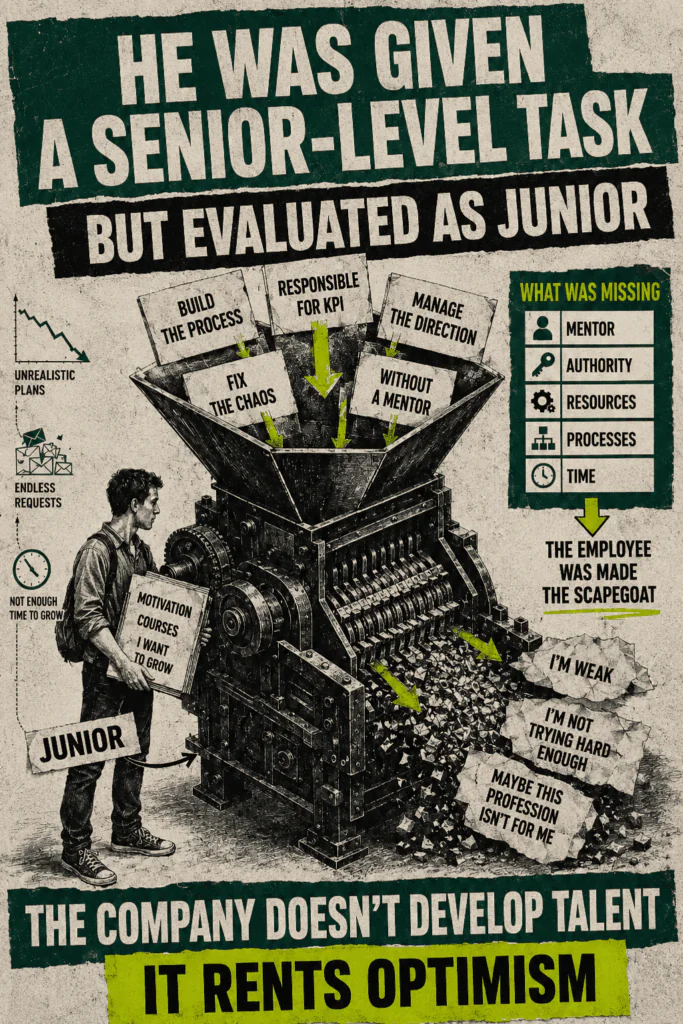
When someone performs work above their current level without support, they often reach a dangerous conclusion: “I am a weak specialist.”
They were given a senior-level task. There are no resources, no processes, and the manager does not understand what result they want. Three months later, the project does not work.
Who is closest to the situation? The employee. Therefore, the employee must be the problem.
The junior begins working more. They study in the evenings, watch courses, rewrite plans, take on additional responsibilities, arrive earlier, and leave later. The result improves slightly, but the systemic limitations do not disappear.
The person decides they are not trying hard enough. A very convenient arrangement for a badly managed company.
Eventually, the employee leaves convinced that the profession is not right for them. A month later, the company posts the vacancy again. The text is almost identical. It now includes the line: “We need someone who can cope well with stress.”
Of course. The previous person was insufficiently resistant to the professional meat grinder.
It is important to understand something simple here. A difficult task does not automatically mean you are not ready for it. However, the level of the result always depends on the conditions, authority, resources, and experience available within the team.
If a company gives a junior senior-level responsibility, it must compensate for the gap with mentoring, a strong manager, time, clear stages, and permission to make mistakes.
When none of that exists, the company is not developing talent. It is renting optimism.
The Phrase “We’re All One Team Here” Deserves Questions Too
A team really can distribute the workload. Sometimes, however, the distribution works like this: weak processes create a problem, and the most responsible person takes it away.
Every company quickly discovers who can “handle it.” That person begins receiving difficult, urgent, and poorly defined tasks. Then they are given work from colleagues who “do not have time.”
They cope. The company concludes that they can be given more.
A year later, the employee is effectively performing the work of the next level, while their job title and salary remain unchanged. Why? Because the system already works.
An employer rarely wakes up thinking, “It seems Andrii is now creating more value for the company. We must urgently increase our expenses.” A review usually begins when a risk appears.
Andrii asks for a raise. Andrii receives another offer. Andrii places a resignation letter on the desk. Suddenly, the budget exists. Sometimes within a matter of hours.
Financial archaeology works miracles.
Everyone who hopes the employer will independently notice their increased workload needs to understand this. A good manager will notice. A strong performance review system will notice. In every other case, your additional work may simply become the new normal.
You saved a report over the weekend once. The company was grateful. You saved the report over the weekend a second time. The company became accustomed to it. The third time, you say you are busy. The company is surprised by your lack of engagement.
The human brain quickly becomes accustomed to free improvements. The corporate brain does too.
When a Low Budget and Difficult Responsibilities Can Still Be a Reasonable Offer
Not every vacancy with extensive responsibility and a modest salary is an attempt to find cheap labour.
Sometimes the company genuinely has limited funds. A young business, a small project, a new business line, or a difficult period. That is reality.
The budget is not the only question. The honesty of the agreement matters too.
Imagine a company that says: “We need someone more experienced, but right now we can only pay X. There are many responsibilities. The first six months will be difficult. Here is the financial state of the division, here are our expectations, and here are the conditions under which we are prepared to review compensation.”
That is an adult conversation. You can refuse, agree, or assess the risk.
A completely different story begins when the same reality is wrapped in language about limitless development.
“A start-up mindset” may mean there are few processes. “A fast-paced environment” sometimes warns you that priorities constantly change. “The opportunity to make an impact” may exist because there is no one else available to make one. And the phrase “compensation is discussed individually” occasionally means the company would prefer not to show the budget to anyone yet.
The words prove nothing by themselves. Candidates must nevertheless learn how to translate corporate language back into human language.
This is especially important when the company asks you to step into a role above your current level.
What will you receive apart from the salary? Genuine mentorship? Access to strong specialists? A visible portfolio project? Management experience? A new market? A clear compensation review?
If the only benefit is “it will be difficult, but you’ll learn a lot,” you are looking at an ordinary difficult job. It has simply dressed itself up as a career opportunity.
What to Ask During an Interview to Understand the Real Level of the Role
Do not limit yourself to the list of tasks. You have already read that beautifully written list in the vacancy. Examine the structure of the responsibility.
Find out who currently performs the work. The answer often reveals where the vacancy came from. If the tasks are currently divided between the manager and three employees, and the company now wants to hand all of them to one new hire, the situation becomes considerably clearer.
Ask why the previous specialist left. Sometimes the answer will be, “Our values did not align.” Fine. Which values? “They couldn’t handle the pace.” What does pace mean? “We have a lot of tasks.” How many?
Continue asking normal questions. Do not turn it into an interrogation, but do not allow attractive phrases to remain nothing more than attractive phrases.
Find out which decisions you will be able to make independently. This separates real responsibility from decorative responsibility. Then ask what resources already exist: the team, budget, contractors, tools, processes, and access to data.
If you are expected to deliver the result, you will need something with which to create that result.
And make sure you ask what good performance looks like after three and six months. Then listen carefully.
A company that understands why it is hiring someone can usually explain its expectations. A company that simply wants “a strong employee” begins talking about proactivity, engagement, and the desire to develop.
Those are qualities. They are not results.
You can be an extraordinarily proactive person and move the company in the wrong direction with tremendous energy.
Candidates Need to Stop Selling Themselves as a List of Responsibilities
There is a reason some strong specialists regularly receive offers below their level. They describe themselves like juniors.
“I worked with advertising campaigns.” “I was involved in recruitment.” “I managed projects.” “I created content.”
Fine. What changed because of your work?
A senior does not cost more because their hands perform different movements. A senior demonstrates impact. What did you rebuild? What did you reduce? What did you launch? Which metrics did you increase or decrease? Which cause did you identify? Which problem did you prevent? Which decisions did you make?
When an experienced specialist describes themselves exclusively through a list of activities, the employer sees an executor. And offers the salary of an executor.
This is particularly noticeable in the Ukrainian market, where candidates are often afraid of sounding “too confident.” Someone has been responsible for an entire function for five years, yet says during the interview, “Well, I helped a little with the processes.”
Why? Why are you independently reducing the value of your work before the negotiations have even begun? No one asked you to do that.
Modesty is an excellent human quality. In salary negotiations, it sometimes works like an employer discount code.
Be precise. Do not turn every working day into a legend about saving the corporation. Recruiters can smell theatre too. But describe the level of your responsibility correctly.
If you made decisions, talk about the decisions. If you managed a budget, state its size or scale. If you built a process, explain what existed before you and what changed afterwards.
Senior-level results must be visible. Otherwise, the market will evaluate nothing but the number of years.
What to Do If You Already Work Like a Senior but Are Paid Like a Junior
First, stop discussing the situation at the level of emotion. “I do a huge amount of work” is a weak argument. Everyone does a huge amount of work. At least according to the conversations beside the office coffee machine.
You need a map of your responsibility.
Look at the role you were hired for and what you actually do now. Which decisions do you make independently? Which metrics are you responsible for? Which processes exist because of you? Which tasks were previously performed by the manager or several employees? What would happen if your function stopped for one month?
The final question is unpleasant but extremely useful.
Then gather the results. Not “the sales department started working better.” What exactly changed? Not “I improved onboarding.” How can that be seen? Not “I built processes.” Which processes? What became faster, and which mistakes disappeared?
Then have the conversation. Do not approach it with the phrase, “I feel I deserve more.”
Discuss the change in the role.
“When I joined, I was responsible for X. My area now includes Y and Z. I make the following decisions independently. Over the past few months, I have delivered these results. In practice, the level of responsibility has changed. I would like to discuss reviewing the role and compensation.”
Then stop talking.
Do not rush to rescue the employer from an uncomfortable silence. Candidates and employees often name their desired amount, see the manager’s expression, and immediately begin negotiating against themselves.
“Well, I could accept less.”
The person has not said anything yet. Perhaps they are simply trying to remember whether they turned off the iron.
Allow the other side to respond.
If a Company Needs Senior-Level Results, It Must Make an Adult Decision
Businesses always have limited resources. That is normal.
Even large companies count money. Sometimes especially large companies, because they employ a special person capable of finding your three unnecessary software licences and sending an email to fifteen recipients about them.
A limited budget does not cancel the reality of the market.
If a company needs a senior, it has several options. It can pay for a senior. It can reduce the scope, hire a middle-level specialist, and give them a strong manager. It can divide the functions between several people or bring in a consultant for the difficult stage. It can rebuild the process or automate part of the work.
There are options.
The arrangement “let us find someone cheap and demand the maximum result” is also a choice. It is simply a bad one.
Sometimes the company really does win. It finds a strong candidate going through a difficult period in life. The person joins, builds the processes, and produces results.
Then the specialist regains their confidence, studies the market, and leaves for a company where their work is valued more highly.
The manager is upset: “We invested so much in them.”
You invested tasks. They invested expertise. Do not confuse the two.
The company then returns to the market in search of a “loyal specialist.” Preferably someone strong, independent, and willing to stay for a long time. There are currently no plans to increase the budget.
The Main Reason Is Rather Unpleasant
Why do employers want senior-level results on a junior-level budget?
Because they can try.
That is all.
A company posts a vacancy. One hundred people apply. There may genuinely be a strong specialist among them who is willing to accept the offer. Why would the employer not test the possibility?
A business will always try to receive more value for less money. A candidate must try to receive fair compensation for the value they provide. That is negotiation.
The problem begins when the candidate expects fairness to operate automatically.
The labour market is not a system of moral rewards. No one is obliged to notice one day that you are a wonderful specialist, start playing ceremonial music, and add 40% to your salary.
The employer protects its budget. You must understand the value of your work. Not invent it or inflate it out of thin air. Understand it.
If a vacancy requires independent management of a business function, influence over business results, process building, and expensive decisions, treat it as an experienced role. Whatever the title says.
If the company offers a beginner-level budget, ask questions. Perhaps the responsibilities in the vacancy are broader than the reality. Perhaps the company is willing to negotiate. Perhaps there is a strong mentor and a clear development path.
Or perhaps someone is simply trying to buy five years of your experience for the price of a person who still needs to be shown where the company’s Google Drive is.
In that case, the decision is also relatively simple. You can accept, refuse, or negotiate. Just do not tell yourself the comforting story that enormous responsibility paired with low pay is automatically an “opportunity.”
Sometimes it really is an opportunity. Sometimes the company has simply found an attractive name for saving money.
And, for some reason, decided that you should be the one developing in this arrangement.