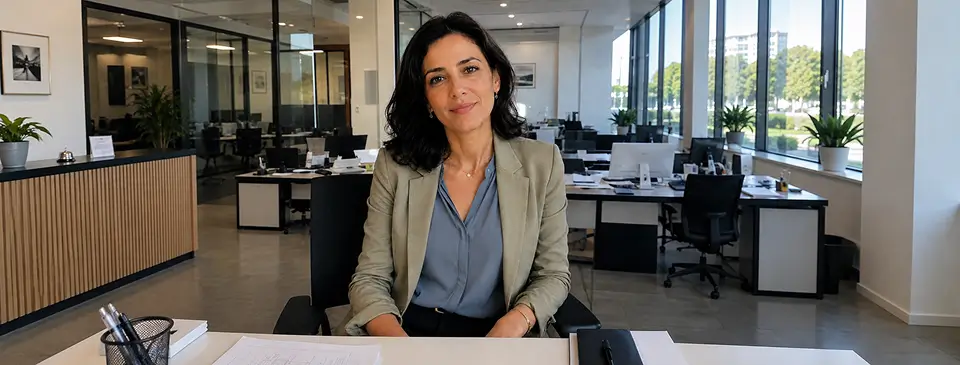



The story of Rustam Jalilov
“I’m Not Against Risk, I’m Against Fog”: How Rustam Jalilov Changed Careers and Found Online Work at Aurum Desk
When people talk about changing careers, they usually picture young professionals: someone finishes a course, puts together a portfolio, sends out a CV, and within a couple of months is already working in a new field. Reality is usually more complicated. Especially when you are 46, and behind you are not startups and trendy case studies, but a warehouse, a hardware store, rent, suppliers, debts, customers, a cash register, and years of making decisions on your own.
Rustam Jalilov from Khujand had not planned to change his line of work. He had a small shop, regular customers, and a familiar rhythm. But the market was changing, costs were rising, and the desire to remain only in offline retail was gradually fading. He did not want to “start life from scratch,” and he did not believe in glossy promises about quick money. He needed clear work where his experience, practicality, and ability to count money without illusions would be useful.
In the end, Rustam found an online job at Aurum Desk, a company that helps private clients and businesses bring order to their finances, assess opportunities, calculate risks, and choose a clear strategy for moving forward. He found the job through LinkWork.
We spoke with Rustam about how it is possible to change careers after many years in your own business, why looking for remote work turned out to be harder than he expected, and what helped him find work from anywhere in the world without leaving Khujand.
“For a long time, I thought changing careers was for people who were twenty-five”
Rustam, you spent many years running a hardware store. At what point did the idea of looking for another job appear?
There was no moment when I woke up one morning and decided: that’s it, I’m leaving for a new life. That only happens in films. In real life, you start by doing the math.
My shop is small. Not a chain, not a big business. A regular place: paint, fasteners, light bulbs, tools, small things for repairs. There are regular customers, there is seasonality, there is rent, and there are suppliers who also want their money on time.
In recent years, it became harder to keep everything tied to one place. People became more careful with spending, some purchases moved online, and rent did not get any cheaper. I began to realize that the shop was feeding us, but it was no longer creating any cushion. And my son is studying in Dushanbe, my daughter is still in school. Paper can tolerate anything; the cash register cannot.
At first, I thought I would simply find some additional income. Then I realized I was not interested in a random side job, but in work where I could use what I already knew: accounting, order, checking numbers, and talking to people without fog.
So you did not want to completely give up your previous experience?
Why would I give it up? I did not just get up from the couch yesterday. I have a warehouse, deliveries, a shop, negotiations, conflicts with landlords, returns, seasonal drops, debts, and purchases behind me. It is not a framed diploma, but it is experience.
I simply thought for a long time that if a person wants to change careers, they need to forget everything old and become someone else. Then I understood: no. You do not need to throw away your past experience. You need to translate it into another language.
I did not call it “financial analysis” when I calculated how much stock to buy before the season. I did not call it “risk assessment” when I decided whether to work with a new supplier. I did not call it “customer base management” when I knew who could be given goods on hold without prepayment, and who was better not to trust. But in essence, that is what it was.
“There are many vacancies, but little clarity”
How did you start looking for work?
Like most people. I opened job sites and started looking. Then I quickly realized that there were many vacancies, but little clarity.
They write: “promising team,” “uncapped income,” “fast growth,” “remote from anywhere in the world.” Sounds good. But I immediately look at the details: who pays, what they pay for, what the schedule is, what the task is, where the fixed part is, where the commission is, who is responsible for training, what the requirements are. It does not need to sound beautiful. It needs to work.
I often came across vacancies where everything was like fog. It seemed to be online work, but the responsibilities were unclear. It seemed you could find work from anywhere in the world, but then it turned out you needed to be available from morning until night. It seemed they would “train you,” but in reality you had to bring in clients yourself, set everything up yourself, and carry the risks yourself.
I am not against risk. I am against fog.
What was the hardest part of the search?
The hardest part was understanding where I should go at all.
When you spend your whole life in a business you understand, you know the market. You know who is serious, who promises too much, who pays on time, and who just likes talking. But when you enter the world of online vacancies, at first they all look the same. Everyone has nice websites, everyone has a “team of professionals,” everyone has a “dynamic environment.”
And then there is age. Nobody wrote directly: “We do not hire 46-year-olds.” But you feel that many vacancies are written for a person who is ready to work for an idea, constantly be “flexible,” and go through five stages for an unclear result. I have no desire to play the young enthusiast. I can work, I can learn, I can be responsible for a task. But I am not going to pretend that I do not care how much they pay and how clear the conditions are.
There was also a problem with my CV. I did not have a proper CV for online work. I had experience, but it looked too “offline”: shop, warehouse, trade, supplies. And I needed to show what stood behind all that: accounting, cost control, client work, financial discipline, and risk assessment.
Were you looking at remote work from the beginning?
Yes. It was important for me to stay in Khujand. I have a family, a shop, and a familiar life here. I did not want to move for a job where, three months later, they might say: “Sorry, this direction has been closed.”
So the request was simple: to find work from anywhere in the world, but not in the format of a fairy tale. I did not need a picture of a person sitting by the sea with a laptop and smiling. I have seen enough of those pictures. I needed normal work: tasks, responsibility, payment, communication with the team, and a clear result.

“At first, I tried sending my CV as it was. That was a mistake”
How long did the first applications take?
For the first few weeks, I simply sent my CV wherever I saw words like “finance,” “operational accounting,” “client work,” and “remote.” There were few responses.
Then an acquaintance looked at my CV and said: “Rustam, it says there that you are a shop owner. So what does that tell an employer?” At first, I was offended. Then I reread it and realized he was right.
I was writing like a person telling his biography. But I needed to write like a person showing value.
Before, it said: “kept track of inventory.” It needed to say: “controlled stock levels, purchasing, and product movement, reducing money tied up in illiquid items.”
Before, it said: “worked with suppliers.” It needed to say: “compared supplier terms, negotiated timelines, assessed the risks of delays and overpayments.”
Before, it said: “communicated with customers.” It needed to say: “built long-term relationships with regular customers, resolved disputes, and maintained trust without offering discounts just for the sake of discounts.”
That was when I began to understand how you can change careers not through beautiful words, but by translating experience into tasks an employer can understand.
Did you go through interviews?
Yes, several. They were different.
At one interview, they spent a long time telling me that the company was young, ambitious, and that everyone was like family. I asked about payment and specific responsibilities. The person immediately started speaking in general phrases. I understood: I have enough family at home. At work, I need clarity.
At another place, they were looking for someone to support clients in a financial service. Everything was better there, but the schedule turned out to be inconvenient: I would have had to work according to a time zone that did not suit me. I can adjust, but not to the point of living at night.
There was also a vacancy that promised high income if you brought in clients. I asked whether there was an incoming flow, a database, a clear product. They answered: “The main thing is your activity.” Count first, dream later.
Did you ever want to quit the search?
I felt irritated. Quitting, no.
I am not the kind of person who says after two weeks: “I did not feel inspired.” Job searching is work too. Just unpleasant work. Nobody owes you anything there, nobody knows your life, and everyone needs to quickly understand whether you are suitable or not.
But I saw that in an online job search, it is very easy to lose confidence. You send an application, silence. Another application, silence again. Then a rejection arrives without explanation. You start thinking: maybe I have gone into the wrong place altogether? Maybe it is too late to change careers?
At moments like that, I returned to the facts. What can I do? Count. Check. Speak to people without too much sweetness. See where money is working and where it is just lying around as dead weight. That means I needed to look for a place where those things were needed.
“On LinkWork, for the first time I did not feel like I was being pushed into some random vacancy”
How did you find LinkWork?
Through an acquaintance from Dushanbe. He had previously looked for remote work in support and said: “Take a look at LinkWork, there are many interesting vacancies there.” At first, I was skeptical. There are many sites now where everything is the same: register, fill something in, subscribe, and then receive newsletters with whatever happens to come along.
But I went in and saw that you could filter vacancies properly there. Not just “remote,” but by tasks, format, requirements, and experience level. That was important for me. I did not want to end up in vacancies where they needed a young specialist with no experience but ready to work twenty hours a day.
What exactly helped on the site?
First, the vacancy descriptions. There was more detail. I could understand what the company did, whom it helped, and what tasks the person in the position would have.
Second, I started searching not only by job title. Before, I had been looking for something like “manager,” “administrator,” or “operator.” On LinkWork, I started searching by skills: accounting, finance, client work, analytics, risks, operational processes.
This is an important point for anyone thinking about how to change careers. Do not cling only to your old job title. The title may be different, while the essence of the work is close.
Third, I refined my CV for specific vacancies. Not one CV for everything, but a proper application. Not a three-page novel, but clear examples.
Were you looking only at financial vacancies?
Not only. I looked at operational positions, customer service, and project assistant roles too. But finance was closer to me. I am not a financier by diploma, but for many years I lived in numbers, where a mistake immediately hits your pocket.
In a shop, you cannot hide behind a presentation. If you buy the wrong stock, it just sits there. If you give too large a discount, the margin is gone. If you do not check a delivery, it is your own fault later. That kind of experience disciplines you.
“Aurum Desk caught my attention because they did not promise miracles”
How did you see the Aurum Desk vacancy?
On LinkWork. What caught my attention was not the name at first, but the description. The company wrote that it worked with private clients and businesses: helping them bring order to their finances, assess opportunities, calculate risks, and choose a clear strategy for moving forward.
To me, that sounded normal. No loud promises. No “we will change your life in a week.” It had an approach that was close to me: careful analysis, decisions explained in simple language, and financial clarity.
I thought: this is where my experience could be useful. I am not a banker, not an investment guru, but I know how to look at numbers calmly. And I know how to explain things without a ten-page dictionary.
What was the position?
The position was connected with client analytics and preliminary processing of financial information. Not a manager, not a consultant who immediately gives a strategy, but a person who helps collect data, structure it, notice weak spots, and prepare the foundation for further work by specialists.
I liked that. Because I did not want to pretend to be an expert where I still needed to learn. But I understood that I could be useful in creating order, checking things, paying attention to details, and having a normal conversation with a client.
What did you write in your application?
I wrote briefly that I did not have classic corporate financial experience, but I did have extensive practical experience managing a small business: purchasing, stock levels, expenses, negotiations, client work, and risk assessment. I added that the Aurum Desk approach was close to me: not selling people hope, but helping them see the real picture.
I also wrote a phrase that they later remembered during the interview: “I do not promise a client that everything will be easy. I can help lay out where the money is, where the risk is, where the habit is, and where the mistake is.” Apparently, it landed.
“At the interview, I did not try to look younger and more cheerful”
How did the interview go?
Calmly. That was immediately a good sign.
They did not ask me to describe where I saw myself in five years in the style of a poster on the wall. They asked about my experience, the shop, difficult decisions, working with debts, clients who do not pay on time, and situations where you need to say no.
I answered honestly. For example, there was a period when we took on too much stock before the season, and demand did not come. We could have pretended everything was fine, but the goods were sitting there and the money was frozen. We had to review prices, negotiate with the supplier, and sell part of the stock almost without profit just to return the turnover. Unpleasant, but useful. After that, you start doing the math before purchasing, not after.
Did you feel that age could become a problem?
I thought about it. But at the interview, I decided not to justify myself. Age is age. I do not have a habit of saying: “I am young at heart.” What for?
I said directly: I am not the fastest person with new software, but I am accurate, attentive, and I do not abandon a task halfway through. If a system is needed for work, I will figure it out. Not overnight, but properly.
I think that worked better than trying to show that I was the same as someone who is 25. I am different. And that is not a disadvantage if the task requires a calm head.
Was there a test task?
Yes. I had to look at a sample financial case for a small business: income, expenses, debts, purchases, and seasonality. The task was not just to calculate, but to write what questions should be asked of the owner and where the weak spots might be.
That was where I felt comfortable. It was not about theory, but common sense.
I noted that revenue figures without a sales structure do not say much. You need to understand which goods or services create margin, where money gets stuck, how quickly turnover returns, which expenses are fixed, and which can be adjusted. I also wrote that a client’s debt is not income until the money arrives. Paper can tolerate anything; the cash register cannot.
Later, they told me that what they liked was not the number of clever words, but the logic. I answered: “If it was done properly, then we can work further.”
“The new field did not become easy. It simply turned out to be understandable”
How did your adaptation at Aurum Desk go?
It was not easy. Anyone who says changing careers is easy either has not changed careers in a long time or is selling courses.
I had to get used to online communication, internal systems, documents, and reporting formats. In a shop, everything is physically in front of you: the goods are there, the customer has arrived, the supplier has called. In online work, a lot exists in spreadsheets, tasks, and messages. If you do not keep order, you get lost quickly.
In the first weeks, I asked a lot of questions. Sometimes I felt uncomfortable. At 46, it is not always pleasant to ask someone younger than you where to click. But it is better to ask once than spend three hours pretending you understood everything.
What felt the most unfamiliar?
The speed of messaging. People write briefly, there are many tasks, and some discussions happen in parallel. At first, I wanted to stop everyone and say: “One at a time, I am not running a bazaar here.” Then I got used to it.
It was also unusual that a client could be in another city or country, but the task was just as real as if they were sitting across from you. Money requires order everywhere. Geography changes; arithmetic does not.
What helped you settle in?
Probably the fact that I did not try to argue with the new format, but I also did not throw away my own experience.
When I saw something strange in a client’s data, I did not write: “Operational inefficiency is likely being observed.” I wrote more simply: “This expense appears to be regular, but it is not included in the planning. We need to clarify whether this is a one-time situation or a recurring burden.” At Aurum Desk, that kind of language is valued. The task there is not to show numbers for the sake of numbers, but to explain what stands behind them.
I like that the company does not pressure clients with loud promises. It does not say: “Now we will turn everything around, and there will be growth.” First, they look at where the person is right now. What money comes in, where it goes, what can be changed, and what is dangerous to touch.
That is a normal approach. Count first, dream later.
“You can find work from anywhere in the world, but you need to understand exactly what you are selling to an employer”
Many people now want to find online work or remote work from anywhere in the world. What would you tell them?
First, honestly answer this question for yourself: what can you do well enough that someone will pay you for it?
Not “I am responsible,” not “I learn quickly,” not “I want to grow.” All of that is good, but nobody pays separately for it. They pay for value.
If you want to find work from anywhere in the world, the employer does not see how you sit in the office, how hard you try, or how you arrive on time. They see the result: whether the task is closed or not, whether the client understood or not, whether the report is done or not, whether the mistake was found or not.
Remote work does not make a weak specialist strong. It simply removes the unnecessary commute to the office.
How can someone understand which field to move into?
Look not at trendy titles, but at your real skills.
If a person worked in retail, they may have experience in customer service, accounting, sales, purchasing, negotiations, and operational control. If someone worked as an administrator, there may be coordination, documents, scheduling, and communication. If someone ran a small business, there is a lot there in general; it is just usually not packaged in beautiful words.
When you think about how to change careers, do not ask: “Who should I become from scratch?” It is better to ask: “Where can my experience already be useful if I explain it properly?”
What should someone do with their CV when changing careers?
Remove the biography and leave the value.
An employer is not obliged to guess that behind your shop, warehouse, or administrative work there is solid experience. You need to show it.
Do not write: “handled various tasks.” Write which tasks, with what numbers, and with what responsibility.
Do not write: “worked with people.” Write what kind of people, in what situations, and what you solved.
Do not write: “have entrepreneurial experience.” Write what you calculated, controlled, improved, and where you made decisions.
And there is no need to pretend that you are a perfect fit everywhere. That is visible immediately. It is better to honestly show where your experience is strong and where you are ready to learn.
“LinkWork helped not through magic, but through order”
What role did LinkWork play in your story?
LinkWork did not take me by the hand and get me a job. And that is good. I do not like it when people promise to do everything for you.
The site helped me see normal vacancies and better match my experience with specific tasks. That is where I found Aurum Desk, understood the requirements, prepared my application, and did not get lost among random offers.
For me, it was not magic, but order. When a person is looking for work, especially if they want to change careers, they need order: where to look, how to filter, how to read a vacancy, and how not to waste time on empty promises.
On LinkWork, I felt less like I was wandering around the market with my eyes closed. The vacancies were clearer, and that is already half the job.
Would you recommend the site to people over 40 who want to change jobs?
Yes, if the person is ready to work with their head and not wait for the site to solve everything for them.
Age itself does not get in the way. What gets in the way is the habit of saying: “I have done it this way all my life, so I will keep doing it.” Or the other extreme: “I cannot do anything because I do not have a trendy job title.” Both are untrue.
People over 40 often have strong practical experience. It simply needs to be packaged properly. Not as a story about the past, but as an answer to the employer’s question: “How will you be useful now?”
“At Aurum Desk, what proved useful was what once seemed like ordinary life”
Which skills from the shop turned out to be unexpectedly useful at Aurum Desk?
First, attention to small expenses. In a small business, small things only seem small. Today you overpay a little, tomorrow you give an extra discount, then you fail to check stock levels, and a month later there is no money. In the finances of private clients and businesses, it is a similar story: weak spots are often hidden not in major disasters, but in regular small leaks.
Second, talking to people. A client may be nervous, ashamed of their mistakes, defensive, or may not say everything at once. If you pressure them, they close off. If you pat them on the head too much, it does no good. You need to ask questions calmly.
Third, distrust of beautiful numbers without context. Revenue has grown — good. But what about expenses? Debts? Seasonality? How much money is actually left? A number without explanation can deceive.
What do you like about Aurum Desk’s approach?
There is no theater there. The company does not act like a magician. The task is to help a person see the real picture: where money is working effectively, where the weak spots are, and what steps can be taken next.
That is close to me. Because in life, many decisions are made on emotion. I will buy more goods because last season was good. I will take out a loan because I will figure it out later. I will open a second location because the first one seems to be holding up. And then it turns out that “seems” is a poor foundation for a decision.
At Aurum Desk, I like that decisions need to be explained in simple language. If you cannot explain it yourself, it means you have not fully understood it yourself.
Do you feel that you really changed careers?
Yes. But not in the sense that I became a different person.
I moved from retail into online work connected with financial clarity and analytics. It is a new field, a new format, and new tools. But inside it, I use what had been accumulating for years.
Before, I helped myself and my shop avoid drowning in chaos. Now I help the Aurum Desk team analyze client data so clients can see the picture more clearly. The meaning is similar; the scale is different.
“I did not become a free person with a laptop by the sea. I became a person with a normal job”
How has your life changed after moving into online work?
There is more structure now. I still spend part of my time on the shop, but I no longer cling to it as the only source of stability. Working at Aurum Desk has given me a new professional path.
I work from Khujand. Sometimes from home, sometimes from a small office near the shop. For me, that is the normal option: finding work from anywhere in the world not for a pretty picture, but for the chance to live where your family and responsibilities are.
I cannot say it has become easy. The workday requires discipline. Nobody is standing over your shoulder, but the tasks will not complete themselves. In an office, at least people can see that a person is sitting there. In remote work, only the result is visible.
How did your family react?
My son was surprised at first. He thought I would not get into online work. Then he began helping me with some technical things, only he explained them too quickly. I told him: “You are not launching an airplane. Speak slower.”
My daughter said that now I am “almost an IT guy.” I said: “Do not insult IT people.” But she is happy that her father did not get stuck in one line of work.
It is important for me to show my children that you can change direction at any age. But not because you need to chase trends. Because life changes, and a person also needs to think.
Do you feel calmer about the future?
Calmer, yes. One hundred percent confident, no. That does not happen.
But now I have the feeling that I am not dependent only on one premises, one street, one season. That matters.
I understood that experience can be transferred. Not all of it, not immediately, and not without learning. But it can. The main thing is not to sell yourself a fairy tale and not to devalue what you already know how to do.
“To anyone who wants to change careers, I would say: do not start with a dream, start with an inventory”
What advice would you give to someone thinking about how to change careers?
First, take inventory of your experience. Literally write down what you have done with your hands and your head. Not job titles, but tasks. What you calculated, whom you negotiated with, what you were responsible for, what problems you solved.
Second, look at where those tasks are needed in another field. Do not search only for familiar titles. Sometimes the right job is called something completely different from what you are used to.
Third, do not believe vacancies where everything sounds too sweet. High income with no skills, a free schedule with no responsibility, fast growth with no clear tasks — that is not a job, it is bait.
Fourth, learn to explain your experience. Especially if you are moving from offline to online. The people on the other side of the screen do not know your story. They need facts.
Fifth, do not be ashamed of your age, but do not hide behind it either. Age should not be either an excuse or a medal. Show value.
And what would you say to those who want to find work from anywhere in the world?
Check three things: skill, discipline, and communication.
Skill is what you can actually do.
Discipline is whether you can work without a manager behind your back.
Communication is whether you can write clearly, ask questions, and admit when something is unclear.
Remote work likes clarity. If you stay silent for three days because you were “figuring it out,” that is bad. If you promise something by Friday and disappear on Friday, that is bad. If you ask a normal question on time, that is good.
Online, reputation is built quickly. And damaged quickly too.
What would you say to yourself at the beginning of the search?
Do not try to look convenient for everyone. Look for a place where your directness does not get in the way, but helps.
At first, I thought I needed to become softer, write more beautifully, and say more of the right words. Then I understood: I do not need to become a different person. I need to learn how to explain my value in a new format.
Aurum Desk turned out to be exactly the kind of place where they value a calm approach, accuracy, and simple explanations. And LinkWork helped me find that vacancy without unnecessary noise.
“The main thing is not to confuse changing careers with running away”
Do you consider your story successful?
It depends on what you call success.
I did not become rich in a month. I did not move to Dubai. I do not sit by a pool with a laptop. I have a job, clear tasks, a new professional path, and the feeling that my past experience did not disappear.
For me, that is normal. Even good.
Changing careers is not an escape from your old life. If you run away, you may arrive at the same problem, only under a different name. You need to understand why you are making the move, what you are taking with you, and what you are ready to learn.
I changed fields not because I got tired of the shop and wanted a beautiful job title. I understood that my experience could be used more broadly. At Aurum Desk, it turned out to be needed. Through LinkWork, I found an opportunity that I might have missed on my own.
Final question. What phrase would you use to describe this journey?
Count first, dream later.
That does not mean you cannot dream. You can. It is just that a dream without calculation quickly becomes someone else’s debt, unpaid rent, or a bad vacancy.
But if you calmly look at your skills, put your CV in order, choose a decent platform for your search, do not grab the first promise, and speak honestly with employers, then it is possible to change careers even at 46.
Not quickly. Not without nerves. But it is possible.
And finding work from anywhere in the world is possible too. It is just better to look not for “any” job, but for one where your experience truly works.