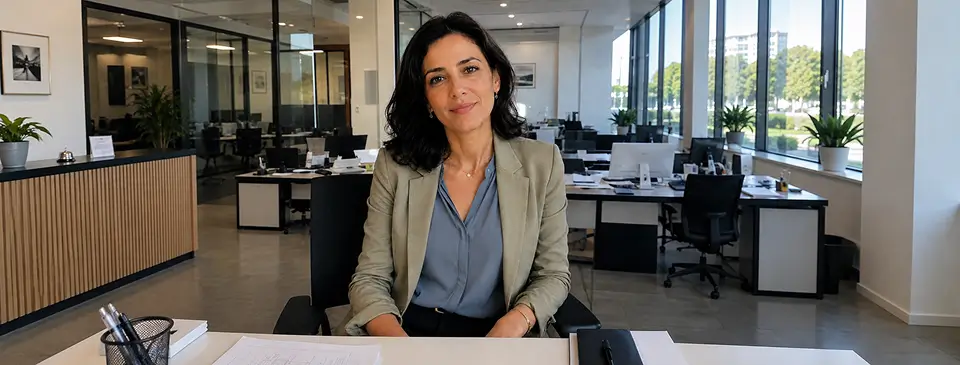



The story of Elina Poghosyan
Job Searching Without a Polished Career Myth: How Elina Poghosyan from Moldova Found a Job at CorePilot Through LinkWork
Job searching rarely looks like the neat story you might read in a career blog: someone discovers their calling, writes the perfect CV, sends out three applications, and receives a dream offer. More often, it starts with exhaustion, doubt, random freelance tasks, a reworked portfolio, and the thought: “Alright, I’ll try one more time.”
Elina Poghosyan from Moldova knows that path well. She is 27. She grew up in an ordinary ground-floor apartment where the door was always opening for neighbors, relatives, and other people’s small requests. Her parents worked different shifts: her mother was a nurse, her father an electrician. Elina learned early to rely on herself, cook dinner, deal with everyday things, and not expect someone to sit her down and explain where to go next.
After school, she started working right away. A coffee shop near a business center became her first real experience: the cash register, customers, shifts, training new employees, schedules, mistakes, responsibility. Later, small writing jobs began to appear: product descriptions, client emails, website pages. That was how Elina gradually moved into content and e-commerce.
But when she needed a stable remote job, the search turned out to be harder than it looked from the outside. Vacancies required experience she barely had “officially.” Recruiters noticed the lack of a strong university background. Test assignments ate up her evenings. And many offers presented as online work turned out to be ordinary office jobs with the occasional call from home.
Today, Elina works online at CorePilot, an IT company that helps businesses launch and develop digital products: web platforms, corporate portals, CRM systems, customer portals, mobile apps, and internal tools. At the company, she works on content for digital projects, helps simplify complex wording, makes texts clearer, and translates business language into the language of users.
Elina was not found by accident. She found the vacancy herself on LinkWork, carefully analyzed the job description, prepared her application, and went through several stages of selection. We spoke with her about what her job search really looked like, why remote work requires discipline even before the offer, and how a candidate without a grand career myth can convince an IT company to give them a chance.
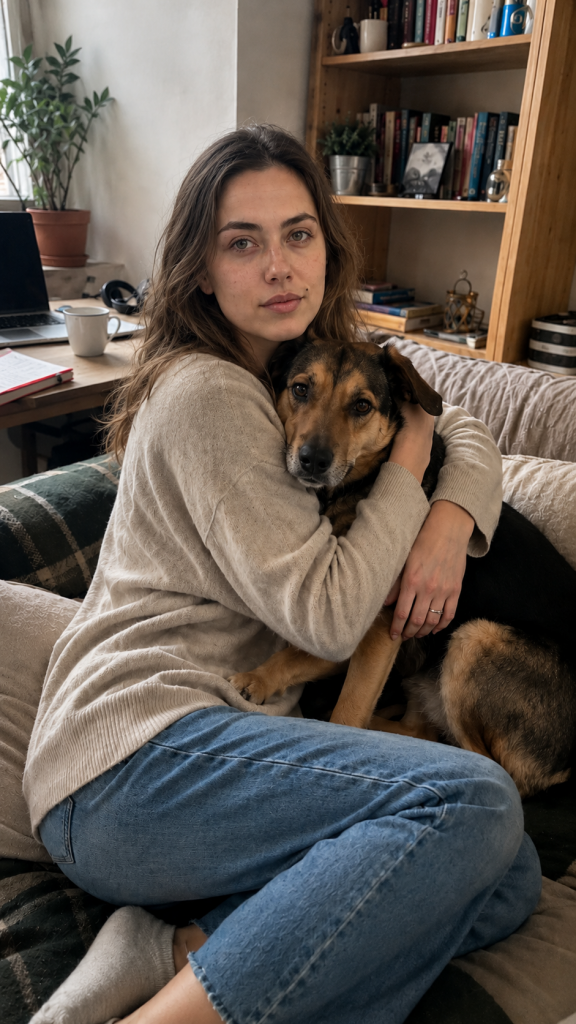
“I didn’t wake up one day thinking: I’m going to become a content specialist. It was much more down-to-earth than that”
— Elina, if you had to briefly describe your path before CorePilot, where did it all begin?
Elina: With a coffee shop, tired feet, and other people’s emails that someone would ask me to read “just quickly.” I worked near a business center, and we had regular customers. Some came in for an Americano, some for a cappuccino, and some to spend ten minutes complaining about contractors.
One client once asked me to look over a short text in English for a website. It was written as if the website was apologizing for existing. I fixed a couple of phrases. A week later, he asked again. Then an acquaintance asked for product descriptions. Then someone brought me a client email.
That was how the first jobs started. Without a sign saying “career in content.” I would simply open my laptop in the evening after a shift and rewrite texts that sounded like notices taped to an apartment building entrance.
— At what point did it become a profession rather than a side job?
Elina: When I realized I was thinking about texts even outside. I would see a banner and mentally shorten the headline. I would open an online store page and think: “The person is already tired of reading, and we’ve only just started saying hello.” At the coffee shop, I was also constantly explaining to new employees how to talk to guests, how not to mix up orders, how not to turn a simple request into a ceremony.
Later, I got a job as a junior content specialist in a small e-commerce team. There were product listings, email campaigns, website copy, promotional descriptions, spreadsheets. I was studying in the evenings and, at the same time, figuring out how content actually works inside a business.
“The job search didn’t start with inspiration. It started with a vacancy spreadsheet”
— Why did you decide to look for a new job?
Elina: I had hit a ceiling. The e-commerce team gave me a lot of practice, but not much growth. The tasks repeated themselves: product listings, edits, promotions, new product listings, more edits. I wanted to move into a team where content was connected with products, users, interfaces, and projects. I was especially interested in IT companies, where text affects not only sales, but also how a person understands a service.
I also needed a remote job. I study in the evenings, and part of the family responsibilities are on me too. Commuting around Moldova drained my energy. I wanted to work online, but in a real team, with clear tasks, not in the style of “write 200 descriptions by morning, payment sometime later.”
— How did you start the job search?
Elina: In a very boring and correct way: I made a spreadsheet. Vacancy, company, format, salary, requirements, whether I had applied, whether there was a reply, what the test assignment was, what I needed to fix in my CV. There was about as much romance in it as in a kettle instruction manual, but the spreadsheet quickly showed me reality.
I saw that I was applying too broadly. Somewhere they wanted a social media copywriter. Somewhere they wanted a content manager with HTML and analytics. Somewhere they wanted a person who would write texts, make banners, call clients, and apparently fix the coffee machine too. At some point I told myself: “Elina, you already worked in a coffee shop. Leave the coffee machines to the previous version of yourself.”
“The main challenge is proving your experience when it’s made up of small tasks”
— What turned out to be the hardest part of the job search?
Elina: Proving that my experience was real. I didn’t have a beautiful path: a specialized university, an internship at a well-known company, a big brand on my CV. I had a coffee shop, e-commerce, evening studies, small freelance jobs, a lot of practice, and the habit of finishing what I started.
In interviews, I sometimes heard: “Why did you start studying so late?” Or: “Your experience is quite mixed.” In those moments, I wanted to say: “Because money for a calm period of ‘finding yourself’ was not being handed out in our apartment building.” But I held back.
The problem was packaging. I myself saw my experience as a set of separate pieces. The recruiter saw pieces too. I had to turn it into a clear story: customer service, e-commerce, texts, training new employees, working with information, understanding the user, discipline.
— How did you change your CV?
Elina: I removed everything unnecessary. Before, my CV had a lot of descriptions like “responsible, communicative, quick learner.” It sounded as if I was applying for the role of a good person, not a specialist.
I rewrote my experience through tasks and results. For example, not just “worked with product listings,” but “updated the structure of product listings, reduced repetitive descriptions, and brought copy into a consistent format.” Not just “trained employees,” but “prepared short instructions for new employees and helped them get into shifts faster.”
I also reworked my portfolio. Before, it had everything thrown in. Then I left several examples: a product listing before and after, a client email, website page copy, a short guide. For each one, I wrote what the task was, what I did, and why I did it that way.
“Remote work is not a sofa and a laptop. It’s the ability not to disappear into your own schedule”
— Were you only looking for remote work from the beginning?
Elina: Yes. I considered online work or hybrid work with rare in-person meetings. But I quickly realized that the word “remote” in vacancies sometimes lives a life of its own.
There were offers where remote work meant: “You are at home, but available every minute, camera on, breaks need approval.” There were vacancies that said “online,” but during the interview it turned out you had to come to the office three times a week. There were also strange offers with payment by volume, where the assignment looked like a marathon with no finish line.
I started reading vacancies more carefully. If the description had a lot of loud words and very few concrete tasks, I closed it. If the test assignment took more than a working day and the company did not explain the selection stages, I closed it too. I was not looking for the perfect job from an advertising picture. I needed a normal team, a clear role, and respect for the candidate’s time.
— What was important to you in a remote-work format?
Elina: Clear tasks, written communication, access to materials, understandable deadlines. I work well when I understand who the text is for, where it will appear, and what action the user should take. The phrase “write it beautifully” sounds to me like “cook something tasty out of unknown ingredients in someone else’s kitchen.”
In a remote format, it is especially important that the team knows how to formulate things. If someone writes: “We need copy for a CRM page, the audience is owners of service companies, the goal is a demo request, the style should be simple and free of corporate jargon,” I can already work with that. If I receive a message saying: “Make it modern,” then the fortune-telling over coffee grounds begins, and I left the coffee shop behind.
“LinkWork didn’t help me find a magic button. It helped me narrow the chaos”
— How did you discover LinkWork?
Elina: Through a classmate from my study group. She was looking for a support role and said that LinkWork made it easier to view vacancies by employment format. I went in without great expectations. At that point, I had a period when I was opening job sites almost automatically, like the fridge at night: you kind of know what’s inside, but you check anyway.
What I liked about LinkWork was that I could filter out irrelevant options faster. I was looking for remote work in content, e-commerce, and IT. I looked not only at job titles, but also at the task descriptions: where I would need to write, where I would structure information, where I would work with a product, where user-facing copy mattered.
— What changed in your search after that?
Elina: I became less scattered. Before, I could send ten applications in one evening and by the morning no longer remember what I had written to whom. After LinkWork, I started choosing more carefully. I looked at how closely the vacancy matched my experience, where I could honestly explain the transition, where my portfolio was relevant.
I opened the CorePilot vacancy because the description felt like real work, not ceremonial copy. It talked about digital projects for businesses: web platforms, CRM systems, customer portals, internal services. That was close to what I wanted. I had previously worked with products and client emails, but I wanted to move toward product copy and interfaces.
“CorePilot caught my attention because they explain technology in human language”
— What did you know about CorePilot before applying?
Elina: Before the vacancy, almost nothing. I studied the company description. CorePilot helps businesses launch and develop digital projects without unnecessary complexity: from the idea and product structure to development, testing, launch, and support. They create web platforms, corporate portals, CRM systems, customer portals, mobile apps, and internal services.
What caught me was the focus: technology should be understandable and useful for business. That felt close to me. I often see good ideas get buried under complicated wording. The company builds digital tools around the client’s real processes instead of handing out the same template to everyone. For a content specialist, that is an interesting environment because you have to understand the task, the user, the product, and the limitations.
— How did you prepare your application?
Elina: I did not send the standard “Hello, please consider my CV.” To me, that kind of letter sounds like knocking on a closed door without explaining who you are.
I wrote briefly: who I was, what experience I had in e-commerce and client-facing texts, why IT products interested me, and which tasks from the vacancy I had already partly done. I also included a link to my portfolio. In the letter, I mentioned that I could turn scattered information into a clear structure. For CorePilot, that mattered because they work with businesses that often have a lot of manual work, spreadsheets, old processes, and internal rules.
I also added one phrase: “I’m interested in writing texts after which the user understands where to click, what will change, and why they need it.” That was honest.
“The test assignment was not about beautiful words. It was about clarity”
— What was the selection process like?
Elina: The first stage was correspondence with the recruiter. They asked me about my experience, work format, expectations, studies, and availability. Then there was a short online interview. I was nervous and kept twisting the ring on my finger the whole conversation. Luckily, the camera mostly showed my face.
After that, they gave me a test assignment. I had to rewrite a fragment of text for a CRM-system page, write a short email to a client after a demo, and suggest the structure of a block for a service page. I liked that the assignment was connected to the real work.
— What was the hardest part of the test?
Elina: Not slipping into ornamentation. When a candidate wants to be liked, they sometimes start writing too solemnly. But here it was important to make things clear. A CRM is not a coronation; it does not need velvet curtains in the text. You need to explain which processes it brings together, whose work becomes easier, where requests, clients, tasks, and reports will be.
I made several headline options, removed heavy phrasing, and added more concrete blocks. For example, instead of the abstract “increasing the efficiency of business processes,” I wrote about requests, statuses, responsible people, and the history of communication with a client. That is easier to understand at a glance.
“At the interview, I stopped apologizing for my path”
— What questions did they ask at the interview?
Elina: They asked how I work with a new topic, what I do when there is not enough information, how I handle edits, and whether I can write for different audiences. They also asked about my transition from a coffee shop and e-commerce into IT.
Before, when I got that question, I would start defending myself. I would explain why I did not go to university right away, why I worked where I worked. At CorePilot, I answered differently: I said that my path was practical. The coffee shop gave me a customer’s-eye view and the ability to explain things quickly. E-commerce gave me experience with products, structure, emails, and deadlines. My studies help me close the theory gaps. Now I want to apply all of that in digital products.
— Why do you think that answer worked?
Elina: Because I stopped talking about myself as someone who needed to be forgiven for having an uneven trajectory. I showed the connection between my experience and the vacancy.
There is a common mistake: a candidate comes to an interview and almost expects the recruiter to assemble their story for them. But recruiters already have enough to do. You need to show for yourself where your experience is useful for the team.
I said that I know how to listen to people, notice unclear points, ask clarifying questions, and turn chaotic data into text. For CorePilot, that is important: clients come with tasks that include many processes, departments, spreadsheets, wishes, and internal rules. Everything has to be laid out so developers, managers, and users understand the same picture.
“There were plenty of rejections. Some still echo in my head like bad advertising slogans”
— Were there rejections before CorePilot?
Elina: Of course. Many. Some companies did not reply at all. Some wrote: “You are interesting to us, but we need at least three years of IT experience.” I would read that and think: “If everyone needs three years of experience, where do people get the first year? In a secret room under the office?”
Once, I was rejected after a test assignment, but two weeks later they used a similar structure on their website. I did not argue; I just drew conclusions. After that, I became more careful about companies and the size of test assignments.
There was also one rejection that hurt at first. They said my experience was “too applied.” I thought about that phrase for a long time. Then I realized that applied experience is not a weakness. I had seen real customers, real products, deadlines, communication mistakes. I did not come from a textbook.
— How did you cope emotionally?
Elina: Badly, but functionally. There are days when job searching turns into a small endurance sport. You send an application, receive silence, fix your CV, send it again. In the evening you study, in the morning you work, during the day you check your email. It is very easy to start thinking something is wrong with you.
Keeping notes helped me. If there was a rejection, I wrote down the reason, if it was clear; what I could improve; whether it was worth applying to similar companies again. When everything is in your head, a rejection grows to the size of a monument. In a spreadsheet, it becomes a row. A row is easier to survive.
“Online work requires visible results. People don’t see you at a desk, so the work itself has to be visible”
— How did you adapt to remote work at CorePilot?
Elina: During the first weeks, I tried very hard not to get lost. In an office, people see you physically: you sit there, you come up to ask something. Remotely, what is visible is the result: the task, the comment, the document, the edit, the question asked in the right place.
I quickly understood that agreements had to be recorded in writing. If we discussed the structure of a page, I would send a short summary after the call: what we are doing, which blocks there will be, what materials are needed, where there is a risk of misunderstanding. That saved everyone time.
CorePilot works with different digital products, and every project has its own logic. In one case, it is a corporate portal for employees. In another, a CRM for a sales department. In another, a customer portal. You cannot write the same way for all of them. A CRM user wants to find a request quickly. An employee in a portal wants to understand where a document is. A client in a customer portal wants to see the status of a service. The text should guide the person, not demonstrate how clever the writer is.
— What are your tasks now?
Elina: I help with texts for service pages, interface hints, emails, feature descriptions, and internal materials. Sometimes I sort through drafts from project managers: they often contain a lot of valuable information, but it is layered like things in a bag after a trip. You have to take it out, sort it, label it.
I also take part in preparing materials for clients: descriptions of future products, section structures, short explanations for features. I like that text here is connected to the real work of the system. It is not “write a beautiful page so everyone admires it.” It is “the user needs to understand what the button does, why the status changed, where the request went.”
“My coffee-shop experience suddenly turned out to be useful in IT”
— What from your past experience turned out to be useful in an IT team?
Elina: The ability to hear where a person is confused. In a coffee shop, you see it immediately: a guest looks at the menu and gets lost. You explain things more simply. IT is similar, except instead of a menu, there is an interface, a CRM, a customer portal, or a corporate portal.
The habit of working shifts and carrying responsibility also helped. If you have trained new employees and made schedules, you understand that chaos in instructions turns into chaos at work. Digital products are the same. Unclear interface text can create extra questions for support, user errors, and irritation.
E-commerce gave me attention to detail. In a product listing, one unnecessary phrase can get in the way of a purchase. In a client email, the wrong tone can spoil the impression. In a CRM, a two-sentence hint can determine whether a person understands the function or closes the tab.
— Do you already feel like “a person from IT”?
Elina: I feel like a person who is learning to work in IT without theatrical smoke. I don’t urgently need to pretend that I dreamed of corporate portals since childhood. I came from texts, customers, and practice. Now I understand products more deeply, learn terminology, ask questions, and sometimes Google so intensely it looks like I’m preparing for an interrogation.
What is good about an IT team is that clarity is valued there. If you can figure things out, ask a normal question, and bring back clear text, people start taking you seriously.
“A vacancy should be read as a task, not as an announcement”
— What would you advise people who are job searching now?
Elina: Read the vacancy as a task. Don’t just look at it and think: “Do I fit or not?” Analyze it: what does the company actually need? Which problems does it want to solve? Where does my experience match? What can I prove?
Many people apply with the same phrase to every vacancy. I did that too. It is convenient, but weak. A good application is like a short bridge between the vacancy and your experience.
If you are looking for remote work, show that you can work in writing. In your CV, in your cover letter, in the test assignment. An online team needs to see that you will not disappear, that you will not wait for instructions for every movement, that you can clarify the task and bring it to a result.
— And what should someone do if their experience feels too mixed?
Elina: Look for the connection. Mixed experience is not a pile of old things on a balcony. It may be a proper set of tools.
The coffee shop gave me service, speed, and training people. E-commerce gave me texts, structure, and work with products. Evening studies gave me discipline. Small jobs gave me independence. When I put all of that into one story, the job search became more conscious.
The main thing is not to hide your path behind generic words. If someone writes “stress-resistant and responsible,” it sounds like a phrase printed on a mug. If they write: “For two years, I trained new employees, prepared instructions, covered shifts, and worked with customer situations,” the picture becomes clear.
“A portfolio should answer the question: what did you do and why?”
— How important did the portfolio turn out to be?
Elina: Very important. For a content specialist, a CV without examples is like a menu without dishes. It can be beautifully designed, but there is nothing to eat.
I recommend not putting everything into a portfolio. It is better to choose several works and explain the context. Here was a product listing: the problem was too many generic phrases, unclear characteristics, repetition. Here is the new version: structure, short blocks, clear benefits. Here was a client email: before, it sounded dry; after editing, it became clearer and more human.
For IT, you can add examples of interface copy, page structure, feature descriptions, FAQs, post-registration emails, notifications. Even study projects are suitable if you honestly state that they are study work. Deception comes out quickly, like bad layout on mobile.
— Does a portfolio need to be large?
Elina: Nobody reads a huge portfolio with a cup of tea and cookies. A recruiter looks quickly. A manager looks even faster. So five strong examples with explanations are better than twenty files named “text final new final version 3.”
“CorePilot gave me the feeling that my experience can keep developing”
— What changed after you joined CorePilot?
Elina: I got a trajectory. Not a loud one, no fanfare, but a clear one. I can see which skills I need to develop: product copy, UX writing, material structure, a basic understanding of CRM systems and internal tools, working with documentation, communication with project teams.
CorePilot builds solutions that can develop further: platforms, portals, dashboards, services. I like that content here develops together with the product. Today, you write copy for the first launch. A month later, you see what questions users ask, what needs to be clarified, where a hint should be added.
For me, this is an important transition. Before, text often lived separately: wrote it, uploaded it, forgot it. Now text is part of the product. It affects how a person moves through a scenario, understands a feature, contacts support, returns to the system.
— How do you see LinkWork’s role in this story?
Elina: LinkWork helped me meet a vacancy that matched my next step. Not a magic wand, of course. Nobody pressed a button and handed me a job in a pretty box. But the platform helped me find a suitable remote job, study the description, apply, and not drown in random options.
Job searching is still work. You need a CV, a portfolio, a normal application, preparation for the interview. But when the platform gives you relevant vacancies, the path becomes less chaotic.
“I no longer explain my career as an apology”
— If you could go back to the beginning of the search, what would you do differently?
Elina: I would have put together my portfolio earlier. I would have rewritten my CV earlier. I would have stopped sending the same applications to everyone earlier.
And also, I would have apologized less for my path. I did not have a perfect start. But I had work, practice, clients, studies, assignments, exhaustion, deadlines, and the desire to grow. That is normal material for a career.
— How do you now define the result of this search for yourself?
Elina: I found a remote job where I did not have to hide my experience. At CorePilot, I can develop my skills, work with digital products, and see how text becomes part of a business solution.
And I think I have become calmer about the word “career.” Before, it sounded too official to me, like a folder with a stamp on it. Now it feels more like a route through a city: somewhere there is roadwork, somewhere you take a wrong turn, somewhere there is coffee along the way, but you are still moving.
— What would you say to someone who is looking for a job right now and feels exhausted?
Elina: Rest, if it has completely overwhelmed you. Then open your CV and look at it through someone else’s eyes. Where does it show what you can do? Where are there only generic words? Where is your experience hidden as if it has done something wrong?
Job searching is not only about sending applications. It is the ability to explain yourself to the market. Remote work especially values clarity: in the CV, in the letter, in the portfolio, in the conversation.
And one more thing: do not wait until your path becomes beautiful. Sometimes it becomes understandable while you are already on it. Mine started with a coffee shop, someone else’s website text, and the thought: “Well, this could be written in human language.” It turned out that a thought like that can also lead somewhere.