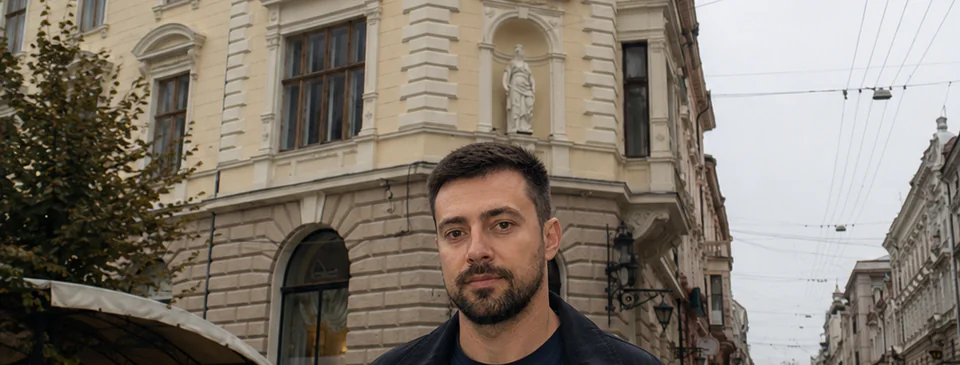
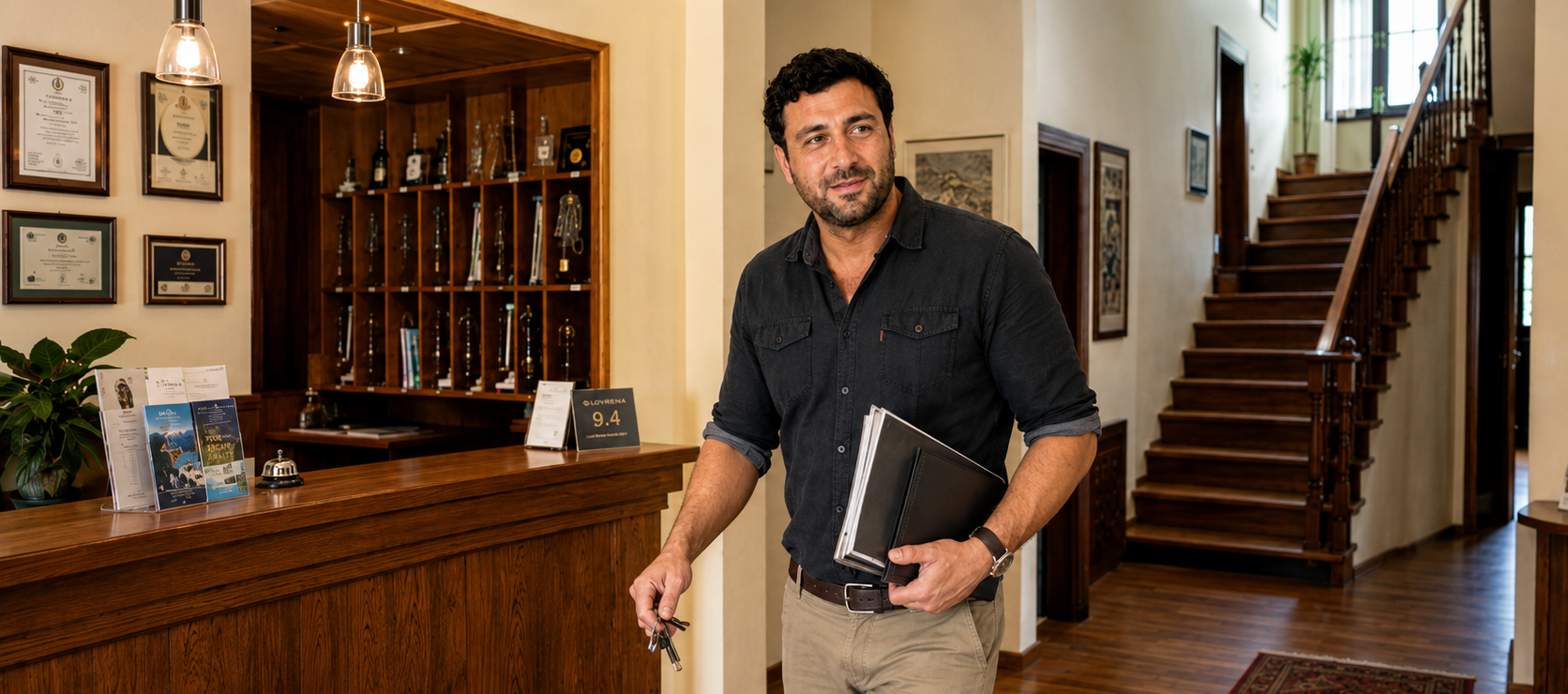
The story of David Kobakhidze
“I Realized You Can Feel a City the Same Way You Feel the Numbers”: How David Kobakhidze Changed Careers and Found an Online Job
David Kobakhidze long believed that his professional life would always be tied to Batumi: the port, hotels, guests, apartments, the summer season, messenger calls, urgent check-ins, broken locks, unhappy tourists, and property owners who wanted things “like in Europe,” but without investing in them. He knew the city and its people well, knew how to talk to guests without a forced smile, and understood where service was built on a system and where it depended on chance.
By the age of 39, David had become the person people called when chaos broke out in a small hotel or apartment rental business. He could quickly understand why guests were leaving bad reviews, where communication was failing, what needed to be fixed in the photos, and how to describe a property honestly so there would be no arguments later at reception. In Batumi, specialists like that are respected: not theorists, not consultants with pretty slides, but people who have personally greeted guests at night, carried suitcases up to the third floor, and explained to owners why “sea view” should not mean a thin blue strip between two buildings.
But one day David realized that his experience could be applied more broadly. Not only in hotels. Not only in tourism. Not only in Batumi.
He started looking for ways to change careers without wiping out his previous experience, and for ways to find a job from anywhere in the world while staying in his own city. Through LinkWork, he came across a vacancy at ROAS Studio, a performance agency that helps businesses attract customers through digital marketing, analytics, and paid traffic. Today, David works online in a team where numbers, attention to detail, clear processes, and the ability to see a task through the customer’s eyes all matter.
We spoke with David about why job hunting after 35 can be more difficult than it seems, how not to be intimidated by a new field, what helps you get through the application process without a “perfect” resume, and why remote work is not an escape from reality, but another way to be useful.
“I Used to Think Changing Careers Was for Young People”
David, before ROAS Studio, you worked in hospitality. At what point did you start thinking it was time to change direction?
There was no beautiful moment where I was standing on the boulevard, looking at the sea, and suddenly realized: that’s it, I’m going into digital. Life usually doesn’t work that way. Usually, you’re just explaining to an apartment owner for the third time in a week that you can’t write “luxury” if the sofa squeaks, the curtain is hanging by one ring, and the apartment in the photos looks like it was shot under the light of a refrigerator.
For many years, I worked closely with guests, owners, administrators, and contractors. Boutique hotels, apartments, seasonal stories — all of that is a living organism. A hotel is like a kitchen: someone will notice the dirty corner sooner or later. You can smile beautifully at reception, you can put out a vase of flowers, but if a person doesn’t get a reply on time, if they arrive and don’t understand where the key is, if they were promised one thing and given another, they will remember it.
At some point, I caught myself thinking that I was no longer interested only in solving the guest’s problem. I wanted to understand why the problem had appeared in the first place. Where did the system break down? Why did the person write a bad review? Why did the listing attract the wrong guests? Why was the owner spending money on promotion and then ruining the impression with poor messaging?
That’s when I started looking toward marketing, analytics, and project management. Not because I was tired of working with people. People remained the main thing. I just wanted to deal not only with the consequences, but with the causes.
Were you afraid that the new field was too far from your previous experience?
Of course I was. I’m not a boy fresh out of university who can say, “I’ll try it for a year, and if it doesn’t work out, I’ll move on.” At 39, you already count your money, your time, your energy. You have a familiar set of tasks, a reputation, people in the city know you. And then you open job listings, and there are words like performance, paid traffic, hypotheses, funnels, analytics, metrics, ROAS, CPA. You sit there thinking: David, what have you gotten yourself into?
But then I calmly broke it down. Hospitality has a funnel too; people just don’t always call it that. A person sees the photos, reads the description, sends a message, receives a reply, books, arrives, leaves a review, comes back or doesn’t. If you promised a sea view, don’t show the person a wall and a sliver of water between buildings. Advertising is similar: if the promise in the ad is one thing and the reality is another, the person won’t buy, or they will leave quickly.
I didn’t know all the tools, but I understood the logic: expectation, trust, decision, result. That helped me not feel completely out of place.
“The Hardest Part Was Explaining Myself in My Resume”
When you started looking for a job, what did you run into first?
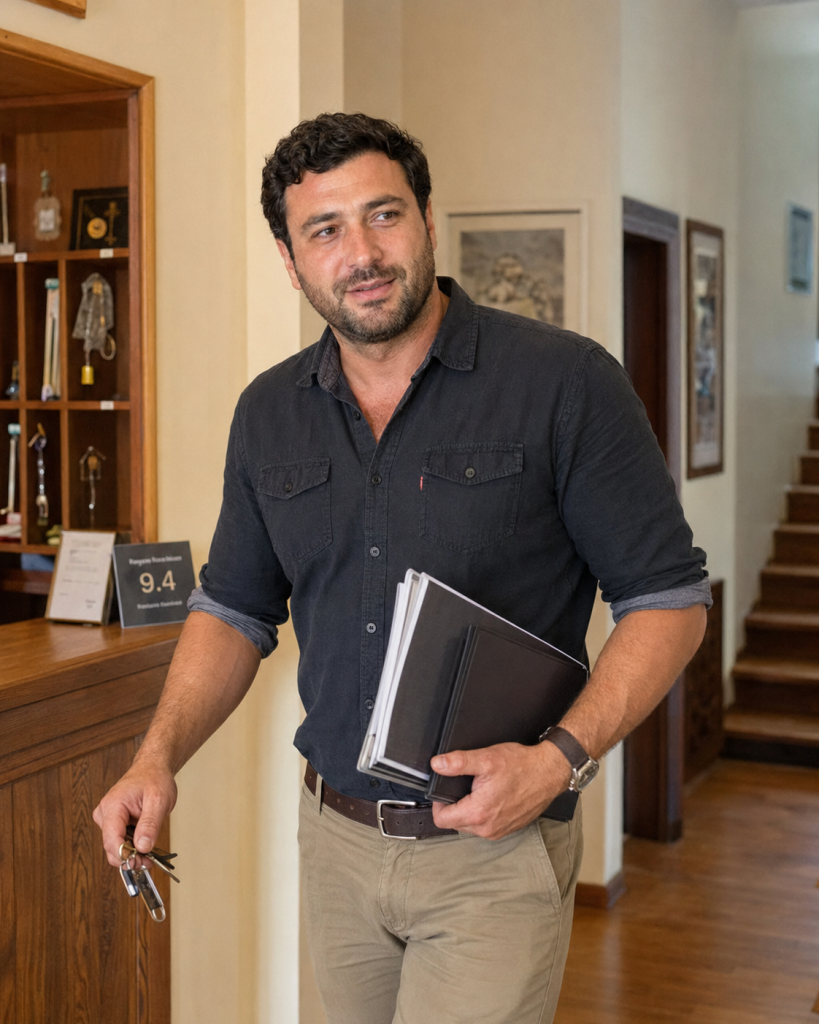
My resume felt like an old suitcase: it seemed to have everything necessary inside, but when you opened it, even I felt awkward. There was a lot about hotels, guests, apartments, the season, administration. If you read it through the eyes of a digital company, it wasn’t clear why they would need someone like that. A good administrator? Maybe. A service manager? Yes. But what does that have to do with a performance agency?
The main difficulty wasn’t that I had no experience. I did have experience. It was just sitting on the wrong shelf. At first, I wrote things like: “worked with guests,” “resolved conflict situations,” “helped apartment owners.” All true, but dry and weak. Then I started translating it into the language of tasks.
Not “communicated with guests,” but “built pre-arrival communication, reduced the number of disputes and negative reviews.” Not “helped with listings,” but “improved property descriptions and visual presentation so guest expectations matched reality.” Not “solved problems,” but “identified weak points in service and proposed clear operating rules.”
That was when the resume started to look like me, not just a list of job titles.
So the question was not only about finding vacancies, but about packaging your experience?
Yes. Many people ask how to change careers and think the answer is to take a course. Courses can help, I don’t argue with that. But first, you need to understand what you can already do. Not by job title, but in essence.
I’ve seen people who worked in sales for ten years and thought all they knew how to do was call clients. In reality, they know how to listen, handle objections, understand a person’s motivation, move a deal forward, and sense the right moment. That doesn’t disappear when you change fields.
It was similar for me. I thought: hotels, check-ins, guests. Then I saw: communication, processes, customer expectations, information quality, attention to detail, working with reviews, understanding human behavior. For an agency that works with businesses and advertising, that already sounds different.
“Remote Work First Seemed Like Freedom, and Then Like a Test of Discipline”
Were you specifically looking for online work?
Yes, although I didn’t come to that right away. Batumi is a good city; I love it. In the morning, you can go out for bread and meet three people you know, and in the evening, you can walk by the sea even if the day has been hard. But the market is limited. In hospitality, you are often tied to a place, a season, a schedule, and the mood of the tourist flow. In summer, everything is on fire; in winter, many people pretend to be resting, while in reality they are counting their losses.
I started looking into how to find work from anywhere in the world because I wanted to stay in Batumi, but not depend only on local vacancies. The online format offered a chance to work with projects from other markets, learn faster, and not wait for the “perfect” position to appear in the city.
But remote work is not lying by the sea with a laptop. Anyone who thinks that should try taking a call when there is wind, seagulls, and a neighbor who has decided to drill into the wall nearby. Online work requires structure. No one is standing over you at reception, no one says: David, the guest has arrived, get up. You have to keep things in order yourself.
That suited me because sport still left me with a habit of discipline. Water polo is a tough school. You can’t show up “almost on time.” The water doesn’t listen to excuses. Neither does the team.
What was the hardest part of looking for online work?
The lack of live contact. In Batumi, many things are solved through people: someone tells someone else, someone has seen how you work, someone invites you. In an online job search, at first you are just a card on a screen. A resume, an application, a couple of lines, a profile. No one sees how you talk to a person, how you hold a pause, how you resolve a conflict without unnecessary noise.
I had to learn how to write about myself more precisely. Not longer, but more precisely. In a cover letter, you can’t tell your whole life story from the old neighborhood to the port. You need to show quickly: I understand the task, here is where my experience overlaps with your vacancy, and here is why I am interested in your team specifically.
That isn’t easy when you’re used to explaining things with your voice. I usually speak at an unhurried pace. But here it had to be in writing, brief, without unnecessary filler. A good application is like a proper welcome for a guest: the person should relax and understand where they are, not feel like they owe you something.
“On LinkWork, I Saw Vacancies for the First Time Where I Didn’t Have to Pretend to Be Someone Else”
How did you find LinkWork?
Through an acquaintance from Tbilisi. She used to work in events, then moved into project management in an online team. I asked where she had looked for vacancies because regular job sites had exhausted me. They are often either very formal, or the vacancies are written as if the company itself doesn’t understand who it is looking for.
She said: take a look at LinkWork, the descriptions are more normal there, and you can find options for people who want to change fields or work remotely. I went in without great expectations. Honestly, after several weeks of searching, you start opening every new site with the face of someone who is already tired in advance.
But I liked that the vacancies on LinkWork were clearer. Not just “stress-resistant team player for a fast-growing company.” Phrases like that make my shoulder hurt more than my old injury. On LinkWork, it was more often clear what needed to be done, which skills mattered, what the work format was, and where you could grow.
What exactly helped you in the search?
The filters and the normal job descriptions. I was looking for online work where I could apply my experience in service, communication, and process management. I didn’t want to go somewhere that needed a purely technical specialist with five years in ad platforms. I understood my limitations.
On LinkWork, I started saving vacancies where attention to detail, understanding the client, working with tasks, communication within the team, and analytical thinking mattered. That’s how I found ROAS Studio.
The description wasn’t about a beautiful “family” or endless drive. It was clear: the agency works with digital marketing, paid traffic, analytics, creatives, and hypotheses. Metrics matter: leads, sales, acquisition cost, return on ad spend, project growth. At the same time, the atmosphere is calm, the processes are clear, and there is no unnecessary bureaucracy.
I read it and thought: this already looks like a place where they value order, not noise.
“ROAS Studio Caught My Attention Because They Speak in Tasks, Not Slogans”
What attracted you to ROAS Studio?
I was drawn to the fact that they look at marketing through results. Not just “we made a beautiful ad,” but what it gave the business. It’s the same in a hotel: you can put an expensive lamp in the lobby, but if no one replied to the guest’s message, the lamp won’t save anything. Beauty without results is decoration.
ROAS Studio helps businesses attract customers through digital marketing, analytics, and paid traffic. They launch promotion, test hypotheses, create creatives, analyze indicators, and scale what works. I liked that the description did not promise easy work. It was clear: here, you have to think.
The logic of performance marketing also suited me. You can’t hide behind pretty words for long there. There are numbers. How many leads came in? How much did a customer cost? What paid off? Where did the hypothesis fail? Why? It is an honest environment. Sometimes unpleasant, but honest.
I like it when things are called by their real names. If a room is small, don’t write “spacious.” If a campaign isn’t working, don’t say “we increased brand awareness” when the client is waiting for sales. Of course, there are different kinds of tasks, but the meaning is clear: promises must match reality.
Did you apply right away?
No. First, I closed the tab. Then I opened it again. Then I read it again. It happens: you see a vacancy and understand that it’s interesting, but an inner voice immediately switches on: David, there are people there with marketing experience, and you’re from hotels. Where are you going?
I gave myself an evening. I made coffee and sat in the kitchen, like in my childhood with my mother, only without the cinnamon. I wrote down what I had: experience with the customer journey, understanding of service, communication, order in processes, the ability to see weak spots, managing expectations, experience with apartment photos and descriptions, working with reviews, and calmness in difficult situations.
Then I wrote down what I lacked: advertising tools, terminology, deep analytics, agency experience. And I decided to show that honestly. Not to pretend I was a traffic specialist. Not to write that I was a “digital guru.” I don’t like words like that. A guru can sit on a mountain; I need to work.
“In My Application, I Wasn’t Selling Myself as a Marketer. I Showed How I Think”
What did you write in your application?
I wrote that I came from hospitality, but had worked a lot with the customer journey: from the first contact to the review after the stay. I explained that I was used to looking at service through a person’s expectations and the result for the business. I gave an example: when an apartment listing promises one thing and the reality is different, the owner gets a conflict, a bad review, and lost future bookings. In advertising, as I understand it, the logic is similar: if the message doesn’t match the product, the metrics will quickly show the problem.
I also wrote that I was interested in a position where I would need to learn performance marketing, work with real projects, analyze decisions, not be afraid of numbers, and keep communication in order.
I didn’t try to look like a fully ready specialist. It’s better to honestly say that you have a solid foundation and a desire to learn than to portray someone who has only seen an ad account in a screenshot but is already writing “confident expert.”
How did the first stages go?
First, there was a short conversation. Then a test assignment. Honestly, it shook me up. It wasn’t about giving a nice answer. I had to think: how to approach the task, which questions to ask, which metrics mattered, what could affect the result. I spent more time on it than I had planned.
The hardest part was not sliding back into hotel examples. When a person changes fields, they often drag their old world with them. That’s normal, but at some point, you have to step out of it. I used my previous experience as a foundation, but I tried to answer in the language of the new work.
At the interview, they asked me why I wanted to go into performance marketing. I said: because I like seeing the connection between action and result. In a hotel, you quickly understand what worked and what didn’t. A guest is either satisfied or not. In advertising, it’s more complicated, but the honesty is the same: the numbers show where you hit the mark and where you just talked nicely.
“After 35, You Are Tested Not Only on Skills, but on Flexibility”
Did you feel age was an obstacle?
Yes. Not directly, like someone said: “David, you’re 39, go fix a lock.” That didn’t happen. But it sits inside you. When you read vacancies, it feels like everyone around you is young, fast, speaking a language where half the words are in English, while you sit there remembering how you chased a ball around a pool at 20.
After 35, the difficulty is not that you learn worse. Sometimes you learn better because you don’t scatter your attention. The difficulty is that it’s harder to admit: I am a beginner. You already have pride, habits, past achievements. You are used to being able to quickly tell in your field who is saying something meaningful and who is just making noise. In a new field, for a while, you are the one asking simple questions.
My sports mindset helped me. When you come back after an injury, you can’t immediately play the way you used to. First, you build the foundation. Boring, repetitive, without spectators. It was the same here. I started reading, breaking down cases, looking at how ad campaigns are structured, what ROAS, CPA, conversions, and funnels are. Not to impress anyone with words, but to understand the conversation.
What would you say to someone who is looking for a way to change careers, but is afraid of their age?
Age is not the main question. The main question is: are you ready to become a student again? If you are, you have many chances. If you aren’t, even being 25 won’t help.
You need to calmly break down your experience. Not by job titles, but by skills. What did you do with your hands and your head? Where did you produce results? What kind of people did you work with? What problems did you solve? What can be transferred into a new field?
And one more thing: don’t pretend your previous life didn’t exist. I didn’t erase hotels and apartments from my resume. On the contrary, I explained why that experience could be useful. A person without a past looks strange. Like a hotel with no entrance: the building seems to be there, but it’s not clear how to get inside.
“The First Weeks at ROAS Studio Felt Like a New City Without a Map”
How did your onboarding at ROAS Studio go?
For the first few weeks, I was quiet and listened a lot. For me, that is a normal way to enter a new environment. In Batumi, when you join an unfamiliar group, you also shouldn’t immediately start loudly telling everyone how to live. First, look around: who sits where, who is responsible for what, what the unspoken rules are, where it’s okay to joke, and where it’s better to take notes.
At ROAS Studio, it helped that the processes were clear. I didn’t feel like they had thrown me into the sea and said: swim, former water polo player. There were tasks, calls, materials, and colleagues who explained things. The team was calm, without unnecessary fuss. That matters. There is already a lot of pressure in a new field, and if chaos is piled on top of that, a person burns out quickly.
I started with tasks where I could become useful faster: communication, structure, attention to detail, helping with project processes, analyzing information, preparing materials, and participating in discussions about client tasks. At the same time, I was building up my performance marketing knowledge: metrics, the logic of tests, and working with hypotheses.
What felt the most unfamiliar?
The pace of thinking. In a hotel, many problems are physical and immediately visible: the guest has arrived, the key doesn’t work, the water isn’t hot, the room isn’t ready. In an agency, some problems live inside the numbers. The campaign is running, data is being collected, the result is changing, and you need to understand why. Here, you can’t always touch the problem with your hands.
But I actually liked that. Analytics is like talking to a person who doesn’t speak directly. You look at behavior, numbers, changes, context. It’s like with a guest: they might say “everything is fine,” but you can see from their face that it isn’t. Only here, the face is a spreadsheet.
“I Didn’t Become a Different Person. I Just Found Another Form for My Experience”
Do you feel that you completely changed professions?
Yes and no. The field is different: digital marketing, an agency, paid traffic, analytics. It is a new professional environment. But inside it, I use a lot from my past.
When we discuss a project, I think about the end person. Who will see the ad? What will they understand? Are we misleading their expectations? What happens after the click? How ready is the business to process the lead? If you bring in customers but there is a hole inside the service, advertising won’t save it. I know that very well.
In hospitality, you quickly understand: you cannot separate the promise from the execution. In performance marketing, it’s the same. You can create a strong creative, bring in leads, but if the client’s process is weak afterward, the result will suffer. That’s why I’m interested in looking wider, not only at the ad, but at the whole journey.
How has your life changed after moving into online work?
There is more independence. Before, the day was often shaped by other people: guests, owners, the season, urgent questions. Now there are tasks, a team, deadlines, clients too, but I manage my time differently. I can work from Batumi, I can go visit relatives for a couple of days, I can stay involved in the process even if I’m not in an office.
That is the main thing in the idea of finding work from anywhere in the world. It’s not the romance of a laptop on the beach, but the ability not to be tied to a single local market. You can live where you feel calm and work on tasks that develop you.
Of course, there is responsibility too. Online, no one sees that you are “very busy.” They see the result. Did you do it or not? Did you figure it out or not? Did you warn them or stay silent? In that sense, remote work is honest. Like the sea: it doesn’t care how you present yourself.
“LinkWork Helped Me Not Just Find a Vacancy, but See a Normal Path into a New Field”
What role did LinkWork play in this story?
For me, LinkWork was not a magic button, but a proper bridge. That matters. I don’t believe in stories where a person was in one field yesterday, clicked a website today, and became a marketing director tomorrow. That only happens in bad advertising copy.
LinkWork helped me see that the market is broader than it looks from Batumi. That you can search not only by your old job title. That there are companies that care not only about formal years in a niche, but also about thinking, accuracy, the ability to learn, experience with clients, and processes.
Through LinkWork, I found the ROAS Studio vacancy, studied the description properly, prepared my application, and passed the stages. The platform didn’t do the work for me, but it gave me access to an opportunity I might have spent a long time trying to find on my own.
What is especially important for people who want to change fields through platforms like this?
Don’t apply blindly. That’s like booking accommodation based only on the first photo of the kitchen. Later, you’ll be surprised that the windows look out onto a construction site.
You need to read the vacancy carefully. What are the tasks? Which skills are required? Where can you learn what you lack? What do you already have? Why might the company consider you specifically? If you don’t understand the answer yourself, the recruiter definitely won’t guess it.
And you need to prepare your resume for the direction you’re targeting. Not invent experience, but translate it into the language of the new field. If a person is looking for a way to change careers, they need to learn how to explain the transition. Not justify it, but show the logic.
“You Can’t Enter a New Field with the Attitude of: I’m Here to Teach You All Now”
Were there any mistakes during the search?
Of course. The first mistake was applying too broadly. I thought: the more I send out, the higher the chance. In reality, you get tired, receive silence, and start doubting yourself. Fewer, but more precise applications are better.
The second mistake was long cover letters. At first, I wrote as if someone was supposed to sit down in the evening with tea and read the story of my life. No one has to do that. A recruiter has their own tasks. Later, I shortened it: who I am, why the vacancy interests me, which experience is relevant, and where I am ready to learn.
The third mistake was trying to look more confident than I was. At one interview before ROAS Studio, I spoke in words that were too general. I could hear myself and thought: David, stop, you sound like an apartment owner writing “European-style renovation” because he bought a new kettle. After that, I decided to speak more simply and honestly.
What helped you not give up the search?
A routine. I set a proper schedule for myself: update the resume, find several vacancies, prepare applications, study, write down questions. Job searching is work too. If you only do it in a bad mood in the evening, it quickly turns into a swamp.
It also helped that I wasn’t waiting for an instant result. In hospitality, you know that if you want good reviews, smiling for one day isn’t enough. You need to work systematically. The job search is the same. One application doesn’t decide anything. Ten random ones don’t either. But regular, precise actions gradually move things forward.
“ROAS Studio Showed Me That a Calm Team Can Be a Strong Team”
What was the work process at ROAS Studio like after you joined?
Calm, but not relaxed. Those are different things. Relaxed is when everyone pretends it will somehow work out. Calm is when it’s clear who does what, where the data is, what the deadlines are, and what the next step is.
At ROAS Studio, I liked that there was no unnecessary theater around work. In some places, people like creating the feeling of a permanent fire, as if people aren’t working unless they are running around. Here, the focus is more on the result. There is a project, there are metrics, there are hypotheses, there is discussion, there are conclusions. Without unnecessary noise.
The team is diverse: specialists in traffic, analytics, creatives, content, and project management. I learn from my colleagues. Sometimes I ask simple questions. A normal team is different because you can ask and receive an answer, not a performance about how new you are.
Which skills from your past turned out to be unexpectedly useful?
The ability to keep communication steady. When you work with guests, you quickly understand: some conflicts appear not because of the problem itself, but because of silence. If a person understands what is happening, they are calmer. If no one replies to them, they start getting angry before the solution even appears.
It’s similar in projects. It is important to clarify things on time, record agreements, not lose details, and warn about risks. The ability to see through the customer’s eyes also helped. Not only our client as a business, but also their buyer. What does the person see? What do they feel? Where do they hesitate? Why don’t they leave a request?
And probably endurance. After night check-ins, tourists with complaints, and owners who want to “make it look nice, but for free,” many work situations feel calmer.
“Changing Fields Is Not Jumping into Emptiness, but Building a Transition”
What would you advise someone who is now thinking about how to change careers?
First, don’t quit in an emotional state. Emotions are a bad navigator. They can show you that you feel cramped, but it’s better to build the route with your head.
I would take several steps.
First, write down what you can actually do. Not job titles, but actions. Organizing, analyzing, selling, writing, negotiating, checking, training, calculating, working with clients, spotting errors in processes.
Second, choose not an abstract “new field,” but a specific direction. Digital marketing is a big world. There is traffic, analytics, content, project management, account management, creatives. The more precisely you understand the entry point, the easier it is to prepare.
Third, find the overlap. Where can your previous experience be useful in the new field? For me, it was the customer journey, service, communication, processes, and attention to expectations.
Fourth, learn the basics. You don’t need to immediately buy every course in the world. Start with terms, cases, free materials, and simple practical tasks. It is important to come to an interview without empty eyes.
Fifth, look for platforms where there are online vacancies and normal descriptions. For me, LinkWork became that platform.
And for those who want to find work from anywhere in the world?
You need to understand that “from anywhere in the world” does not mean “however you want.” Companies look at reliability. An online worker needs to be even clearer than an office worker. Where are you? When are you available? How do you manage tasks? How do you write? How do you warn people about problems? How do you treat deadlines?
Remote work amplifies both good and bad habits. If a person is organized, they become freer. If they are chaotic, the chaos simply moves into the laptop.
I would advise preparing a resume, a proper profile, a short description of yourself, examples of tasks, and a clear application. And don’t limit yourself to your city. If you live in Batumi, Almaty, Yerevan, Tbilisi, Bishkek, or anywhere else, that should not automatically narrow your market down to the nearest offices.
“I Didn’t Leave Batumi, but Professionally, I Became Broader”
Do you miss hospitality?
Sometimes. I still help local acquaintances with advice when they ask. Batumi is small in that sense: someone always knows who to call. Sometimes I walk past a hotel and automatically notice: the sign is dirty, the photos on the website are old, the administrator is looking at their phone, guests are standing with suitcases. Occupational disease.
But I don’t feel that I have gone into someone else’s life. Rather, I have expanded my own. Before, I helped one hotel or several apartments become clearer for guests. Now, at ROAS Studio, I take part in projects where businesses look for customers, test hypotheses, calculate efficiency, and grow. The scale is different, but the logic is familiar in many ways.
What became the main result of this story for you?
I stopped thinking that my experience was tied only to one place. That is a powerful feeling. I grew up near the port, my father worked with machinery, my mother baked at home, and there was always someone sitting at our table. Then sport, injury, different jobs, hotels, guests. For a long time, it felt like all of that was just my personal road — beautiful, difficult in places, but narrow.
It turned out that from that road, you can take skills that are needed in another field. You just have to be willing to break them down and show them honestly.
I found online work through LinkWork, joined ROAS Studio, am learning performance marketing, working with a team, and seeing how decisions affect a business. For me, this is not a story about a sharp turn. It is a story about a normal transition.
You know, a guest should be welcomed in a way that helps them relax, not feel like they owe you something. It is similar with a new profession. You don’t need to burst in and prove to everyone that you already belong. You need to enter calmly, look around, understand the rules, do the first good piece of work. Then the second. Then people will see for themselves that they can work with you.
What David’s Story Shows
David Kobakhidze’s story is an example of how changing careers after 35 is possible if you don’t try to erase your previous experience. His path from hotel service into performance marketing was not random: he found the overlap between what he already knew how to do and what the new team needed.
For those looking for a way to change careers, the main takeaway is simple: courses and new terminology matter, but they are not the only thing. What matters is the ability to see the value of your old experience in a new system. Communication, working with expectations, analytical thinking, responsibility for the result, and attention to detail can all become a foundation for transition.
For those who want to find work from anywhere in the world, David’s story shows something else: the online format opens up more opportunities, but it requires independence, precise applications, and a willingness to work for results. LinkWork helped him move beyond the local market, and ROAS Studio became the place where his calm approach, client experience, and desire to learn found practical use.